Is Apple Still Undervalued?

Despite all the negative attention it suffered from in the last couple of years, Apple (AAPL) was able to deliver incredible earnings performance last couple of quarters. More specifically, it had EPS growth of around 15% for the year ended in September 2014 and an astonishing 50% for the last quarter ending in December 2014. Estimates for the March 2015 have been creeping up since, and I think the company is about to beat earnings estimates yet again as various sources indicate stronger iPhone demand than expected.
Most of the growth was due to better earnings, but you can also give some of the credit to financial engineering, a word that Wall Street seems to misuse quite often, as is the case with IBM. In reality, buybacks make sense when the company's stock is trading at a discount to fair value. That was the case of Apple throughout 2013 and 2014 because, as we found out; while the net earnings of the company did not materially change during those two years, the company's stock varied by a significant amount all the way down to about $55 and back up to $100, and now at around 125$. A nice ride to have been part of.
Is Apple still a growth story?
The question that needs to be answered is if Apple is still undervalued today. The big question always concerns future growth. That is why in valuing a company, I always like to have multiple scenarios that support my thesis. We can expect Apple to at least maintain its current earnings for the foreseeable future, as the company has demonstrated the loyalty of its customers and the profitability of each of its products. Maintaining current earnings implies no new products, no market expansion, no growth in software and services business, etc. That is why my pessimistic scenario is one where Apple stops growing earnings. That is in my opinion important because we can then evaluate the potential downside of the stock.
Growth sources until 2024 and beyond
Many potential factors can contribute to Apple's growth for the next 10 years. Here a list of a few of them:
-Apple Watch market expansion;
-Emerging market growth where market share for Apple is still very low: China (growth rate is still strong there and ecosystem expansion is materializing), India (where Apple is still a non-factor and recent government party change will help drive business), Europe (potential economic recovery and growth I'm untapped markets);
-Enterprise sales growth: recent IBM partnership,continued iPhone/iPad expansion, possible bigger-sized iPad. and potential Watch penetration;
-Further Mac market share gain over Windows devices, PC market in slight decline but nevertheless still important;
-Digital entertainment through iTunes store and potential TV/cable bundle;
iOS App store continued growth;
-Apple pay expansion: worldwide presence, more merchants/banks signing in, possible money transfers (as hinted by Tim Cook in most recent conference call);
-Full-fledged Apple TV: company interest in TV is still apparent, recent HBO and other TV networks talks, next potentially big market for Apple;
-HomeKit/HealthKit: possible monetization on those apps/devices sales;
-Apple Car: big question mark there if it is an actual car vs CarPlay, huge market potential for Apple, Ive and team obsession about car design, recent car industry hires, Apple's M&A team's discussions with Tesla
Realistic scenarios
I'm going to try and value the company using the following assumptions:
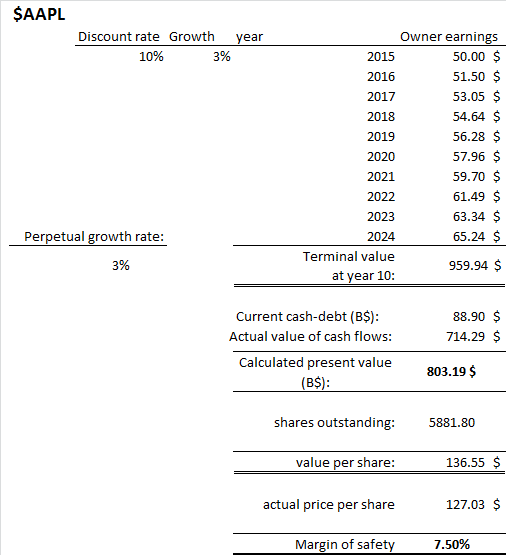
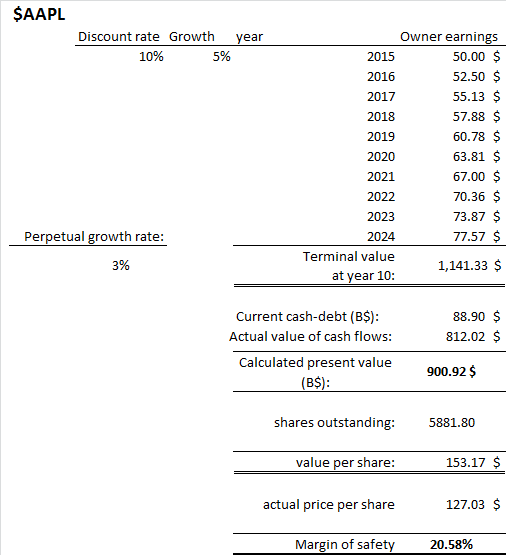
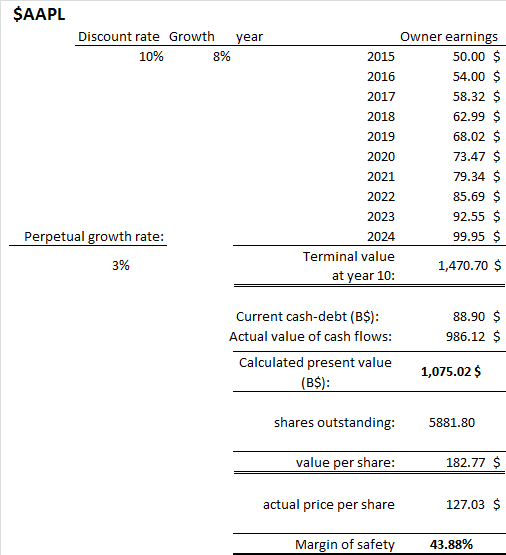
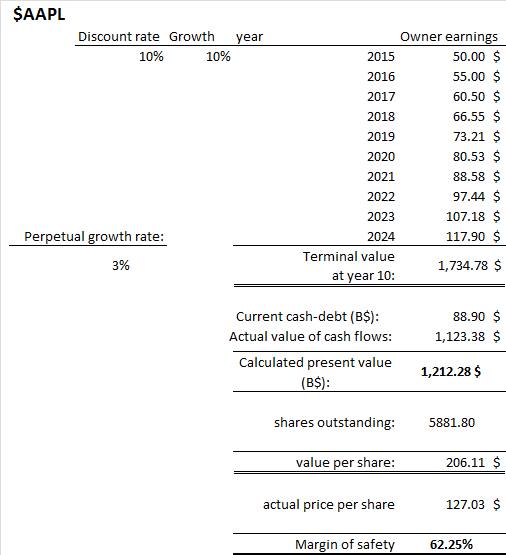
-Owner earnings estimate of $50 billion in 2015 ($60 billion in operating cash flows minus $10 bllion in capital expenditures)
-Earnings growth of 3%, 5%, 8% and 10% for the next 10 years
-Perpetual earnings growth of 3% after 2024
-A 30% tax on cash and short term investments (means they are valued at 70% of the amount from the balance sheet)
-10% discount rate, which I use for all my DCF valuations rather than a low interest rate.
Here are the results:
What if Apple stops growing?
Those who are bearish on the stock will point to its huge size as a cause for the company to stop growing. They view it more as a blue chip company which spits out huge amounts of cash and dividends, while earnings growth remaining very low. Therefore, I am also going to include a scenario in which Apple has 0% growth forever:
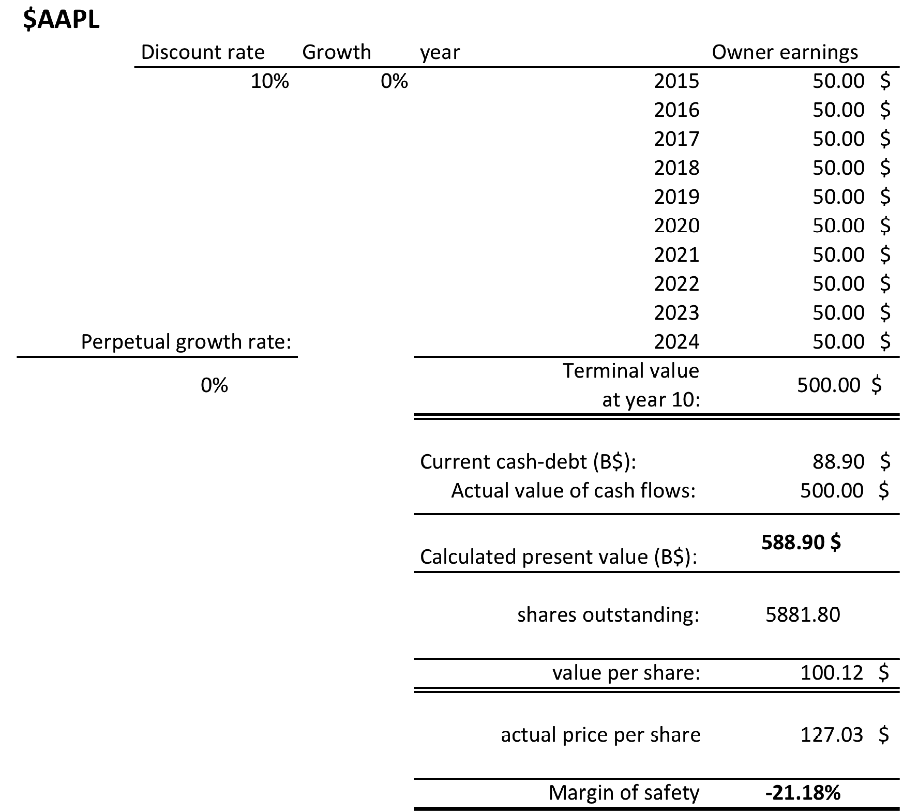
(click to enlarge)
My thesis
In my opinion, and given the presented potential growth sources, Apple can double earnings in 10 years, therefore the 8% growth scenario is the one I believe is the closest to reflecting the company's intrinsic value. That gives shareholders a 44% margin of safety on today's prices.
To be more conservative, other scenarios have been considered as well, with growth as low as 3% per year, which would make the stock just slightly underpriced.
On the other hand, if you think Apple is not a growth story anymore, then you shouldn't buy it as it has a potential downside of 21%.
Of course, there is always the risk that Apple loses its competitive advantages and sales as well as margins starts to decline, which would be catastrophic for shareholders of the company. You have to take that scenario into consideration as well.
What we can derive from these estimations is that they point to the same conclusion: Apple is still significantly undervalued, but only if you believe in the company's long-term growth prospects.
Disclaimer
This is not financial advice. Our content is intended to be used and must be used for information and education purposes only. Please read our disclaimer and terms and conditions to understand our obligations.
4 comments
Great analysis.
Apple is the huge amazement stock this year, increase to new highs in spite of all the critical expectations from numerous cynics that its development force has leveled. The stock's latest rise took it to another high of $122 a partake in late January, easily getting through various downsizes by a few Wall Street experts a year ago that pulled down Apple to as low as $104 a partake in November.
For Apple, however, such downsizes haven't been the standard, as administration has demonstrated that history rehashes. As a general rule, Apple's stock unavoidably skips back subsequent to getting smacked by unfavorable analysis from examiners about projections of feeble deals for its items, including the safe iPhone.
Still, speculators have turned out to be acclimated to being overpowered by innnovative treats from Apple, and now they have bcome eager for additional. Apple is planned to report its monetary first quarter comes about tomorrow, Jan. 31, 2017, so its stock will again be tried - and smacked down ought to the organization neglect to meet agreement profit and income gauges.
Hi dre1012
Great analysis and I generally concur. Couple of observations.
Apple's PE is 19.7 dropping to 14.8 for 2015 forecast. I haven't got the data but if you adjust this for the so-called mountain of cash they are sitting on, then at the last reading PE drops to below 10. Even by UK standards, this says 'buy' to me.
My second point is just that numerical analysis cannot tell the whole story. Think back of fantastic technology stocks such as Nokia and Blackberry which at their height looked bullet proof and showed a stellar growth trajectory. True these two were one trick ponies and Apple is far from it. But it only requires Apple to make a few bad calls (of monumental proportions) to suffer the same fate. Too big to fall doesn't just apply to banks.
Good write up, I like the multiple DCF models. Useful to have a look different at growth assumptions (disclosure: long AAPL).
Have you thought about modelling some permutations of two/multi stage models? Maybe coinciding with major product release cycles? While DCF is not overly sensitive to the discount rate, have you considered using WACC instead of an arbitrary required rate of return?
Lastly your model suggests the market is forecasting a very low growth rate, have you any thoughts on why this could be? Possibly specific market expectations or maybe model limitations?