Mark Slater's picks at the 2015 UK Investor Show

It was an exceptionally busy day for the Stockopedia team at this year's UK Investor Show. But happily I managed to duck out of duties on the stand for a short time to listen to Mark Slater's presentation. Slater is chief investment officer at Slater Investments and ranked as one of the best performing fund managers in the UK, with funds including the MFM Slater Growth and MFM Slater Income. As Paul mentioned in his blog, Slater is a source of a huge amount of investing common sense, so it was no surprise that his presentation was packed out. Here is some of what he had to say…
New and existing concerns
Tackling the macro view, Slater picked up on a number of concerns he highlighted a year ago, but continue to persist.
- We have still got distortions from the effects of quantitative easing in the market.
- There hasn't been a market correction (of more than 10%) for some time, and that is still the case. Although he noted that there had been bigger pullbacks among small-cap and technology shares.
- He said it was becoming increasingly difficult to find high quality growth companies, with most now trading at 20x earnings or more.
Among his more recent concerns, he said that the pick-up in currency volatility was making life difficult for both investors and companies. For the most part, he noted, the market is being grown up about this, with companies prepared to report on an actual and constant currency basis. However, it does make life complicated. He also mentioned the fact that the Eurozone has joined the “QE party", which elevates risk because if additional challenges emerge [a possible reference to Greece], it's difficult to see what the solution would be.
Ideal conditions for investors
Having acknowledged the present concerns, Slater said that conditions for equity investing are ideal, with the current 'cheap money' environment likely to continue for “a long time". He said that there was less certainty that rates will go up, likewise in the US, “because the world doesn't work otherwise". In addition, he noted:
- The yield on equities is still attractive versus bonds.
- The bear case, which includes factors like ISIS and the Middle East, is well rehearsed and is therefore priced-in.
- There are pockets of exuberance but most investors are looking over their shoulder a bit (which is a good thing).
Slater said that the risks of being out of the market are greater than being in it: “Now isn't a time to be greedy, but it's a good time to take a bit of money off the table. Be mindful of the downside compared to a year ago."
He quoted Sir John Templeton's famous meme that “Bull markets are born on pessimism, grow on scepticism, mature on optimism and die on euphoria." As far as Slater is concerned, “For a year we've been in optimism but not euphoria."
More investment activity than normal
Slater said that his funds had been more active than usual over the past year, booking profits and redeploying into more attractively valued shares. The largest position in the MFM Slater Growth Fund remains Hutchison China MediTech, and he talked about some of the background to that stock.

He said the original investment rationale was that Hutchison was a classic growth company. It had two parts - a healthcare division and an R&D division. Originally, the R&D business had no value but the group had net cash so Slater focused on the healthcare division.
He said that Slater Investments loves a tailwind in a business and that healthcare has a hurricane behind it in China. Allaying concerns that Chinese companies have a reputation for infringing intellectual property rights, he noted that China's home-grown IP is actually very well protected. In addition, the group had strong cashflow and a controlling shareholder in the form of the highly regarded Hutchison Whampoa. He said that Hutchison Whampoa had better governance than most UK companies, which made Hutchison China MediTech investable.
Since the original investment, the group's healthcare business has compounded at 20% per annum. One observation is that valuations of healthcare companies in China are currently in the region of 40-50x earnings. But one of the key changes is that Hutchison's R&D division has blossomed into a very valuable entity. While it doesn't make money, it has become most advanced home-grown drug developer in China. Slater said that while it was hard to value, a base case valuation of the R&D business could be somewhere between US$1-2bn and $5bn (it is currently valued at around US$400-500 million). He noted: “Originally we were paying nothing for it." He added that Hutchison's Chairman and a NED had recently been buying meaningful amounts of stock.
Turning his attention to technology investing generally, Slater said the firm's view was that it's a difficult sector to invest in: “We avoid hard to understand businesses with sky high valuations." He noted that part of the problem is that it is hard to work out who the winners will be.
He said the sector also has challenges that he likes to avoid, such as lumpy revenues, dependence on a small number of customers and the scope for creative accounting. He said that while they rarely invested in the sector, when they do it's in easy to understand companies in established markets, generating cash and on low ratings - “which are rare". He added that a second type of technology investment would be a profitable business that has a “moonshot" that's in for nothing.
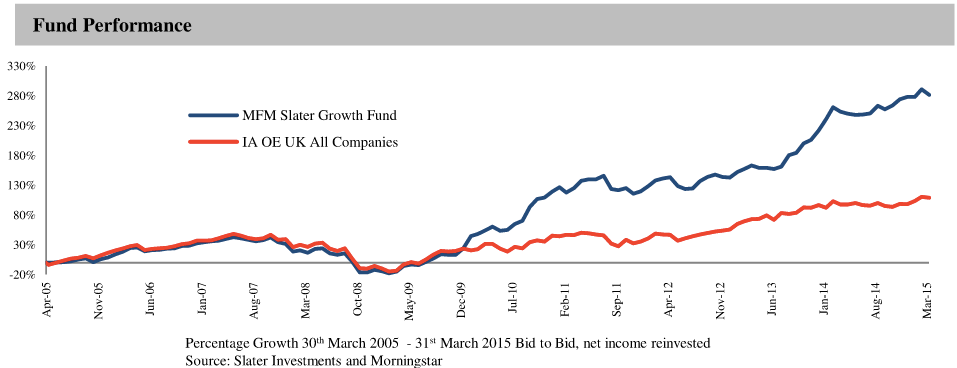
MFM Slater Growth Fund performance since April 2005
Risky Investments and general lessons
Slater went on to “ram home the dangers of investing in companies that don't make profits". He compared the performances of the AIM All Share and the Numis Small Companies Index since 1996, which produced respective returns of -25% and 353%. He said the implication was that the more seasoned the company you invest in, the more likely it is that it will do well.
He then turned his attention to IPOs and started by saying that investors generally have the the choice of not investing and the choice of timing. However, with IPOs, investors have no choice, because it is the vendor that has decided the timing. For this reason, he said IPOs on average don't make sense for the investor in the UK: “If you are going to invest in early stage VC companies, don't do it in public markets."

Slater said another lesson from Hutchison, and his second largest holding in the Growth fund, Restore, is running profits. “It's against human nature and it's very hard to do," he said. “But when you're in a good company at a good price it's hugely important to run profits." He said it was important with any portfolio that you shouldn't treat all stocks the same: “You should be a bit greedy - you'll know what those special companies are."
Stock picks
Moving on to some of the stocks Slater has been buying recently (and in some cases owned for a while), he highlighted IT consultancy First Derivatives, which he said was a good, solid growth business.
He pointed to a solid track record of 15-20% earnings growth and that it was embedded with big firms. In particular, he said the company's 'market surveillance' technology had been implemented by the Australian Securities and Investments Commission and that a big reference customer like that could create a 'food chain' where others start to buy the same thing. First Derivatives recently acquired one of its key technology partners and had broadened its product range. Slater said the shares were on 21x earnings and a PEG of just over 1.
Elsewhere, he noted that housebuilders have dominated low PEGs for the last few years. This previously happened back in February/ March 2000, “when the world suddenly changed". At the time, high growth parts of economy were on 40-60x earnings but the old economy was cheap. “There was a stunning number of housebuilders and I was forced to look at them differently," he said. At the time, housebuilders were trading in optimal conditions, with no/ low debt, low ratings and good dividend yields and they went up many times between 2000 and 2005-7.

Slater said that today housebuilders have done very well but they are still good. He said the firm's largest holding is Bellway, which he has owned for a couple of years and probably will buy more. But he noted: “It is cyclical - it's not a Domino's Pizza - this won't go on forever."
Slater also stressed that there are risks in the sector, particularly political risks, but that every party agrees that more houses need to be built. He said that the housebuilding industry had completely changed since the crisis. Previously, 50,000 homes were built each year by small builders but that has collapsed through lack of finance. Bigger players are now not going for volume and are returning capital. Slater noted that Bellway can increase volume and that the land market is benign because of low competition. He also said that new regulation, such as Help to Buy, had cross-party commitment. Combined with new rules on mortgage approvals, which means that lenders are much more sensible, the cycle is likely to be extended, he said.
Slater has been involved in a couple of recent IPOs, including social housing maintenance firm, Lakehouse. He said it has an experienced team, high margins, excellent visibility and high cash conversion. It could benefit from good growth drivers, such as outsourcing and regulation and there was scope for more accretive acquisitions: “It's interesting and relatively low risk".
The second IPO was Premier Technical Services, which works in access and safety services. He said this was a leader in a small, fragmented market which generates high margins, high cash conversion and has a big management holding.
Finally, he referenced the MFM Slater Income Fund, where his higher conviction income investments include City of London Investment Group, which he said had bounced back and was improving. Elsewhere, he noted that Marston's was “not exciting" but growing at 10% per annum with improving returns and that the business was now firing along nicely. The fund also includes housebuilder Taylor Wimpey, which is on a higher yield than Bellway, and Centaur Media, which he said had repaired its balance sheet and was now on the front foot.
As a parting shot on a more general investing theme, Slater reminded the audience that if your companies are expensive, you sell them. If there is nothing of value to buy, you do nothing.
It was pretty tough keeping up with Mark Slater because most of what he says is worth reporting. If you think I have missed anything please do add a comment.
Disclaimer
This is not financial advice. Our content is intended to be used and must be used for information and education purposes only. Please read our disclaimer and terms and conditions to understand our obligations.
4 comments
Excellent write-up. Any plan of having the full recording available on say Audioboom?
Not sure whether the recording will be made available on audioboom, but it may be well be uploaded to Youtube. Looking back at last years event, there are quite a few videos from the Investor show that have been uploaded to Youtube.
Hi Ben,
Really excellent review, thanks for posting - I was only able to attend about half of Mark Slater's talk, as I arrived slightly late, and then had to retire to the green room to get fixed up with a mic, etc, for the following session.
I compared my hastily scribbled notes from what I saw of Mark's talk, and it exactly coincided with your report.
However, I think you omitted one section, where Mark reviewed his prior year stock picks at the last 2 UK Investor Shows, which I thought was quite interesting, as he recapped on his views on old favourites like Restore (LON:RST) and an out of patent pharma company, forget its name, Allied something? He mentioned it every year.
Also, you picked up on his mentioning Marston's (LON:MARS) which is a stock I also like, but I was amazed that Mark didn't mention two key bull points for me with MARS, namely that it owns tons of freehold property, and also has long term interest rate caps on its borrowings - so best of both worlds probably, in the long run.
I am sure that Mark also mentioned Avation (LON:AVAP) positively, but can't remember what he said about it. I think it was just an aside.
Terrific write up though, thanks very much indeed for posting it.
Regards, Paul.
Ben,
Really useful and detailed summary of Mark's talk. One point my notes differ on was the valuation of the R&D section of Hutchinson China's business which is the key valuation driver. My notes say roughly as follows
R&D section of Hutchinson China - above you say that this could be worth US$400-US$500m. From my notes actually this is referring to what the market is currently valuing this part at. I.e. the market value of Hutchinson China minus the value of the property and the healthcare business.
Mark went onto to say that a base case valuation for this could be US$1-2bn at the lower end and US$5bn at the higher end. These are just my scribbled down notes but I think this is what he said. Obviously a fairly important point and maybe we can get a video of the talk.
Andrew