Small Cap Value Report (24 Apr 2014) - Risk management, PURI, BVXP

Good morning.
Risk Management
Before looking at individual company results, I must make some comments on portfolio risk management. A share that is very popular with retail investors, Quindell (LON:QPP) recently plunged almost 50% on a new shorters attack by a website called Gotham City Research. I won't go into the ins & outs of that here, as it's neither a small cap, nor something I can comment on at Stockopedia, because I have personally been short of the shares for some time, and indeed have been very bearish in my comments here about the company since 2012.
The reason I mention it though, is my shock and dismay at reading some bulletin board comments about how some people have said that the shorters have ruined their lives, inflincting huge financial damage on individual investors. The reason I am shocked is that anybody could be so reckless, and stupid, as to expose themselves & their families to huge financial loss on an AIM share dropping 50%.
This shows appalling lack of risk management, which is the vital first step that all investors must put in place before they even get started. You MUST have portfolio rules to manage risk in any circumstances, as follows;
1. Diversification - the simplest way of managing this is to set a maximum percentage of your portfolio that any share can reach. Personally I have a 15% rule - i.e. that I keep a running total of all my portfolio on a spreadsheet (which consolidates all positions, however held - e.g. ISA, SIPP, spread bet accounts, etc), and then ensure that no individual share can represent more than 15% of the overall portfolio. This ensures that when (because it is inevitable with small caps) something goes wrong, and your biggest holding drops by 50% on a profit warning, that you can emerge relatively unscathed. With a 15% rule, the maximum you can ever lose is 7.5% of your portfolio, if your largest share plunges by 50% in price. That's just happened to me too, but not on Quindell shares, but on SpaceAndPeople shares. It hurt me financially, but it came nowhere near causing me financial ruin. That wasn't an accident. It was because I had set a sensible rule on maximum position size. So position size is one thing, and diversifying into various sectors is another good idea. Make sure that your portfolio is not just a collection of speculative blue sky stocks for example - as they tend to drop as a group when the market gets the jitters.
2. Gearing - don't use it! Gearing is so dangerous, and is only suitable for very experienced investors, and in highly liquid shares, and even then only in moderation. However, if you must use gearing, then again set a limit, and don't breach it. I would say that 50% gearing on top of your equity (i.e. taking positions up to 150% of your equity) can be justified for relatively short periods in a bull market, and providing your portfolio is already diversified. Notice also how shorters always pick target shares where there are large numbers of leveraged mug punters holding spread bet positions. They do this because they know that if the share price can be slammed down by more than 10%, then it will trigger a domino effect as forced closures of sometimes quite large geared positions starts & rapidly escalates. You need to be the smart person buying the dip, not the mug being stopped out of your spread bets on the dip.
3. Learn from your mistakes! So instead of blaming others (e.g. shorters) for attacking a share you hold, find out why they targeted that share, and spot the warning signs for weak & over-priced shares in future. Try not to be on the other side of the trade to short sellers, because they tend to be the smartest & most experienced investors out there, and are usually (but not always) right.
4. Ditch the emotions - the market is currently awash with inexperienced, foolhardy investors, who simply don't know what they are doing. However, a long bull market is like a rising tide which lifts all boats - so bad decisions have been rewarded handsomely (the riskiest shares often go up the most in bull markets, but eventually many turn out to have been in reality worthless), which can give these foolish people big portfolios, and big egos. Yet they are almost destined to lose the lot, or most of it, because they're not taking basic measures to manage portfolio risk. So if you are treating your favourite share like supporting your favourite football team, then that means you're behaving emotionally, not rationally. Do you try to shout down any negative comment on your favourite share? Do you get abusive online towards anyone who is critical of your favourite share? If so, then it means you're a muppet, and will probably lose your money on that share.
I've been an active investor for about 18 years now, and in that time I can tell you that pretty much every speculative share that had a large fan base on the bulletin boards, turned out to be an investment disaster. So if you are part of an unsophisticated, and noisy crowd on a bulletin board, that has become obsessed with your favourite share, then you are almost certainly going to lose your money, sooner or later. You have been warned! Unsophisticated investors tend to bunch together in story stocks, and are impervious to the risks that most sophisticated investors have spotted and avoided in the accounts. So try not to become part of a fan club for any share, as this also clouds your judgment about when to sell.
Buying and selling shares should never be based on emotions, it should be based on careful analysis of the facts and figures. If you're taking investment decisions based on your emotions, then you're going to under-perform, potentially very badly, in the long run. The best investors follow Buffett's rule of being greedy when others are fearful, and fearful when others are greedy.
So I hope none of my readers ever see a 50% share price fall as anything more than an annoyance, and a small and temporary financial setback. In fact, I challenge every reader to write down on a piece of paper now, how much it would cost you if your largest shareholding (including leveraged positions) instantly dropped by 50%. Is that amount of money a loss that you could cope with comfortably? Would you be able to explain easily to your partner that you had lost that amount of money, without feeling reckless or stupid? If that potential loss figure is getting anwhere near to where it would change your life for the worse, then it means the position is too large, and it should be reduced.
I'm speaking from experience here, as I've made all the mistakes in the book in my time! Arguably it's the only way to learn. However, these mistakes are simple and easy to avoid, if you just have a couple of basic rules on portfolio management. Above all, you must set a rule on maximum position size, and stick to it. That might well save your bacon one day, in a market downturn or crash.
EDIT: Please also see the comments section below, where John Rosier makes some useful points, and has included an interesting graphic of a portfolio management tool he uses. I should also add that Stockopedia has some excellent portfolio management tools under the "Folios" tab on the black menu bar above. So it's worth monitoring your portfolio using such tools, which can help you manage risk.
EDIT 2: Here is an example of one of the Stockopedia portfolio management screens, which I set up about a year ago, but haven't updated since, so the holdings do not reflect my actual portfolio, it's just an example. You can see how Norcros was significantly over my 15% position size limit here! So that flags immediate action required to reduce that position:

Also note how under the "Events" tab within Stockopedia's "Folios" section, it will create a calendar of forthcoming results, dividends, AGMs, etc, for the shares in your portfolio! This is a really nifty feature, and it integrates with popular calendar functions such as Google Calendar, or Apple equivalents. Here is a screenshot for my test portfolio's calendar that Stockopedia has generated for me;

PuriCore (LON:PURI)
This is a potentially interesting growth company. They make machines which extend the life, and disinfect fresh food, cut flowers, and also for sterilising medical instruments. The company has looked a basket case in the past, but it caught my eye about a year ago when they restructured the Balance Sheet, got rid of all their debt, and that was then followed with some substantial Director buying later last year - usually a positive sign of good things in the pipeline.
Results for calendar 2013 are issued today, and show some progress in my opinion. Revenue is up nearly 16% to $54.8m, so it's a proper business, not a blue sky thing. EBITDA nearly doubled to $2.4m. However note that they capitalised $1.2m of development spend. There is a pre-tax loss overall of $6.5m, but that's distorted by a $5.8m exceptional write-off relating to the debt restructuring. The operating loss is $0.7m.
These figures may not look particularly exciting, but should be viewed in the context of disastrous losses in the past, so very much a recovery/turnaround type of situation. What makes it potentially interesting is that they are building recurring revenues for the fluids that their machines use, so in time perhaps this might build into a profitable business?
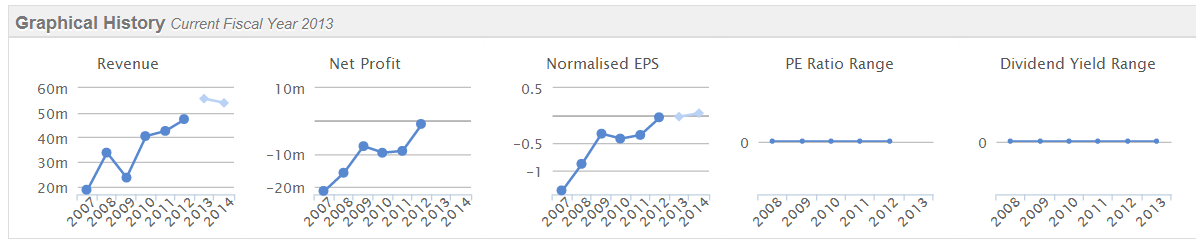
My only reservation is that the outlook statement is probably not upbeat enough to trigger much immediate interest. Note also that some hardware sales are not likely to repeat;
Consistent with market expectations, revenue is expected to soften in the short term as PuriCore balances declining revenue from capital equipment and grows consumables and other recurring revenue.
Therefore I think it might be a case of going back to sleep for another six months with this share.
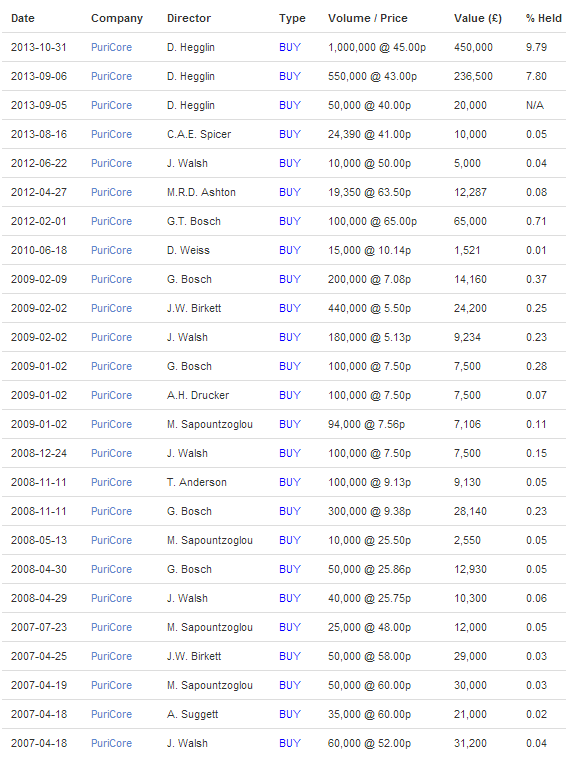
I shall remain invested, as the big Director buying stands out here, in particular the last two Director buys were £236k and £450k. That's a meaningful vote of confidence from D.Hegglin who has personally spent over £700k buying shares since Sep 2013. I doubt he did that in the expectation of nothing much happening.
Very large Director buying has served me well in the past as a buying signal. If Directors are willing to invest meaningful amounts (i.e. well into six-figures) into a company's shares, then we should sit up and take notice.
I would say that the Balance Sheet is OK, but not strong. Current assets are 107% of current liabilities, which is not as strong as I would like, but it isn't a serious worry either. There are no long term creditors at all, so that's a positive. Net cash was $3.4m at 31 Dec 2013, although as it has been historically loss-making, a small fundraising might be required at some point.
I've just noticed that the 2013 results are stated after a $1.8m charge for inventory write-down. So as that's a one-off, the underlying trading is better than reported.
The market cap (at 42p per share) is just over £20m, which strikes me as potentially cheap, IF they succeed in driving up recurring revenues to a point where it becomes decently profitable. So this one is speculative, but there might be something exciting here, if the company executes well going forwards.
Bioventix (OFEX:BVXP)
This is small (£28m market cap at 550p per share) specialist biotechnology (antibodies) company. It has only just over a dozen employees, and makes the most astonishingly high profit margins - e.g. interims to 31 Dec 2013 issued today show £1.5m turnover and £975k pretax profit! Wow.
The company also announces it is moving up from ISDX to AIM, which is a good move in my view, and might help the shares become more liquid.
I was tremendously impressed with management here, who presented at an investor event last year. However, my main worry is that the company could be too heavily reliant on one or two key individuals. If you accept that risk however, then the company just looks like a tiny cash machine - generating pots of cash from its speciliased niche.
Basic EPS was up strongly, from 12.5p to 16.0p in H1 (vs H1 in 2012), so annualise that to a run rate of 32p EPS. That puts the shares on a PER of about 17.2, so not cheap on a PER basis, but on a PEG basis that's under 1, since the EPS growth rate is 28%. Therefore if you think that sort of growth rate is sustainable, then a premium PER is justified.
So, a very interesting company.
I've not spotted anything else of interest on the results front.
A reader asked me to look at results from Trap Oil (LON:TRAP), but I've no expertise in the resources sector, so prefer not to make a fool of myself by writing ill-informed rubbish on that!
Good discussion in the comments section below, so do please feel welcome to add your thoughts to the debate on risk management.
Regards, Paul.
(of the companies mentioned today, Paul has a long position in PURI, and no short positions)
Disclaimer
This is not financial advice. Our content is intended to be used and must be used for information and education purposes only. Please read our disclaimer and terms and conditions to understand our obligations.

51 comments
With regard to Bioventix and the patent litigation they have out, I would draw attention to the company's admission document:
http://www.bioventix.com/217431PLUS.pdf
I am invested here and think the company will do well long-term, but feel the lack of patent protection is probably the biggest long term threat to the company. This is over and above the issues with concentration of intellectual know-how if a few individuals within the company. i would be interested to see how they intend to fight a patent without proper protection granted for their intellectual property.
First day of the 14 day trial so am finding my way around. I'm approaching retirement and through a great deal good fortune and generous tax breaks have built up a sizeable pension which will give me a comfortable lifestyle. I now need to use my time to research my investments better as historically it has been gut feeling and newspaper tips, mostly. I fully endorse your remarks about bulletin boards. Been there seen it and got the tea shirt, wishing I hadn't, but hindsight is a great thing and it's all experience.
Hi Paul
Arguably that's a survivorship bias effect. It's hard (impossible probably) to become very wealthy with a highly diversified portfolio so the people who are the most successful investors will tend to be very concentrated. Unfortunately that's a bit like looking at Richard Branson and deciding that becoming an entrepreneur is the way to become a billionaire. It is, but the odds against succeeding are astronomical: we never hear about the tens of thousands of entrepreneurs and concentrated investors who end up bust, it's only the successes that make the headlines.
For the majority of us, especially if we don't have a lot of time, a highly diversified approach built on very focused rules is likely the best approach. We may not shoot the lights out, but we'll not end our days eating cold baked beans and drinking Special Brew on a park bench either.
timarr
Anecdotally, talking to the most successful investors I know, most tend to have fairly concentrated portfolios - i.e. they are experts at picking the best investment ideas in a specialised niche, and they then concentrate their money quite highly in those best ideas.
Although that's not necessarily a good approach for everyone, it's a trait I frequently spot with wealthy & consistently successful investors. They also tend to spend a lot more time & effort on research than less successful investors - who typically flit from one thing to another, doing minimal research.
You also find that many very successful investors have a great sense of smell - they always seem to somehow sidestep trouble, but sensing that something wasn't right about a company. Not always, but usually, as everyone makes mistakes some of the time, it's unavoidable.
One other trait I've noticed with the best investors I know - they quite often just sit in cash, if there's nothing available at the right price, so they tend to side-step big market sell-offs, which has a dramatic impact on long term performance.
Oh, and they rarely buy story stocks, unless we're in a roaring bull market, and then they will just ride the wave, and jump off at the first opportunity.
Regards, Paul.
As the aforementioned author, just an additional point on Modern Portfolio Theory. It's not just about diversifying to 15 stocks it's about the right 15 stocks: it's about making sure that the stocks aren't correlated such that if one goes down, another goes up. So in terms of risk management this is about minimizing volatility, not protecting total returns. These are very different things.
All too often, I think, people just pick a random bunch of shares and assume that they're diversified. Worse still, people sometimes pick a random bunch of shares in the same sector (oil, tech, etc). I might even go so far as to argue that small cap stocks as a group don't offer the diversification you might expect. At least when the market collapses I can sell my Big Pharma stocks, but try getting rid of small cap companies when there's a liquidity crunch ... There are two solutions to this: (1) make sure you never need the capital invested in shares in a hurry or (2) make sure you diversify across market cap as well as sectors, asset classes and geographies.
But as for MPT: well Harry Markowitz (who invented it) coudn't be arsed to use it because it was too complex, so I can't see most private investors doing so either. Who here really bothers calculating cross-correlations? Otherwise my thoughts are set out in the article Mark references: it's hard to be too diversified.
timarr
Paul,
I would be interested to hear your views on using Modern Portfolio Theory and the efficient frontier as a guide to diversification? MPT suggests that the benefits of diversification start to diminish beyond a holding of around 15 shares - that the more shares you hold beyond 15 the more likely you are to achieve the return of the market as a whole (everything is mean reverting).
Hence if you are prepared to hold up to 15% of your portfolio in one share that implies that you may only be holding around 7 shares, which sounds like under-diversification. However, given the number of shares you actually write about and from spreadsheets you have let us see in the past I am guessing your holding is actually significantly above the 15 shares efficient frontier (i.e. about 7% of total portfolio in each share).
I would be very interested to know how you go about choosing the number of shares you do hold in your portfolio.
For me this would be very useful to understand as i am now fully invested with last year's ISA and SIPP money and need to invest this year's allocation, which implies a rebalancing of my portfolio. My own portfolio is now at 14 shares and I don't want to be adding many more shares to it
Thanks!
K
Khaledfan,
You need to read the interesting article by Tim Richards referred and linked to, by Marben, in post 36.
Hi Kahledfan,
I don't follow any portfolio theory ideas, I've just worked out through trial & error what works best for me.
So for my long term portfolio, I hold 15-30 stocks, but weight them very differently. So the top 3 or 4 positions would be between 10-15% of the total portfolio each, so I could quite easily have half my money in my largest 4 stocks. This is because it makes sense to concentrate my money into the best stock ideas. However, you have to put in a limit (hence my 15% limit) to avoid the inevitable mistakes doing too much damage. You also have to make sure that you generally get more stock ideas right than wrong, and that the wrong ones aren't disastrously wrong (which I generally achieve through strict Balance Sheet testing - this eliminates 100% losses, or should do anyway).
I tried out an even more concentrated portfolio approach publicly on a website I set up called SmallCapValue funnily enough! The idea was that I'd got access to some excellent stock screening software developed by an academic, which virtually eliminated the risk of insolvency in individual companies (based on a modern redevelopment of Z-scores). So the idea was to build a portfolio that theoretically contained companies that could not go bust, and then hold massively overweight positions (up to 33% in each stock). That should then outperform.
Trouble was, both the 2 largest holdings unexpectedly warned on profits, and the portfolio performed dismally for a while. Although interestingly enough, it's still going, and has actually recouped all the losses now thanks to one big out-performer (FCCN). Although it was on the back of this experiment that I realised how vital it was to put in a much lower individual position size limit, and I've settled on 15% as being about the right level for me. However, that is after screening out all stocks with weak Balance Sheets, and requiring a track record of decent profitability, etc.
Then I also have a personal trading account, where I do pretty much anything I fancy doing. That can have another 20-30 different stocks in it, which I might hold from a few hours to several years. Anything goes in that account basically.
Overall then in terms of portfolios, the key thing for me is;
1) Making sure that money is concentrated into my best ideas - otherwise you just end up building a closet tracker. If I do my job properly, this usually leads to (often significant) outperformance.
2) Limiting that amount so that no individual share going wrong can do me serious damage.
3) Avoiding marginal ideas, and only going for conviction buys where risk/reward is heavily skewed in my favour.
4) Starting off new positions small, until my research has deepened, then gradually adding to the position if I become more convinced that I'm right. Equally, cutting back or exiting positions where more research makes me realise I was wrong.
5) Keeping a totally open mind at all times, and being prepared to perhaps instantly change my mind, if the facts change materially.
6) Sitting in cash if nothing sufficiently attractive is available at the right price.
7) Balancing up the longs with a few shorts, if suitable candidates appear, but keeping individual short positions small enough to mean they won't hurt me too much if the underlying share doubles. Larger caps are better, as the risk of a massive upside move is less likely).
Regards, Paul.
Paul, I remember you telling us you had a small punt on Trap Oil at 10.4p.
What happened ?
I just got bored with TRAP and moved on.
P.
Thanks again Paul for being the still small voice of calm and offering some really good advice. I am one of the 'inexperienced, foolhardy investors' you mention. I am trying to change that though.15% in any one company seems an excellent idea, and one I try to keep to. However in two cases I have exceeded this by buying more in an attempt to average down. I actually bought more stock in Spaceandpeople (LON:SAL) and Goldplat (LON:GDP) after they fell because i thought both companies still offer potential, based on simple screening. What do you and everyone else think of averaging down as a tactic?
Avoiding over exposure to any one sector is, I think, a good idea. One faller will often drag others from its sector down, and it has occurred recently with the energy and insurance sectors that government statements impact a whole area.
By and large I have learned, through loosing money, that the resources sector on AIM should be avoided.
I also think that one or two foreign stocks could be potentially profitable depending on currency shifts.But they should be real quality items, not hopeful punts. I opted for £VZ and £CSCO .
I have also split my portfolio into two, with a third in established dividend paying shares, and two thirds out hunting for value and growth.
I never hold more than sixteen companies as this allows me time to follow them in some detail. I also never buy without doing a LOT of reading (which I can luckily do on my shift work!). Mind you I still get caught out!
I should also say I have VERY limited funds to work with (£50K redundancy money), and spotting a bargain and buying it usually means I have to sell to make the purchase. That brings me to a point that i do not think has been mentioned yet: that is, overtrading. I have been tempted too often to ditch shares to buy others that seem to have greater potential. My broker must like this, but I have spent way to much on fees and duty! If you find something decent, sit on it for a while. Investors will out win traders, if they do their homework!
Last of all I have a rabbit's foot: though it did not seem to do the poor old rabbit much good!
Good luck to us all.
Hi beginner,
I think "averaging down" is a misnomer... I think of it this way: the price of one of my holdings has fallen. Why? Sometimes the fall is justified (by actual or imminent negative news) but sometimes not. After a fall the investment will (obviously) be smaller than it was before, therefore in terms of diversification rules, you can afford to put more into it. However, to do so, you have to be very confident that your analysis is correct and "Mr Market" is making a mistake. In my experience, sometimes I'm wrong on this... but, conversely, my largest gains have come from buying shares in companies that I know well and the market has incorrectly assessed.
A good illustration was Renew Holdings (LON:RNWH) , which I originally bought @ 56p in 2006, took a nice profit @ 100p in early 2007 but then re-entered - too early - in late 2007 at the slightly lower price of 94p. During the financial crisis the SP declined all the way to the 20p region and I added @ 27p in 2009, then as the company made progress, without gaining market recognition, I added further tranches at 33p, 36p and 34p, giving me quite a chunky holding. The shares today stand at 212p (a little off their peak). I have topsliced heavily along the way, banking nice profits considerably in excess of my investment, but it remains one of my larger holdings as I do not believe the shares are expensive at the current price, in light of the substantial progress the business has made, being 2.8% of my portfolio. "Wins" on this scale outweigh my losses in cases like MBL (LON:MUBL) , where my assessment of the company was wrong and topping up turned out to be money down the drain.
NB I always keep a significant % of my portfolio in cash (currently 9.4%) so that when opportunities arise, I do not have to sell other holdings to take advantage of them. I keep that cash pile topped up with dividend & interest income and top slices of holdings that have either become too large or where I feel the undervaluation has reduced.
Cheers,
Mark
Thanks Mark
This is very sensible, and stated in a way I had never really considered before. Essentially we should consider all our stocks and their related movements individually, and in the light of all the available evidence. Thank you also to all the posters here, from whom I have learned a great deal.
£50K is a pretty good stake for a small cap portfolio IMV. And way too much to loose carelessly. I subscribe to a tipsheet "The small company Share Watch" written by Smit Berry (i.e. I pay them not the other way round!). They started a £50K portfolio in March 2001 which is now worth £710K. They publish trades done with each publication including full dealing costs. Divs are ignored (for what that may be worth in a small cap portfolio). Holding period is up to forever but they do top slice a bit. Currently they hold 25 positions - including Quindell net of topslicing so it might be c. £700K today.
I have benefited from a number of their recommendations, but usually sold too quickly, e.g. Photo-me.
Anyway the main point I want to make is that it is possible to produce exceptional performance within decent risk parameters.
Hi Paul
I thought you had a speculative punt on Trap Oil?
Hi Paul
Absolutely fabulous article on risk management. Some great advice and so well written.
Thank-you for commenting on Bioventix which hints at some of the attractions of this stock. I have taken the liberty of writing a more extensive review which can be found at http://www.stockopedia.com/content/bioventix-plc-aim-listing-imminent-dividends-up-65-82892/
Regards
Leon
Do you know if the balance sheet of Bioventix has been reset during one of the various previous phases of its history? The intellectual property doesn't show up in the assets, so presumably wasn't capitalised, but was it all self funded as expenses, or did previous owner(s) write off some of the capital investment? That would explain the "astonishingly high profit margins" observed by Paul (collecting royalties on gifted capital).
It's a bit odd not to account for it: while intangibles can be abused, it's here a large part of the value of the company (what clients pay for) so having an estimate in the accounts would seem fair.
Also did they consider skipping AIM and listing on Nasdaq directly? Anything with "bio" in the name attracts muppets by the cartload there. Was it too expensive for a small company maybe?
The development of the intellectual property has been fully expensed or amortised with the exception of around £10k which will be expensed this year. As you say the high returns on tangible assets reflects the fact that the value of the intellectual property is not on the balance sheet. It would not be possible under accounting rules for the Company to capitalise this "value". In any case where would it stick the credit!
If the Company was sold to another the acquirer might seek to attribute some of the goodwill to the intellectual property and amortise that over a period of time.
I don't think there was any consideration of a Nasdaq listing.
i often read the business pages several days late - it can be quite illuminating !!
Hi paul
I was a shareholder in qpp until today. Have been wary after reading pauls comments and my looking at the cash flow. I currently look at gearing but will read pauls suggestions on this.
Many thanks for the effort you go to sending out your daily updates
Cheers
Alex
With regard to risk analysis and portfolio analysis generally, it would be useful if Stockopedia, as well as offering individual portfolio analyses, also allowed an amalgamated analysis of multiple portfolios (for example, SIPP, ISA, share, family, etc.). This is one of the suggestions on the Feedback Forum, Top Ideas which Stockopedia are considering implementing, but it has received surprisingly few votes. I would urge posters who have multiple portfolios and want to assess their overall investment portfolio easily to add their vote to this idea.
Good article
I was passing through Bloomsbury and popped into the SAL AGM; but could not stay for the full grilling.
I am not a shareholder, but am curious to understand the company better after recent events – which the market may have over-reacted to. Who knows?
Here is my take on the meeting (please note that I know very little about SAL)
+ CEO is humble, not a great salesman (which I like). He contritely explained the recent issues in a lot of detail. He is also financially aligned with shareholders – which he was keen to re-iterate.
+ As Paul mentions above, SAL’s issues do not seem to be related to negligence, a flawed budgetary process or deliberate attempts to mislead the market. I think SAL was genuinely caught out by multiple negative events.
+ Some of the shortfalls are due to temporary budget variances, others seem to be more endemic to the industry.
+ I guess my main concern, therefore, is that the permanent variances suggest the emergence of a more challenging competitive environment for SAL.
+ SAL generates just over 10% ROIC which suggests it has limited competitive advantages.
+ Are there any barriers to entry in this industry? I would have thought it would be relatively easy for a start-up to compete – though not many would bother for 10% ROIC.
+ Until I do some proper work on SAL I would not value it at more than 10x earnings. Perhaps there is a bit of upside given today’s stock price?
As I have mentioned, I know very little about this business - I have barely read the annual report.
Well done on writing Investing 101. Every aspiring investor should read this page before spending any money.
Hi Paul,
Interesting discussion on risk. Agree that it's key to manage your risks and that setting a max % for an individual share is a good discipline. Personally I set 10% as a general max stretching to 15% if I have one on the up that I'm confident in. But for some of my shares that I consider to be at the riskier end of my portfolio I halve those figures; so for the more speculative investments I hold such as Zanaga Iron Ore (ZIOC) or Mirada (MIRA) I would look hard at top-slicing at a 5% holding.
I too got hit by SAL and sold them when the bad news came out - unpleasant but not a problem, in fact my total portfolio value hardly changed on the day. Of course the opposite in also true, that a 50% rise would not have had a major impact either. But being at the upper end of the age scale (even older than you) preservation of capital is more important to me; although my non-investor friends think I'm completely balmy and taking huge risks whereas I think they are paying dearly for avoiding risk - so it's horses for courses I guess. Two aphorisms I hold dear are "don't lose money" and "most investors don't take on enough risk" though I think that latter one is aimed more at people like my non-investing friends and not readers of your highly informative blog.
Happy investing
Terry
Non investors probably hurt themselves more by avoiding risks they imagine they might regret than by taking risks they really do end up regretting.
People who avoid actions that they think might later hurt are buying emotional insurance that they do not actually need.
The other point to consider is that people often confuse risk and sentiment.
So nearly all my biggest & best investments wins have been when I have totally ignored negative market sentiment, because I had worked out that the market was dramatically wrong, and had priced in far more risk than actually existed.
The best example being Trinity Mirror (LON:TNI) at 25p in 2012, when despite me explaining in great detail why the shares were a ridiculous bargain on a PER of 1, not many people could overcome the crushing negative sentiment around the share to buy in size. We can now see that it was the most obvious bargain of the last few years - free money just sitting on a plate really, but people were reluctant to take it, due to sentiment generally being foremost in peoples' minds, ahead of real risk.
So I think separating the two is vital. That's when sometimes it's good to tune out of Bulletin Boards completely, as they can badly cloud your judgment.
Take SAL now. It's actually lower risk at 70p (because there are no solvency issues, and the bad news is all in the price now) than it was at 140p. Yet we were all far more positive about the share when it was double the current price early last week! What we didn't realise is that there was big risk lurking unseen, about to be revealed.
That's why I think there can be good money to be made buying after profit warnings. You've got to be so selective though.
Regards, Paul.
I'll bet you a 3 Michelin * dinner that Spaceandpeople (LON:SAL) put out another profit warning in the next 12 months!
That is just meaningless. Besides, I'm a bargain-hunter - I wouldn't feel comfortable in a 3 Michelin * restaurant, regardless of who is paying.
The issue of risk and diversification is an interesting one.
My attitude is guided by the fact that I don't need the amounts I'm investing in order to maintain my lifestyle. So I can take comfort from the fact that if all of my investments went to zero I would live no differently. Yes, I would be upset, but it wouldn't change how I lived.
Once you've established the maximum downside you can tolerate (mine is 100%) then you are left judging your ability and inclination to do a lot of research into each stock you purchase. I've decided that I am prepared to do quite a bit of research (reading company statements etc) before investing and that I am quite prepared to be very patient with my holdings.
In light of the above I consider over-diversification to be a much greater risk than under-diversification to my portfolio. Risk is mitigated by the work that you do before entry into the position, rather than spreading your portfolio across lots of positions that you can't possibly have researched properly. Have few eggs in the basket and watch those eggs carefully.
Setting arbitrary % limits at which you will sell, top-slice etc. is only going to hinder you from running the winners, which is where the money is really made. All that over-diversification will do is average out your performance to something approaching mediocrity.
Excellent original article by Paul.
This is a key point and a pretty obvious one, now you've made it. Paul, Terry and I all depend on our porfolios for our income & well-being. Therefore, our attitude to risk necessarily must be different to someone who wouldn't have a problem with all their investments going to zero. Because we're all reasonably full time, we can also devote the required time to monitor portfolios of ITRO 50 investments - yes, it does take a considerable amount of effort.
However, my own experience has been that my overall returns are improved by taking a more disciplined approach to portfolio diversification, rather than diminished. As others have mentioned, I not only limit the size that any individual position can reach, by topslicing when necessary, but also set specific size targets for groups of investments of particular classes (e.g. high yield equities, fixed interest, real estate, natural resources etc). These size targets are generally contrarian: i.e. I will favour more out of favour classes, and lower my target allocation to "hot" asset classes. Dividing my investments into such classes necessarily means a large number of investments in total, to have sufficient diversity within each class.
Currently, my largest holding (RIT Capital Partners (LON:RCP) ) represents 5% of my total portfolio, but I have two closely related holdings that together represent 5.6% (Doric Nimrod Air Two (LON:DNA2) and Doric Nimrod Air Three (LON:DNA3) ).
Like Paul, I have often been surprised by which investments turn out best, with sometimes those I've considered riskiest being the best performers and conversely being let down by some that I was most confident about. I try to welcome those that point out problems they perceive with my chosen investments, to overcome confirmation bias, but I find that's one of the hardest things to do.
I recommend this excellent article by Tim Richards on the subject of portfolio diversification.
Cheers,
Mark
Many thanks for this Mark. I'll read the article with interest.
Rupert
Hi fek47,
I'll bet you a 3 Michelin * dinner that Spaceandpeople (LON:SAL) put out another profit warning in the next 12 months!
I was tempted to take you up on this offer, then realised it's exactly the sort of thing that, as rational investors, we should be avoiding - because it's an emotional response to an investment problem!
I accept that it's possible that SAL might issue another profit warning, we don't know. Equally, it might get back on track and put out a positive trading statement later this year. At this stage we don't know which it will be.
Cheers, Paul.
Hi Paul. I echo thoughts that you are feeling better. I agree with all your comments and they are good advice IMHO.
However, no one so far as I am aware has mentioned the ethics of shorting. I don't do it - maybe to my cost - but I presume that in a hypothetical case (which is quite possible I would guess) a share I hold with the hope of a rising price based on performance can be 'borrowed' and used against me in a carefully planned exercise to reduce the price and then make money by buying back in at the lower price? In fact, with gearing that process can be multiplied several times over. I feel that your shorting should be limited to selling a holding you have in that share to reflect your lack of confidence in the company. Similarly with your going long - buy the share.
Even accepting the current system of short and long positions, I regard these organized raids as being no less wrong than insider trading which is an illegal act. I would like to see the same limits put on trading. I expect it will never happen, but that is one of the major problems wrong with our financial system and the same sort of behavior led to a near cataclysmic result in 2008-9. For those of us who save, it was catastrophic and we will be picking up the tab in terms of annual reductions in the value of our money for several decades - if we live that long.
Just a thought to balance the absence of morality in all I have read so far - yet if I remember rightly it was your comment on the morality of the potential behavior built into the model of Staffline that encouraged me to think about it again and eventually to sell my stake far too early. My fault - always up to individuals to take or reject advice / comments, from whatever source.
That said, I enjoy reading your comments and value the experience behind them..
Hi ridavies,
Re shorting, I accept there are differing views on this. I've also struggled with the morality of shorting in the past, but these days I believe it is an essential part of an orderly market. If people are not able to short over-valued companies, then bubbles will continue to expand until they are so huge, that the eventual collapse will cause utter carnage to the financial system.
Take ASOS or OCDO for example. Both reached ludicrous over-valuations, and eventually short sellers find a weakness, and bring the price sharply down to reality again. ASOS is now still expensive, but not in dangerous bubble territory any more. So in my view the short sellers who helped bring down the share price there have actually performed a vital service in snuffing out an irrational boom.
For a market to function healthily, there need to be mechanisms for share prices to rise and fall, to bring them back into line with reality. That means, that love them or hate them, shorters perform a necessary function.
These days there is no issue with borrowing shares. I just place a down spread bet with a SB company, and they simply match off my down bet against another client's up bet. So no stock borrowing is necessary. The SB company simply sits in between a bull and a bear on the same stock, and pays the winnings out to the client who gets it right, funded by the other client who lost.
Where shorting becomes unethical is where misinformation or lies are spread. However, that is just the flipside of the coin for all the ramping & lies that is peddled to push up share prices! So anyone presenting false or misleading information about any share should be rightly condemned, irrespective of whether they are trying to pump the share price up, or pull it down. Everyone talks their own book, and personal opinions are fine, whether bullish or bearish. However, deliberate lies are not fine, and should be punished by the market regulators. Note that by far the overwhelming bulk of misinformation out there, is overly bullish comment! So a little bit of balance from shorters is surely a good thing?
Look at all the abuse I get when I point out the negatives in popular shares. My name is dragged through the mud on advfn, people try very hard to shut me down, but you know what? In the long run, I'm usually correct! And the fools who only wanted their shares to be ramped, and tried to silence dissenting voices such as mine, end up losing their money. Karma.
So overall, a healthy market needs a healthy dose of scepticism. Bulls and bears are needed. Providing everyone speaks the truth, and/or just airs personal opinions, then it's fine. When people start lying by ramping/deramping, then they should be rightly condemned.
Thinking about 2008, the shorting bans didn't really work, and can be seen by markets as being counter-productive measures driven by panic. In a capitalist system you've just got to let market forces play out in whichever way they are going. There will be winners & losers from that process.
As regards individual shares, if you want to avoid being attacked by shorters, then just stick to buying good quality, reasonably priced companies. If a shorter attacks such a company, absolutely nothing happens.
What shorters do is to seek out pockets of over-valuation, and weakness. Then they go for the jugular. The person who is in the wrong, is the person who is holding the over-valued share! Also I feel that if people are so stupid that they can be panicked into selling by something written on a bulletin board or Blog, then more fool them. If they had done their research properly, then they would see a shorting attack as a chance to buy at an artificially favourable price. If they are right, then the shorters will have helped them make a big profit.
Regards, Paul.
Thanks Paul for the very good advice re risk management. I've just accepted your challenge and although my largest holding Synety (LON:SNTY) is just less that 15% of my overall portfolio a 50% fall would be quite painful!!
Incidentally, for Mac users Investoscope software is brilliant for managing multiple portfolios as it presents a consolidated view of all your holdings across multiple ISAs/SIPPs etc. This makes it easy to spot when you've become overweight in a particular stock.
Note: I've no connection with the company - just a satisfied user of the software.
Very good advice! I hope I take it.
It's difficult, I agree some limit is a good idea, but do you do this based on current price or on purchase price ?
It seems somehow odd to trim your winning shares just because they continue to go up. It's one thing to actively top slice when that seems appropriate, but quiet another to sell just because the price rise has made it a higher proportion of your portfollio (though considering it for a top slice at that point of course makes some sense. you need to consider future prospects for the company, is there some info in the pipeline that might push up the share price ?
I must admit a massively oversized share in one oil company which I have held for many years. (soco sia),
They are now producing and paying divis so I consider them lower risk, but anyone could have a disaster like the bp one and that would be disasterous to a small company, so I probably need to reconsider it. With strong cash flow and divi's being paid, while all the time more oil reserves being proved up and hopefully production to increase, it now seems like a pretty safe investment. Though I'm not plugging it, just trying to explain why I am happy to hold a over large position in it. I recall someone famous once saying that it was good to keep all your eggs in one basket and then watching it very carefully.
It would be hard to follow say 50 companies in detail and attend agm's etc, but perhaps the advantages of diversification out weigh this disadvantage,
cheers K
Hi Kenobi,
Risk management requires that all positions should be valued at the current market price, not at your purchase price. This does indeed mean that your top performing shares become overweight in your portfolio. I deal with that by top-slicing my best performing shares, to bring them back under my 15% maximum position size.
Although I don't top slice automatically, I think about it carefully in each individual case. So I allow myself "stretch" up to 20%, if a share keeps going up in price, and I'm super-confident about it - e.g. if there's been some spectacularly positive news about the company, and the market is still digesting it, with the shares likely to go much higher, then I would not sell.
Rules are made to be broken in my view (but only when it's your own money), but you have to have a bloody good reason to break any of your core rules. Also if you're managing anyone else's money, then the rules you've agreed with them have to be observed rigidly in my view.
Cheers, Paul.
Paul,
Hope you're feeling a little better today. I would be interested in any comments you might have on the results of Trap Oil (LON:TRAP) announced today. I know this is not your normal territory, being oil exploration, but you mentioned on your blog site you had dabbled in these shares last year so I just wondered if you had a view, or background info from your community of PI's.
Sensible advice, avoid the greed factor
Very sound points on portfolio risk management, Paul.
Diversification also includes international which reduces risk for a target rate of return, and there is also currency risk. Many stocks quoted in £ are in reality foreign exchange risks, e.g. oil companies which are US risks.
My personal limit on any one share is 10%, and the highest is 7% (Weir - held profitably for about 20 years). Portfolio theory suggests that most of the benefits of diversification can be achieved by holding about 15 well diversified stocks, but I am far too scared (or 'risk averse') to go so low. I also tend to go for small company, low beta shares, so my portfolio beta is only about 0.5 (elevated by Weir which is about 1.5).
As regards successful investing, I am grateful when I make money on a share. I have no ambition to try to find multi-baggers. They seem to arise randomly, and there are plenty of potential multi-baggers running at Beverley this afternoon for those who like that sort of investment.
Richard
Paul, I personally think 15% of a portfolio is way too high - my own limit is 5%.
The trouble is, even with the most sensible investment decisions/process in the world, you never know what's coming. It should be obvious that if you invest in companies like Quindell (LON:QPP) that you're going to be in for a bumpy ride, however you can still get blind-sided by the company that you thought was the safest bet in your portfolio.
This happened to me on Spaceandpeople (LON:SAL) - I was taken in by the (what now turns out to have been) dishonest trading statement a month or so ago and increased my holding to ~5% of my portfolio, and then wham - down c. 50% in a couple of days. Losing 2.5% of my portfolio in this way isn't going to put me off investing, but it is making me think whether a max holding of 5% might be too high.
There are so many good companies out there I could easily expand my number of holdings to, say, 50. In that scenario, when you do get SpaceandPeople'd by dishonest management, it only knocks you back a barely noticeable 1%.
You really do have a chip on your shoulder with the whole SAL thing, don't you.
With 50 holdings you may as well own a low TER index tracker and save yourself the hassle.
How can you possibly keep an eye on the performance of 50 businesses, anyway?
If you are so risk averse as to set a 5% limit on an individual holding and are going to cry yourself to sleep at night when a tiny AIM company issues an unexpected profits warning...
"How can you possibly keep an eye on the performance of 50 businesses, anyway?"
You can by simply making long term bets that don't require day to day monitoring. Most short term news is either irrelevant noise in the long term, or significant but included in the price either at the open or during the first hour, which for most people is impractical to trade, and after which you're usually back to a fair deal for the circumstances.
If you have a portfolio of 50 five year bets, you will rotate 10 stocks a year, so less than 2 trades (1 buy 1 sell) a month, which is not that taxing.
I bet most investors would improve their performance if for some reason they got news with a one-week delay as it would prevent some emotional instant reactions and mitigate overtrading. (I try to follow a "never trade news on the day" rule personally.)
Hi fek47,
I think you should stop saying that Spaceandpeople (LON:SAL) have been dishonest, when you have presented no evidence whatsoever to back up that accusation. Their trading sharply deteriorated, and several expected revenue streams failed, for various reasons. That resulted in a profit warning, and mgt are facing the music today at their AGM - so no doubt we will hear back from attendees later. I hope they grilled management hard on the issues concerned, but I don't believe there has been any dishonesty in play.
I do agree though that smaller companies can be very volatile. This is because they are small businesses, which get knocked about by any number of factors. Whereas with large caps you're really buying a portfolio of companies, where risk is spread throughout the group. Also you are 100% right when you say that, no matter how much research we do, something completely unexpected can happen, especially with smaller companies. That's so true, and reinforces why it's vital to have a maximum postiion size limit, set at whatever level works best for you as an individual.
Each investor's risk appetite is different. Personally I accept a chunk being taken out of my portfolio every now & then from a profit warning. It's part of life in the small caps world.
The flip side of that is returns can be spectacularly good too. So this year I've had one of my main shares halve (SAL) - very painful. However, I'm still up on the year, and ahead of the relevant indices FTSE SMALL CAP INDEX XIT (FTSE:SMXX) and FTSE AIM ALL SHR (FTSE:AXX) because other things have gone up quite a lot.
That volatility doesn't bother me, and hence 15% for me is about the right limit for individual position sizes. I've noticed that temperamentally, you seem to take losses very badly. Hence I can see that in your case a 5% max position size might well make more sense at the moment. Although on the other hand, as you're a good bit younger than me, it probably should be the other way around - i.e. that you should be more risk accepting than me! (since you can recoup losses over a much longer time period than I can).
All interesting stuff to think about. The main thing is that we're both actively managing our risk, where so many punters recklessly ignore risk, leading inevitably to the disaster stories you read about, on shares like Quindell (LON:QPP), where unsophisticated investors fell in love with the stock, and massively over-sized their exposure to it, and are now in some cases cases nursing ruinous losses. I feel sorry for them on a personal level, but they should take a long hard look at their own failings, instead of scapegoating short sellers.
Regards, Paul.
I take being misled badly, that's for sure!
Get over it. No you don't. You take seeing your investments decrease in value badly, that's for sure!
If SAL had 'misled' you in the other direction and their statement had said "Actually, things have gone a lot better than we expected only last month, a couple of unexpected orders have come in and we are going to make more money than we previously thought..." I doubt you'd be bleating so much.
I agree that management do not come out of this smelling of roses, but they are guilty of hubris and not dishonesty. Continuing to make unfounded allegations is not really cricket.
You should temper your own disappointment, sell, and move on to the next one. With such a diversified portfolio you should have plenty of other businesses to focus on.
Superrupededupe, in response to your points:
- if management had announced a big upgrade 3 weeks after the last update, I would also have sold due to questions around the reliability of their forecasting. Although yes, I accept I would have been pleased with the outcome, rather than furious as I am now.
- I did sell straightaway.
- Yes, fortunately my well diversified portfolio has done well subsequently. I am up 5% in the last 3 days (on paper at least) even after the SAL debacle. If you know of a low TER tracker that can produce that kind of return, please let me know and I'd be happy to put my entire portfolio into it!
- Re the 15%/5% limit on one investment, surely I don't have to explain to you the mathematics of the outperformance you need to recover from a 50% fall in a holding which represents 5% of your portfolio, versus the situation if it represented 15% of your portfolio?
Hi fek,
You said;
- Re the 15%/5% limit on one investment, surely I don't have to explain to you the mathematics of the outperformance you need to recover from a 50% fall in a holding which represents 5% of your portfolio, versus the situation if it represented 15% of your portfolio?
That point isn't valid though. Because the winners will also be larger in a 15% portfolio, as opposed to a 5% portfolio.
So in my portfolio, I've lost half my money on SAL, but I've more than doubled my money on FCCN. Both were similar sized positions, so overall I'm still up. That would be pretty much the same situation in both the 5% portfolio and the 15% portfolio.
So to my mind it's more about your appetite for volatility. If you can cope with increased volatility without being phased by it (which I can), then 15% is fine.
Although I also agree with Terry's previous comment that a lower % should be used for higher risk shares. So if something was high risk/high reward, then I'd probably not put more than 2-3% of my portfolio into it.
The trouble is though, you never really know for sure which shares are the most risky. I thought SAL was safe as houses, and was astonished at their profit warning. Equally, I was really nervous about being wrong on FCCN. But as it turned out, my best performer this year has been the one I was most worried about, and the worst performer has been the one I was most confident about!
So it really goes to show that we try our best to predict the future, but ultimately small caps investing can sometimes be little more than educated guesswork. There's a considerable element of luck involved too.
Regards, Paul.
The diversification rule should also go for industries, if you find yourself overexposed to a certain industry and it suddenly tanks then you can be in serious trouble. When you get that kind of "lesson", you just need to make sure you don't have to learn it twice.
1. Disagree
2. Agree
3. and 4. = the key to investment success and much easier said than done. First port of call must be to go onto You Tube and listen to The Psychology of Human Misjudgement by Charlie Munger.
All seems very sensible stuff. Personally I set my upper limit at 10%. Currently my largest exposure across all portfolios is Third Point Offshore (TPOG.L) at 7.4%. Its a UK quoted hedge fund managed by Dan Loeb and is unlikely to fall 50% in a day!
Chart below shows HeatMap from Statpro plc of the JIC Portfolio a few weeks ago.
Size of the box represents size of the holding. Darker the red the larger the contribution to overall volaitility of Portfolio and the the darker the blue the smaller the contribution.
So, British Pound,(not surprisingly) Third Point, Worldwide Healthcare risk dampeners whilst Lamprell, French Connection, Crawshaw increase overall volatility of the Portfolio.
Its all about getting the right mix and as you say not being so exposed to one company/theme that it hurts too much on a bad day.