When facing the beast... keep calm and carry on

The recent share price volatility has rocked investors all around the world. The FTSE is now officially in correction mode, 11.5% down on just a couple of months ago with another terrifying plunge today. The viciousness of these price falls has led to huge trading volumes on exchanges as stop losses are hit and investors readjust their portfolios for seemingly escalating risk. At times like these shouldn't we just run for the exits?
The beast on wall street
Regular readers will know that I'm a fan of the late Professor Robert Haugen's work. Robert Haugen was one of the great financial academics who railed against the idea of efficient markets. Sadly much of his work has gone underappreciated by his peers due to his tendency for polemic, though more recently the rise of low-volatility funds has seen his star re-emerge.
One of the lesser known books he wrote was titled "Beast on Wall Street... how stock volatility devours our wealth". In it he illustrated with his custom panache how the prices of stocks are far more volatile than their underlying fundamentals can explain. What he found was that price volatility begets price volatility. The market watches and feeds on itself... to such an extent that it tends to be excessively volatile. He called this excess volatility 'the beast'.
During major volatility bursts I frequently get calls from the media asking for an explanation for the stock market's strange behaviour. In the case of 1987, they seemed to want to pin it on the federal deficit. Nonsense... The market was just going through a process of "scaring itself to death". It had done that many times before, and will do it many times again. The key thing to watch for is the dissipation of price-driven volatility. If it goes away things will be fine. And if it doesn't...
It's this excess volatility in the stock market which freaks everyone out, separates weak hands from their holdings and ensures that the stock market remains, on average, under-invested in. One of the main reasons the stock market outperforms other asset classes over the long term is how frightening the beast of volatility can be. It scares most investors off.
The press are of course scratching around to rationalise where this volatility is coming from. Ebola, German GDP, growth stutters, QE tapering etc etc. But this is what Nicholas Naseem Taleb in Black Swan calls the 'narrative fallacy'. We have a limited ability to look at facts without 'forcing a logical link or arrow of relationship upon them. Explanations bind facts together. They make them all the more easily remembered; they help them make more sense. Where this propensity can go wrong is when it increases our impression of understanding.' Haugen was saying quite clearly that sometimes there is no reason, prices can just freak themselves out.
Keeping an eye on the VIX
Rather than being surprised at the market's current volatility it perhaps would perhaps make more sense to consider how anomalously calm it has been recently. One of the key measures of market risk perception is the S&P Volatility Index (or VIX). It hit it's lowest level in July since January 2007 just the credit crunch. Now levels this low were also seen in 1994 before a massive 6 year bull market rise, but nonetheless many perceived this extreme low volatility as calm before a storm.
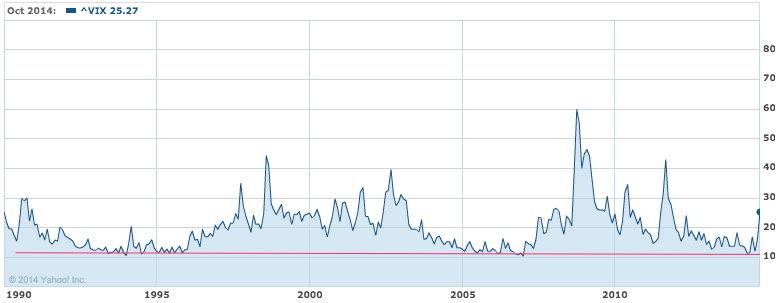
It may be that we are moving into a period of much higher stock price volatility again. Clearly from the chart above spikes this high from periods of low volatility have often led to more volatility. But are we going in to 1990, 1994, 1996 or 2007stylevolatility? Frankly I'm not smart enough to know. What I do know is that if I'm committed to stock market investment as a source of higher returns I have to learn how to live with the beast.
How to live with the beast
The first thing to do is reassessing whether one really should be investing in stocks at all. Thinking of investments like a pyramid, with a wide secure base, and higher risk investments stacked on top can help. Most people need a certain amount of short term liquidity - for bills, purchases, holidays. This stuff shouldn't be invested in the stock market. It should be kept it in cash. Nearer term income requirements should be kept in bonds - secure income streams. The stock market should really only be used as a long term compounding capital growth vehicle - which is where it stands out. Of course we all like to use stocks to speculate, but the beast can devour you so quickly if you are leveraged or overexposed.... be smart.
The second thing to do is to switch off. There is a famous study of Ivy League student investors in the US given demo portfolios to manage. One half were given news and prices daily, the other were given them monthly. It's perhaps little surprise that the investors with less frequent information won. They traded less and were less easily flushed out of their positions at the wrong moment. There's a lot to be said for only checking a portfolio once per year.
The third thing to do is stop trading so much. Stocks are expensive to trade no matter how cheap your broker is. There are taxes, commissions, fees, bid-ask spreads and market impact costs. Volatility encourages over trading. Much of the underperformance of private investors is due to overtrading. The beast makes us trigger happy.
Ride like Dionysus...
At times like this one sympathises with those who feel like running for the exits... after all cash is safe, stable, certain. But if one is investing for the long term and doesn't need short or medium term liquidity what's the point of second guessing the market? The market fools most of the people most of the time. I shall sign off with a quote from one of my favourite mystic writers Joseph Campbell...
"The goal is to live with godlike composure on the full rush of energy, like Dionysus riding the leopard, without being torn to pieces."
Safe investing.
Disclaimer
This is not financial advice. Our content is intended to be used and must be used for information and education purposes only. Please read our disclaimer and terms and conditions to understand our obligations.
29 comments
Yes indeed-I was jumping the gun on my mental interpretation of fracing a tight zone. At least we can top up.
FH
Like it paul. Takes guts to gear up in volatile markets but that's what made you your first million. If I recall correctly?
Hi,
Learning from mistakes I've made in the past, these days I tend to liquidate (or heavily reduce) any geared positions when the market starts to wobble. Or if this is not practical due to wide bid/offer spreads and/or lack of market liquidity, then I might hedge by buying Put Options on an Index.
However, for ungeared accounts, then I wouldn't react to a market correction at all. I'd just re-assess each position in turn, and providing the fundamentals are unchanged, then I would ride out the downturn and not do anything.
Then as the correction reaches its capitulation phase (which we had a day or two ago, when the Dow spiked down almost 500 points intra day, then bounced strongly), I would make a list of stocks that have been spuriously sold off and are now too cheap, and then plunge in with my geared account & buy up everything on my list! (that's what I've done this morning incidentally, and have picked up some excellent bargains).
So in a way, the above is a hybrid approach that seems to side-step serious problems by not being geared in a downturn. But the availability of gearing gives scope to buy bargains at the lows.
This strategy would only go wrong if the market was going to do a series of sell-offs, like it did in 2007-8 due to some major underlying fundamental factor going wrong. But in all other circumstances, it should work well for market corrections - so to summarise, I'm suggesting holding long-term positions in ungeared accounts, but dumping geared/trading positions at the first sign of trouble, and then re-deploying that capital once the market has capitulated on the downside & the forced sellers have been cleared out.
Regards, Paul.
Hi Paul,
I'd agree with all of that - though I don't run any gearing at all myself. As I noted many years ago, there is enough embedded leverage in an E&P portfolio anyway ;-)
One thing that these sharp corrections do (as your comments and those of others elsewhere illustrate) is blow away all the leveraged and stale positions and cut the market back to a decent base.
As I've also previously noted, when I can spot a 20% move in advance (as in Oct 2007 and 1989) I will try to trade out and back in myself - but I have to say that I didn't see this one coming (and it hasn't got to 20% down for me anyway).
I'm pretty relaxed, especially as I'm expecting some fundamental good news (re SOCO International (LON:SIA) ) in the coming months
rgds
ee
Reference SOCO,its interesting that the directors aren't filling their short's (with shares) suggesting that they may be party ("interested party") to something that restricts them from trading. The Congo well results are out and the share price is very tempting.
regards,
FH
The well "results" aren't out yet, FH. I'd be sure they still consider themselves to be in a close period - and may well still be so until after next month's IMS.
Long term hold is a great idea, but sometimes you have to think about wether or not a stock is going to recover suffiently to get your money back in a realistic time frame. Overcoming your own convictions can sometimes be the most difficult decesion. The simple chart below helps me to be focused.
Investment Reduction "Increase
required"
£1,000.00 25% £750.00 33%
£1,000.00 30% £700.00 43%
£1,000.00 35% £650.00 54%
£1,000.00 40% £600.00 67%
£1,000.00 45% £550.00 82%
£1,000.00 50% GBP500.00 100%
£1,000.00 55% £450.00 122%
£1,000.00 60% £400.00 150%
£1,000.00 65% £350.00 186%
£1,000.00 70% £300.00 233%
£1,000.00 75% £250.00 300%
£1,000.00 80% £200.00 400%
Surely there is nothing inconsistent in a LTBH strategy but occasionally getting out and into cash when you are convinced that a crash is imminent. The problem then becomes, how imminent is imminent, but usually when you take such action it is after a long spell of expectation and resisting the urge to sell when it would be too early.
I've sold out twice, in July of 87 (think that was the year - the October crash year) and October 07, and sat through the most obvious one - the TMT bubble bursting, because I had no relevant shares. It used to be made more difficult because of ISA rules about staying in cash, which meant that you had to subsequently "show willing" within a reasonable period, but that rule has been dropped in a short burst of common sense within the political establishment.
Twice in forty years doesn't negate LTBH as a strategy, imho, but it should be a rare occurrance .
Regards.
PS. Nice article ED.
FWIW, Muckshifter, I did similarly.
October 2007 was one I was very glad to have spotted - but then I didn't sell absolutely everything (except in the pension fund) - and then I didn't buy back in in 2009 either, as I'd originally thought. Inertia often is a factor, when there are few alarm bells being rung.
I'm pretty surprised at the reaction of (apparently) a good number of retail investors. Granted I'm in the unusual position of my second-largest holding having gone up significantly in recent weeks and my largest holding having fallen by "only" 20% net (in a sector where 25-50% has been quite common), but I do find it curious that there is a rush to dump stocks.
I'm a bit surprised that nobody (this time!!) seems to have invoked the ghost of Black Monday to explain yet another sharp fall in October - but perhaps it is because it is an odd number of years ago rather than a headline-friendly 25 or 30 years!?
It seems to me that the trading community must take a fair share of the blame (or credit?) for kicking things off in October. Low VIX has been pretty common in recent years, so arguably the market is easy to catch off-guard if a major move can be generated out of nothing. Personally I don't think it is a coincidence that October seems a favourite time for these surprises - being a couple of months before books close for year-end, this is the last opportunity in a year to trigger a big move because we have a short window of relatively high liquidity between the summer hols and the year-end book-closing.
This time around, there has been some real economic concerns overlaid on the harder-to-read OPEC politics and ebola epidemic.....so if a bit of uncertainty and concern can be generated by traders then it is quite easy to start a panic.
So well done the Saudis (and, no doubt, their bankers and insider friends in hedge funds). But I don't think there is any change to the 12 month view of markets - just that many stocks are now 10-20% cheaper than they were. So perhaps a good base to build from?
'nobody (this time!!) seems to have invoked the ghost of Black Monday'. Maybe because 27 years ago most of today's traders were in short pants?:-).
Question for those who sell - when are you going to buy back in? The market doesn't hold aloft a flag saying buy me now.
Superb post. I've been amazed at the recent panicking by so called investors who one minute are singing the praises of the latest oil stock and then the next selling everything. Each to their own but if you are invested in highly geared sectors you have to expect volatility.
tournesol,
Re your comment about going back to cash and waiting it out...
"I have spent the past few hours compiling a list of good quality stocks with solid yields which have fallen significantly and already look like bargains".
I curious which are the top 3 shares you have earmarked as being bargains now and why?
Ian
re. LTBH. Yes I am definitely an advocate of holding stocks through volatility. As long as :
1. You don't need the cash in the short or medium term.
2. Your portfolio is allied towards the core return drivers in the market - which can pull you out of trouble when it recovers.
Whatever you want to call it... GARP, QARP, QVM, Buffett's Alpha... buying quality, reasonably priced shares with growth potential builds a portfolio with the best chance of generating compounding, market beating & drop defying returns - again Haugen is particularly brilliant on this stuff, but so is Greenblatt or O'Shaughnessy. If you can practice a strategy like this in smallcaps or midcaps all the better. 2008 hurt everyone, but plenty managed to bounce back using the right approach.
Classic public examples are the records of any of the GARPY small cap fund managers like Giles Hargreave... 2008 was just a blip, within 3 years he was in credit again. He's managed 8.8% annualised over a decade - it's not massive returns but he did it owning 600 stocks and through the worst bear market in recent history ! That 8.8% compounded has led to 220% appreciation since 2004 (and 2009). Of course fund managers HAVE to stay invested... so they don't have any choice but keep their money in stocks - we on the other hand have to deal with the devil on our shoulder who keeps wanting to bail out.
All of the above comes with the caveat that if the world ends and the financial Ponzi scheme implodes I am not to be held responsible for the failure of above mentioned strategies.
It all depends on your natural psychological make-up, but dare I say, this is when over-diversification can help? I read your article on that with interest, Ed, and I follow John's Investment Chronicle as well. I know I am "over-diversified", but with c. 35 high-yield stocks and 10 growth or speculative ones with little or no yield, and a portfolio-wide nett current yield around 5%, I feel OK. Yes, I can kick myself for not having more cash, but what's the point? Market-timing is the hardest thing of all. Even Stockopedia's excellent Guruscreens are having a tough time recently.
Multi-baggers are the siren-call. With most stocks varying 40% in a year anyway (which itself disproves EMT for me), who needs them? Just make sure this is 'patient' capital, though.
johnrosier
if you are invested in an index tracker then your approach is more robust
but if you are overweight in a sector which has just seen deterioration in some of the fundamentals then it is, IMHO, too optimistic to hope that it will recover with the rest of the market.
I see the current situation as the run up to an opportunity in sectors/stocks different from those I bailed out of.
I think tournesol has a valid point. Many times in the past I have got to the "bottom" (however you want to define it) only to find the bombed out stocks that I currently own are not the ones I want to own. They may have had their "day" so to speak and do not either meet my investment criteria anymore or are not in the sectors that are currently performing the best in the new market environment. So in a market like this having a high cash position is actually not such a bad thing IMO.
Its great to hold cash in a falling market but always difficult to time entry back into the market.
The chart below printed at close last night, shows the FTSE 100 since 2000 together with the RSI (Relative Strength Index) at the bottom. It shows that the RSI has only dipped lower than last night's reading on four occasions; August 2011, January 2008, June 2002 and September 2001. Historically, whenever the reading has been at the current extremes it has been succeeded by a pretty decent rally in the market. It could of course go lower but it looks like we are pretty close to the bottom. I’m hanging on in there despite the gloom.
bsharman
'smart money'? I think you are endowing the closet trackers with too much craft! (Obviously as a herd they are slightly smarter than the most retail of retail investors...)
This is why i put the 'smart money' in '' !! Perhaps it should be narrowed down to the likes of Warren Buffet, Neil Woodford, Mark Slater etc.. i.e. top performing managers. - see when they are moving into cash or buying in the market.
When will the Smart Money money module be available?
Thanks.
I guess you need a large enough portfolio throwing off cash and not using it to buy at the top but wait for mr market to give opportunities.
Great piece! The only time I have felt really sick on market falls like this is when I have been forced to sell because I have "over invested". You normally end up doing it at the wrong price and just before it then bounces which makes you feel even worse. You learn that lesson, hopefully only once, and then you can actually quite enjoy these periods of volatility as it can throw up great opportunities.
These things happen so fast that unless you have been clever enough/lucky and raised cash beforehand I always think the best thing to do its sit on your hands.
I too got badly hit in 2000.2008,and Aug 2011 it does take a long time to claw back the losses if you just hold.
This time I have headed for the exit and have around 50% cash with a view to sell more even at a large loss as the overall situation declines, divi are all very well but not a the expence of large capital losses
I written about VIX and a market timing indicator in the past and looked at them again and some technical analysis on markets on my Blog this morning called Be-greedy when others are fearful?
If that's of any interest to anyone?
Website: Compound Income
Twitter: @CompoundIncome
Ed
You seem to be extolling the virtues of the LTBH* approach.
Whilst that is my own "natural" style and I've followed it for many years, my experience is that it can prove sub-optimal when there is a significant crisis. My own portfolio was smashed in 2001 and again in 2008/9. Both times I locked myself into LTBH thinking. Both times that was the wrong thing to do. The losses experienced were not quickly made back. This time I decided to run for the exit as soon as I felt the first tremor. I am presently about 75% in cash and in no hurry to re-invest it. I have spent the past few hours compiling a list of good quality stocks with solid yields which have fallen significantly and already look like bargains. I will keep my eye on these and will look to swoop when the time feels right. But that is not going to be today.
LTBH = long-term-buy-hold
Ed - thanks for the article! Is there a way to monitor (in aggregate) when institutions are buying and when they are selling? - i.e. follow the 'smart' money!
The thing is that institutions are generally just aggregate private investor savings. Institutions tend to buy when the public is buying funds, they sell when the public sells funds. Also most funds are fully invested and mandated to be so... so I'm not sure that the signals are that clear. You can though buy fund flows data... that's something I'm trying to get my hands on.
Some of the best indicators for market turns are yes, the VIX, the put/call ratio, insider sentiment and momentum indicators - e.g. the major indices have all been tumbling through their longer term moving averages... I've long wanted us to build these indicators into a Stockopedia dashboard - but it can be tricky to get all the data ! And the signals can be quite mixed at times.
Any ideas v. welcome of course... so please do drop comments and feedback here if you have ideas.
Solid post. Definitely getting a little nervous with how things are looking at the moment. Hard to call what is going to happen with the various things going on... currently fighting the urge to sell up and sit out for a while. Probably best to ride things out, but can be quite painful to watch!