10 stocks for investors looking for growth and income

When it comes to investment strategies, there are various reasons why “fast growth” and “dividend income” are often considered to be polar opposites.
After all, rapidly growing firms generally channel cash into expansion rather than paying it back to shareholders. And for income-hunting investors, the most dependable dividends are routinely found among predictable but slow-growing large-caps. But is there a happy medium for those looking for the best of both worlds? It turns out there can be.
Back in the early 1990s, the late City businessman Jim Slater, wrote an investment guide called the The Zulu Principle in which he described his strategy of buying fast growing companies trading at reasonable prices. In assessing the investment case of a share, he saw dividends as an important marker. He wrote:
“I prefer companies to pay a dividend, as most institutions need an income stream from their investments. Also, the dividend payment and forecast (if any) to some extent corroborate the management’s confidence in the future. The ideal company will have a steadily increasing dividend growing broadly in line with earnings.”
For Slater, dividend payouts were a sign of management confidence and the expectation that earnings would continue to grow. He wanted to see earnings and dividend growth to go hand in hand.
A combination of growth and income might sound like some unlikely ideal, but stocks that fit this profile have actually enjoyed periods of very strong performance over the past eight years. Of all the investment models tracked by Stockopedia, one of the standout performers this decade is called Winning Growth & Income.
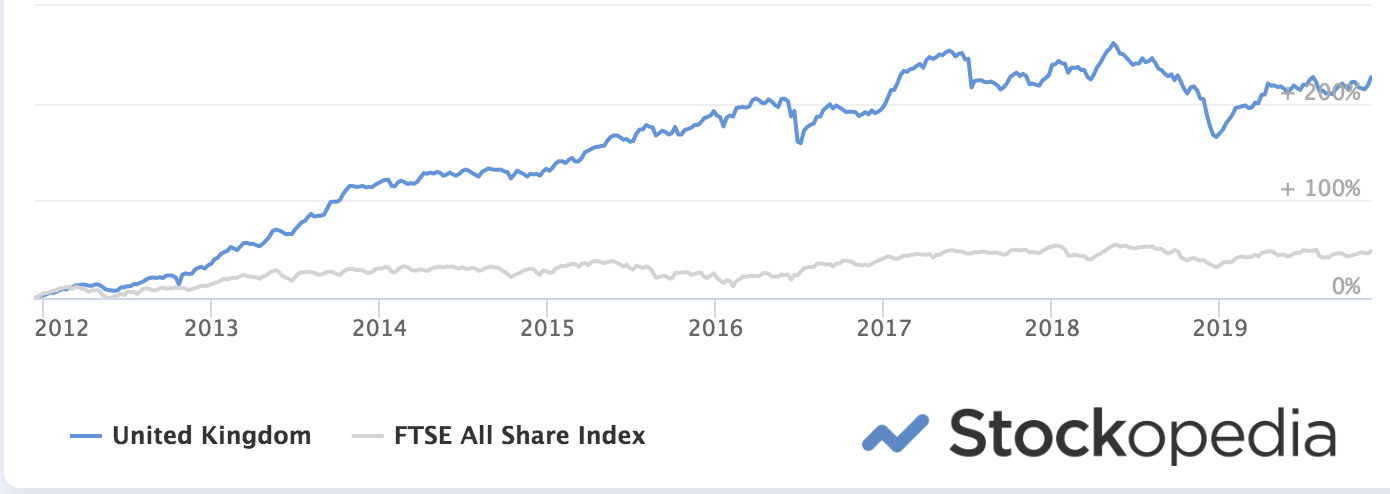
This strategy had a particularly strong run between 2012 and 2017. Overall, it’s has produced a theoretical cumulative return of 222 percent (pre-costs and excluding dividends) since we started tracking it in late 2011. It pulled back sharply in 2018, but there are signs now that it has started to stabilise. Just as importantly, the numbers of companies passing the strategy rules is starting to grow.
What makes growth and income a winning strategy?
The consistency of Winning Growth & Income is down to a simple set of rules that touch on three influential drivers of returns - Quality, Value and Momentum, with the important added bonus of above-average yield. It’s a strategy inspired by work by US investment analyst Kevin Matras in his book, Finding #1 Stocks.
In terms of quality, the screen looks for companies that are generating profits by looking for an above average Return on Equity and below average levels of debt. In the valuation stakes, the shares should be trading on a below average rolling price-to-earnings ratio. And for momentum, companies need to have seen recent analyst upgrades to their earnings forecasts for the next financial year.
In addition, the minimum market cap rule is set at £20 million, which opens the screen up to smaller - but not micro-sized - companies. But their Beta (the sensitivity of the share to the movement of the broader market) also has to be below average.
In many respects, these rules echo some of what you see in GARP (growth at a reasonable price) strategies but with an extra focus on dividends. Here are some of the top qualifying UK shares for the Winning Growth & Income approach:
Name | Mkt Cap £m | Dividend Yield % | Forward P/E Ratio | Return on Equity | Forecast EPS upgrades (over the past 3 months) |
369.6 | 6.8 | 7.6 | 16.0 | 7.40 | |
81.0 | 6.8 | 8.8 | 15.0 | 9.75 | |
89.4 | 6.7 | 8.5 | 57.8 | 1.74 | |
192.7 | 4.7 | 11.6 | 48.7 | 0.01 | |
1,840.8 | 4.7 | 10.2 | 13.7 | 2.20 | |
48.7 | 4.6 | 12.4 | 23.5 | 8.51 | |
328.5 | 4.4 | 8.3 | 19.3 | 0.39 | |
2,170.5 | 4.4 | 11.0 | 4.8 | 3.69 | |
6,933.9 | 4.3 | 9.4 | 15.7 | 0.46 | |
447.2 | 4.2 | 11.9 | 17.1 | 0.24 |
Interestingly, this predominantly small-cap list is punctuated by a few very large stocks that manage to tick the growth and income boxes - the interdealer broker TP Icap and the housebuilders Bovis and Barratt. But elsewhere, these higher yielding growth shares range from names like Amino Technologies and the mining company Central Asia Metals to Property Franchise and the property developer MJ Gleeson.
For investors tempted by the excitement of growth but conscious of the importance of dividends when it comes to total return, a combined growth and income strategy could be a useful place to start. As always, care is needed, particularly because this strategy picks up small-cap stocks, which can be potentially vulnerable, together with high yields, which in extreme cases can be a sign of trouble. But looking for signs of strengthening profitability, an improving outlook and below average valuations could help in the search for growth companies with an added dividend kick.
Disclaimer
This is not financial advice. Our content is intended to be used and must be used for information and education purposes only. Please read our disclaimer and terms and conditions to understand our obligations.

4 comments
As Ben said, this screen did very well for 5 years. I still use a variation of it. The biggest issue with it, is that according to Zacks handbook of equity market anomalies the EPS forecast upgrades should be at least 5% and as high as possible. Ed Croft also mentions this in the excellent financial ratio cookbook.
This obviously reduces the number of screen results so I have compensated by raising the p/e ratio slightly and dropping the dividend yield.
All look like duds to me (Except MJ Gleeson). If I can't double my money every 5 years I'm not interested. But Gleeson, Revenue +20%pa (ave. over 5 years), Profit +24%pa, eps +15.7%pa?, PEG=0.82 That's more like it.
For me, a combination of income and growth is important. With dividends it is also important to look at the history of payment, anything less than 5 years in a row in my mind should be ignored.
I think it should also be pointed out that 5 of the above are property related - a traditional strength for the UK, but with elections/brexit somewhere that thought needs to be put into before cash is invested
Yes that's what I thought when I got out of Builders 2 years ago when London started dropping. But they still seem to keep going up and up.