2014 Guru Strategy Review: Income and growth strategies lead in challenging year

Our 2013 review of the 60 GuruModel investing strategies tracked by Stockopedia picked up on some incredibly strong performances. Strategies that focus on small and mid-cap companies soared as investors swept into riskier parts of the market. It was perhaps a tall order to expect that confidence to stay intact. After all, many stocks on stretched valuations were under pressure to hit earnings expectations. With many of them missing those targets, earnings season turned into a bloodbath for some and 2014 proved to be much more challenging for the gurus.
The long-only GuruModels span a range of investment disciplines - from deep value small-cap bargains to high yield blue-chip income. That means benchmarking them against a single index isn't always that useful. Likewise, the demanding criteria of these screens means that some of them don't always offer up adequate numbers of realistically investable stocks.
| Index / Strategy Composite | 1 Year Performance |
| FTSE 100 | -2.7% |
| FTSE 250 | 0.9% |
| FTSE All Share | -2.1% |
| FTSE SmallCap XIT | -4.8% |
| AIM All Share | -17.4% |
| AIM 100 | -20.7% |
| Top 10% StockRank stocks (> £10m Mkt Cap) | 1.2% |
| Guru Strategy Composite | -2.65% |
| Income Composite | 1.0% |
| Growth Composite | -0.8% |
| Value Composite | -1.9% |
| Momentum Composite | -3.2% |
| Quality Composite | -3.9% |
| Bargain Composite | -9.8% |
Caveats aside, the overall GuruModel Composite just beat the FTSE 100 by 0.05% and the FTSE All Share by 0.55%. But it did better against small cap indices which may be more appropriate - beating the FTSE SmallCap by 2.15% and the AIM 100 by over 18%. The notable poor performance of the AIM 100 last year, down 20.7%, was exacerbated by a handful of single stock wipeouts. Tumbling prices at previously high flying shares like Asos, Quindell and Monitise all dragged on the performance.
Individually, all the strategy composites except the Bargain Composite remain ahead of the FTSE 100 over the past two years. During that time, the best overall performance has come from the Momentum strategies, which have produced a 41% return.
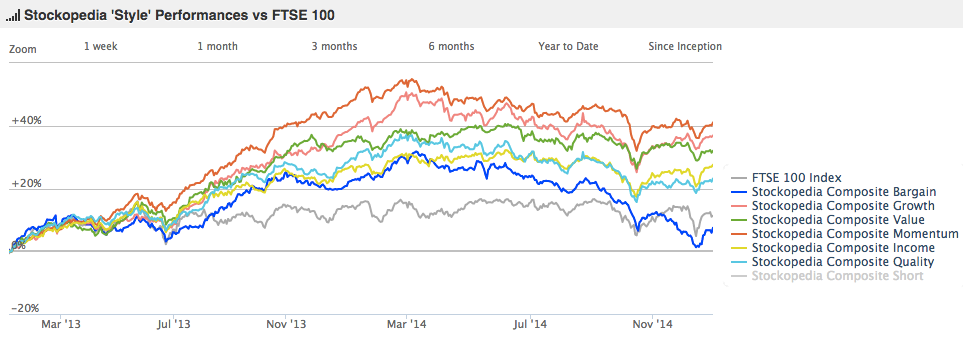
Which investing strategies worked in 2014?
Overall, it was the Dividend strategies that managed a whisker of outperformance this year - as we wrote about in detail here. Growth strategies also held up well, with our interpretation of US investor William O'Neill's CAN-SLIM strategy topping the list with a 9.9% return. Among the highlights during the year, the strategy made significant gains on stocks like Sprue Aegis, Plus 500 and Solid State.
Our modelling of the Robbie Burns' Naked Trader approach netted a 7.0% gain, helped by positions during the year in Trifast, Kentz (which was taken over) and, latterly, Mountview Estates. That was followed by the academic-inspired Growth at a Reasonable Price (GARP) model, which finished the year up 5.4%.
Among the Quality screens, it was the Cash Accruals strategy that edged the best performance with a return of 7.3%. This is a strategy based on evidence that companies with small or negative accruals tend to outperform. It's an approach that managed to ride substantial price gains on stocks like Barratt Developments and United Utilities.
At the other end of the performance range, it was a dire year for the Peter Lynch growth screen whose strict criteria make this a highly concentrated screen with an average of 4.5 stocks held With a 23.5% fall, the risks of concentration are all too clear. We repeatedly preach the benefits of broad diversification in portfolios, and it's no surprise that more diversified strategies have crushed many concentrated strategies this year.
It was also a poor year for the Joel Greenblatt Magic Formula strategy, which underperformed by 13.9%, although it remains up by 7.6% over the past two years. Greenblatt originally warned that the Magic Formula could underperform over prolonged periods - and that's certainly what we saw in 2014. There are though a growing number of voices who query the efficacy of Greenblatt's perhaps overly simple model.
Value strategies under pressure
After a strong performance in 2013, one of the biggest challenges facing Value investing strategies in 2014 was the dearth of opportunities. Leading the list at the end of the year was the extremely demanding John Neff Value screen, which returned 8.8%. Neff's strategy looks for good companies with moderate growth and high dividends while out of favour. During the year it saw useful gains on stocks like Fairpoint, Travis Perkins and Pace. Elsewhere, that return was matched by another contrarian value strategy, the David Dreman Low Price to Cashflow screen. It was helped by positions during the year in Persimmon, Aberdeen Asset Management and Plus 500.
The best performing Momentum strategy this year was the Richard Driehaus screen, which looks for both price and earnings momentum in stocks. It returned 12.1% through the year and picked some strong performers early on, including Solid State, Chesnara and Staffline. It was a similar story with the James O'Shaughnessy Tiny Titans momentum screen, which notched up a 7.1% return. This small-cap focused value and momentum approach picked up some major gainers like Character, Servoca and Victoria.
What to expect in 2015?
After the glorious gains of 2013, investors faced much more challenging conditions in 2014. Weaker sentiment in small-caps in particular caused havoc for many of the GuruModels tracked by Stockopedia. It ended up being the Dividend strategies, which gravitate to larger, better quality and higher yielding stocks, that performed the strongest. In good times, these income strategies could be seen as a little boring for investors searching for blistering capital growth. But in 2014 they proved to be one of the few sources of outperformance. The best performing GuruModels this year tended to be some of the most demanding quality, value and momentum approaches. There is little to suggest that a marriage of those disciplines won't continue to find the best performing shares in the market in 2015.
If you want find out more about hunting for big winners in the stock market, a free investment guide from Stockopedia could make a big difference.
Stockopedia's Guides to Making Money in Value & Dividend Stocks can help you become a more successful investor in 2015 and beyond. They are simple and straightforward reports on what works in the stock market and explain how to find shares that can enhance your returns.
Click here to find out more about Stockopedia and see our Subscription Plans to take a two-week free trial.
Disclaimer
This is not financial advice. Our content is intended to be used and must be used for information and education purposes only. Please read our disclaimer and terms and conditions to understand our obligations.

6 comments
Very disappointed at this 'fund manager'-esque review of the year which mostly focus's (conveniently) on the performance over 2 years and includes gems such as 'the growth composite held up well" when its massively down over 12 months along with all other composites.
As an independent research facility for investors (as opposed to the fund manager view of selling you more of their funds) I would have thought it more helpful to be pointing out that over the last c.12 months virtually no strategy has worked, presumably because the market is gently rebalancing overall valuations (multiples) down,
This bodes well for the future as it increases the potential for regaining the lost ground and then progressing further if earnings are robust but does mean short term pain (or lethargy) for most investors. The most important message for investors therefore is to stick with it even though it may be challenging to do so.
Interesting to see that the worst 1 year performance from Aim 100 @ -20.7% and Aim All share @ - 17.4% can produce fantastic returns from stock picking with Victoria @ around + 375%, Solid State + 180%,
Sprue Aegis+160% & Plus 500 +100%, not forgetting Fitbug in excess of +1000%, all Picked from Stockopedia Aim market.
The beginning of the year has produced another stock gain of over 125% from the Aim market already from one of these strategies, (that is only day 9 into the new year & I am not revealing which one it is.) These stocks are there for the picking.
At least there are now PLUS 500 T shirts available in Madrid to the football club, which should promote the company further in Europe.
That's great news Ed. Will this be included within the Folio tool as well?
Hi Ben,
The index numbers you are quoting are based on price indices and therefore ignore the dividends. In fact, index returns are in low positive digits. I suspect this means that you are calculating the strategy perfomance excluding dividends as well, so that they are comparable.
The return calculations should really include the dividends as well as this is the true return. Income strategies tend to have above average yield and will look better than they currenty do. Strategies that tend to have lower income, such as growth strategies, will look comparatively worse.
Best regards,
Mark
Jeavom, Yes indeed you bring up a good point and it's something we are working on. We recently acquired a global dividend database so that we can calculate Total Returns across all portfolios and strategies. This will be integrated within the application at some point in 2015. It will of course make comparisons across different strategies a lot fairer.
Ed:
May I suggest you offer options to:
(1) switch "on" or "off" the dividend in the total return calculations for strategies and portfolios
(2) put in a tax charge on the dividend (so I can decide that eg my dividends are taxed at 40%, or 20% or 0% or whatever I chose - both currently and historically)
(3) Allow the option to 'reinvest' dividends (post any tax charge) into the strategy or into the same equity. (Important to have both options - as else if one stock in a strategy is a heavy dividend payer it is likely to lead to big skewing in the strategy if the dividend is only reinvested into the same stock).
(4) I realise that for portfolios that cross countries or currencies some of the above is 'interesting' - eg you need to effectively reweigh a portfolio using the relevant exchange rates on the day of a dividend. (Also if I was really being pedantic I would note that tax rates (including withholding taxes) on dividends are not the same globally so investors might want an 'advanced' feature where they can configure dividend taxes on a per country basis).
I am sure both will be a pain to do but add massive value to investors.
Randeep