A Boris boom or Corbyn crash? How will the election result move the stock market?

With just days to go before the UK general election, all eyes are on the stock market for clues to which way prices might move once the result is known.
After three and a half years of uncertainty since the EU referendum, the biggest questions surround Brexit, and whether the result will make things clearer. There’s a view that Brexit turmoil has put the brakes on big decisions by corporates and consumers alike. So, will the Conservatives win a majority and “get Brexit done”? Will Labour defy the polls and introduce a new agenda for Brexit and business? Or will a coalition government emerge and bring with it all manner of uncertainty?
There are also wider questions about how the market will react to some of the policies on offer. In many ways, the Tory manifesto promises more of the same, together with pledges on infrastructure spending, house building and progress on a new free trade agreement with the EU. That’s likely to soothe investors, but the outcome of Brexit looks likely to remain a big uncertainty.
Labour’s manifesto offers some rather more dramatic changes - some of which contain at least a kernel of common sense. But it’s likely that pledges on nationalisation, higher corporation tax and windfall taxes on oil and gas companies won’t go down well with investors. Labour’s pledge to renegotiate the Brexit withdrawal bill and hold a new referendum on it, might increase the chances of no-Brexit, but it would also prolong the uncertainty.
Right now, there’s evidence that the outcome of the election itself is the most pressing issue in the minds of investors. A survey by Interactive Investor found that its customers were more concerned about who will win the election rather than what will happen with Brexit (44% versus 32%). A third of their customers said they were not investing in anything until the outcome of the vote is known.
Meanwhile, 43% of respondents said they were increasing their cash holdings but an equally large proportion (45%) said they were sticking with their investment strategy whatever the political weather.
Are indices sensing a Tory win?
In terms of trends in the main share indices, there are signs that the market is sensing a result. Interpreting short-term gyrations is tricky, but the FTSE 250 index has clearly broken free from the large-cap FTSE 100 in recent weeks (+5.1% versus -1.8% over three months). There has also been a pick-up in the smaller-cap AIM All Share through November.
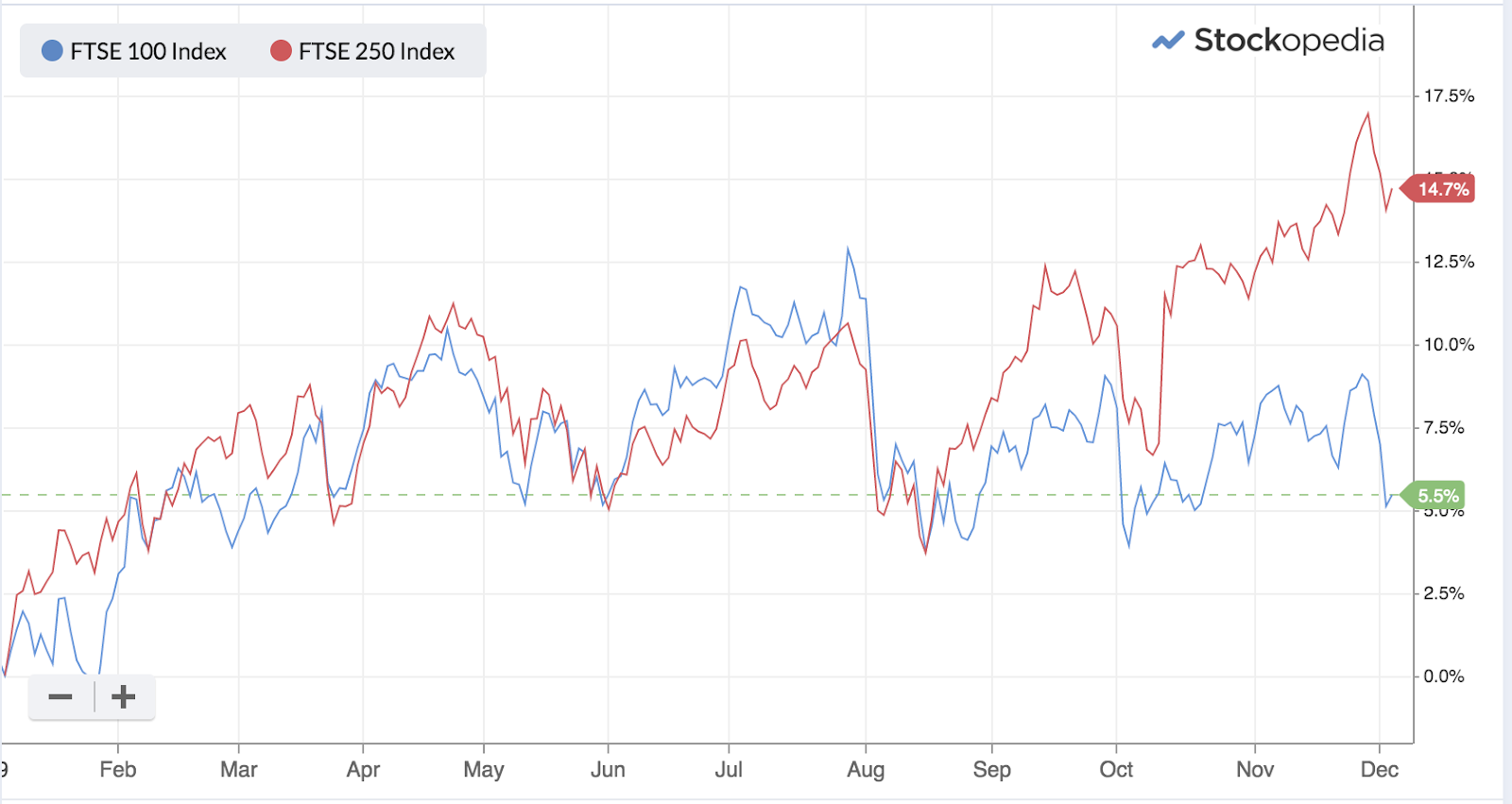
FTSE 100 and FTSE 250 indices, year to date
Source: Stockopedia
Why would small- and mid-caps be bouncing? Despite deriving 35% of its revenues from abroad, the FTSE 250 (like AIM) is a much more domestic-oriented group of companies compared to the blue-chip 100 index. So gains on these indices are perhaps a whisper that the market is sensing a Tory win and the clarity that would (presumably) bring to Brexit and British companies.
Another recent survey, this time by The Share Centre, found that an outright Conservative win was by far the overwhelmingly preferred election outcome among its customers.
Analyst Helal Miah, suggests that an outright win for the Tories would lead to a “small bounce in the stock market, led by the small and mid-caps”. Companies strongly exposed to the domestic economy would also do well as Brexit uncertainty lifts. On the flipside, he says the medium term outlook would be less rosy as companies start to “assess the impact of the removal of free trade from the transition period onwards”.
On a potential Labour win, Miah reckons markets “will not take well” to the party gaining power on Friday the 13th. If that happens, utilities, banks and betting companies will take the brunt. However, he says that markets should recover in the weeks and months ahead on the prospect of staying in the EU and aided by huge amounts of fiscal spending. “The much maligned government contractors, Balfour, Kier, Costain and others could lead the recovery in stocks,” he says.
Ways to trade the election outcome
Bearing all of this in mind, which stock market strategies are worth watching in the aftermath of the election? One approach might be to look at what’s going on among the cheapest, high quality stocks in the mid-caps. With the FTSE 250 trending higher, are contrarian shares starting to re-rate on a potential Tory win?
This screen looks for just that. It takes the highest blend of company quality and appealing share valuation using Stockopedia’s QV rank (stocks must have a QV rank in the top 20% of the market). It also looks for a solid 10%-plus relative price strength over the past three months - so it’s focusing on contrarian value shares that are on the move.
The results are interesting because they pick up stocks in economically-sensitive sectors like cyclicals and industrials. Housebuilders like Bellway, Redrow, Bovis and Galliford Try all appear to be on the move. Likewise, recruitment stocks, which can be a bit of an economic bellwether, often lead the market on an improving outlook - and here we have Hays and Pagegroup passing these rules (you can find the full screen here).
Even the online trading platform IG makes it onto the screen. IG shares have been hit badly by profit warnings in recent years, but its price has been trending upwards in past couple of months. Perhaps the anticipation of much higher levels of forex and share trading in the weeks ahead has got investors warming to IG again?
Name | Mkt Cap £m | QV Rank | StockRank Style | 3-Month Relative Price Strength | Sector |
4,083.9 | 93 | Super Stock | +12.1 | ||
2,482.3 | 87 | Super Stock | +22.0 | ||
2,414.5 | 89 | Super Stock | +15.6 | ||
2,324.5 | 97 | Super Stock | +15.3 | ||
1,784.5 | 96 | Super Stock | +15.2 | ||
1,742.3 | 95 | Super Stock | +35.8 | ||
1,569.4 | 85 | Neutral | +13.9 | ||
980.6 | 84 | High Flyer | +48.4 | ||
797.8 | 89 | Super Stock | +21.0 | ||
639.5 | 93 | Super Stock | +18.2 |
In search of clarity
Overall, the sense among individual investors, fund managers and brokers is the desire for clarity. While the UK’s two main political parties offer very different manifestos, the main issue in this election is Brexit and how it might start to be resolved, one way or another. Whether or not we’re in for a short-term Boris boom or Corbyn crash, the longer term issue of Brexit - and the need for a much clearer outlook for UK-listed stocks - is crucial for investors.
As Blake Crawford, a fund manager at JPMorgan, said in a recent note: “Whichever way the result goes... I’m just hoping for a clearer path forwards and something that resembles a modicum of clarity and with any luck investment fundamentals will once again come to the fore as we head into 2020.”
As always, it would be great to hear your views on all of this. From an investing perspective, is Boris really best? Is Jeremy really someone to fear? Is there actually a good case for re-nationalising some companies?
Disclaimer
This is not financial advice. Our content is intended to be used and must be used for information and education purposes only. Please read our disclaimer and terms and conditions to understand our obligations.

36 comments
How disappointing to read these money grubbing diatribes. The people voted to leave the EU by the democratic process, they don’t want to be ruled by Brussels and be part of the 4th Reich. Westminster, with all its faults is our elected body and what we prefer not a bunch of unelected bureaucrats . A great country like ours can stand on its own two feet, be brave there is more to life than a few more quid in the bank.8
The people voted to leave the EU by the democratic process, they don’t want to be ruled by Brussels and be part of the 4th Reich.
Being charitable I assume you're not suggesting that the EU is directed by a bunch of genocidal psychopaths hell bent on using military power to establish male Aryan supremacy and ensuring the extermination of all those peoples deemed inferior?
But if you're not, it would be nice to know what you do mean.
timarr
A great country like ours can stand on its own two feet...
Why would you want to?
In Adam Smith’s imagery, “By directing industry in such a manner as its produce may be of greatest value, a worker intends only his own gain, and he is in this, as in many other cases, led by an invisible hand to promote an end (the Wealth of Nations) which was no part of his intention .”
Smith saw the main cause of prosperity as increasing division of labor. Using the famous example of pins, he asserted that ten workers could produce 48,000 pins per day if each of eighteen specialized tasks was assigned to particular workers. Average productivity: 4,800 pins per worker per day. Absent the division of labor, a worker would be lucky to produce even one pin per day.
Westminster, with all its faults........
The country has the advantage of being close to European culture with a channel tunnel, built at great expense, and a border less society that prevents delays in crossing between countries. Free movement of people allows domestic agriculture to function and the NHS to flourish with workers from poorer countries doing what nobody born in the U.K. will touch. Everybody has realized this so arrangements are being made for nothing to change except an increase in bureaucracy and the loss of manufacturing capacity.
...democratic process...
Meanwhile China without existential dilemmas about democracy is the country of tomorrow.
In the U.K. 17 million out of a population of 66 million does not make a majority and with those results there will be paralysis for years to come.
...there is more to life than a few more quid in the bank....
One has to be healthy. However
I find it sad that cosmopolitan U.K. has painted itself into a corner.
Perhaps to add a little controversy...
The most positive outcome for Thursday is Boris winning and then implementing Corbyn's agenda. He doesn't need to do it exactly as Corbyn would in all regards and obviously he shouldn't go for the Corbyn blinkered ideological madness of believing he can immediately instigate such a huge economic and social change just as he is on the side of morality (in his opinion obvs). I mean Thatcher lead a revolution....but it actually unpacked quite slowly. A few key initial initiatives and then unfolding the plan over a decade plus.
If Corbyn had been more modest at the outset and just focused on a few things (and to be honest done by someone else than his flimflam self) rather than got out his socialist bazooka then he'd have given a weak Tory party a real run for their money and would at least achieve coalition of some sort and maybe majority.
We need social and infrastructure investment. For sure we have too much debt generally in the world but there is no way we are going to manage that down with hair short of austerity or depression....inflation and financial repression the only route that is happening in our modern proletarian polities. That's the Corbyn plan!...and BoJo seems to recognise that its a better one really so hopefully after slagging him off for the sake of the election result he can then get round to pinching his clothes..
What does it mean for the market? A lot of volatility and rotation. With inflation real assets are desired but high multiples and may be tricky to sustain....but the US is probably going to beat us to it as their economy and market creaks look out for the radicalism of modern monetary theory in full swing from either Rep or Dem. The US tax base cannot afford the US equity market to decline meaningfully without triggering a balance of payments crisis (US financial hegemon style...I know its got the $ and it aint Argentina) and dual action of seeking to keep market up and plugging the fiscal hole through monetisation likely to occur (the latter already has in response to recent repo stress which originates from dealers having to swallow too much treasury issuance).
So, vote Boris, get Corbyn if we're lucky.
Isn't it lovely that people are so uncertain about the future? Usually when they are certain about it they are disabused of their conceit within the next year.
It was ever thus...
Timarr,
there is of course some sense it what you say. However I would (gently) challenge the statement :
I actually think that most 'economists' actually do have an interest in the status quo : partly because they are heavily (intellectually) invested in the idea that "globalisation" (whatever that means) is the best thing sliced bread ; but also because to be honest that is the only environment they can really "model".
I cannot claim to know the best outcome, but having worked with economists for many years, I do think they are very biased to stay within an economic model where they think/claim they have some expertise.
Hi Gromley
I would (gently) agree with you.
Economists, as a group, have a specific world viewpoint. For instance, there is research that shows that the only people that act in the their own self-interest in the way that neoclassical economics would suggest are economists. This doesn't explain Roger Bootle unless, of course, he somehow personally benefits from Brexit.
As you might find from my blog, I am extremely dubious about a world driven by economists. Nor do I believe that a world driven by economic growth as measured by economics is the kind of world we should necessarily aspire to.
So, yes, I completely agree with you, but I still stand by my previous statements :-)
timarr
It'll be a Boris short honeymoon; then he'll be expected to perform. Corbyn won't happen.
At 2 448 reads this post is not going to change enough votes to merit a lot of time. However two anecdotes may help your reflections.
First look at the Quebec referendums to leave the Canadian Confederation of Provinces. Both failed. Yet only now is the province attracting investment. That is 25 years after the last one and approx 35 after the first one. Society has been divided all that time. Capital has kept away all that time.
There is no quick fix for Brexit. Whatever the election outcome or the subsequent Brexit outcome there will be more elections and more negotiations.
I have moved as much capital as possible out of the U.K. despite the lousy exchange rate.
Anecdote two. The grand-daughter of an acquaintance works in the Cabinet office. She went to a poor comprehensive school, won Ox-bridge scholarships, then was fast-tracked within the civil service. Plus point, says something for a system that recognizes talent not privilege. However take note of what comes next. Her duties are to brief politicians on the facts of whatever issue they are dealing with. None take any notice in their public pronouncements, preferring headline catching banalities.
It was ever thus, aflash.
There is an opportunity for the UK to benefit from Brexit but I doubt if any of our politicians have the ability to grasp it. I am old enough to remember the 1975 referndum on the Common Market when it was touted as an organisation that while not currently beneficial to the UK could be "reformed" once the UK was on the inside as a member. The exact opposite has happned, even during Thatcher's reign. I conducted business in the European Union between 1996 and 2012. The only way to succeed was to use indigenous nationals and to hide as much as possible the British antecedents. Everybody seemed prepared to accept German hegemony in Europe as a natural and unavoidable state of affairs.
The UK will only be missed in the EU because of its excessive net contribution to the EU budget. The EU has looked on the British as "chumps" we have regarded them as "chums".
Mrs Merkel has already offered to build Airbus, at the expense of the German state, a factory to replace Broughton. When the gloves come off (and they will) the EU will be tossing hand grenades with the pin out towards our economy at every opportunity. Our political elite will be responding with cricket balls and a "Britian Can Take It" fortitude.
Have a good weekend everybody.
Bonitabeach
Bonitabeach. Yes, I think the UK will be missed mainly for her financial contributions and the fact she's a net importer from the EU. Sad but true.
A Brexit will, according to every think tank, result in diminished economic growth.
A solid Conservative majority will make Brexit happen and if the stated deadline is immovable this will be a disastrous no-deal.
With a Labour win, Britain will be a Marxist country with dissent stamped upon (as has been happening under Corbyn), economic disaster, and rising social unrest (a la 1970's) .
For the referendum, the voters were fed many lies and deserve another referendum as there is much more clarity over what leaving the EU means. It will not be democratic to deny voters the right to vote again now that they have more information.
For the sake of our economy and good long term investment returns we need to stay in the EU.
Frap. May I respectfully dispute a couple of your points:
1. A Brexit will, according to every think tank, result in diminished economic growth.
I don't think we know what 'every' think tank believes. The respected economist Roger Bootle (2017) argues convincingly the outcome of Brexit is undecided and not necessarily bad for the EU or for the UK.
2. For the referendum, the voters were fed many lies and deserve another referendum as there is much more clarity over what leaving the EU means.
Is there really more clarity over what leaving the EU means? For the referendum of 2016, voters were certainly told many lies for and against Brexit. Most arguments concerning Brexit have been based on emotions, ignorance, prejudice, suppositions and irrational assumptions. Facts are conspicuous by their absence. We don't have crystal balls. We cannot predict the future with certainty. It would be naive to think that politicians say anything other than what helps them to get elected at the next election.
If we do have another referendum and the vote is to remain, the logical thing would be to hold a third referendum and settle for a best of three.
Reference:
Roger Bootle (2017) Making a Success of Brexit and Reforming the EU, Nicholas Brealey Publishing (London)
I think it might be worth pointing out that Bootle is an ardent eurosceptic and his views on Brexit are ideologically tinged, to put it mildly. You'd be hard pressed to find an economist with any aspirations to neutrality who thinks that leaving the EU is likely to boost the UK's economy.
But frankly who knows? We can't even predict the result of the election next week and even if we call that correctly we don't really know what the new PM will actually do when they assume the levers of power. Trying to trade this is like throwing darts blindfold at a board on a conveyor belt in the middle of a rugby match while wearing boxing gloves.
timarr
Timarr.
Bootle may well be a eurosceptic and ideologically driven, but his arguments are based on facts and history. Admittedly he may be a little selective in his data, but I very much doubt if anyone is truly neutral on Brexit, and that includes economists.
Bootle may well be a eurosceptic and ideologically driven, but his arguments are based on facts and history. Admittedly he may be a little selective in his data, but I very much doubt if anyone is truly neutral on Brexit, and that includes economists.
There are plenty of non-European economists out there who haven't got a direct interest. It's hard to find any that believe Brexit will benefit the UK in economic terms - and they all base their arguments on facts and history (and economic theory): it's largely about the process that determines which ones they choose - and it's easier to believe someone who hasn't nailed their colours to the mast before the event.
But, frankly, I think you'd have to be quite ideologically purist to think that Brexit can be justified on economic grounds - the economic arguments are covering fire, the real battlegrounds are immigration, sovereignty and an instinctive English dislike of not being in control of their future. All of which I sympathise with, but there'll need to be a remarkable series of events for the UK to end up better off as a result.
timarr
Actually Bootle fundamentally changed his arguments re the desirability of exports/a lower pound AFTER the brexit vote had reduced the value of sterling, to enable him to claim a positive brexit effect. Previously he had been very dismissive of export sourced growth and had championed consumption as the key variable to consider.
He is not only selective in his data sets, he changes his economic views to fit his ideological predisposition.
I disagree with at least one observation: NONE of Labour’s policies have any common sense about the, kernel or superficial. This idea inevitably leads to the notion that perhaps they’re “worth a try” or “that things won’t be too bad.” They will. Moreover, no hardline Marxist party, of which Labour is now an exemplar, has ever been removed through the ballot box. Avowed Lenninists like Corbyn and McDonnel don’t bother with trifles like elections once in power: they have to be forcibly ejected.
Not so. The land tax is an excellent idea and is in fact a major source of revenue in that oft mentioned exemplar Singapore.
Have a read of the Adam Smith institute on the subject.
I cannot work out whether that is the voice of the Daily Telegraph or the Daily Express or perhaps something a little more 'alt-right'.
Whichever - this is clearly not the right forum for idealogical claptrap of whatever persuasion.
Depressingly a Conservative small majority governmet looks most likely but one with an increasingly populist twang from both the crowd pleasing PM and new Tory MPs replacing centrists. This govt. will get Brexit (apparently) done quickly and will spend strongly. Short term this will be good for the stockmarket as animal spirits return. Longer term the news will be less good as increased borrowing makes any medium term rise in interest rates more problematic. Real Brexit ie the full exit from the customs union to trade alone is also more likely to be difficult challenge to manage than a benefit. Brexit is also likely to lead long term to the break up of the UK - first a United Ireland (in 5 years), then Scotland leaving (in <10 years).
However, since the Labour party have also shifted towards to the left, even if Corbyn is replaced (as is likely - he seems old nowadays!), then the party will will remain strongly re- distributionist and somewhat anti-business. This will keep them out of power in England (& thus whatever exists of the UK) but require the Conservatives to be seem to be less pro-business & efficiency and be dragged into more consumption spending (social care, hospitals) vs the investment boom it promises.
First-past-the-post will keep out the increasingly sensible, centrist Lib Dems from making a breakthrough. Net, we will face a populist Cons govt for some time.
My take is therefore that after a short lift in early 2020, the UK stockmarket is likely to remain relatively slow growing for the next decade, held back by political and economic weakness including govt debt
I will look to deploy the cash I hold in international-facing and dividend stocks LT but ST hope for some domestic trading opportunities.
An outright Corbyn victory would be a market shock. Stocks earmarked for nationalisation would fall sharply whilst those with big overseas income would rise.
Both a Labour and Tory government face the same demographic rising pressures on pensions and adult social services. They're not going away, so over time taxes will rise regardless. They saying is that Labour governments run out of money after a few years. I doubt Corbyn could revolutionise the UK system and after 5 years he'd be out.
Brexit is almost irrelevant. Great Britain has been an outward facing, trading nation for over 300 years. That won't change. Whatever type of arrangement is cobbled together with the EU, it's just not that significant either way. The only (small) impact is that a majority Tory government should quickly lead to formal Brexit and there would be a spurt of business investment as projects held by uncertainty are activated.
A Boris win might lead to a short term boost to the stockmarket but it might go into go into long term decline if he delivers a hard Brexit.
A minority Corbyn Government might lead to a 2nd referendum. If that resulted in the cancellation of Brexit the stockmarket might recover, especially if Labour's political partners prevent Corbyn carrying out his wilder plans.
Any Brexit is likely to lead to Scotland and Northern Ireland leaving the UK to return to the EU. It would be to the long term political and economic advantage of Scotland and to the economic advantage of Northern Ireland to do so.
My selfish option would be a Boris win, take my profits from the short term boost and reinvest outside the UK.
Depending on your timescale, the question in the heading should perhaps be reversed?
A short term a boost to the markets seems likely following a Tory majority, but longer term a Johnson govt will lead to Brexit, probably a hard one, possibly no deal. Whereas a hung parliament and probable Corbyn PM would lead to another referendum which is likely to stop Brexit. Over time that will be beneficial to the UK economy, and is likely to lead to both a short term rise in the markets after a decison to cancel Brexit, and a longer term benefit against the Brexit case.
I am going to hold off until after the election and ride any up or down wave, holding mainly cash at the moment.
Though did put a spread bet on the FTSE100 at 7150 yesterday.
Thanks Ben. A thoughtful analysis. The other issue that's going to affect the markets is how the GBP:USD ratio will respond to a Tory win. If our economy strengthens as optimism prevails, the pound will gain agains the dollar and that will depress the FTSE 100 since around 70% of the FTSE is dollar based. The FTSE 250 will be much less affected. Once the election is over, I shall be watching the GBP:USD ratio very closely before making any major investment decisions.
I fear that the indices and the FX market may have got it wrong. So many people in our society today want something for nothing or a least as cheap as possible, a trend exacerbated by the apparent costless nature of social media, online information, etc. (data harvesting aside!), and this is just what the current Labour Party is offering. They are offering electoral bribes to all and sundry: WASPI women, students, social media users (free broadband), 33% reduction in train fares following nationalisation, lower utility bills following wholesale nationalisation of the energy and water industries and many many more 'bungs'. But who will pay for all this? - the top 5% of income earners (£80,000+) and big business apparently. Today's World at One on Radio 4 was fascinating and enlightening as Evan Davis carefully and logically dissected the Labour promises and sensibly suggested they were unrealistic. This was followed by an increasingly defensive and strident John McDonnell trying to defend his party's promises!
IMHO and leaving any party political leanings aside (as far as I am concerned the song lyrics "Clowns to the left of me, jokers to the right" are very apt in the current election!) this version of the Labour will be pretty catastrophic should it get its hands on the levers of power. What they propose is likely to be the thin end of the wedge and we will see much more anti-capitalist rhetoric and attacks on the perceived rich and the 'hated' business community should Labour win on the 12th December. Unfortunately I think this is increasingly likely what ever the polls indicate. As regards investment strategy I, like many other investors, am holding plenty of cash and leaving existing holdings pretty much unchanged (save exiting businesses threatened with nationalisation!). One thing I have done following a helpful comment in Stockopedia's SCVR is to buy insurance in the form of a December 20th expiry FTSE 100 Index put options with a strike price of 7000. If Labour do defy the polls and win the election then I suspect the FTSE 100 will fall dramatically in the short term and this put option will act as a substantial hedge vs. the UK portion of my portfolio. Friday 13th (!) could be a very interesting day for the UK markets whichever way the election goes.
If Labour do win then I think the £ will fall which will benefit many FTSE100 companies, so the FTSE100 may well bounce back as it did when the Brexit vote happened. The £ has been strong recently, probably because of a Tory win in the election. My prediction is a Tory win with a small majority or no overall majority. If Labour do win it will be like back to the 70s, many voters won't remember those dark days. Labour may struggle as they have lost a lot of seats in Scotland, they may lose some in strong Brexit areas also. I believe Labour have only won a majority of seats in England once since 1966, that was Blair's landslide in 1997. I think the Liberals will do well.
Please pardon my ignorance but how does Joe Blogs go about trading options? I do understand Futures and Options but out of the trading loop for them.
I'm surprised that you didn't include in your list of the effects of a Labour victory their pledge to put 10% of the shares of all listed companies with over 250 employees into a fund will be partly held by the employees and partly by the government.
"Are indices sensing a Tory win?"
Given that the markets are shown by the adjusted data to be fairly agnostic over any preference for whichever party is in government, there is a risk of beginning with a false premise from which to attempt to rationalise short term movements in the indices.
For example, it could similarly be rationalised that the indices are turning up as the polls are tightening which suggests a hard brexit is becoming less likely which means less disruption to companies and their profitability.
A win for Boris leaves open the possibility of a no deal exit at the end of 2020, which could be a drag on the market. The EU will follow its previous strategy of putting off the difficult part of a future trade arrangement until Britain the end of the transition, which would give Boris the headlines of achieving a free trade deal by 2020 but actually leave a lot of uncertainty over services and some other areas where the EU is reluctant to make concessions.
The UK will inevitably become a rule taker in many areas without the leverage and opt-out possibilities that we currently have as one of the three major EU powers, so negotiating trade deals with non-EU countries will be constrained by a treaty obligation not to deviate too far from EU rules. Negotiating new trade deals will be complex and will leave a lot of uncertainty for many years, during which time we will lose some of the deals that the EU has already negotiated and (as a much smaller market) the UK will be in a far weaker position than the EU to negotiate good trade terms.
On the likely Conservative win, I expect a short term rally followed by a slow decline relative to EU major economies, reduced inward investment, a growing trade deficit, relocation of UK activities into the EU, increased willingness in Scotland and NI to leave the UK (by 2028 I predict the EU will offer to provide financial support to Dublin for Irish reunification) and there will be a slow decline in Sterling because of the return of austerity that will reduce domestic demand and import inflation.
I don't see how the Government will finance and refinance its borrowings without increasing interest rates to make gilts more attractive - and higher interst rates would further depress the economy.
That leaves the BoE with a bloated balance sheet. QE will really have been the magic money tree, but I doubt it will be able to bear much fruit in future without spooking international markets.
So in 5 years time, Labour will win an election and then be blamed in 2030 for the dire state of the economy ... ... that they will have inherited.
Bit of a downbeat comment FREng. It's human nature and easier to measure the tangible risks and negative effects following certain outcomes eg. B**x*t. Much more difficult to measure are the opportunities and "upside risk" from said outcomes. Personally i think we'll thrive afterwards - especially economically.
A great analysis, FREng. I agree that Brexit uncertainty will probably grow during 2020 after a clear majority for Boris, resulting in a gradual decline in the markets (after an end-of-year rush to the head) as it dawns on investors that a trade deal with the EU is likely to be more unfavourable for the UK - and it could go the wire, with the prospect again of a no-deal Brexit this time next year.
Meanwhile, the US congress won't agree to any UK/US deal that jeopardises the Good Friday Agreement, so the US won't agree to a deal until after the EU and UK have sealed theirs first. Overall that suggests a continuing lack of confidence in the UK with potential investment by businesses being delayed or diverted elsewhere for at least a couple more years, if not longer.
Great analysis Feng; I agree. Assuming a Conservative win (and the UK then leaving a trading block with a GDP not far off that of the US) combined with the glacial pace that making new deals with major players will take (and from a place of weakness) then I too see a short term rally followed by slow decline. Especially as the UK’s likely EU exit on Jan 31 may just replace that uncertainty with many more new longer term ones of what future trade deals might look. And so the potential for reduced inward investment, and the other things you note Freng.
Regarding the question posed in your excellent article Ben, then I’m not optimistic for 2020 regarding the sentiment expressed in the quote from the JP Morgan fund manager at the end of your piece.
Jonah