A closer look at two contrarian Leisure opportunities

So much depends on your investment horizon.
Markets could well get worse before they get better - it’s not hard to envision negative scenarios that aren’t really priced into the market. On a 12-24 month view, there is great uncertainty. But if you are thinking in terms of five years or more, this could actually be a good time to get into UK equities in terms of valuation.
UK Leisure has been hammered, and understandably. There are signs of lockdown being eased but this could all be reversed at the drop of a hat. If you look further out it gets easier to see a path back to previous levels of trading, but many companies in affected areas will go out of business between now and then.
I worry that most of the businesses to suffer will be smaller single and multi-site operators. Larger companies tend to have better access to more financing options and more favourable rates. As such they are better placed to navigate these conditions.
We’ve seen a raft of fundraisings from larger, public companies over the past week. These placings aren’t a silver bullet, but each one marks a de-risking to one degree or another in the respective company:
- 22 May - On The Beach placing, gross proceeds of £67.3m
- 21 May - Dart Group placing, gross proceeds of £172m
- 21 May - Whitbread underwritten rights issue, gross proceeds of £1bn
- 19 May - Compass Group placing, gross proceeds of £2bn
For many it is still too early to invest, with too many important unknowns. Key issues include:
- When sites open. Social distancing is here for a while. At least until Christmas and possibly longer. This probably means operators with larger sites stand more chance.
- Their level of trade. How will customers behave once they are allowed to go out?
- The cost of reopening (stocking, cleaning, re-staffing).
- Wider economic impacts of the lockdown. Everything else could just be rearranging deckchairs on the Titanic if the global economy tanks.
- Potential for a second spike and timing of a vaccine.
- Company-specific working capital requirements.
Restaurants: the canary in the coal mine
Even if you have no intention of going anywhere near this part of the market, it employs nearly two million people in the UK (or at least it did) and so it provides useful readacross.
Looking to countries further along the curve helps. This article from The Economist is about the US restaurant sector and comes with the cheerful subheading: “Many establishments are likely to close forever”. It includes a chart of reservations.
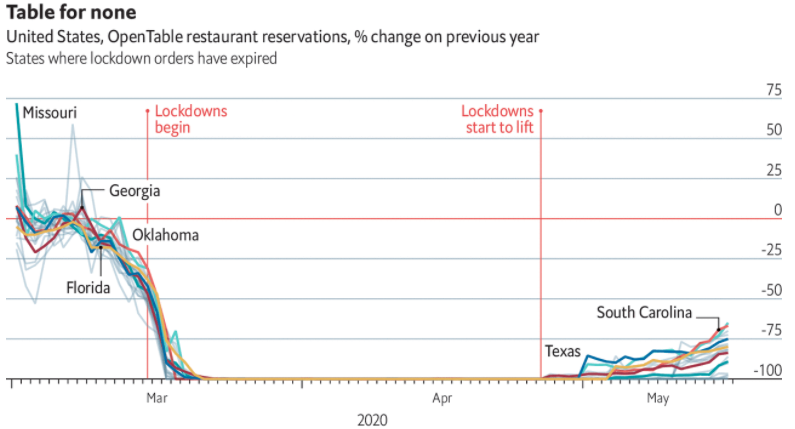
Steve Hafner, chief executive of OpenTable, a restaurant-reservation website, said that as many as a quarter of restaurants in the country will never open their doors again. I don’t see why the number wouldn’t be similar in the UK.
Industry specialist CGA has a more positive take when looking across the pond. It has reported that restaurants and bars grew sales by 25% in the week that some states re-opened. Momentum has continued and now national sales are 54% down on pre-COVID levels (up from an initial fall of some 80%).
DYOR but I have started looking at some of these stocks a bit more seriously, with a view to allocating a small part of my portfolio to the thematic bet that Leisure will bounce back in the medium term. I’ll only do so if I can find suitably distressed share prices, though.This could be wrong, and even if it’s right, share prices could be very volatile. Many companies will go bust between now and then.
In particular, I’m looking for companies with:
- Strong and experienced Leadership,
- Companies with the scale, finances, and liquidity to gain share in a weakened market, and
- Equity upside - a lot of Leisure companies seem to be priced as if there is no lockdown.
Two companies that have caught my eye are Marston’s and The Restaurant Group.
Marstons (LON:MARS)
- Market cap: £374m
- Enterprise value: £1.77bn
- StockRank: 54
- Share price: 59.6p (0.9%)
Last week, Marston’s announced a joint venture partnership with Carlsberg and its share price doubled in a day. The deal values its brewing division at just shy of £580m. Meanwhile, Marston’s market cap pre-announcement was just c£200m.
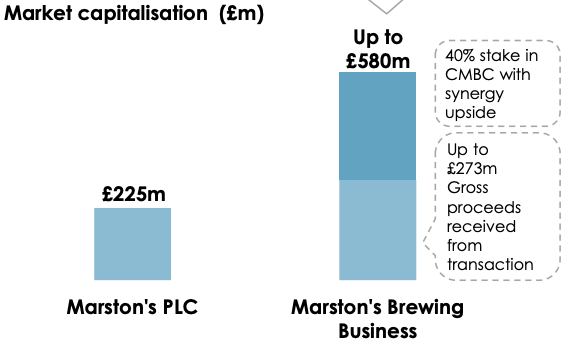
It’s a stark reminder that there are many different views of value in the market.
JV details
The JV is called “Carlsberg Marston’s Brewing Company” (‘CMBC’) and is a “brand-led, best-in-class brewer with increased scale”.
Marston's receives a cash equalisation payment of up to £273m and will own 40% of CMBC. The deal materially reduces Marston’s net debt, increases financial flexibility, and allows the pub group to partake in any future upside in the combined brewing entity.
The pub group still has a lot of debt, but it also has a lot of freehold property.
2019 (£m) | Target (£m) | JV impact | |
Securitisation | 745 | 600 | nil |
£400m to 2023/4 | 296 | 240 | decrease |
Property leasing (35-40 year) | 358 | 360 | nil |
Net debt (pre IFRS) | 1,399 | 1,200 | decreases |
Leverage | 6.3x | 5.0x | decreases |
Of the equalisation payment, £34m will be deferred 12 months from completion with the amount payable contingent on the share price performance of a basket of companies including A.G. BARR, Britvic, C&C Group, Marston's and Mitchells & Butlers. I’d like more detail on this point.
Regardless, the JV looks attractive: it will generate c£24m of cost synergies per annum (from overhead costs, brewery and logistics efficiencies, and procurement savings) will seek to leverage its scale to drive as yet “unquantified” revenue synergies, and should generate c£65m of EBITDA per year straight away.
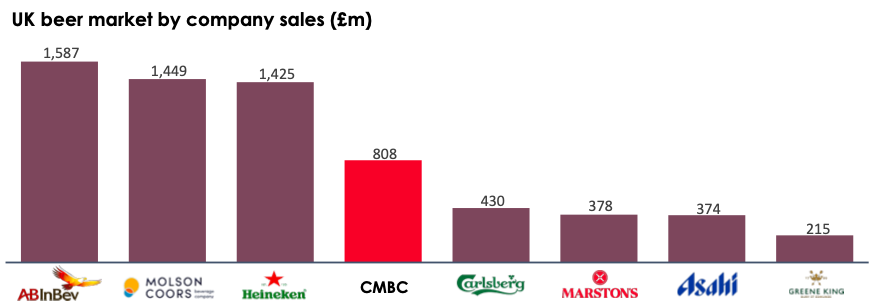
It consolidates the two groups in fourth place in the market (source: FY18 sales figures), marrying Marston’s local provenance with Carlsberg’s global reach:
Debt update
So the above all looks well and good, but the majority of Marston’s business is still in locked down pubs and it continues to have what many think is an excessive amount of debt on its balance sheet. The group has negotiated further with its debt holders.
Banking arrangements
- MARS has negotiated £70m of additional liquidity via an increased bank facility, and
- Bank covenants have been amended for September 2020 and March 2021
Securitisation
- MARS has made a request to bondholders for technical waivers and amendments to January 2021, with c50% agreeing on announcement
The new facility together with mitigating actions and government support should provide enough liquidity to meet financial obligations beyond the end of the financial year, according to the company.
The above suggests that larger companies, with their superior access to financing options, are more likely to survive this lockdown that small multi and single-site operations. Sadly, I think that a larger proportion of economic pain will be felt further down the food chain.
My view
If this sector does ever return to something like previous levels, MARS has a simple strategy that it had previously been executing well on. The question ultimately comes down to your view on life after lockdown, which still depends on many uncertainties.
The shares are double what they were a week ago but the company has also pulled a rabbit out of the hat in order to meet its 2020 liquidity requirements, so the risk has gone down.
The JV shows the latent value at Marston’s though. It has many strong, local brands, a diversified business model, and a large freehold estate. All of these offer possible routes to raise cash if needed, as evidenced last week with this JV.
It’s not the answer to all of Marston’s problems. The entire sector faces a lot of risk and liquidity will be an ongoing issue. Shares were down yesterday after last week’s jump - perhaps we can expect more selling pressure as rattled holders take advantage of a much improved sell price. MARS may well make it through but, with shares now pushing 60p, I am looking for a better risk:reward and the potential for more equity upside.
Restaurant Group (LON:RTN)
- Market cap: £311m
- Enterprise value: £598m
- StockRank: 39
- Share price: 55p (+5%)
Trigger: And that's what I've done. Maintained it for 20 years. This old broom’s had 17 new heads and 14 new handles in its time.
Sid: How the hell can it be the same bloody broom then?
Trigger: There's the picture. What more proof do you need?
While Only Fools and Horses is not known for its philosophy, the paradox of Trigger’s broom does get you thinking.
Restaurant Group is a bit like Trigger’s broom. I was bearish on it for a long time, since the 500p level five or so years ago. It can be hard to alter your opinion on a stock but things do change, and often market perceptions lag operational progress.
Since the wheels came off, there have been two or more new line-ups at the board level, one new and growing brand has come in, two or more stale brands have been jettisoned, hundreds of millions in equity has been raised, the dividend has been cut, and the group is on course to shrink its estate by about a third in one fell swoop.
The above can’t have been much fun for long-suffering shareholders, but those approaching the company anew might find that quite a lot of painful restructuring has already taken place. The difference between Trigger’s Broom and The Restaurant Group is that while one retained its fundamental broom-y essence the other is much-changed.
Forgiven but not forgotten?
It’s a story you’ve heard before: a young headstrong CEO is appointed to a company, with a mandate to radically reshape the business. Goldman Sachs sees him coming and pitches him a high growth company. Next thing you know, Restaurant Group is paying half a billion pounds for some noodle bars.
I saw this tweet over the weekend - it seems apt:
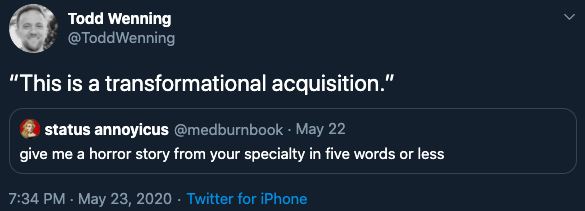
Wagamama was certainly “transformational” for The Restaurant Group, saddling it with debt. Going over the figures again, they are as ridiculous as I remember:
- Wagamama enterprise value of £559m, financed by
- £315m rights issue and £220m revolving credit facility, which buys
- 138 owned restaurants and a 58-strong franchise business, meaning
- An enterprise value per unit of £4.05m (not including the franchise arm)
Today, the entire 650-strong The Restaurant Group has an EV of £556m - that’s an enterprise value per unit of £0.86m. The entirety of the group is now worth less than what it bought Wagamama for just a year or two ago.
Companies change and market perception can take a while to catch up. I suspect that RTN is now a much better company than it was three years ago, and its share price is a lot lower. If you are looking at this company anew, over the past two years it has fortified itself with a £315m rights issue, a £58m placing, a sector-leading brand, and it has replaced its Board and management with a strong and experienced C-suite.
My view
Here’s what we know:
- RTN is exiting 61 sites as part of the Chiquito’s administration,
- It is probably closing 200 relatively unprofitable leasehold sites (25 concessions in regional airports, with the remainder being Coast to Coast and Frankie & Benny’s),
- This will reduce the rent bill but increase the onerous lease charge,
- It has strengthened its finances and liquidity with £55m of gross placing proceeds
- This should leave an estate of c400 outlets: Wagamama 145, pubs c75, concessions c46, Frankie & Benny’s c134
Restaurant Group is accelerating years of estate resizing. It has plenty of liquidity headroom and much-reduced cash burn of between £3m and £5m under closure. Wagamama, which has a growing delivery business (last seen at around 12% of revenue), is becoming a much larger part of the group.
I think there is scope for a material rerating in these shares if lockdown is lifted gradually in line with plans.
Here’s some illustrative numbers - it’s all guesswork right now so I’ve kept it very simple. The like-for-like guidance for FY20 comes from RTN’s April COVID update. I’ve forecast a pick up in FY21 and for margins to recover to FY19 levels. I haven’t even attempted to fill out the FY20 column. For FY21 PAT, I’ve applied a notional 20% tax rate:
2019 | 2020 | 2021 | |
Sites | 650 | 400 | 400 |
Revenue | 1073.0 | 536.5 | 697.5 |
LfLs | 3% | -45% | 30% |
Adjusted EBITDA | 136.7 | 88.9 | |
Adj EBITDA margin | 13% | ||
Adjusted PBT | 74.5 | 48.4 | |
Adjusted PBT margin | 7% | 7% | |
Adjusted PAT | 59.6 | 38.7 | |
Shares in issue | 491.0 | 590.0 | |
Adjusted EPS | 11.9 | 6.6 |
I see the group is up 11% today to 59p so that would put it on c9 times FY21 earnings, although that forecast really is uncertain.
The group’s core growth division (Wagamama, pubs and concessions) accounted for three quarters of group EBITDA but made up less than 40% of total sites in FY19. With the probable closure of 200+ units, this core growth division will represent a larger part of the company going forward. When you consider this, it is not hard to see margins actually improving in the medium term, especially if there are less challengers around.
With its improved liquidity position, accelerated estate restructuring and probably decline in market supply, I’m actually more interested in The Restaurant Group than I have been for half a decade or more.
DYOR but RTN strikes me as an interesting contrarian bet. It probably offers a more attractive risk:reward now that Marston's has doubled. However with the strong gains so far this week, I do wonder if there will be better buying opportunities in the weeks ahead.
Disclaimer
This is not financial advice. Our content is intended to be used and must be used for information and education purposes only. Please read our disclaimer and terms and conditions to understand our obligations.

8 comments
You could argue that the Sp of rtn doubled in a day on the announcement of their placing, something that has never happened before as far as I am aware. Cant understand how they pulled that off. Huge sums of money continue to be raised in this way which in itself is astonishing.
I traded RTN quite a bit last year, after the rights issue to buy Wagamama. It was the limited success and contraction of expansion plans of its new acquisition that made me aware that the timing of this was unfortunate. In a sense they couldn't afford not to buy it in a attempt for survival. No way was a non expanding over priced Wagamama ever going to offset their dire leisure arm. Unlike many in their sector the writing was on the wall long before the virus. I did ok out of RTN last year, possibly with a large slice of luck and a certain amount of twitchiness. I'm not about to give it back! of the 2, I prefer the free holds and Carlsberg deal of Mars. Might have a go at that on any further weakness. Thanks for the very useful article.
There is a good take on the restaurant sector in the FT today by Tim Hayward - What is the future of restaurants? His view is that the fast food sector will bounce back fine if they can find the staff at minimum wage, the lower margin independents, who do it for the love of food, will recover/start again, but it going to be hard. The investment grade chains he is less positive about. He considers the margins already being tight pre-lockdown and they may have been a bubble which was going to burst anyway. There are some good comments worth reading as well.
Held Restaurant for a while, selling about a fortnight ago for a decent % gain. Personally I started to get twitchy about their lack of capital and got unsure about the uptake we'll see post lockdown. Their delivery business for Wagamama relies on expensive city-center type sites rather than your corner takeaway reducing the profits per delivery and isn't going to be easy to remain both profitable and socially distanced enough to encourage the footfall they need.
Hi Jack,
Thanks for the write up . You mentioned wanting to see some more info on the £34m deferred payment for Marston's. The document here https://www.marstons.co.uk/docs/jv/2020/Marstons_PLC_forms_JV_Partnership_with_Carlsberg_UK_220520.pdf states that it "will be calculated on a linear basis based on the extent to which the 3-month VWAP (volume-weighted average price) of a pre-agreed basket of companies recovers (or not) between the date of Completion and the date that is 12-months after Completion. The recovery of the pre-agreed basket of companies will be benchmarked against the share price performance of those companies between (2nd March 2020 and 15th May 2020). If the recovery of the pre-agreed basket of companies is equal to or exceeds the benchmark reduction, then the full amount of the deferred contingent payment will be payable." Hopefully that's helpful!
I think Marston's (LON:MARS) is an interesting one with just the brewing division alone being valued at £580m and the current market cap being lower than this, essentially valuing the whole pub portfolio at less than zero?!. Obviously the big factor is what sort of eventual recovery there will be to the pub business and whether the large debt will continue to be manageable. I think the latest debt negotiations certainly help to reduce risk.
A simple look at the last annual report shows property valued at c.£2.35b with net assets being £811m which suggests the company is potentially significantly undervalued on an asset basis but the question is whether the property is actually worth that much. Note 12 says the properties were revalued at 28 Jan 2018 on an open market value basis but looking further down under "Fair Value of Land and Buildings" the vast majority of the property is noted under Level 2 with the values "obtained using a market approach, primarily using earnings multiples derived from prices in observed transactions involving comparable businesses...there are two inputs to the fair value measurement of the public house assets, being the fair maintainable trade and the multiplier applied".
I'm no expert when it comes to valuing commercial properties or pubs in particular but if they're valued based on a multiple of a "Fair maintainable trade" then surely any large and/or prolonged impact to trade would have a significant impact on the value of the property? If anyone knows more about this and has more insight into the valuation process then I'd be happy to be educated on the matter.
AJ
Interesting article, thanks Jack!
do you think they will pick up some small pub chains who are not liquid(excuse the pun) with the money they have?
Thanks, Jack, for a very thought-provoking article. Companies like VISA and OpenTable have a really useful real-time picture of what is happening in individual countries as the restrictions get lifted, reimposed and lifted again. Do you know a website that offers PIs access to data like that?
Hey FREng,
I haven't found one standout site for that type of data - I've typically been coming across it as various trackers etc. issue press releases. You've mentioned OpenTable which comes up with good data here for the US, UK, parts of Europe, and Australia.
CGA's monitors are good but focused on the UK.
If anybody has any other good sources for this type of thing then it would be great to hear them.