A Letter to Investors: The Case for Bitcoin

A Letter to Investors: The Case for Bitcoin
In this article I give an ‘entry level’ overview to people already familiar with investing, as to why I believe Bitcoin is worthy of your attention. I touch superficially on many topics to provide a starting point for your own research and debunk some common misconceptions. Many of you will have heard of Bitcoin already and I ask you to approach with an open mind…
Why was Bitcoin created?
Bitcoin’s very first block in 2009 incorporated a message at the heart of Bitcoin’s purpose.
"The Times 03/Jan/2009 Chancellor on brink of second bailout for banks."
The creator of Bitcoin laid bare their opposition to bank bailouts, the moral hazard involved and set a path towards a new sound money standard. Later in 2011, the creator, who went by the pseudonym of Satoshi Nakamoto, stepped away from Bitcoin leaving it as an entirely open source form of money under no-one’s direct control.
11 years later Bitcoin has grown from a handful of extremely early adopters to an estimated 50 million users, a daily average transaction volume equal to $1 billion USD and the hash rate of the network (a measure of network security) sits near all-time highs. The current price is c. $7,000 USD per Bitcoin with a market capitalisation of c. $133bn.
Who values Bitcoin and why should it be worth anything?
The reason Bitcoin is valuable is because it is money, the best money to have ever existed in fact. Increasing numbers of people are recognising this by asking a question most have never asked – what is money?
Various monies have been used throughout human history as a store and exchange of value across time, space and scale. Money solves problems such as how do economic actors exchange the fruits of their labour, when
- neither is producing a good that the other wants,
- neither want to transact at this very moment,
- or indeed in the quantity offered.
Seashells, cattle, wooden sticks, Rai stones, glass beads, gold and paper have all been used as money in different cultures and during different periods of history. The requisite attributes of ‘good’ money are well understood.
Below shows a comparison across Bitcoin, Gold and Fiat (government issued currency) against these attributes:
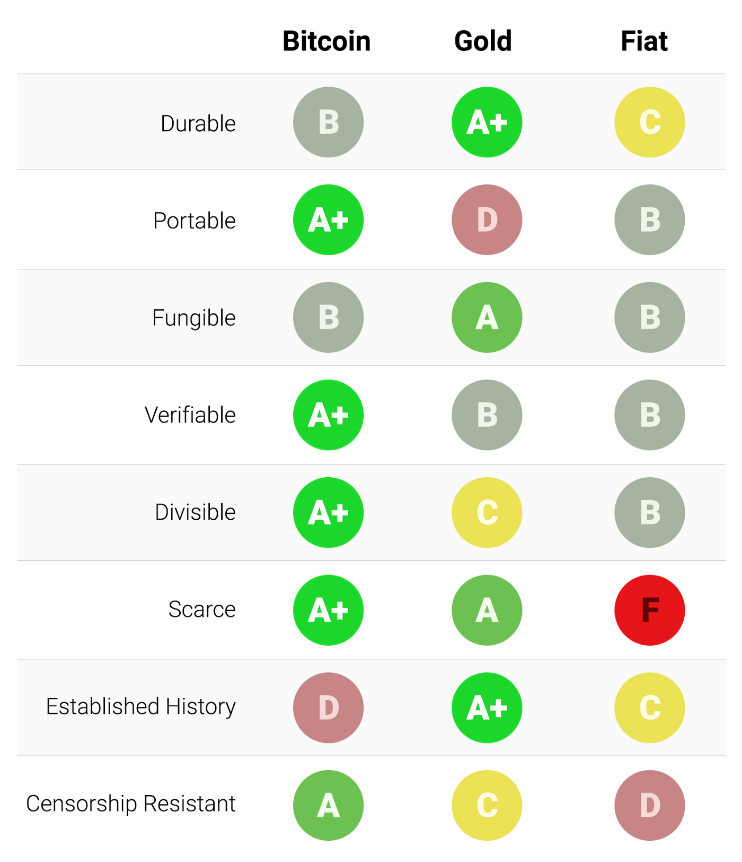
(table taken from Vijay Boyapati in ‘The bullish case for Bitcoin’)
The stand out score is Fiat money’s scarcity – F! It is not at all scarce and is created at will by governments around the world.
As well as excelling at the various attributes of ‘good’ money, Bitcoin also solved the Byzantium General’s problem – how to transfer value between two parties without an intermediary. Solving this allowed Bitcoin users the ability to transact peer to peer without requiring trust between them. It also sits at the heart of Bitcoin’s censorship resistance whereby no-one can interfere or interrupt a transaction between two parties.
More than just money
Bitcoin is money to a growing number of people, yet it is also more than just money – as viewed through these various lenses:
- Digital gold – a scarce, high stock to flow asset.
- The world’s first and only immutable digital asset – no other digital asset can realistically claim they are unable to be copied – like a photo or an mp3 for example. Bitcoin is absolutely unique in this sense.
- Payment network – a global network capable of transferring $billions of value daily
- A protocol - the protocol for trust-less value exchange. Just as IPv4 became the standard for data packet transfer across networks in 1983 and continues to power the internet today, bitcoin is becoming the de facto protocol for digital exchange of value. Protocols once in place are notoriously difficult to dislodge.
- Truth machine – An ultra-secure distributed ledger. Once information is committed to it by way of a transaction, it is permanent and unalterable for all of history.
These different perspectives chime differently with different people. Interestingly Bitcoin appeals much more to the younger generation. A United Kingdom YouGov poll in 2018 found that “one in eleven (9%) 18 to 24 year olds say they have bought the cryptocurrency, compared to one in a hundred (1%) of those aged 55 and above.”
As a digitally native audience, the idea of a digitally native money resonates. As wealth is passed down through the generations, an increasing amount of it will find its way into Bitcoin.
As an investor, why own Bitcoin?
- Asymmetric risk reward. Ask yourself if Bitcoin were to become the new global monetary standard, what market capitalisation would be appropriate? Gold has a total capitalisation of c. $8trillion at current prices. If Bitcoin were to match this, divide $8trillion by the 21 million bitcoin fixed supply and you have a price per bitcoin of $380k – 54 times higher than the current c. $7k Bitcoin price. Many would argue that this is conservative with Bitcoin eventually equalling all global monetary bases which again would be many magnitudes higher. On an expected value calculation – you should invest in Bitcoin if you assign a higher than 1.85% probability of Bitcoin reaching golds market cap. If you are wrong, you may lose 100%, if you are right, you stand to make 5,400%.
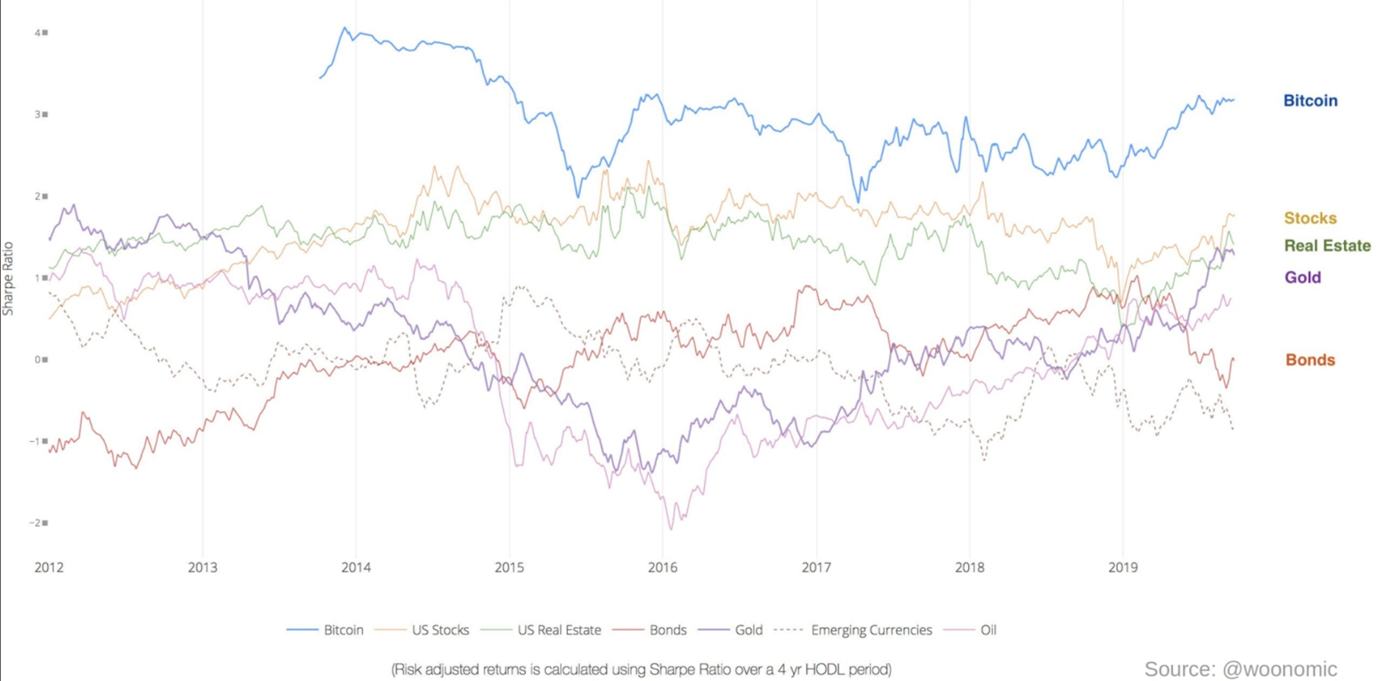
- Sharpe ratio. The Sharpe ratio is a common metric used in investing to denote the risk-adjusted return of an asset. Bitcoin has a higher ratio which means that you are getting higher returns compared to other assets for the risk taken. If this continues to be the case, there’s a strong argument for an allocation to Bitcoin in your portfolio.
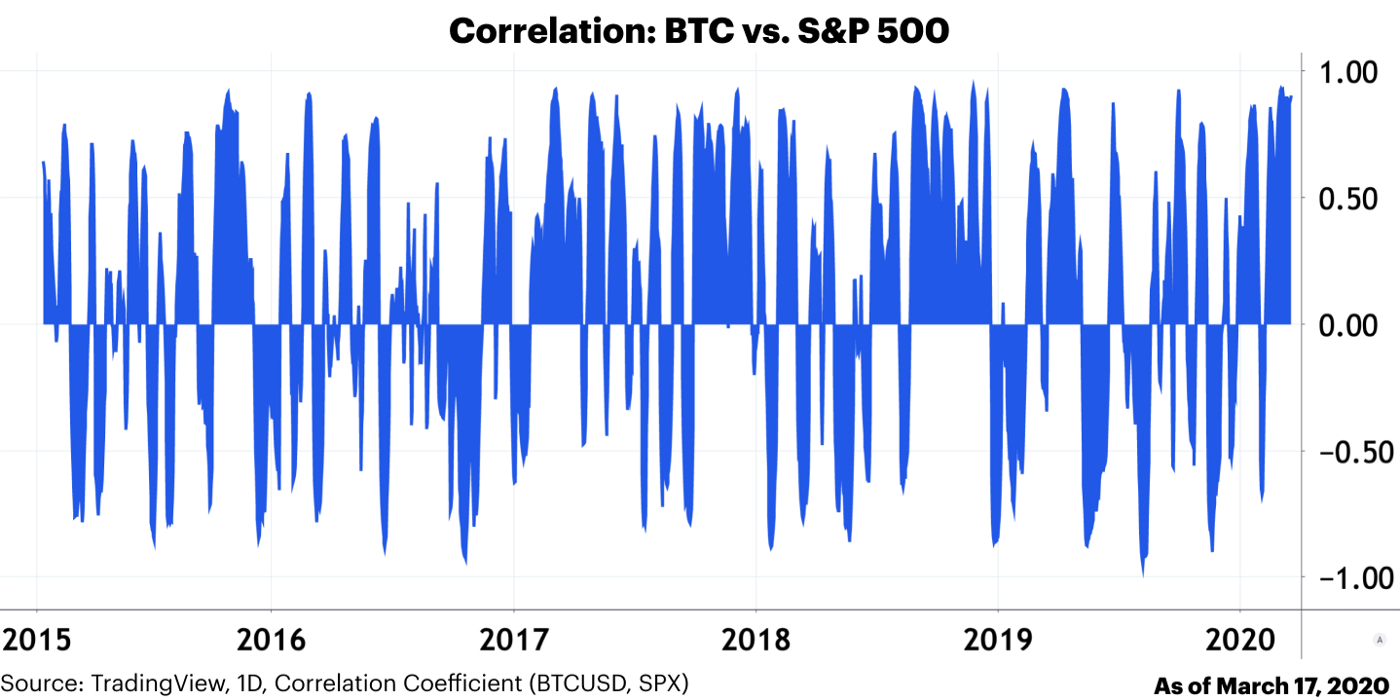
- Non correlation. Bitcoin is generally uncorrelated to stock markets. The below chart shows that Bitcoin has historical low correlation to the S&P 500. (1 is correlated and -1 is oppositely correlated). From a portfolio allocation perspective, a prudent investor wants to own uncorrelated assets. If Bitcoin continues to be uncorrelated, then owning some as part of a larger portfolio is entirely sensible.
- Inflation Hedge. As a finite and scarce asset Bitcoin can be viewed as an inflation hedge similarly to Gold or other finite assets such as land. With the unprecedented actions governments and central banks around the world are currently taking, there is a growing possibility of inflation or even uncontrollable inflation in the future. Owning Bitcoin may be an insurance policy against this. It is also a hedge against negative interest rates which in previous decades were considered fantasy but are now closer to reality - with interest rates now sitting at next to zero.
- Ownership in a new financial system. Bitcoin is a standalone and separate financial system. Global massive investment into ‘on and off ramps’ from fiat currency have been built in the last 2 years allowing greater funds to flow into and out of the Bitcoin network. If Bitcoin’s success continues however, it’s not hard to imagine at some point in the future a world in which Bitcoin becomes a standard denominator of exchange and from a Bitcoin user’s perspective, there being no requirement to interact with fiat currency whatsoever.
But Bitcoin is bad!
In quickfire fashion I tackle a couple of the common myths and misconceptions around Bitcoin that people may have, particularly if they are new to the space.
- Terrorist money. Bitcoin is pseudo-anonymous, not anonymous. It’s public record of all transactions actually helps law enforcement track bad actors in many cases. Not to mention that bad actors use all forms of technology including mobile telephony, the internet, transportation, pounds and dollars.
- Governments will shut it down. Bitcoin was designed with this in mind. It’s decentralised and open source, running on many thousands of nodes and miners across the globe. As the network grows, the possible forced shut down of any of them becomes increasingly irrelevant. There is no person or organisation in charge. No group or person can be coerced in any way that can stop the Bitcoin network.
- Bitcoin is Myspace, the next coin is Facebook. Bitcoin was not the first digital money but was the first successful one. This supposition makes even less sense if you think of Bitcoin as a protocol rather than a company. Protocols once established are difficult to replace, even when a new improved protocol is available. The Lindy effect states that the longer a technology has existed, the higher the probability it will continue to exist. Bitcoin’s 11 year track record is a hurdle any competing money would need to overcome. Finally, the network effects at this point are huge with recognition and mind share amongst consumers, developers and investors increasing relentlessly. The 11 year growth of the network explains the current high security of the network. Any competing money would need to convince possible users to store value in a less secure money - clearly against a rational economic actor’s best interests.
- It cannot scale. Think of Bitcoin as the base settlement layer of a new financial system. It exhibits properties of security and trust-lessness and it fulfils these properties vigorously. It could be changed at the base layer to enhance another attribute – for example increasing transaction throughput. But in doing so there would be an engineering trade off and some of the prior attributes would be diminished. Ultra-secure and ultra-fast are mutually exclusive. Bitcoin would become a swiss army knife able to do a lot of things but none very well. But actually Bitcoin is scaling. There are improvements being made to enhance throughput at the base layer, but the majority of scaling enhancements will come at the second layer and above – these are protocols and applications built on top of Bitcoin. The lightning network is a brilliant example of this - allowing 1 million payments per second! And although still extremely secure, not as tremendously secure as a base layer transaction.
- Bitcoin mining uses too much energy – Bitcoin miners spend energy in mining on the bitcoin network as it makes economic sense for them to do so. They perform costly ‘proof of work’ and in doing so contribute to Bitcoins security. But compared to what does it use too much energy? Do we compare to the energy used in servicing the existing financial system or gold mining for example – which are both enormous. This misconception neglects the innovative use of bitcoin mining in reducing oil and gas field waste emissions and in enhancing business cases for renewable power generation which, often in remote locations, have difficulty in selling energy produced back to the grid. This is a whole topic worthy of further investigation.
- Volatility makes it worthless – Bitcoin is volatile but in the medium to long term this has been reflected in ever increasing prices. At only $133billion in value it is small compared to other asset classes such as stocks, bonds or foreign exchange which measure in the tens or hundreds of trillions. As Bitcoin grows, expect this volatility to diminish.
Getting Exposure to Bitcoin
Bitcoin is a digital bearer asset and taking self-custody of your own bitcoin at some point is important, however falls outside the scope of this article. At present you can:
- Buy Bitcoin on an exchange. There are many well known exchanges with Coinbase being one of the biggest brands globally and CoinFloor being a popular UK based exchange. Once purchased, your Bitcoin resides on the exchange where you have the option to leave it there on the exchange or take self-custody into your own wallet. The most secure and safest method of owning Bitcoin is to take self-custody by using a hardware or ‘cold wallet’.
- Funds. There are two existing funds: Grayscale Bitcoin Trust based in the United States and Bitcoin Tracker One based in Sweden. Access to these may be possible through a stocks and shares trading account/ISA/SIPP.
- Spreadbetting/Contracts for Difference. Companies like IG markets allow you to take a position on the Bitcoin price, albeit it with a high funding cost - so not ideal for long term holding.
- Bitcoin ATM. It is possible to exchange cash for Bitcoin at one of many Bitcoin ATM’s around the world, although fees can be in the region of 10%+. Note: using a Bitcoin ATM involves taking immediate self-custody of your Bitcoin.
Final thoughts…
Bitcoin has come a long way in 11 years but is just getting started. There is a huge community of people around the world dedicating their lives to Bitcoin. Their numbers grow and they are absolutely committed to the concept of sound money and the societal and economic improvements this will bring. Through exploring this new technology and dedicating many hundreds of hours to understanding the space, I now count myself amongst them.
Feel free to post questions in the comments below and i'll do my best to respond intelligently. I'm also on Twitter @shauniekent
Hopefully this article has provided ideas for further investigation on your own part, satisfying any burgeoning curiosity. Below is a handful of places you may like to start for further research.
- Raoul Pal (Real Vision) and Dan Tapiero (DTAP Capital) discuss Bitcoin from a macro and institutional investors perspective
- Vijay Boyapati outlines ‘The bullish case for Bitcoin’ in early 2018
- Jameson Lopp with a number of links to Bitcoin investment thesis’s and approaches to valuation
- ‘Bitcoin for beginners’ YouTube playlist from Anton Antonopoulos – one of the space’s foremost thinkers
- Bitcoin Wiki page
- And finally, one of the best known Bitcoin related podcasts, Peter recently recorded a season of interviews aimed at newcomers to Bitcoin. Start with the first 2 episodes and you’ll be gripped
Disclaimer
This is not financial advice. Our content is intended to be used and must be used for information and education purposes only. Please read our disclaimer and terms and conditions to understand our obligations.
106 comments
@Billfunk1
100% agreed - managed to buy more later this AM. For me, one to hold throughout 2021, taking stock/ re-evaluating around half year.
When looking at the key metrics versus other Miners all show an incredibly undervalued entity notwithstanding the fundamental differences in liquidity / investor mindset between the different markets in which they operate.
Spl183
do you know the volumes traded in the US? I suspect it's pretty thin .. given these were trading on a UK market holiday then is the US OTC book completely removed from the UK book? Ultimately they have to reconcile and volume will drive that reconciliation price point: most of that volume will be UK based by definition (unless and until Argo Blockchain (LON:ARB) is dual listed which does bring cost and complexity in reporting and regulation etc)
Argo Blockchain (LON:ARB) has done a very poor job of marketing itself in the UK so its relatively unknown
Agree with the disconnects between US and UK, 'twas ever so even pre the Robinhood generation: I used to live there and there is a big cultural difference in owning stocks in the US compared to the UK. However, there may also be selling owing to arbign the US OTC prices with the UK LSE price: no way of knowing from the order book where that volume is coming from
It was only 1.84m volume yesterday in the US. Schwab and RH can't get any yet. The OTCQB listing will be a few days, apparently.
We managed to get 950 followers on stocktwits in only a few days starting from nothing. It's hard to market crypto stocks in this country because most people are so cryptophobic. People here still talk about bitcoin like it's 2013.
Billfunk, DS Collard and Spl183.
Perhaps I could have made myself clearer. I consider Argo poor based on its earning potential and underlying fundamentals. The share prices may move with the 'Bitcoin' hype. But I don’t want to second guess where the market takes them. I am assessing underlying fundamentals only. On that basis I'd much rather own Bitcoin itself.
Do any of you have much knowledge of Bitcoin mining? I understand that it is a capital intensive and ruthless industry to be in. The value will accrue to those who can exploit cheap/free or stranded energy assets globally. Miners will 'mine' fewer Bitcoin as the price of Bitcoin rises and competing mining hash power also increases in tandem. On this basis I sketched out likely revenues and found them unappealing.
Ps watch out for part 2 article coming out Friday.
I just buy what the market likes. There's no point forming abstract valuations if 99.9% of the market doesn't adhere to them.
The FED have printed 34% of total M2 money supply in the last year and this needs to find a home. All crypto stocks will rise because the underlying asset is deflationary and will appreciate. So I buy crypto stock.
A quick razor is to total up the PH of the miner and compare it to the MCAP. This gives a snapshot of value. Often there is a good reason why a stock appears to be good value. Momentum is far more important in this market.
I saw the RNS for the OTCQB, given that 57% of the 240m shares in issue are in tight hands ..not sure this will improve liquidity (unless some of those hands loosen up)
Given the SP movement today and the fall-back off intraday highs I'd anticipate a few TR1s over the next few days: over 42m traded today which is about half the free float and the highest volume trading day to date by a long shot in Argo Blockchain (LON:ARB) 's history
Momo stocks that go parabolic often have a few days to weeks of reckoning as they digest the move. Be interesting to see how the price action plays out after today.
.
Odd thing is I couldn't buy even £500 this morning, I suspect, due to limited available float. Will see what happens post US markets opening at 2.30 pm.
It's going to be dominated by London for at least the next few sessions, I fear. But we've done just shy of 30m volume today so I'm hoping most of the dinosaurs have exited with their 2 bags or whatever. People selling now are just lucky morons who have fluked it as far as I'm concerned. Fancy selling with BTC only $27k, further expansion in Feb, a new OTCQB listing this week and yet still undervalued versus US equivilants.
The mind boggles.
I've mentioned blockchain VC investment Kr1 (OFEX:KR1) (on Aquis market) previously. The market is starting to understand the investment potential for the only pure UK listed VC sector play (and it can be held in an ISA and SIPP). See George McDonaugh interview
detailing recent investments.
Interestingly the company is one of the few which have been selected into the "premium" listing on Aquis from January which should increase interested and liquidity. As is confirmed in the recent RNS;
“We are delighted to be one of the first members of the "Apex segment" and look forward to working with Stock Exchange to increase support for the market from both retail and institutional investors”.
The MMs who have agreed to support the initiative include the likes of liberum, Peel, Winterflood, Stifel and Shore for what that's worth!
@shauniekent.
Firstly, may many thanks for your initial, new $BTC post. A great one, with insightful eye-opening concise analysis. Long-overdue in fact too.
But I have to say that I do disagree with your thesis on Argo Blockchain (LON:ARB). By no means an expert, but everything I have read/ digested implies that the Miners will excel as $BTC's price surges. In fact as flagged above by Billfunk1, the initial surge on the German listing, and subsequent 'pop' in the US (currently at $1/ c75p) means that in theory we should see a c 300%+ at opening tomorrow.
@Billfunk1 100% with you on that statement. Plus I also have personally experienced severe fatigue trying to spread my energy too thinly looking at individual stocks on more than one market.
Sadly, volume is extremely thin today on the US OTC market. I was hoping to see bigger orders here but the Americans naturally prefer Marathon and Riot. When this opens in London I would not be at all surprised to see a very harsh correction as all the soft British capital takes profits. After all, they have doubled their money! That's practically the holy grail here. Meanwhile, Riot and Mara have more than ten bagged this year and look set to go much higher. Mara have announced yet further Bitmain purchases which will take them to 10.34EH by EOY 2021.
10.34EH!
The London market is a graveyard for capital.
@Bullfunk1
Thanks for that - yeah ARBKF is the ticker. Also, out of the 8 most well-known miners, $HUT8 and $ARB at present seem to be thought of as the most undervalued. I was able to buy a few of the Canadian miners, as stock, via DeGiro.
I also watch a German known as BILONY who provides really insightful yet brief analysis/ comparisons between the miners. Link to his channel page as follows :
https://www.youtube.com/channel/UCPJvLknI9JEwW_p4m8xaAow
They are also adding 430PH in February taking them up to 1075PH in total, with low debt, and 280ms equihash (about 5% of global ZEC).
If they were on the Nasdaq they would be valued at $1bn already.
In the UK, only a tenth of that. It's a stark lesson to me and I won't be investing in London stock in the future. The 1% FX charge is a small price to pay for entry into a market with proper aggressive speculative capital and liquidity. And I don't have to explain what bitcoin is to every other person whilst they yawn and roll their eyes.
It's a graveyard over here.
100% agreed !
When I started, I naively only invested in UK stocks (direct). But my eyes have properly opened this year, getting much closer to the US markets as I've embarked on (trying to) learn and understand US equity Options. Think US markets represents c 45% of global markets vs UK at like 2.5-3%. Says it all really in terms of liquidity / opportunities. The frequency of parabolic moves in US names never ceases to amaze.
(albeit will keep a close eye out on a few UK recovery stocks earmarked following Brexit deal ..)
Just a heads up that Argo Blockchain (LON:ARB) got a US OTC listing last week. I would expect them to do well in this market even though OTC is clunky and illiquid.
I hope the strategy is to beef up the MCAP before listing properly on the Nasdaq and leveraging heavily in state fiat to purchase many more ASICs.
I'm looking for Argo Blockchain (LON:ARB) to five bag in fairly short order now. £1.
Re AltCoins, mainly I am long in $BTC, $ETH, $LINK & $DOT with smaller balances in $VET, $XRP, $TZS and few others. TBH, I think they're closely correlated to $ETH which seems to lag $BTC and has yet to make some gaps upwards akin to $BTC.
I got sold on $LINK via quite a bit of research, but wow now there are just so many popping up left, right and centre.
I only hold RavenCoin, XZC (renamed Firo recently) and ETH. I mine the Alt coins and hope that they ride up with Bitcoin.
Thanks @Carey Blunt
Have you looked much into/ invested in the listed miners ? I think that $HIVE mine a lot of $ETH too ...
Spl183
I have looked at a few of the miners a couple of times and never quite pulled the trigger because I can always find less risky tech shares I prefer. The coins I have are enough exposure to the sector for me to have some diversification but without too much volitility risk.
Great article. After studying crypto for several months, I am so excited to be invested in a selection of altcoins as well as Bitcoin.
This is the biggest revolution since the dawn of the internet and it’s happening right now with a bull run that is mirroring 2017.
Personally I see XRP as the most exciting project. With over 6000 coins to choose from, I focus on the top 20. Some might fail but some should provide gains that will surpass the kinds of returns that long term investors have made with tech stocks. My strategy has been to invest money that I can afford to lose, over a period of several months.
The beauty with some of the altcoins such as XRP or XLM is that you don’t need to invest thousands but the rewards could be life changing if held for 3-5 years. What’s even more exciting is that the vast majority of the public haven’t even heard of the altcoins but media traction is growing by the day.
Since a breakout in the price of XRP this week, one of the most popular (and accurate) analysts on YouTube increased his subscribers from 50k to 82k followers in less than 3 weeks. Check out Blockchain Backer for proof.
I'm sorry but it lookslike yo have learnt a lesson on altcoins early in this Bitcoin bullmarket. XRP is to many an outright scam and certainly the SEC action currently will likely lea to it being delisted from all US exchanges.
Altcoins are a way for you to lose Bitcoin. See https://deadcoins.com/ for the HUGE number of coins that ave tried and failed. Good luck picking the handful (if any) that survive of the current several thousand.
When you full yunderstand what Bitcoin is, and its value proposition, you will likely see alt coins as *mostly* a waste of time.
Argo Blockchain (LON:ARB) remains a fairly undervalued proxy for trading BTC in the UK ( and will be even more so when the retail ban on trading cryptos kicks in at year end)
Argo Blockchain (LON:ARB) literally makes money by mining cryptocurrencies using specialized hardware in data centers., In its November update it held 178 BTCs in treasury which is around $4.2m in cash at current prices
Aside from their hardware and assets (which suffer rapid depreciation as mining difficulty accelerates as a function of price) , Argo Blockchain (LON:ARB) have the IP and business process to make money from cryptos: analogous to the gold rush of the wild west, there is often more money in picks and shovels than in wild prospecting. They have also sourced cheap power and developed innovative data center and managed service agreements to reduce hosting and capital costs
BTC and cryptos will likely remain maligned by many investors for some time: these are similar to the psychographics of advanced technology adoption (Moore's Chasm Crossing model: much of the above Black Hatting above is classic Late Majority/Laggard speak ).
A salient reminder on why gold and BTC have been outperforming so much in 2020 comes from today's BoE QE set against the past 10 years ....
Thanks for that dscollard,
V useful. Yes I have made a handsome return from Argo Blockchain (LON:ARB) since buying a few months ago. I actively trade US Equity Options via TastyWorks and closely follow the US Markets/ subscribe to a US Options / Stocks Charting Set Up Slack Group. $RIOT/ $MARA and all related blockchain stocks are seeing parabolic surges, following $BTC's recent surge, which effectively is buy in from institutions / hedge funds who are starting to buy at volume. Getting more and more time on CNBC which I have on in background most days. $HIVE a Canadian one, also where Argo Blockchain (LON:ARB) utilise Canada's cheap hydro-power for large mining operations.
In addition, via DeGiro I am able to invest in the European ones, eg Bitcoin Group SE, Blockchain GP as well as recently discovering that open-ended BTC Warrants are available to trade on there too.
Also, use Binance but their app is highly technical (for me anyway) and not so easy to navigate all functionality.
.... I am now at a point where, ahead of the crypto derivatives ban in UK, sticking some ISA cash on a $BTC Spreadbet (at like 20p a point) with no stops and just letting it run ... Who knows, could be a daft punt. Or a ballsy move, with sufficient buffer to accommodate the choppy pullbacks. But if most of the so called 'experts' out there. Given that we are permitted to keep existing positions open.
I think the spreadbet idea is a great one.
'm not really interested in second guessing MR Markets appetitie for frankly, unintersting Bitcoin mingin stocks - from a revenue perspective. Their revenues will likely fall as the BTC price rises and competing mining hashpower comes online. Own Bitcoin instead for more favourabel outcomes if you can. ELSE, own Microstrategy - they hold 70,470 bitcoin bought at average price $15,964. They are effectively as close as we have to a Bitcoin ETF.
I ran the numbers on Argo Blockchain and i thin they are a poor investment. Even if the Bitcoin price goes to $200k in 2021, they will make limited revenues from mining as the hash rate rises. Their smallish holding of Bitcoin wouldnt move the needle either when compared to their market cap.
There is much better reward simply by buying Bitcoin itself, wihout any of the operational/AIM market risk.
Nonsense Shaunie. Argo are already up 140% in Germany today. US hasn't even opened yet. They price these crypto companies differently over there. Just look at $MARA ($675m MCAP for 180PH rising to 3.56EH in Aug) and $RIOT ($880 MCAP for 550PH rising to 2.8EH in Oct).
If you get a Nasdaq listing the Americans are very happy to stick a forward PE of 100+ on these companies now.
Your comment exemplifies why I won't be touching the UK market with a barge pole from now on. Argo are (for at least another hour or so) the most undervalued miner in whole world. yet poor value for the UK market.
The timing of your comment was a bit unfortunate , Argo Blockchain (LON:ARB) opened +100% today and at 35p is x8 the low of March '20.
It closed in the US at 75 cents so should be 55 pence here. In reality it is getting slaughtered and currently on a massive discount! £1 a share would put it £293m and it would still be reasonable value versus Mara and Riot. Yet Brits take profit at 30 odd pence. This is why London cannot be trusted to have nice things.
And the problem is now if London do cock this up all the US capital will be put off buying.
Why would an American ever want to bid this up to anything approaching a good valuation when the Brits just come in the next morning and sell it all?
As I say it's weak versus strong capital and it's why I won't be investing in the UK after Argo.
Bill you have a strange view of money markets. You speak as though it is only people in the UK who buy UK assets. Money has always flowed freely throughout history and when governments have tried to control it, that has generally caused war and disaster (or at least been a strong sign it was coming). We are blessed to be living in the free market west.
Various shares are under and over valued routinely by different markets every day, sometimes for months or years on end. The fact that something is expensive in one market doesn’t mean it should be expensive in another. Do you think big investors in the US using Bloomberg terminals are unaware of Argo (LON:ARGO)? No, of course not. However they are willing to buy US miners because they think retail buyers are coming or might be sparked. They aren’t so sure the same rules apply in the UK.
If you think Argo (LON:ARGO) represents a good return on your capital, buy it. If it stays cheap, thank your lucky stars and buy more. Don’t get annoyed at ‘silly’ UK investors not realizing the golden opportunity in front of them, take advantage of them. Don’t be angry if some want to take profits - there is nothing wrong with that.
Personally, I think the current oversold nature of the UK markets (which has been there since 2016 - Brexit) is set to reverse in a big way in 2021. I’m super bullish on the UK. If you think now is a good time to jump to a market where they have certainly rewarded companies with what seems to me to be frothy prices, be aware you are just adding to the bubble.
Most American PIs will not touch the UK with a barge pole. It's a weak, backward and illiquid market. And it's not me adding to the bubble, it is the FED.
I am putting my money where my mouth and have withdrawn from the UK market with the exception of Argo which will hopefully get a Nasdaq listing in 2021.
60 million volume today in London out of a free float of 213m suggests this won't be held back by London for much longer. I can but hope.
Pirate Chain is the most private and secure crypto. Bitcoin fails on the privacy front I'm afraid.
https://pirate.black/
Bitcoin, while used as a store of value, underperforms Pirate Chain in many aspects. First, Bitcoin uses a public ledger. This allows everyone to see who you transact with, how much you sent/received and when the transaction happened. Pirate Chain removes this information and doesn’t allow anyone to see it. Bitcoin is slow and can take hours to confirm, while Pirate takes a very small fraction of that time. Bitcoin has a large barrier of entry if you try to mine it; Pirate has a low bar of entry and you can even earn some if you tweet about them, help develop the ecosystem and take part in the community!
- Independent assetchain launched on Komodo secured by dPoW
- Private send transactions only. No Public sends make it the largest shielded funds pool of any project using ZK-snarks
- Sapling upgrade implemented and opens the path to lite wallets, mobile wallets and Point of Sale functionality
- TOR network supported
A week ago on this thread weren't you highlighting an association with crime as one of the ways that Bitcoin would collapse, and yet here you are suggesting that a coin that on the face of it looks designed for crime is better than Bitcoin?
Half of Bitcoin detractors say it is "only used for crime" because they don't understand that the blockchain is public, while the other half complain that it is not secure or private enough. Despite the fact that it holds up well on those measures.
It is the original coin and so yes, it does transact slow but that doesn't matter for a store of value and can be fixed. I suspect it will continue to be the grand daddy of coins regardless of the limitations.
I am convinced about bitcoin but is there a way to invest through a uk fund that is available on the open market rather than bitcoin wallets or spread bets
The big one is Greyscale listed in the US. Catch is it trades at a premium to the underlying coins.
Morning All,
So $BTC at hew high, and continues to surge .... $64M question is where abouts is the next resistance level ??!
Have been long in all the well-known Miner's; MARA/RIOT/ARGO/HIVE .... very bullish movements, and at present daily gap ups. But as mentioned above, cannot go on forever ...
Hope you've all made gains from the recent MOMO (rather than suffer form FOMO!)
Safe regards,
Spl183
By definition, there is no resistance when an instrument makes an all-time-high. Resistance is just a proxy for supply or overhang (when previous holders sell). At all time highs there are no previous holders, it's clean air
There are ways to evaluate when a breakout may be losing momentum, parabolic price moves with decreasing volume are often indicative of momo exhaustion
OK, next major pullback is what I meant. A couple sources I have read forecast it at c $30K ...
Bitcoin depends on deflation and debt depression for its future relevance. In a way its like a levered long bond.
If we have high notional growth and/or inflation bitcoin will be very unattractive
Yeah have to say that’s my major problem so far with Bitcoin as an investor, Mojo. Let’s say I agree that Bitcoin is a secure store of wealth at least as attractive as gold. And let’s say I buy into the prevailing narrative that millennials will prefer it because of security, ease of transport and because it’s just generally cooler than alternatives and over the next ten years it attracts more and more of the world’s wealth as a store of wealth. It becomes established in this narrative as an alternative to gold.
Well that’s awesome but I have no interest in holding gold. There’s no return, simply a binary play that I think fiat currency will devalue over time and Bitcoin will be more valuable in comparison. I do hold various gold miners because that’s a leveraged play on the price of gold with two ways to win (price of gold increases/ miner outperforms versus market expectations) - that makes sense to me. I’ve been looking for an alternative investment option on Bitcoin and besides a few prominent tech names that have decided to hold their corporate treasuries in Bitcoin, the options are really thin.
I did come across Mode Global Holdings (LON:MODE) and actually did make a small Bitcoin purchase there last week, more to say I’ve done it than anything else. They are offering a 5% interest on deposits with immediate access, which is attractive. But I don’t hold the keys, they are lending it out in some sort of mezzanine finance for which the details are extremely scant. My capital is at risk and I can’t quantify the risk so for me it’s going to remain an extremely small bet. The company is interesting for investment but I can’t work out how they will make money (they have 30k customers now and say they will have 1m next year once they start marketing - who pays for the marketing??? And what is the damn return? Definitely a wait and watch for me).
Bitcoin is interesting. I love the story and I want it to succeed. But there is a reason I don’t speculate on currency markets - everyone except the quants loses money. With Bitcoin, it may be awesome and it may be nothing. But right now, it is simple speculation. And without a decent way to generate return or at least someone creditable authority willing to guarantee it will still be here in even 20 years, it is neither an investment or a store of wealth - it is simple speculation. That doesn’t mean it won’t work and I have to admit the upside is starting to look big enough that even if you decide there is a small chance of success it may be worth a small bet. Not an investment though because I can’t quantify it.
If nothing else all this tumbleweed goes to prove we are still early adopters here and can look forward to significant growth in the future. I was worried that I had left it too late but this thing obviously still has plenty of time to run. We are at the stage of institutional investment. I wonder where we will be when central banks are interested, if indeed this ever happens.
One thing is for sure, the future for Fiat looks troubled.
So far, the central banks have expressed an interest in their own digital currencies, not bitcoin. It's pretty easy to understand why. They don't control bitcoin. Central banks hoard gold and issue fiat (digital fiat), that's their business model, I doubt it will change.
Hi Bill and Alpha
One of the things that I like about crypto investment at the moment is the lack of mainstream media noise. Maybe its that there is so much else going on in the world with COVID, Brexit, elections etc. It's an indication that we are no-where near the top. The crypto 'media' on the other hand is full of stories of increasing institutional investment. As per my post below, I would thoroughly recommend a listen to the recent Pomp podcast with Raoul Paul.
Regarding CBDCs, yes these are likely, with China and Russia leading the way. IMHO these are more of a threat to banks than to crypto. Banks are financial intermediaries, CBDCs potentially act as dis-intermediaries. CBDCs do not necessarily slow down monetary growth and maybe speed it up? Hence does this increase the case for cryptos in which the supply is more fixed? The attached shows the scale of the money printing that has occurred this year. It really is mind-blowing...
Having said all of that, I agree that central bank / government regulation is one of the key risks to bitcoin. Again Raoul Paul discuses this in the podcast. With the institutions coming in now, I think the probability of significantly negative regulation is diminishing. However every day, I do look at myself and say "you could be wrong". Its really important to try to stay balanced and be alert to the bearish case.
I don't actually see crypto as being a replacement to the dollar, I am bullish, but not that bullish! I view it as becoming increasingly used as a store of value, alongside, but not replacing gold and other assets. Due to the relatively fixed supply of bitcoin, then with modest increases in demand, it does seems possible to see some exponential price growth in the medium term.
Thanks
MT
Hi MattT,
Raoul Paul pointed out that trading BitCoin reminds him of the 1980s equity trading before High Frequency Algorithms got involved. In other words it represents a pool of money to harvest through via market manipulation tricks and simple better training and knowledge.
BTC has a lot of facets to it, and people can see what they want to see. It appeals to the disaffected anarchists because of its supposedly subversive nature. It appeals to the young as the iPhone version of gold. And it hugely appeals to the traders out there.
I think it is a trial balloon to test acceptance and training wheels for FedCoin, and the rug will sooner or later be pulled out from under it. The governments relentlessly crack down on currency counterfeiters when they use paper. Why are they tolerating the competition in BTC, unless it has some degree of official backing?
You saw how swiftly the USG told Facebook to back off the Libra idea. Why is Libra verboten and BTC legal? My answer is that Libra would have been very popular with the Facebook crowd and provided significant competition for a future FedCoin. It would have been hard to ban Libra once it was in wide use by tens of millions around the world. But any problem banning BTC? Easy to do via tax rates (already in place), association with crime and volatility. BTC can be banned tomorrow by recognizing it as an "unregulated security".
AlphaFlight - the question of whether Bitcoin could be banned has been discussed non stop since 2011. The answer unequivocably is it cannot. Whether due to the fact free speech precedent in the USA (see PGP encryption case) protect it, else the simple fact that it is so decentralised it is imposible to globally coordinate and destroy all nodes.
Yes governments can make life difficult - but in the US for example the policital noises are the opposite - see Cynthia Lummis US Senator and Bitcoin advocate for example. Or the cryptocurrency legislation passed in Wyoming in the last year. Or the permission granted in the US for banks to custody cryptoassets. They are moving to regulate further on and off ramps. You dont regulate what you intend to ban or destroy.
The above is a very US centric view btw - Bitcoin is global. Countries and people within are adopting at varying rates.
Lastly, there is some confusion arund CBDCs.
They are talked about by some as a competitor to Bitcoin - but this belies a lack of understanding of Bitcoin. Bitcoin is first and foremost a store of value, it allows me or anyone elsse to store their labour, time and value in a scarce fixed asset.
CBDCs on the other hand are not only permissioned, but they guarantee to debase and erode your value stored in them. One is sound money, the other is not. Central banks know this and that's why when you watch their presentations on the subject, they repeat the mantra 'means of payment' and completely ignore the first and more important characteristic of money - a store of value. They ignore this either because 1. they do not understand money or 2. They know fiat monies fail miserabley at it.
Bitcoin (BTC) now approaching all-time highs of 2017. At time of writing is bumping up against $18,000 up ~6% today.
Miners all up significantly today
Argo Blockchain (LON:ARB) up 14%
$HIVE up 19%
$RIOT up 33%
BTC has risen too fast and too quickly though, there has got to be a pullback from here?!
It's easy to get excited about Bitcoin but i agree, there is normally a pause and correction after such large run ups. Historically its very often been the case.
If i had to guess, i would say that we see lulls to 16k or so for the next 5 weeks before breakig 20k early next year. Dont't attempt to trade it, the risk of losing your position and missing out on the huge bull run coming is not worth the extra small % you could gain.
Bitcoin up nearly 300% since i wrote this article - to much sneering and dismissal. And the bull run is just getting started.
Yes I think a drop is likely short-term. All the commentators I follow are warning its overbought and to watch for a pullback to the $16k area, or even lower, The 17% drop that we saw a week and a bit ago was short lived, so there is some near-term strength there. One of the things to watch for is lots of profit taking into the end year from Americans. Something to do with timing of their tax-year
I also agree tend to agree with your points around trading. The risk of missing out on a significant up move appears to considerably outweigh the benefits of taking some profits and waiting to re-enter.
On a broader note, one of the best commentators I have found in the field is Raoul Paul. He was recently on the Pomp podcast. It was the most insightful assessment as to what is really happening in the macro-economic environment and how this relates to crypto.
Hi shauniekent
Thanks for you post. I read it some time ago and recently have re-read. I think it is a great summary of the investment case for Bitcoin. It is a whole different world and takes some dedication and commitment to even get a basic understanding. I have been a Stockopedia subscriber since 2015 but have generally not posted, however I thought I would share some of my views on approaches to invest in cryptocurrency
Background
This year, I have got curious about cryptocurrencies and decided that ‘I am going to get this’. I have invested in myself and did the below course at the LSE. Its not really linked to personal financials, but it really enabled me to get a good in depth understanding. I would recommend it; however it was a bit of a commitment when also holding down a full-time job
LSE Course
Investment Case
I will not go back over the above case that you have made, but I would summarise my view as I believe that over the long-term bitcoin could well become the primary global store of value. There are challenges with it being used for payments, but that is irrelevant. It excels at being one of the four functions of money, it does not need to good at all of them. This trend is clearly accelerating with the fiat printing under COVID. As btc is ‘guaranteed’ to be capped at 21m, then its increasingly attractive as a store of value because of this
I like your point around asymmetric risk reward – that captures it well for me. In a way it is an insurance policy. There is a chance it could go to nothing, but the upside on even some conservative assumptions is off the scale
There are all sorts of forecasts out there for long-term prices. Obviously need to take this all with a massive pinch of salt. Nevertheless, here are a couple of interesting ones
Stock to Flow
Winklevoss $500k
It looks like we are entering a new bull market on btc (and eth). It is ‘curious’ that this seems to regularly happen in the 12-18 months after the btc reward halving
Coins
I have been focused on bitcoin and ethereum, but also dabbling with altcoins. This was mainly driven by the miner (see below), but also a bit of ‘learning by doing’ on a small scale. Binance appears to the best exchange for this dabbling, such as staking shown below. Not really got going with the defi stuff yet, but the top appears to have come off that now
Binance launchpad
Investment opportunities
A few additional thoughts on getting bitcoin / crypto exposure
1. Buying direct – I have been ‘DCA’ and ‘hodling’ to use the phrases of the community, via a couple of exchanges. Like Coinbase Pro for its simplicity and low fees. Been gradually moving this across to my own Ledger hardware wallet
2. Mining – I bought a mining rig from these guys. They were great and no complaints about them, but if I had my time again, I would not have done it now. Its generating exposure to altcoins, at a time when the market is piling out of alts and into btc and eth. Ah well you live and learn…
Easycryptohunter
3. Exposure through ISAs – most of my capital is in ISAs, so I have been looking at ways in which can get exposure through them. Btc is obviously is not directly investable through ISAs, and there are a few ETFs as you say. Here are a few other options. Would really appreciate views on this.
Argo Blockchain (LON:ARB)
$HIVE
$RIOT
£MSTR
Companies with Bitcoin
Kr1 (OFEX:KR1)
Coinsilium (OFEX:COIN)
Of the above I currently hold
Argo Blockchain (LON:ARB),
$HIVE
$RIOT
$MSTR
Advantage of $MSTR is that you also get tech company exposure, and technically the charts on all of these looks bullish
Obviously, there is also the dollar (US and CAD) risk on some of these, and if the investment thesis is linked to the dollar is going down, then that is going to offset some of the gains
I might push the button on some Kr1 (OFEX:KR1) but its linked to the alts, so will likely lag those more exposed to btc
Around 25% of my ISA capital is exposed to the above. I am thinking of taking this nearer to around 50% to ride the forthcoming bull market
Thanks
MT
Since writing this article Bitcoin is up c. 90%. Volatility is often a criticism aimed at Bitcoin but when it is more often to the upside this is to be embraced.
Covid and global lockdowns happened, Authorities responded as predicted with unprecedented monetary and fiscal stimulus. All countries are competing one another to debase and ultimately destroy their own currencies. It’s been likened to as a free marketing campaign for Bitcoin.
The next phase of Bitcoin’s rise is underway with corporations adding Bitcoin to their balance sheet. Microstrategy, a billion dollar US listed company recently announced they had added $250m of Bitcoin to their treasury – c. 21,000 bitcoin, sending their share price immediately higher. Their CEO very clearly articulates why in the news release (excerpt below) https://ir.microstrategy.com/news-releases/news-release-details/microstrategy-adopts-bitcoin-primary-treasury-reserve-asset#:~:text=In%20considering%20various%20asset%20classes,Mr.
Mr. Saylor continued, “MicroStrategy spent months deliberating to determine our capital allocation strategy. Our decision to invest in Bitcoin at this time was driven in part by a confluence of macro factors affecting the economic and business landscape that we believe is creating long-term risks for our corporate treasury program ― risks that should be addressed proactively. Those macro factors include, among other things, the economic and public health crisis precipitated by COVID-19, unprecedented government financial stimulus measures including quantitative easing adopted around the world, and global political and economic uncertainty. We believe that, together, these and other factors may well have a significant depreciating effect on the long-term real value of fiat currencies and many other conventional asset types, including many of the assets traditionally held as part of corporate treasury operations.”
In considering various asset classes for potential investment, MicroStrategy observed distinctive properties of Bitcoin that led it to believe investing in the cryptocurrency would provide not only a reasonable hedge against inflation, but also the prospect of earning a higher return than other investments. Mr. Saylor articulated the opinion, “We find the global acceptance, brand recognition, ecosystem vitality, network dominance, architectural resilience, technical utility, and community ethos of Bitcoin to be persuasive evidence of its superiority as an asset class for those seeking a long-term store of value. Bitcoin is digital gold – harder, stronger, faster, and smarter than any money that has preceded it. We expect its value to accrete with advances in technology, expanding adoption, and the network effect that has fueled the rise of so many category killers in the modern era.”
- Bitcoin now up 112% since article written.
- Outperforming every other asset class.
- People will think it's too late, that they have missed out, but this cycle is only just beginning.
- Note that from Jan 2021 no retail customer in UK can access any Bitcoin derivatives or funds - so if you consider putting an allocation in your pension to a Bitcoin fund for example, you need to do it before then as you will not be forced to sell, simply unable to buy.
Following Microstrategy, Square Inc has also taken a $50m position in Bitcoin, placing some of its corporate treasury into Bitcoin. They are listed on NYSE and run by Jack Dorsey. https://squareup.com/us/en/press/2020-bitcoin-investment
Paul Tudor Jones has spoken about how he likes Bitcoin more now than when he first bought it https://www.youtube.com/watch?v=SmH1avX_RVc
If anyone would like any help or guidance with regard to Bitcoin, please reach out.
I'm amazed there has been so little interest here for crypto stock. What are people waiting for?
It being up by 112% proves it's deflationary and no good as a currency.
Enjoy the ride
1. Bitcoin is first and foremost savings technology.
2. Eventually at a much larger capitalisation volatility and growth in purchasing power will be vastly lower. It will serve much better then as a medium of exchange.
3. You seem to be stuck in the predominant narritive and mindset that currency must be inflationary. Most of history this hasn't been the case - but presumably must be the case now and forever onwards?
ponzi scheme masquerading as tech
even if it had any value (which it doesnt) it is impossible to store securely or insure.
*sigh* Did you even read the article or any of the links i shared?
When half the responses i receive to Bitcoin are of this nature, it reminds me just how little many people know on the subject and how early we are.
That's half the market saying it's a dud. Not seen anything in past 5 years that's gonna convince them otherwise. Get out while you can!
I have a bitcoin enthusiast friend who failed to encourage me to buy, just before he lost his entire net worth in Mt Gox. I have continued to be interested in the crypto space but cannot get a satisfactory assurance about the security of it.
Since each bitcoin code is known to my friend it is strange to me how any unlawful attempt to monetize his bitcoin can be done without detection as part of the blockchain.
Also there must be increasing amounts of "lost" bitcoin as codes are destroyed accidentally (think the guy who sent his hard drive to the Cardiff tip), or on purpose.
Although I hear that bitcoin should be the medium of future exchange because of difficulties with the current system I also never find myself (or meet anyone) who, transacting reasonably often, finds any serious cost or difficulty in the major currencies. Minor currencies may be an issue now but as the volumes grow the cost goes down and the convenience goes up. Leaving bitcoin for handling minor, troubled, currencies.
Unlike gold, bitcoin requires electricity, computer and unfettered internet access, and like gold, when things are truly in disarray everybody gets to try and sell their gold/bitcoin at once - so it only has a store of value as long as you don't need it urgently.
Your friend learnt a lesson the hard way, similar to those holding Lebanese pounds recently. If someone else has custody of your money, it is not really yours, not when you get to the sharp end of things.
Your friend kept his Bitcoin on Mount Gox which meant that the exchange held the private keys. When they engaged in fraudulent behaviour, your friend suffered. If he had held the private keys, no-one could spend, transact or restrict his use of his money.
Today the 'not your keys, not your coin' risk still exists - however since those wild west early days exchanges are much safer as the whole industry has grown up a little with exchanges now operating as multi billion dollar companies. Having said that, people should learn to take custody of their own Bitcoin.
Before trading long on bitcoin i'd encourage anyone to research Tether.
The whole industry seems built on fraud/dubious exchanges with dubious claims to reserves that may or most likely may not exist. There is just too much risk in this blowing it all up and seeing a 80% decline IMO.
Whilst one can argue the pound and other currencies can see such value declines, at least the fiat currency is backed by government (in the long term, maybe not til the end of time! but then we'll have quantum computers and bitcoin will not and cannot exist in its current form then anyway)
Bitcoin cannot be used as a transactional medium. Once we get bigger adoption fees are likely to trend higher into $00s per transaction making this impossible to buy your loaf of bread or pint of milk. It could only ever be a store of some value , held on a Chinese computer somewhere as a series of numbers. (or written down in your safe)
Topturkey - i advocate owning Bitcoin - nothing else and certainly not tether. Most of Tethers volume is or was going through one API !! Horrendous centralisation and coiunterparty risk that i would never advocate using. This illustrates an important point that to the uninformed, all 'crypto currencies' appear similar perhaps. None have anywhere close to the 'settlement assuarances' that Bitcoin has.
You raise a couple of questions which are often wisely posed by newcomers to the space.
Quantum computers - if they ever arrive, pose little threat to Bitcoin (i won't delve into why not as i'm trying to not get too deep into the weeds on my replies to avoid boring or scaring off the majority, but you can explore the idea with a quick google)
Transaction fees - you'd be surprised im sure to understand that transaction fees have been declining over Bitcoins 11 year history. Nevertheless, if we measure them in Venezualan bolivars they have risen tremendously, The honest way to track fees is in Bitcoin, rather than an arbritry currency against which it's value is increasing.
The most interesting thing that's happened in cryptos recently is the Chinese launching their national digital currency:
https://www.theguardian.com/wo...
They started trialling this the same week the US government started mailing out stimulus checks, some of them to dead people. If you wanted a metaphor for our times ...
For a glimpse of how central banks view the future of cryptocurrencies this Forbes article provides a taste - although the linked ECB paper is the meat of it:
Essentially, central banks want the near-instant transfer powers of digital wallets, but none of the technological or ideological preferences within Bitcoin, from decentralized peer decision-making to finite supply.
https://www.forbes.com/sites/r...
More generally the crisis is throwing up a bunch of use cases you'd think were ideal for cryptos as transactional payment solutions but people are resolutely sticking to the existing payment systems.
In California, for instance, the legal cannabis suppliers largely run on cash because federal laws prevent the use of Visa and Mastercard. At the moment that's impractical - the stay home Californians don't have any cash and don't want any. So the enterprising weed suppliers have developed their own payment app that connects directly to peoples' bank accounts to push the money from consumer to supplier.
We saw something similar in Venezuala when their currency became worthless - although there was some crypto adoption for cross border in the main people started using payment apps like Vippo. So even where you'd think there was a strong case for a non-fiat digital currency people tend not to use it. In the end it's an agency problem - people have to have it and people have to want to accept it.
Most likely the future of cryptos will follow the Chinese model - a fiat version of cash (the Chinese app even supports offline person to person payments). It'll probably take a collapse in a major currency to push people over to transacting in Bitcoin, et al. Until then they're likely to remain an interesting sideshow in the greater currency game.
timarr
We live in interesting times indeed. The current monetary response from central banks is like a free marketing campaign for Bitcoin with central bank governors openly stating they can print unlimited money at will. People are starting to wonder how can it be that central banks inflate the money supply printing new currency at will, favouring those closest to the monetary spigot, yet ordinary folk get no such privileges. This contrasts starkly against Bitcoins finite and fixed supply. Bitcoin can never be debased.
Understandably, and like many, you view Bitcoin as a payment mechanism first and foremost. I once questioned this use but came to the realisation that store of value is the most important use case. I want to be able to protect and secure my wealth before I want to be able to spend it in a shop.
I don’t agree with your assertion that Bitcoin is not being used in Venezuela. I’ve read plenty of stories about its use there for transacting but also for saving. If a Venezuelan had saved their wealth in Bitcoin they would have avoided the wealth destruction and misery wrought there. They could have chosen gold, but gold comes with its own inherent drawbacks such as it’s poor divisibility, difficulty to transport and the ease with which authorities can seize. Bitcoin suffers none of these drawbacks.
The number of people owning and using Bitcoin is growing relentlessly year after year for 11 years as demonstrated by increasing address use and increasing price. Volatility will be a constant feature until a price equilibrium is found. I personally believe this to be 10yrs or more into the future.
Briefly on nation state crypto currencies, I think they are somewhere between pointless and dangerous for citizens. Pointless as they show that authorities still don’t understand what Bitcoin is and represents. Dangerous as I imagine the government having even greater -> full visibility of all transactions you make at all times, alarming for a number of reasons.
Despite your concerns and perceived risks, an investor needs to ask themselves what the upside potential is if Bitcoin does actually fulfil its potential. For all but the harshest sceptics I think it makes logical sense to have a small exposure to Bitcoin.
I give a thumbs up because its a well written piece and you have dared to bring the subject back to this forum which I think is well worth doing every now and then to get the wide spectrum of educated opinions that this site represents.
I was aware of and agree with your points but I also agree with the other comment that Bitcoin isn't as fungible as portrayed. There is an argument that money isn't money until you can actually easily spend it and that people are actually spending it. Bitcoin doesn't meet that measure yet but certainly could do in the future. More likely via Alt coins with Bitcoin being the background store of value.
I have previously argued for Crypto on this site so will be interested to see if we get into another good quality debate.
cheers
Carey
I would rate Bitcoin only as D for being fungible. Certainly nowhere near as good a rating as Fiat (as long as by Fiat we are talking about mainstream currency and not that issued by Zimbabwe etc)
Right now, I have every confidence that I can buy anything in the shops in GBP. Furthermore, I am confident that the prices in GBP of the vast majority of goods/services will not be radically different in two months time. So, I am happy to be paid in GBP because I have that confidence.
However, Bitcoin has not established any significant stability as to what it can be exchanged for and attracts many speculators who hold it simply as a bet because they think it will be worth more in the future. So, it is impossible to know how many Bitcoins I will need to buy something in the future. It is just too volatile to be rated highly for being fungible.
The value of a loaf of bread shouldn’t be radically different in three months time to its value now (unless some highly unlikely scarcity has occurred). However, in Bitcoins the value of the loaf of bread could be significantly different. Now, ask yourself this, what has changed its value the bread or the Bitcoin?
Maybe I’m naive or stupid when it comes to Bitcoin. But I cannot see how it can be either as useful as Fiat nor a store of value until it is much more stable. Until that time it’s for the speculators/gamblers and perhaps the criminals.
Graham you bring up Bitcoins volatility and lack of use as a means of exchange in shops yet. I typed a response, but then thought I’d share this article which does a much more thorough response to this question than I can give here ->
https://unchained-capital.com/blog/bitcoin-is-not-too-volatile/
As a rule of thumb though history shows us that people save in ‘good money’ and spend in ‘less good money’. So it makes sense to save in Bitcoin and spend in fiat.
Since I wrote the above article my ‘loaf of bread’ is approximately 35% cheaper.
A little update as almost a month has passed since posting.
- Bitcoin halving has passed, with the new issuance of bitcoin reducing 50% as written in code every 4 years. This 'quantitative hardening' took place as fiat money sees massive and unprecedented quantitative easing. Bitcoin now has a stock to flow ratio similar to gold.
- hedge fund pioneer Paul Tudor Jones discloses Bitcoin position saying it reminds him of Gold in 1970s https://youtu.be/k9VpVf3g9Y0
- YTD Bitcoin is the best performing asset.
I believe we are now in the 3rd epoch of Bitcoin where it's dominant narrative is as a financial asset. Large institutional on ramps have been built the last couple.of years and we are now seeing them enter the market in increasing numbers.
No, a store of value doesn't take priority. It's why people invest their spare cash, money inherently loses value and it is necessary it loses value to encourage people to spend it. The real economy functions because people spend their cash, on food, houses, cars, holidays. If people used bitcoin, a lot of that goes away as I'll be richer doing nothing than I am spending, this won't make a more robust and productive economy, it'll cause mass unemployment and hardship.
Money's big advantage is, it's fungible. People liquidate into cash to buy what they need. No one sensible stores money for a long time, because, basically, it's not a store of value. We left the gold standard for these very reasons.
It all falls down on this premise.
Stated in the article “money is a store of value”.
No it isn’t. It’s a medium of exchange.
Also, Bitcoin suffers the gold standard problem.
Because there’s a limited number of them, why would I spend my coins when they’re worth more in 1 month than they’re worth now? They’re inherently deflationary, causing people to save rather than spend.
I don't think that is true. It is both - but if you had to choose which is the most important, then store of value takes priority.
Something cannot be a medium of exchange if it is not *first* a store of value.
Yes I agree Bitcoin may be inherently deflationary. Yes it incentivises saving and the fiat monetary standard disincentives saving. Some people see this as an advantage and as a basis for a more robust and productive economic system.
FT Alphaville has a _very_ long series of articles on Crypto.
My take:
If you do not trust governments with your 'money' in their fiat currency, and think that a distributed group of server farms / organisations are more trustworthy or If you live in Venezuela or Zimbabwe or really do not like the idea of your govt ever seeing your account,
by all means Bitcoin or equivalent.
The downside to be is that
- as a store of value, its exchange rate changes a lot over time compared to other things
- one risk is with govts, the other is with a network of private individuals, Not convinced it actually reduces risk
- as a medium of exchange, it can only be exchanged for other things in a relatively small number of places
To answer the question:
Money is whatever enough people agree money is.
Bitcoin is just about the stupidest concept to emerge from the digital age. Like gold bullion, it’s only worth £x because people agree it’s worth £x; at least governments buy into the fiction and agree that gold is worth £x, so they hold it in reserve and support the price. Bitcoin isn’t supported by anything other than hype and drug dealers; It’s digital tulip bulb mania. It now takes the energy requirements of a small country to “mine” it. Your comparison with other energy intensive activities is misplaced. With gold, you have something in your hand, even if it is ultimately worthless. But a government will still give you hard cash for it. You can only sell your mined bitcoin to the next fool. When he or she concludes it’s just worthless 1s and 0s, the price will collapse to 0. And the sooner the better.
Most of the remainder of your piece is an analysis of a pyramid scheme supported by the bigger fool hypothesis. And I can’t see how “innovative use of bitcoin reduces oil and gas field waste flow emissions” as you claim.
I have electronic banking. I buy and sell on line using government backed currency. Why do I even need bitcoin?
Hi Snodgrasse, it seems you have already firmly made your mind up and feel passionately so, but I feel like it comes from your heart not your head. Respectfully some of the points you make are the sensationalism I also find in the tabloid press.
You make a good point and I agree money is only worth ‘something’ because a critical mass of other people also believe it functions as money. The value of an item above what’s it’s worth for other reasons is called it’s monetary premium. Gold for example is worth vastly more than what it’s value would be if it were simply used for jewellery. Same also can be argued for land/property. But interestingly money is arguably the most important good in an economy –it is the pricing mechanism that coordinates all else.
This comes back to a point above – that many people have not asked themselves the question – what is money. What was money even before government fiat currency for example?
Tulip bulb mania lasted a year or so in a small geographical area. Out of interest, how many years would Bitcoin have to exist and for there to be a market for it for you to believe it isn't just the same hype?
The thing with technology is that it can't be un-invented. It will be interesting to see how governments deal with their current borrowing for the COVID outbreak. It feels like there has to be some monetary correction somewhere. Maybe crypto is a beneficiary.
Yep Steamships have yet to be uninvented. Ditto typewriters.
Not sure that makes it a good argument for investing in them though.
I'm not getting your point, i'm proposing you invest in the new thing not the old thing.
Those things went on to be replaced by better versions of themselves. Snodgrasse seemed to be saying "why do I need Bitcoin when I have a government backed currency". The answer is because crypto may be a better version of what we have today. Its the same as someone saying, I have a typewriter, why do I need one of these computer thingys. It would have been great to have been an investor in the things that replaced the typewriter and the steam boat.
It follows that it could (and probably will) be a good strategy to look for things that have been invented that may replace the current system of money we have today.
Hi Carey, thanks for your response. I linked an article in my last reply below which explored Bitcoins volatility.
It’s interesting that you bring up alt coins as a way to ‘spend’ crypto currency. I disagree. I do agree that Bitcoin is the bedrock of a new monetary system but layers will be built upon the protocol to solve all manner of monetary needs – such as very high payment throughput, albeit sacrificing some security to do so. Lightning is a prime example of this that is in use but in its infancy.
Alt coins generally do not have value to me, they are not verifiably scarce or decentralised which makes them little better than fiat.
Bitcoin has existed for 11 years, I do not believe it is hype – although I did at first. I was a sceptic.
I believe its inherent properties, its network effects and its rapid adoption (remember it started at just a handful of people on a mailing list) mean that is is here to stay.
Very interesting article, I actually invested into Bitcoin back in 2008 (from memory), it’s a long story but it turned out to be a scam although I managed to get my money out in time and made a small profit. Are there any good articles or books you know at a real ‘dummies’ kind of level? I’d be interested in a small investment once again but would really want to understand it properly this time.
Maybe it was something else - Bitcoin launched in 2009. But as with all investments there are scams referencing Bitcoin to hook people in.
Try the links below - particularly the 'What Bitcoin Did' podcast or watch some talks by Anton Antonopolous. Or for real basic just search you tube for 'Bitcoin for beginners' or something like that.
You are quite right to understand something before investing money.
Many thanks Shauniekent! It was definitely Bitcoin so must’ve been 2009, I know it was in its infancy at the time
When I first saw the title of this piece, for some reason or another, I thought that it would probably be a short piece of low quality, in which some idiot says something like "Buy some bitcoins and make a fortune!" First of all I must apologize for my prejudice. Then I must congratulate you on producing such a well written piece. I am still far from convinced that I should own some bitcoins, but I have to say that you shattered some of my misconceptions! Anyway, I have some questions about bitcoin becoming the new global monetary standard. 1) How likely do you think this is? 2) What are the main obstacles to this coming about? Surely governments would be very resistant to this! 3) Is it the case that, because it is impossible to create new bitcoins, that the existing ones would become very much more valuable, and all other forms of money, would become worth a lot less? This would be a colossal change/disruption to the global financial system!
Thanks for your kind words.
1. I try to avoid giving my wholehearted opinion because i realise how fantastical it sounds. But the more i've learnt and delved into this area the more i am convinced it is inevitable (if Bitcoin does not fail first). History shows us that 'hard' money displaces less hard money and Bitcoin i believe is objectively the hardest money to ever have existed - combining the benefits of gold and the digital dollar/pound but having the downsides of neither. Most people quite rightly are sceptical as i was on first pass.
2. In no particular order the obstacles to Bitcoins continued success are:
- catastrophic bug in code either previously unknown or introduced as part of a protocol update. 11 years is a lot of time to give confidence in the code and any updates go through a painstaking open source review process. And even if this were to occur, i think the Bitcoin protocol would survive, or a fork of it, which would be owned still by existing Bitcoin holders, which would become the 'new' money.
- the world just not caring about Bitcoin. If people are apathetic to this new money and adoption stalls as a small minority. But Bitcoin adoption is a linear up trend and in all honesty the continuous price increases pull people in with motivation of profits. Some of those people stay and learn about the underlying principles and potential future.
- government hostility. You are completely right that Bitcoin fundamentally reduces the power of governments the larger it grows. Bitcoin only has value because it is decentralised and is censorship resistant. I believe it is now too big to be stopped - even if all governments around the world somehow managed to agree and coordinate in doing so. Indeed in the USA there is a precedent in law that states that 'code' is free speech. On that basis many believe it unconstitutional to ban Bitcoin there. I do wonder that if Bitcoin cannot protect it's privacy/pseudonymity then it could be at greater risk of government pressure.
3. Absolutely. Bitcoin is a scarce asset limited to 21 million bitcoins ever to exist - around 18m have already been mined and the remainder are mined between now and c. 2240 on an ever reducing inflation rate. Each Bitcoin is divisible into 100 million Sats. If Bitcoin wasn’t finite in supply, it wouldn’t be worth anything to me and would be no better than existing monies.
I think the implications of this new monetary technology are profound and you can read the opinions from people far cleverer than I on how this plays out. I believe it's not long before the first countries start to realise that owning part of this potential new monetary system is an issue of national importance.
I have listened to the Peter McCormack beginner’s series and would recommend it for covering the history and political motivations behind BitCoin as well as the technology itself and would recommend it even if you don't intend to ever own any.
Pobby mention them in passing but surprised you didn't mention BitCoin miners as a way of being exposed to BitCoin. Was there a reason for this? Disclosure: I hold a small amount of Argo Blockchain (LON:ARB) which is London listed but has most of its operation is in Canada. I’m currently up as I bought it over a year ago but it is very volatile so not for widows or orphans.
Although recovering now, the bitcoin price didn't fare well in the recent market crash when compared to gold. Do you think this was just that the baby was thrown out with the bath water as everyone liquidated what they could?
You also didn't mention Alt coins. Or Sh1t coins as many true BitCoiners like to refer to them. I think it's an area that investors new to the area should be warned about as they may think all coins are the same. But DYOR.
Thanks for writing the article. It's an area I've been looking at for the past year and find fascinating so welcome informed debate on it.
Argo blockchain - I've never really looked and perhaps unfairly dismissed it as uninteresting. I don't want to try and analyse a companies profitability to mine bitcoins based on power costs, impact from forthcoming bitcoin supply halving etc - I think it's too complicated when you can simply own Bitcoin via another route.
March 13th was one of those once in a decade or 2 liquidation events with all markets tumbling including gold, I imagine there were some funds blowing up somewhere and dumping everything at any price. With Bitcoin being still a small asset class it showed again how volatile it can be. I'd encourage people to look past Bitcoins volatility and view medium and long term performance - when I last checked a fortnight or so ago, Bitcoin (or cryptocurrencies) were the best performing asset globally YTD.
I don't mention 'alt' coins as this is a little detailed and will confuse newcomers. To evaluate them you need to understand why a blockchain money such as Bitcoin has value, what attributes it has and how well it fulfils those attributes. When looking critically at almost any other alt-coin you see that they are little more than a gimmick or trading token. History also shows that whilst Bitcoin has grown and cemented its position, being larger in capitalisation as all other alts combined, many of these alts come and go over the years, fading and disappearing after making their founders rich.
KR1 on the UK's AQSE (ex-NEX) market is a (long-term) picks and shovels type play on the blockchain sector (note they are not bitcoin miners as some listed companies are but are Europe's leading digital asset investment company supporting early stage decentralised and open source blockchain projects.)
There's little coverage/interest on-line excepting "Wexboy" who is active on twitter and who is invested - https://wexboy.wordpress.com//...
I know KR1 well. They invest in a number of small 'crypto currency' projects and tokens - often getting allocations in the seed funding stages and then able to sell these on at a much higher price once the token launches to retail.
They do not invest in Bitcoin but they are a 'play' of sorts on Bitcoin because the whole crypto market tends to move together. What Bitcoin does, broadly all others follow.
I personally am sceptical that any of their investments will ever develop into something widely used and adopted, however that wont stop KR1 from making a large profit trading them :-)
57 reads, no thumbs up and one thumbs down :-s ... if you *do* make it to the bottom or found this valuable - let me know!
Central banks have been creating and testing their own cryptos (rather than using existing cryptos such as bitcoin). The only sound money that has ever worked was the PM standard (i.e. gold / silver). If the USD starts to fail then the odds are they will be forced to revert back to the pre-1971 solution (i.e. gold standard) because the proletariat will not trust a new (crypto) currency that governments can monitor and effectively control again.
Aristotle’s definition of money:
Like it or not, bitcoin and other cryptos fail the above criteria.
As for cryptos being unique, this isn’t the case. The code could be forked off, renamed and then “coins” could be mined again from scratch, only this time with a different name. This could be done an infinite number of times.
Cp001, respectfully i disagree with your confident assertions.
Bitcoin fulfills all those properties listed and does so far better than gold. Gold was the monetary standard but had inherent qualities which meant the world departed from the gold standard.
- It was difficult to transport across time and space
- not easily divisible
- costly/difficult to verify
This lead to gold becoming centralised in vaults and banks and governments legislated agasint it. I can't imagine the world reverting back to a system so easily dsimissed and controlled by central authorities.
You put forward a common misconception that Bitcoin is not unique which i do not believe is a true representation of reality. Why do people consider iron pyrite to be 'fools gold' and not real gold? Indeed it may resemble gold but it is not gold.
Bitcoin has forked (been copied) in the past and those forks have faded into insignificance. Bitcoin's proven history, track record, developer resource, community, infrastructure, merchants, full nodes, miners and all the other actors in the Bitcoin ecosystem are not also 'copied across'.
I like gold, silver, and even central bank reserve notes and coins because I can carry them around in my pocket and trade them for things anonymously.
There are many thousands of crypto currencies, Bitcoin is just one of many. Cryptos fail on the intrinsic value front. The media like to show a nice picture of a tangible gold colored coin with, for example, the bitcoin symbol stamped on it when in fact a bitcoin is merely a long alphanumerical code that some people just happen to attribute value to.
As for your "central authorities" argument. Bitcoin's public ledger model doesn't exactly fill me with confidence, gold is still 100% anonymous and can't be tracked and monitored (unlike bitcoin).
Central banks save in gold and issue fiat currency to the unsuspecting proletariat. Moreover Gold is a tier 1 asset in banking terms. I’ll continue to keep a proportion of my portfolio in gold and silver. If we get a fiat currency collapse I’ll guarantee you that gold and silver will be a better hedge than cryptos.
Here is the maths behind bitcoin.
https://www.finitespaces.com/2...
and here is primer on all the things crypto currencies are not:
https://www.finitespaces.com/2...
CP001, money does not have value because of something intrinsic. Take gold - the value of gold does not depend upon people using it as jewellery. just like the value of rai stones didnt depend on the value someone derived from owning a lump of stone. The value is in it's monetary premium- the value people give it based upon it's value to them as money. What makes a good money.. scarce, divisible etc etc etc
I am not knocking Gold,i own Gold and am bullish on it.
The two links you shared, the first is a good basic description of Bitcoins workings. The second i believe is innacurate and i might respond to the article as i quite like the look of the site/blog. Bitcoin is not perfect, i wouldn't pretend so, but that 2nd article isn't quite grasping it.
Gold was the monetary standard but had inherent qualities which meant the world departed from the gold standard.
Nope. The world moved off the gold standard because a country on it couldn't increase its monetary supply without also increasing the amount of gold it held - after all, if the currency can be redeemed for gold, then you need to hold the gold to redeem the currency against, or at least a pre-determined proportion. And the amount of gold in circulation is limited which meant the amount of cash, and credit, was also limited. Which, of course, is the Bitcoin model.
Limiting the money supply is superficially attractive but restricts the ability of governments and central banks to engage in Keynsian style contra-cyclical investing. Critics might argue that it's the flexibility a fiat currency offers that leads to governments devaluing their currencies in the first place. Like most arguments of this ilk there are pros and cons, but the reason the US came off the gold standard originally was to fix the Great Depression: now, realistically, it's no longer possible to artificially limit the money supply without sending the world into an even deeper tailspin.
The impact of restricting money supply is to restrict credit. By releasing currencies from gold supply it's been possible to allow the almost unlimited issuance of credit. Again, that may not be viewed as an unmitigated good but we've gone far beyond the days when whether you could get one of a very limited number of mortgages depended upon who your father played golf with.
Ultimately no government can or will accept a currency that restricts their ability to issue money. Nor will they willingly give up control of their money supply. For Bitcoin to become the world's defacto default central bank currency you would have to see a collapse in the world economy and a wholesale flight to alternative payments.
But if that happens then people are going to want gold under the bed not Bitcoin on a server in China.
timarr
Good point timarr "But if that happens then people are going to want gold under the bed not Bitcoin on a server in China."
In addition to timarr's post, I would also point out that gold (or silver) has no counter party risk. Bitcoin however does in fact have counter party risk and lots of it because it is entirely dependent upon lots of infrastructure (servers, telephone lines, electricity, other people unknown to you, etc) in order to make a simple transaction. As I said gold has intrinsic value, bitcoin does not I'm afraid.
By the way Sprott (SII) invest in blockchain related crypto companies tied in with gold (such as Tradewind and Emergent Technology Holdings). https://www.sprott.com/investment-strategies/digital-gold/
I think that puts the cart before the horse there though Timarr. Countries wanted to debase their currency so they changed the rules. They were *able* to change the rules. Gold had no defence against that.
The money that the market had chosen over a period of millenia was able to be sidestepped by central powers. Bitcoin has inherent qualities that make this very difficult for central powers to do, which means that if citizens increasingly prefer it as money, then they are able to do so.
The power to ‘temporarily’ inflate the money supply was far too attractive for authorities to ever give up, they can continue to promise today and print tomorrow ad infinitum. Do you believe the Keynesian view has been a success? Do you see the world is in nothing short of a perilous race to debasement whilst drowning in debt like I do?
As for mortgages, you can now get a mortgage if your parents and your grandparents combined have enough money to lend you for a deposit in order to be able to borrow more in the form of a mortgage. The world is drowning in debt.
My view doesn’t depend on governments adopting Bitcoin, and you are quite right Bitcoin reduces their power. My view of Bitcoin is that Bitcoin cannot be stopped now – this is another idea that people find difficult to understand. I do believe citizens of every country will continue to adopt Bitcoin one by one and slowly, surely and peacefully its adoption rises.
In terms of societal collapse I think you were hinting at, then gold is of no use. To be macabre, you want to own guns. Whoever owns a gun owns what’s yours - including gold.
shauniekent : “In terms of societal collapse I think you were hinting at, then gold is of no use.”
The MadMax scenario does indeed require guns but the much more likely hyperinflation scenario does not.
Cryptos (if they hold their value) could be very useful for avoiding the inevitable capital controls however (i.e. so you could move your wealth from one jurisdiction into another), but the caveat is that KYC and so on will mean you might not be able to use them.
You do realize that in the Weimar republic of Germany’s hyperinflation period, a single gold coin bought a hotel at the time, gold was king. In 1990 when Brazil had hyperinflation (and at the time 6 different currencies) a gold coin would buy a 200 acre farm in a good area (now worth about £500k). When the proverbial hits the fan for GBP, USD et al, the hard assets that you will want to own will be the same ones that have proved to be resilient in the past. Moreover PMs are hard for governments to expropriate.
P.S. You mentioned mortgages, UK house prices are back to their circa 1990 price if you use gold as a yard stick. No mention of that in the media however:
http://pricedingold.com/uk-house-prices/
"Gold is money everything else is credit": JP MORGAN
Cp001 - i repeat, I like gold :-)
Do you believe the Keynesian view has been a success?
Yes, I do. The world is hugely healthier and wealthier than it was 100 years ago. Even if we were to undergo a significant depression that would still be the case. The downside is greater levels of volatility and the possibility of human error and bias.
But prior to coming off the gold standard recessions and depressions still happened. The US was on the gold standard as it went into the Great Depression. Limiting the money supply to a scarce resource is crazy. Of course, if you're one of the people who own the scarce resource then you don't care. But everyone else does.
timarrKeynesians still believe government intervention during a recession/depression to inject spending into the economy is the correct policy. Austrian macroeconomic theory states that government "fine tuning" through expansions and contractions in the money supply orchestrated by the government are actually the cause of business cycles because of the differing impact of the resulting interest rate changes on different stages in the structure of production. A country cannot become rich by consuming, and therefore, by using up all their resources. Instead production is what enables consumption as a possibility in the first place, since a producer would not be working for nothing, if not for the desire to consume
I guess thats a fundamental disagreement we have then. I believe the rise in prosperity is due to capitalism - free markets specifically.
I believe Keynsian ideas have lead to poorer allocation of scarce resources and i believe the world is less prosperous as a result. I also believe Keynsianism is storing up trouble which when it can be kicked down the road no longer, will eventually be terrible for everyone in society. By then of course it's proponents and enthusiasts will have long since left the building.
I guess thats a fundamental disagreement we have then. I believe the rise in prosperity is due to capitalism - free markets specifically.
"Capitalism" or "free markets" alone aren't an explanation for anything - you have to look at the underlying drivers, things like property rights, technological advancement, access to pools of capital and improved transportation systems. When the right things come together you get economic growth. However, the way that growth is distributed is a function of the money supply - poorer people can't get access to credit if the rich control how much money there is and who has access to it.
Essentially the gold standard - and any approach that artificially limits the money supply in a world where economic improvements are constantly increasing our stock of capital - are a way of denying the benefits of capitalism to the masses. Simultaneously it reduces the amount of capital available to invest and retricts economic growth.
The price of that is greater volatility - but the fact is that even if we enter a prolonged economic depression the stuff we've build and invented on the back of an expanded money supply - everything from mass transportation systems to the internet and from Google to the iPhone - will still exist and when we reboot it will be from a far higher base than even a decade ago.
None of which has much to do with Keynesianism which, at root, is the uncontroversial idea that contracyclical government spending can reduce the depth and length of economic downturns. Of course, Keynes also said that you should turn the spending taps off when growth returns. If either the US - who didn't stop spending - or the UK - who never started - had actually followed what he suggested we wouldn't be in quite such an economic mess now.
timarr
The current situation is precisely one where the richest have most availability of cheap credit whereas the poorest do not. This is the cantillon effect. Growth should not be distributed by the money supply which is decided by an unelected small group, it should be distributed to those that do the work, those that create businesses – those that do the ‘growing’ by a process called the free market.
The enormous debt burden Keynesianism has encouraged is stifling growth and productivity. Inflation will see to this, but again those with ‘assets’, ie the rich, will benefit and be protected most.
A radical idea is to let the free markets set the interest rates with economic actors in that economy adjusting readily to market realities, rather than artificial prices causing mal-investment and unchecked over exuberance. This arguably would remove such booms and busts– a direct creation of attempted intervention in markets by those ‘experts’ at central banks.
But all this is beyond the modest scope of my article but I ask rational investors whether
- given the historical performance of Bitcoin,
- disregarding one’s own subjective view of Bitcoin and the new financial system it proposes
if the asset deserves an allocation within an investment portfolio?
I argue that you can believe Bitcoin is ‘probably rat poison squared’ (as per Warren Buffet) and still logically and rationally assign a small portfolio allocation. I believe that the evidence shows that to not do so, is illogical.
The enormous debt burden Keynesianism has encouraged is stifling growth and productivity. Inflation will see to this, but again those with ‘assets’, ie the rich, will benefit and be protected most.
You can keep on saying that and I can keep on pointing out that it's nothing to do with Keynesianism, which merely says that governments should spend during downturns to minimise their duration and depth. It's politicians that drive policies and stuff like the Cantillion effect, not economists. There ain't no way they'll give up that control willingly.
Anyway, central banks are already pushing out into the new world. Central Bank Digital Currencies (CBDC's) are the new thing. The BoE has just published a discussion paper on the topic, the webinar is well worth a listen.
timarr
Timarr – those damn politicians doing what all politicians throughout history have always done. It sounds like you almost might be in favour of a currency that can’t be debased at will by those in authority ;-)
Thanks for pointing out the webinar, I did watch it and I’ll be honest, their CBDC is a solution in search of a problem - they themselves weren’t even sure what they were going to use one for. It was interesting to note that they do not understand, or more likely omitted the primary use case for Bitcoin from their presentation.
Thanks for pointing out the webinar, I did watch it and I’ll be honest, their CBDC is a solution in search of a problem - they themselves weren’t even sure what they were going to use one for. It was interesting to note that they do not understand, or more likely omitted the primary use case for Bitcoin from their presentation.
It's clearly a response to Libra. If you dig into it there is some possible value here -the ability to directly fund consumers and businesses without going through the existing banking system for instance. The BoE could also intervene to sponsor initiatives that were deemed societally important for monetary stability but which simply don't fit with the existing banks' commercial objectives - there are lots of good ideas around about supporting financial inclusion for instance, but almost no way of making them happen.
But the main point here is that the BoE - and Central Banks generally - won't allow a private currency, crypto or otherwise - to disrupt their main function of financial stability.
On the other hand, given that there seems to be a willingness to print as much money as deemed necessary while simultaneously charging people to store it for them you'd imagine a lot of scarce assets will get pumped up. The insane stockmarket rise is the most startling example of that but I can't see why that won't spill over into other assets including cryptos.
Personally, being old fashioned, I prefer my assets tied to real earnings but that is so very last century ....
timar
I think the last ten years if not more has been an exercise where looser and looser monetary policy inflates the prices of scarce assets. I'm with you on the stock market, I do not believe it reflects economic reality, but the rise in prices lately makes sense if you adjust the denominator for the huge increase in money injected into the system. You could also use gold as the denominator.
I also agree that authorities will not be happy about the challenge to their power from a private currency.
And believe you me, if I thought they *could* stop it, I would assign little value to Bitcoin. But they cannot.
The reasons Bitcoin cannot be stopped are numerous and are a separate article alone.... but a quick google can find interesting discussions on the subject.