A set of potential BPR / Inheritance Tax portfolio screening rules

Introduction
I've been looking at, "Business Relief for Inheritance Tax", also known on most web sites as "Business Property Relief" (BPR). In case you didn't know, after two years BPR gives you 100% Inheritance Tax (IHT) relief for shares in an unlisted company, which includes many AIM companies. I want to identify a few simple screening rules for finding BPR shares, which when added to one my existing favourite screens would provide a quick shortlist for a BPR portfolio.
After several minutes of extensive research I've found several web sites that discuss this topic. A lot fell short of my expectations merely stating that is was very difficult to build a BPR portfolio, and that you should subscribe to their discretionary portfolio management service. No thanks.
Some of the more useful research finds
The HMRC page includes the following rules:
- You can get 100% Business Relief on shares in an unlisted company
- You can only get relief if the deceased owned the business or asset for at least 2 years before they died.
- You can’t claim Business Relief if the company:
- mainly deals with securities, stocks or shares, land or buildings, or in making or holding investments
- is a not-for-profit organisation
- is being sold, unless the sale is to a company that will carry on the business and the estate will be paid mainly in shares of that company
- is being wound up, unless this is part of a process to allow the business of the company to carry on
This PDF (possibly out of date now) adds more light. The forth page includes some examples of legitimate exceptions to some of the rules, for example dual listed companies can qualify for BPR if the second listing is a foreign equivalent to AIM such as the Emerging Securities Market (‘ESM’) of the Irish Stock Exchange. The document also discusses property holdings (as do a number of other sites), rules for companies "for sale" or being wound up, and other useful points.
This site has more depth on some of the complexities:
- On when an activity includes both investments & services:
"Thus, for example, BPR has generally been denied for property letting activities, even where the landlord provided some services (Martin and another (executors of Moore deceased) v CIR [1995] STC (SCD) 5 and Burkinyoung v CIR [1995] STC (SCD) 29). More recently, BPR was refused on a furnished holiday letting business (HMRC v Mrs N V Pawson’s Personal Representative [2013] UKUT 050). The Upper Tribunal held that the few services provided by Mrs Pawson and others were ‘unlikely to be material’ and insufficient to prevent the business being mainly one of property investment. On the other hand, property development businesses are eligible for BPR as per DWC Piercy’s Executors v HMRC [2008] SpC 687."
- Also, on cash balances:
"In the wake of the recent economic conditions, many companies have prudently retained increased cash balances to act as a buffer against any future downturn in their trade. Many would argue that these amounts should be considered as being legitimately held for business purposes. However, somewhat surprisingly, HMRC recently confirmed that, unless there is evidence showing that the cash is being held for an identifiable future purpose, it is likely to be treated as an excepted asset for BPR purposes. HMRC stated that holding a ‘surplus’ cash buffer to ‘weather economic difficulties is not sufficient reason’ to prevent the funds being treated as an excepted asset (see ICAEW tax faculty tax guide 1/14)."
And here is another site with a comment on cash balances:
"...using an unquoted trading company as a ‘money box’ for surplus cash (i.e. cash not required for present or future trade use) is unlikely to shelter those funds from IHT, as cash which is an excepted asset will generally restrict BPR on the shares. HMRC does not consider that holding surplus cash on deposit constitutes an investment business activity (see HMRC’s Shares and Assets Valuation manual at SVM111220)."
Screening rules
To avoid complications, I'm not going to worry about the exceptions where companies still qualify for BPR although they fail one of these rules (such as a dual listing on the Irish ESM) as it makes it too complicated. I'd like to exclude at the individual industry level (see the full list of classifications) but for screening purposes I can only screen at the industry group level (the Stockopedia listings of industry groups are here). This might mean I'm screening out more than I need, but this is a compromise I've decided to accept.
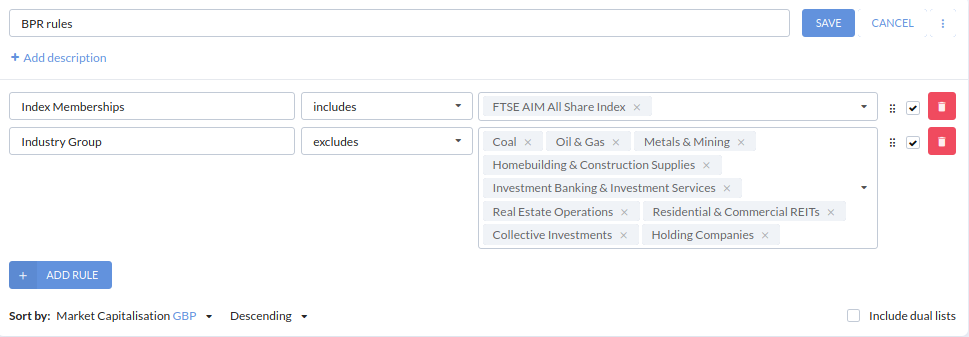
Based on the above I'm adding the following rules to my prototype BPR screen.
- Indices includes FTSE AIM All Share Index
- The "include dual listings" checkbox is not ticked
- Industry group excludes:
- Coal
- Oil & Gas
- Metals & Mining
- Homebuilding & Construction Supplies
- Investment Banking & Investment Services
- Real Estate Operations
- Residential & Commercial REITs
- Collective Investments
- Holding Companies
It seems too simple, so what have I done wrong? What have I missed? What could I do better?
As mentioned these rules are for potentially BPR qualifying stocks, so need further rules to add other investment selection criteria (or use it as it stands but as a checklist). Also I'd not hit the buy button on any stocks found without manually checking for the required BPR qualities. I intend to over-provision the potentially BPR shares in my mother's portfolio vs. what is actually needed, so that I've room for the odd mistake or change in the BPR status of any individual holdings. Finally, everything could change on 11th March (or any any time for that matter). As ever DYOR. Usual disclaimers apply.
Thanks - Lion Tamer.
Disclaimer
This is not financial advice. Our content is intended to be used and must be used for information and education purposes only. Please read our disclaimer and terms and conditions to understand our obligations.
3 comments
And thank you for your homework which is v interesting
My suspicion is that the biggest 2 risks are over inflated prices of qualifying AIM firms and the government changing the rules away from AIM stocks qualifying in which case any portfolio would take a double hit.
My own portfolio has plenty of AIM so I've stayed well away from recommending BPR stocks for my parents.
Good luck though.
I have yet to find any comment online from anybody who has actually set up one of these portfolios for an elderly relative and then been through the process with HMRC as executor.