A soldier in a hedge-a Covid Risk Management experience

I have reported here on Stockopedia my 2018(5%) and 2019(20%) portfolio performance in posts as a means, as I indicated in my first article, to encourage others to ‘soldier on’. Paul Marshall, the successful hedge fund manager, in his excellent recent book, 10 and a Half Lessons from Experience(ISBN 9781788166232) describes US Army David Hackworths keys to being a good soldier as similar to those of being a good investor:
‘Insight, receptivity and risk management. It takes insight to formulate a battle plan or thesis, receptivity to change the battle plan as the facts and circumstances change and risk management to avoid large losses and/or commit your resources to the most vital part of the battle-proper risk management is how you become an old soldier’
The last six weeks or so will find many investors feeling beaten up, so I contribute below my campaign notes and, while you might feel downbeat now, I have a few thoughts on how to win in the aftermath.
As I described in my 2019 review Hurricane Energy was my biggest holding and at the turn of the year I was convinced that the oil companies were exceptional value. I was only peripherally conscious of the news of virus that was wreaking havoc in China but it was gaining my attention and I was sufficiently interested by 22nd January, reviewing my Amazon account purchases, to order a stock of face masks for my family and, much to the amusement of fellow passengers and crew, to sanitise the seat on the aircraft taking me to Dubai for a months February sunshine.
While in Dubai I followed the news carefully. One of the podcasts I listen to, Macrovoices, gradually helped me understand the potential financial implications, initially on the Chinese economy and , as it developed, more widely. Like the mortgage mis selling that led to the 2007 financial crisis, the Covid warning signs were hiding in plain sight. Further research led me to another podcast, Peak Prosperity, which began daily reports on the spread of the virus. I started listening to the periodic WHO press conferences which underlined the authorities complacency. By Friday 14th February I was convinced that the implications were substantial, but the markets were not alive to the dangers. Amongst even my medical friends there was a feeling it was ‘just the flu’.
On Monday 17th February my investment diary shows that I started selling index spread bets and continued over the next 2 weeks with an aim to ‘hedge’ half my portfolio. Although I have had a spread betting account for over a decade I had never used it extensively or as a hedging tool. Essentially, I was prepared to give away any increase in the value of half my portfolio in exchange for similar protection from any fall. I also, a week later on 24th February, started to modestly increase the cash in my usually fully invested portfolio such that it reached 8% cash over the following 3 weeks.
I returned to the UK on 28th February, with fewer quizzical looks at my seat sanitising. My weekly stats below show how my portfolio and hedging performed.
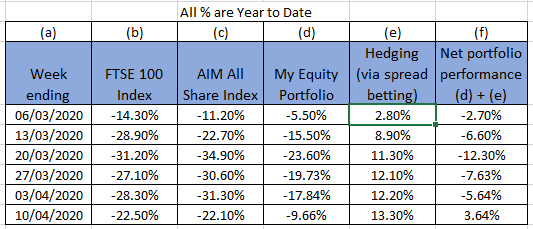
Today my share portfolio is down 9.7% compared to the FTSE 100 which is down 22.5% although I have additionally the proceeds of the hedging which I account for separately. I arrogantly believe that my share selection is based on finding excellent companies with sustainable business models and, as importantly, strong balance sheets. Over the last 3 months the portfolio has outperformed the index by close to 10%, which you may recall was about my outperformance in 2018, another down year on the markets. I will be well satisfied if that margin in maintained through the rest of the calendar year.
Although I tried to protect half of my portfolio, at the peak of the fall I had protected about a third with index selling, the index fell 31% and I was compensated with cash to the value of 11 % of the portfolio in my spread betting account-shown in the table above as ‘hedging’. When the index fell to 5500 I took the hedging off. Today I have 13.3% of my account value in cash(actually in gold, but that’s another story) as well as my share portfolio down 9.7%. I’m thus 3.6% ahead for the year to date and have had turnover of about 10% of the portfolio with only modest selling, and post crash reinvestment.
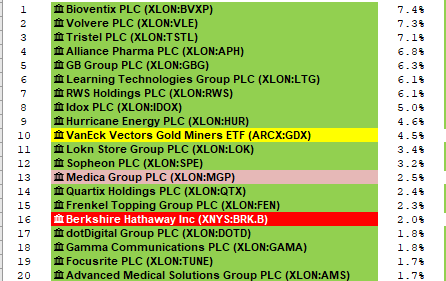
I publish my ‘top 20’ shares in my annual review. They form just over 80% of my 45 strong portfolio and is shown below with 2 new entries since 31st December Frenkel Topping (LON:FEN) has been cheap and I have increased my holding there and Gamma Communications (LON:GAMA) I suspect will be a beneficiary of the ‘work from home’ new reality. Both were holdings outside the top 20 at my last review. I have also made modest purchases of Zytronic (LON:ZYT), Sigmaroc (LON:SRC), Ab Dynamics (LON:ABDP) and £CAMB. All were previously small holdings in the portfolio over the last 5 years which I had sold out of as they became too expensive. They had all fallen more than 50% in a month, thus presenting repurchase opportunities. I have also initiated small new positions in Arcontech (LON:ARC) which looked good value below 120p and Ramsdens Holdings (LON:RFX) where I felt 90p was good value.
So this old soldier feels he has had a good defensive campaign so far. I had a plan based around the recovery in oil prices. That plan went to a ‘ball of chalk’ upon contact with the enemy-the 2020 pandemic. As the reality and circumstances change its sometimes best to protect what you have got, to dig in, rather than risk exposure to unknown forces. Of course if I was really smart I would have hedged the whole portfolio……but I’m not. I’m risk averse and there was a possibility it was indeed ‘just the flu’. I still own 90% of the shares I did on 1st January, although I have done a little bit of opportunistic sales and repurchases. The value of my portfolio and hedges is within a few percent of that date. So what are my thoughts on the past couple of months.
Firstly successful investing is hard, time consuming, brain aching work which means absorbing all the information available in books, blogs, podcasts, meetings, presentations etc. Ninety five percent of what you look at will be interesting but not investible or actionable, most of the remaining 5% will help highlight a fertile spread of investment opportunities. The odd sliver of that 5% will be attractive and actionable for the prepared mind and will make you comfortably wealthy over time.
Secondly, I could not be more optimistic about the medium term future, although there will be gut wrenching jolts along the way. Brutal though it is to disregard the disorderly and uncomfortable present battle, our role as stewards of our own and our families capital is to look for the successes two to five years into the future. The prices of excellent businesses have fallen while opportunities for good companies have expanded. For the last decade we have watched zombie companies survive, despite moribund management, because of benign circumstances and cheap credit. Poor companies will feel the effects of the Covid financial asteroid and change over the next few years will kill off or diminish many of those dinosaurs. There will be space for agile managements and aspiring entrepreneurs, and my intention is to be alive to the opportunities and to benefit from participating in that upswing.
Finally I would commend a helpful mental model that I have found useful, particularly in times of market turmoil. I measure my portfolio as a (microscopic) percentage of the value of all the companies in the All Share Index. A shorthand proxy for that is simply dividing the portfolio value by the FTSE 100. As the FTSE rises and falls that ratio should stay the same... This mental model thus removes the movement of the markets and, in my view, provides a much more reassuring measure of the worth of the portfolio, as a share of the economy, and distances the investor from the periodic irrationality of ‘Mr Market’ and, over time, any long term government debasing of the currency.
Christopher
Disclaimer
This is not financial advice. Our content is intended to be used and must be used for information and education purposes only. Please read our disclaimer and terms and conditions to understand our obligations.
3 comments
I love your dividing the portfolio value by the FTSE100 idea and have added it to my own weekly record. What a great but simple idea, thank you.
Good thoughts. I think mental models that help keep you calm in a crisis, such as the one you describe, are particularly useful. One I use is to not look at monetary figures in my portfolio, just target weighting and actual weighting. It removes the emotion of I made or lost £x.
Coincidently, I take a look at both Zytronic (LON:ZYT) and Enteq Upstream (LON:NTQ) here in my review of Graham Net Nets:
https://youtu.be/L8nZIqaK97g
Which is part 2 of a series I recorded on investing in a crisis. Part 1 looks at the challenges of investing when short term earnings, dividends, buybacks and book value are highly uncertain:
https://youtu.be/c3ld9CF_g6A
if you are still positive on the outlook for oil over the next 2 to 5 years, you might like to take a look at Enteq Upstream (LON:NTQ) the oilfield services technology and equipment supplier
The company is very prudently managed and trades at close to its cash balances. It's business model very much faces the less conventional oil explorers. You might like to start here with the RNS:
https://www.investegate.co.uk/Index.aspx?searchtype=3&words=ntq
I've no position in the shares.
Asagi