A US Large Cap Special - Micron Technology

With over 10,000 stocks to pick from, the US stock market offers investors unrivalled opportunities - ranging from iconic names to exciting start-ups. However, for many investors, investing abroad in markets like the US can still be quite daunting and not without risk.
As a UK based investor, exchange rates and trading costs are a factor worth bearing in mind when venturing across the Atlantic. The exchange rate environment is not very favourable at the moment and the pound is currently at near one-year lows against the dollar, with £1 currently buying you just over $1.28. However, as “no-deal” Brexit fears persist, and it becomes an increasingly plausible scenario as the 29th March 2019 deadline approaches, the downward pressure on the pound will likely intensify. In that case, holding US shares may be a good way to benefit from the weakening pound.
Trump’s trade policies are a regular feature in the news, and investors looking at US companies are right to question what they might mean for them going forward. If Trump is successful in bringing China to the negotiating table then it could lead to more favourable terms for US based companies trading abroad. But if China continues its current stance, and the US proceeds with 25% tariffs on $200 billion worth of Chinese goods, then in a worse-case scenario, US companies could miss out on a potential 1.4 billion consumer market.
Whatever one may think of Trump’s global policies, there is no doubt that the US economy remains strong, resilient and bullish. In the second quarter of 2018, it was growing at an annual rate of 4.1%, its fastest rate in 4 years and well ahead of most major developed economies. The current volatile environment has also carved out new opportunities in the market.
One interesting prospect is Micron Technology, a Nasdaq listed company, which is a market leader in the field of semiconductor systems. The company offers a range of products to drive optimal memory and storage solutions in applications such as mobile devices, PCs, data centers, Artificial Intelligence (AI) and autonomous vehicles. It is the only company in the world to provide DRAM, NAND and 3D Xpoint technologies.
DRAM, which stand for Dynamic Random Accessory Memory, is what determines the performance of your technological device. In computers, for example, whether you are surfing the web, loading applications or keeping several tabs open, your computer’s memory is constantly carrying out a multitude of tasks. More memory allows these tasks to be performed at greater speeds.
NAND (negative AND) Flash, is the storage component, which allows data to be stored and transferred. NAND is commonly used for memory cards, USB flash drives, and solid-state drives (SSDs), Micron also uses NOR Flash as the basis for its SSDs. 3D Xpoint is a technology in the second generation of its development, which is a essentially a blend of DRAM and NAND memory, enabling high-speed, high-capacity data storage.
In this article, I will discuss the dynamics of the semiconductor industry, analyse Micron’s strengths, look into its valuation, and investigate the threats it faces.
Changing industry dynamics
In the past, the semiconductor industry has experienced pronounced cycles. It is very cyclical by nature, with DRAM and NAND prices greatly affected by sudden changes in demand and supply dynamics. This fluctuation can be seen by Micron’s share price chart below, which mirrors the fall in DRAM and NAND prices in May 2016, and the gradual uptrend to today’s higher prices.
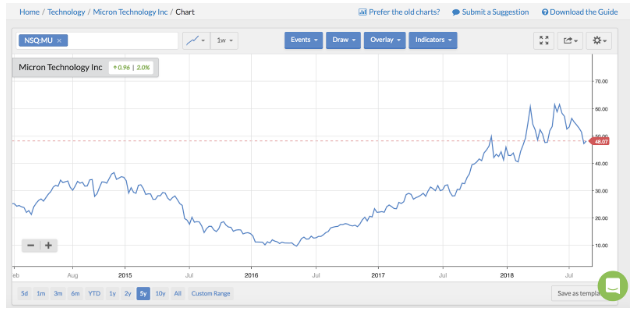
In the past, memory and storage demand was almost entirely driven by PC sales. Any sign of a slowdown in demand for PCs had a dramatic impact on DRAM and NAND prices. In recent years, technological advancements have led to a proportional increase in the demand for memory and storage products, as, they now form an integral part of their functionality and performance.
Secular demand drivers
Demand for memory and storage solutions is now much more diversified, and secular growth drivers have come into play. The demand growth is coming from sources ranging from data centres, to mobiles, the Internet of Things and even autonomous vehicles. The growth potential of the data economy is enormous. The Data Economy created 22,000 billion GB in 2017 worth $128 billion in revenue. In 2021, it is estimated that 62,000 billion GB will be created, the equivalent of about $360 billion in revenue.
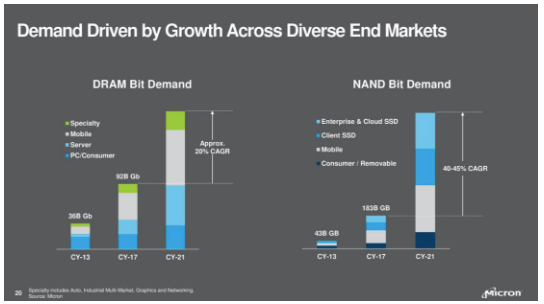
Image Source: Micron Technology Inc.
If we were to focus on one particular growth driver, we might consider the evolution in mobile phones. Whether it is the transition to 5G, the desire for higher resolution images, videos, and screens or the development of AI applications, advanced user authentication and augmented reality, all of these will require increasingly sophisticated memory and storage chips. You don’t have to look far to see how rapidly these developments are progressing - 5G mobile data connection is being tested throughout the world this year, and the first 5G integrated smartphones are expected to be released early next year. Advanced user authentication, or facial recognition, is becoming more widely available and prevalent due to devices such as the iPhone X and the Galaxy S9. Many apps are starting to implement this technology as well. DRAM is essential to process all the data quickly, and to make sure there aren’t any phone glitches.
Whereas in the past, growth depended more on the volume of phone sales, it is now the ever expanding content growth within these phones that is fueling memory and storage demand. These secular growth drivers, coming from a range of differentiated products, has arguably placed the semiconductor industry in the best position is has been in since the beginning of the internet era.
What about the supply-side?
The competitive landscape was very different in the past. There were many players in the memory and storage solution markets, and supply was always ramped up when possible to make market share gains. This would take its toll on DRAM and NAND prices. Below is a chart to show the quarterly market share of the DRAM chip market worldwide over the last 7 years.
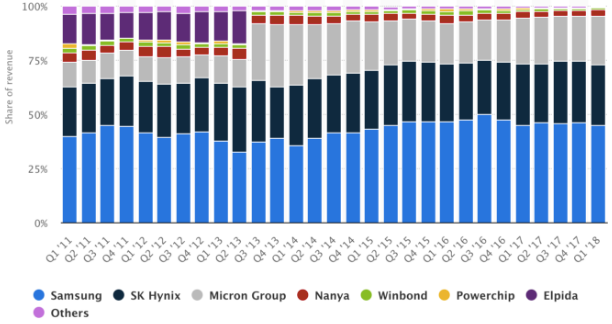
Image Source: Statista
However, in recent years, considerable consolidation has taken place. Micron, for example, bought Inotera Memories for $4 billion in December 2016, and acquired Elpida Memory for $2.5 billion in 2012. These acquisitions have allowed Micron to expand its manufacturing capabilities, improve its operating margins and gain a better control of market supply.
As a result of mergers and acquisitions, the market for DRAM has become a 3 player oligopoly. South Korean companies, Samsung and SK Hynix, along with US based Micron, held 96% market share for DRAM in Q1 2018 with individual market shares of, respectively, 44.9%, 27.9%, and 22.6%. As DRAM prices are now at higher and more stable levels, the companies are now reluctant to aggressively increase productive capacity. They have all made it apparent that they will now focus on profitability rather than market share gains.
There are also supply constraints due to the huge costs associated with the building of fabs (chip manufacturing plants), and as a result of the ever increasing complexity of chip manufacturing. The CapEx required to achieve the same level of output growth is no longer cost effective. This can be seen by the slides below, taken from Micron’s investor presentation day on 21st May 2018.
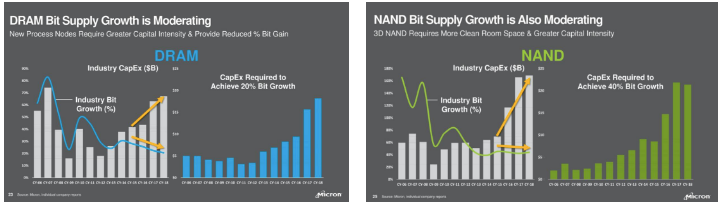
Image source: Micron Technology Inc.
During the investor presentation, Sanjay Mehrotra, the CEO of Micron, said that “the increasing complexity of the technology transitions, both on the DRAM and the NAND front, as well as increasing capital intensity involved with this transition” means that “the memory industry on the supply side is stable.”
What may be the most important factor going forward is that demand and supply are forecast to grow at the same rate over the next few years. DRAM Bit Demand is expected to grow approximately 20% CAGR, and NAND Bit Demand around 40-45% CAGR through till 2021. This should lead to stable prices, and continued high levels of profitability for these chip manufacturers.
Micron’s strengths
There are several key reasons why Micron is going from strength to strength. We’ve discussed the secular growth drivers, but there is one particular growth driver that stands out - the potential of Artificial Intelligence (AI).
Sanjay Mehrotra, the CEO of Micron, says that we are “barely seeing the tip of the iceberg” when it comes to the growth of AI. The company has on countless occasions described AI as a game changer. Simply analysing AI usage in the cloud data centre market can illustrate how meaningful AI could be to the company going forward. AI Training Workloads will require 6X DRAM and 2X SSD of a standard cloud server, leading to a dramatic rise is memory and storage demand. This can be seen in the image below.
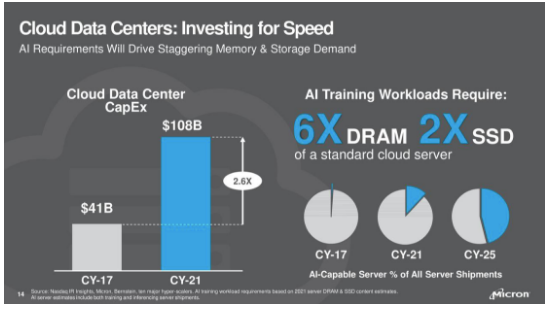
Image Source: Micron Technology Inc.
AI Services will also improve the company’s Premium Offerings, potentially leading to higher margins over the long-term. The Hourly Pricing of AI Services is $11.20 for accelerated compute, which is 50X greater than the $0.22 for standard compute.
Basic forms of AI are already well known, with Apple’s Siri and Amazon’s Alexa operating from a simple voice command. They may seem simple, but if you were consider the amount of technology that goes into understanding your accent, language, intonation and responding accordingly to this, then you’ll realise just how much DRAM and flash storage is required. There is also huge potential for AI in the healthcare industry, where it is helping to improve accuracy of diagnostics and developing precision medicine and precision health treatments.
Micron’s domination of the market for DRAM in autonomous vehicles is another one of its notable strengths. It currently owns over 50% of the market, which is estimated to be worth $5.9 billion by 2021. Autonomous vehicles will have several cameras, sensors, radars, lidars, voice commands, all creating data, which needs to be processed, analysed and stored in a matter of seconds. For fully autonomous vehicles (L5 as defined by the Society of Automotive Engineers), 74 GB of DRAM and 1TB of NAND will be needed for the memory and storage for each vehicle (2025). This will continue to drive growth for Micron’s products in the future.
Fundamental analysis
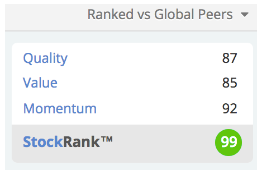
The company boasts some impressive characteristics across all Quality, Value, Momentum and Growth metrics. Its StockRank currently stands at an admirable 99, making it one of the best ranking large-cap stocks on the US market.
In its latest earnings release, it announced that revenues had grown 40% from Q3 2017 to Q3 2018 and that Non-GAAP Net Income more than doubled from Q3 2017 to Q3 2018. The higher profits have not only been driven by higher DRAM and NAND prices, but through effective cost management. The company has realised significant cost efficiencies over the last few years. It has outperformed its industry peers by reducing DRAM costs 1.3X the industry rate, and its NAND costs by 1.9X. This in turn has led to the realisation of $6 billion in operating profit improvement from FY16 to FY18, with a further $3 billion being targeted between FY19 and FY21.
It is no wonder that its operating margin, currently at 45.2%, is ranked 6th out of 627 companies in the global semiconductor & semiconductor equipment industry.
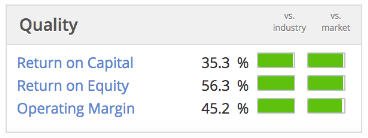
Micron is also ranked in the top decile for returns on capital employed (35.3%), and returns on equity (56.3%), when compared to its global peers. Its steadily improving Return on Assets, standing at 32.2% on a TTM basis, further highlights the company’s ability to generate high levels of profitability.
Micron’s balance sheet is in remarkably good health: at the end of Q3 2018, the company was net cash positive, with debt reduced to $7.34 billion, and cash, marketable investment and restricted cash at $7.68 billion. The company’s liquidity ratios are exemplary, with its current ratio of 2.63, quick ratio of 2.06 and interest cover of 31, indicating that the company can comfortably meet both its short and long term obligations.
When assessing the financial strength of the company, it’s always good measure to check the Piotroski F-score. Micron scores a near perfect 8/9 on this metric. It is improving its profitability, operating efficiency and debt profile. The one measure that the company currently fails to meet is the ability of the company to trade without having to raise funds from shareholders. A series of convertible loan notes, which convert debt into equity, have increased the share count. However, as the company is now net cash positive, it has announced that it will focus on redeeming its existing loan notes and paying down debt. The company’s near perfect F-Score, means that it qualifies for the Piotroski F-Score Price to Earnings Guru Screen, which has been one of the top performing value strategies over the last 5-Years.
From a momentum perspective, a MomentumRank of 92 would suggest that Micron is on the right track. Brokers have been consistently upping their EPS estimates, almost doubling from $6.02 a share last August to $11.77 this August. The average broker price target is currently $83.6, which would represent a 73.9% increase from today’s prices. Price momentum has also been strong, with the shares advancing 34.8% over the last year, although they are 25% off their recent highs.
However, it is Micron’s valuation that really catches the eye. Its P/E ratio on a 12 month rolling forecast currently stands at 4.1, which is very seldom seen, with most large-cap tech-related companies in the US trading on P/E multiples of more than 30. Micron’s ability to generate high levels of Free Cash Flow is equally impressive. The company is a current cash cow, generating $2.23 billion and $2.16 billion of Free Cash Flow for Q2 and Q3 2018, respectively. Its Price to Free Cash flow of 7.38 demonstrates the ease with which the company can use its cash to pay down debts, re-invest in the company or begin capital return programmes.
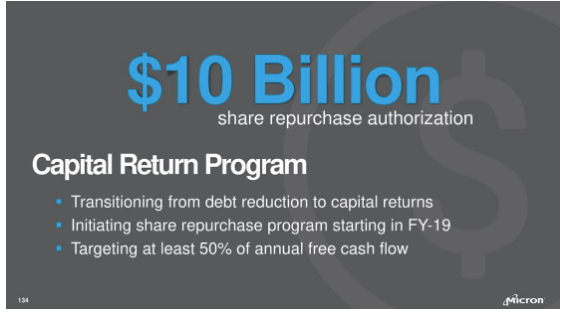
Image Source: Micron Technology Inc.
Despite not currently offering a dividend, the company has recently begun a capital return programme. On 21st May 2018, Micron announced $10 billion worth of share buybacks starting in FY 2019 (i.e. September 2018). The share buyback (worth 17.9% of share capital) is greater than Apple’s as a percentage of market capitalisation. The company has also promised to return at least 50% of annual free cash flow to shareholders.
Threats
The main threat to Micron is perceived to be related to the current trade war between the US and China. There is unease with regards to what actions the Chinese may take against US companies like Micron, which generate significant parts of their revenues and profits by from product sales in China. China accounts for over 50% of Micron’s revenues in fiscal 2017, so any action taken directly against Micron, especially the leverage of any trade tariffs, would have a significant impact.
However, “China is the world's largest importer of memory chips, consuming 20% of DRAM and 25% of NAND chips worldwide. (DRAMeXchange)” and as it currently does not have the technologies to produce the same quality of chips, it would have to seek the supplies from Micron’s main competitors - South Korean firms Samsung and SK Hynix. As noted earlier, though, increasing manufacturing capacity is not so straightforward. There are huge CapEx requirements involved in building chip manufacturing plants, and they take a long time to build as well.
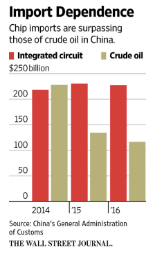
If, hypothetically, Micron was precluded from trading in China, and was effectively replaced by Samsung and/or SK Hynix, the latter would not be able to supply the rest of their global clientele, giving Micron the opportunity to do so in their place. The market shares between the 3 companies would remain roughly the equivalent of current levels, only the geographic distribution would change.
To reduce its dependence on foreign chipmakers, China has aggressively invested in the expansion of its domestic DRAM and NAND industries. The major players include Tsinghua Unigroup, the state-run tech giant that tried to acquire Micron three years ago, and state-backed chipmakers Changjiang Storage, JHICC, and Innotron. The Chinese continue to invest heavily in their semiconductor industries, and they could eventually flood the market with cheap semiconductor products.
However, as Sanjay Mehrotra, has stated: “The Chinese can't just make a lot of low quality DRAM and flood the market, because it's a lot cheaper to make the cutting-edge stuff, but they just don't have the IP or know-how for it. Expert consensus seems to be that the Chinese are at least 3-4 years from selling today's state-of-the-art DRAM”. Furthermore, analysts from Cowen & Co. have suggested that “Longer term, we cannot ignore competitive risks that are mounting in the memory market, though we remain skeptical that XMC, Jinhua and Innotron will be able to materially disrupt memory supply/demand dynamics for the next 5 years given XMCs poor yields on 32L 3D NAND and the broader group’s unproven commercialization of DRAM technology.”
The last threat of note is a recent preliminary injunction which has been imposed on Micron, after supposed patent infringement cases were brought forward by United Microelectronics Corporation (UMC) and Fujian Jinhua Integrated Circuit Co. (Jinhua). The preliminary injunction means that Micron’s Chinese Subsidiaries will no longer be allowed to manufacture, sell or import certain DRAM modules and SSDs in China.
Micron’s senior vice president, Joel Poppen, responded with a firm statement, saying that “We strongly believe that the patents are invalid and that Micron's products do not infringe the patents. The Fuzhou Court issued this preliminary ruling before allowing Micron an opportunity to present its defense".
Additionally, in its press release, the company also mentions that it has “submitted compelling evidence to the Patent Review Board of China's State Intellectual Property Office demonstrating that the patents are invalid because they are directed to technologies that were previously developed and patented in other countries by other technology companies”. Perhaps the key take away from the press release was that the preliminary injunction would only affect just over 1% of Micron's annualised revenues and “the company continues to expect revenue to be within the previously guided range of $8.0 to $8.4 billion”.
Is there an competitive moat?
Before making any final decisions on an investment, I like to evaluate if a company has some competitive advantages, which would give it some form of economic moat. It was Warren Buffett who popularised the economic moat concept, which can be defined as the sustainable advantages that protect a company’s long-term profits and market share from competitors.
In his book, “The Little Book That Builds Wealth”, Pat Dorsey elaborates on the four key sources that give a company a structural competitive advantage: whether a company has intangible assets; customer switching costs; network effects; and cost advantages.

I applied Pat Dorsey’s criteria to test whether Micron really does have an economic moat. Micron passes the first test, the possession of intangible assets, with flying colours. The company currently owns more than 20,000 patents, and its constant innovative approach and meaningful focus on R&D allows it to sell products or services that can’t be rivalled by competitors.
The second element is customer switching costs. This refers to the difficulty customers would experience, if they were to give up a particular product. Fortunately for Micron, the company’s products form an integral part of the vast majority of today’s technological devices, and will likely take an even more prominent role in the future.
Micron may also qualify as a textbook example of a company with a strong network effect. The network effect is a powerful form of competitive advantage that occurs when an increase in the number of users leads to an increase in the value of a company’s products or services. In Micron’s case, as more people begin to use intelligent devices, the value of memory and storage solutions increases, as not only is it required for the user experience, but the device itself creates data that then also needs to be stored. This in turn leads to further requirements for memory and storage for the cloud. This virtuous cycle acts as an incredibly strong network effect.
The last key indicator of an economic moat is whether it has a cost advantage. As mentioned previously, the reduction of DRAM costs by 1.3X and NAND costs by 1.9X the industry rate over the last 2 years, leading to the realisation of $6 billion in operating profit gains, indicates that the company does indeed benefit from significant cost advantages. It is confident in its ability to drive further efficiencies, creating an additional $3 billion of operating profit gains from FY-19 to FY-21.
As Pat Dorsey says in his book, “Just as moats around medieval castles kept the opposition at bay, economic moats protect the high returns on capital enjoyed by the world’s best companies.” The fact that Micron satisfies all of Dorsey’s criteria illustrates the strength of the company’s economic moat.
Despite the mid-long term threat of competition within the Chinese market place and the risk of a trade war, the fundamentals of Micron remain robust and it is clear that the company has confidence in its own potential, as demonstrated by the capital return programme and continued bullish outlook.
All data accurate as at 20/08/2018.
Disclosure: I hold a long position in the stock.
Disclaimer
This is not financial advice. Our content is intended to be used and must be used for information and education purposes only. Please read our disclaimer and terms and conditions to understand our obligations.
18 comments
Just to reiterate that I am no expert on Micron but my general view is that this is probably a capital intensive and cyclical industry. Even with fewer players and demand that is more stable you will still have periods of oversupply and lower prices. I also think you have to be very wary of looking just at the recent ROCE. This can be increased by previous capital losses and one off profits. My view on Micron is that it isn't a high quality company. It looks average or below average. But in any event it is great to get an investment thesis out there to be debated. So thanks again for the article.
Some recent warnings on memory prices and demand:
https://www.cnbc.com/2018/09/06/micron-chip-stocks-plunge-after-morgan-stanley-warns-about-weakening-semiconductor-demand.html
Keelan, excellent article!
Anyone tempted to invest in Micron should also take a look at the numerous articles on seeking alpha - there are a large number of recent posts, many of which suggest the company is undervalued.
Consensus seems to be that the Trump(‘ed up?) tariffs have been the main reason for recent underperformance.
These may be a short term headwind, but should be a tailwind once the tariff situation is resolved (and these things have a habit of being resolved, it’s just a question of when).
I agree that long term share price performance of Micron is heavily dependent on AI and the increased memory and processing power it requires. Of course, this being tech, maybe AI programs will become more efficient as they become more powerful.
Hmmm ....... I recently came across this graph of 20y ebitda margins - which begs a qu .
http://tinyurl.com/ydchkxb2
Could MU fall back to $36?
http://tinyurl.com/yae9kh5x
Any comments?
Thanks schober that first link is interesting on ebitda margins. I think Keelan's thesis is that things will be less cyclical going forward. On a broader note I think that cyclical companies will often look very cheap in screen platforms so you have to be very wary.
Hi Keelan,
A really great report, very professional; well done. I notice they have in fact grown significantly in price (approx. five-fold over the last 2 years or so). I am not thinking of buying currently for the simple reason that I already own Nvidia and Apple (plus Amazon, which is not really a tech stock, but they are into cloud solutions), so I feel I am already as exposed to American tech. stocks as I can risk at the moment (circa. 15% of my shares portfolio). However, your report has given me enough food for thought to add Micron to my American stocks watch list. If I get disgruntled with any of the others, I will look to switch and Micron will now be on the short list.
Thanks for this great piece and good luck with your degree and future studies. For what its worth I also think, loosing 80% of your investment capital as a young teenager is also a great education and using the other 20% to gain it back is like a post-graduate phase :-)
Good luck for the future.
Hi Keelan,
I guess the other problem for any consolidation in semiconductors at the moment is the trade war. If the US competition authorities let this one go on the basis they are both US corporations, the Chinese would likely want to intervene.
Thanks for an outstanding article. This is not a share that would come onto my radar, but the quality figures in particular are fantastic.
I won't be investing though because the PE is so low that the market is telling us to beware. Now the market might be wrong and this share price might multi-bag from here but its not my kind of share. As a growth investor, stocks like this scare me. And while this year's EPS is due to see massive growth, next year's is due to fall slightly. Again, a red flag for me. The 50 day moving average is in a clear downtrend. Another red flag.
The green all over the Stock Report, the 99 Stock Rank means that this has a real chance to be a winner. Best of luck to all who give it a go.
M.
I agree, excellent. I bought these shares in Nov. 2017 and they dropped but have returned to the price I paid. They have low PE , high return on capital , not highly geared. Certainly looks a great share to me.
Goronwy
Excellent article, keelancooper..
Can someone tell me what the connection is with Micron Solutions ASQ:MICR?
Reading that they contract manufacture Healthcare equipment suggests to me that the company is a subsidiary/satellite company using some Micron Technology NSQ:MU know-how.
May be in the High Quality Article somewhere but could not see it.
I can't see that there is any connection between those two companies beyond both having Micron in their name. I certainly don't see any synergy or common know-how, they are in quite different businesses.
Thanks for this write-up. If you know the main reasons why the shares are at such as low P/E ratio that would be interesting to hear your thoughts. I.e. investors or the markets main worries and why you think they are wrong. Some initial thoughts below:
Looking at the group and 51% of revenue is to China and 12.5% to Taiwan. So I guess this is what the market may be focusing on? Most of the assets are in Taiwan and Singapore combined. Capex has been higher than depreciation from fiscal 2014 to 2017 so when the investment cycle ends they may have a lot more free cashflow. However, capex is also expected to be higher than cashflow in 2018, 2019 and 2020.
On the quality front the long-term ROCE performance isn't great. The business appears to be very capital intensive with each US$1 of investment generating about US$1 in a good year. The EBIT margin is good but this is offset by the capital intensity of the sector I guess.
So I guess the thesis is that this will be a much higher quality business going forward for the reasons you outline. I guess one reason for the low rating might be that while earnings are expected to increase significantly in fiscal 2018 they are then expected to decline in the following two years.
Free cashflow conversion has historically not being great. Capital employed has also increased from US$18bn at the end of fiscal 2014 to US$30bn at end of fiscal 2017. I do like the fact that the net cash position is expected to increase in the coming years. The share buy-back also looks positive. This is typically the approach taken for cyclical businesses i.e. Ryanair.
Summary: This is a fairly capital intensive business and has been cyclical in nature historically. Probably people are focused on the risk that this company will be shut out of its largest market: China. For me the underlying business quality is ok but not great. Free cash flow conversion has been weak, capex exceeds depreciation, capital employed has increased significantly and this is a capital intensive sector. The underlying result is that ROCE is unlikely to hit very high levels. This is an initial view and could be wrong. If your argument that demand is more secular in nature this will keep ROCE from falling back significantly. But can this really be a quality business with ROCE consistently above 15%? We shall see I guess.
The trouble with capital intensive businesses for me is that they tend to always be cyclical. The heavy capital investment cap lead to industry over investment and declining prices. It also puts a heavy drain on cashflow. There is always the risk that capital investment will be spent on areas that don't bear fruit. So this probably wouldn't be the kind of stock I would look at. But I will take a closer look at your thesis to see if I am wrong.
The trouble with the P/E metric in my view is that can appear cheap for stocks with lots of debt or where earnings don't reflect the ability to produce cash. The debt isn't an issue at Micron but the latter may be an issue. Depreciation is based on the historic cost of assets and may understate the actual cost of buying or creating them today. The P/E also always looks low for cyclical businesses at the top of the cycle. That said Micron's P/E still looks low even factoring in these issues.
Thanks again for the writeup.
I have held Micron for 18 months and so have had a decent return, but the market does seem determined to keep it cheap. The thing "everyone knows" is that it's a cyclical business and so that is being priced in.
The counter argument is that the past was a function of the Windows/Intel PC upgrade cycle and that these days the drivers are smartphones and cloud computing, IoT, and AI as you say in your write-up. And management are confident enough of that to launch that massive buy-back programme.
The demand for memory is essentially infinite. We would all like ten times the storage in our phones and computers if it was cheap enough, and we are all storing more of our photos and videos in the cloud.
There is an argument that the computing paradigm is shifting to be memory-centric rather than processor-centric. The ability to rapidly access the memory is the critical factor rather than the ability to process instructions. But the new standards are not set - or rather Intel has their standard and the rest of the industry has a different one. Intel and Micron are going their own ways on XPoint, bringing their joint development programme to an end.
In my view Intel should buy Micron in order to stay relevant. Maybe when Intel get a new permanent CEO the rumours will start up.
Hi JohnEustace,
As you have said, Micron does operate in a very cyclical industry, and a lot of the risks associated with China seem to have been factored in. Despite this, the company does still seem grossly undervalued when compared to its industry peers. Micron's P/E of less than 5 is significantly below the semiconductor industry median of 15.9. The demand drivers discussed should change the cyclical nature of the industry going forward.
The point you make about Intel is very interesting. It would make a lot of sense for the company to acquire Micron. It would add DRAM to the company's memory & storage product offering, which is currently more profitable than NAND, and given Micron's current valuation it would make sense to do so sooner rather than later. Intel is also having struggles of its own right now with its CPU division losing out to Advanced Micro Devices. As it might take some time for the company to recover on this front, an immediately accretive acquisition, along with the news of a new CEO would help soothe investors worries, so it is definitely a scenario worth considering.
Hi Keelan,
SK Hynix Inc is directly comparable to Micron Technology Inc and is currently available to purchase at a P/E below 4, it also pays a dividend. Micron is considered as a company that historically has been poorly managed; the new management is better regarded but too new to change that view completely.Between 2012 and 2017 Micron generated $26bn in operating cash flow - $24bn of that went on "investing activities" - in semiconductors you have to run very hard to stand still.
Anybody expecting a re-rating from low P/E ratios wiil have to wait for the next profit collapse in the industry, then the P/E explodes!
Despite the above Micron was my best performer in 2017.
Bonitabeach
Disclosure: Long: Micron Technology Inc
Thanks for giving us a broader background, plus a deeper look into this opportunity. Micron has been on my watch list, and this gives me a much greater understanding of what's ahead.
Frank
Dear Keelan,
Thank you for a very good write-up!
Jatin
Hi Keelan
Thanks for taking the time to write this up, it is one of the best company write-ups i’ve seen in a long while. Micron is duly added to my watchlist.