An Investors Guide to Pension Plan Analysis - Visualising Actuarial Assumptions

Following from a previous article, I’ll be looking a little further at the impact of some actuarial assumptions. It can be difficult to get your head around some of the ideas the actuaries talk about so a super simplified and visual example is a great way to get a better feel for it all. As such we’re going to be doing some easy present value liability analysis for ‘Company X’, which is in a very unique position.
It only has a few employees, they’re all going to live for precisely 25 years after retiring and the rate of inflation will be precisely 2% from now to eternity. Further, they’re all going retire at exactly the same time and will all receive exactly the same benefit as each other. The accountants have decided to use a discount rate of around 3%, in line with the requirements of IAS 19.
An investor in Company X is unsure about this and wants to know what the impact might be should the number prove to be inappropriate. As such they’ve hired us to do some sensitivity analysis on their pension fund in order to see how varying the discount rate, number of employees and benefit due to employees will affect the present value of their liabilities.
This is, of course, a completely unrealistic scenario and in reality things are much more complex, but it suffices for learning purposes and helps us to isolate a couple of effects.
Varying the Discount Rate…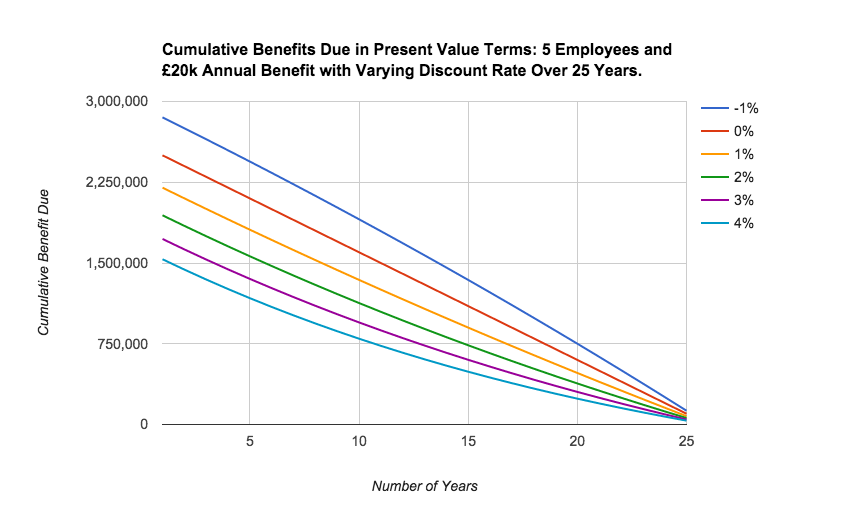
First up, a brief explanation of what the chart is showing (this will be the same for all of the charts). Let’s take the left hand side of the chart where ‘Number of Years’ = 0 on the y-axis. Each of the different colour lines shows us the present value of the liabilities at a given discount rate (inclusive of the effect of inflation, legend on the right).
The value on the y-axis shows me the present value of the benefits due from that date to the end of the 25 years on a cumulative basis. In other words, it adds up all the present values of individual cash flows at that point to arrive at the total still due. As we progress to the right of the chart, the figures fall as the cumulative amount still due falls - this is simply because we’ve paid off some of our liabilities! When there is only 20 years to go, it makes sense that we have less left to pay than when we had 25 years to go and so on.
You will notice the large spread between the lines at the left hand side of the chart - note how a change in discount rate of only 1%, when applied over a 25 year horizon, can impact the present value calculation by around about 13% (this does vary, it is lower between 4% and 3% and higher between 0% and -1%). This means that when you take a big pension scheme with, say, £10bn in liabilities on the balance sheet, then a discount rate that is just 1% too high could mean that liabilities are understated by around £1.3bn. That money has to come from somewhere and there is only one place it can come from - future operating income.
Do also note that the spread between high and low discount rates is magnified as we increase the time horizon. Over a ten year period only, the spread is actually quite low and so the calculation is not quite so sensitive to errors. Over a much longer period though - say 30 or 35 years, the errors can be magnified even further.
A final interesting point on this topic - note what happens when we slip into negative real interest rates (the dark blue line marked -1% in the legend). Instead of future cash flows being worth less today than tomorrow, they are actually worth more. In particular, look at the shift in present value from a real discount rate of 1% to a real discount rate of -1%! There is over a 25% increase in the present values from this change and this is the kind of territory that we could soon be flirting with in the present interest rate environment.
Overall we’d have to conclude that this is quite a concern for our client. The company is using a discount rate of 3% after all and we suspect there is a good chance that this number could be out by enough to have a material impact on the balance sheet. True, the result could ultimately be positive should interest rates rise again, but either way there is a lot of uncertainty here.
Varying Benefit per Employee…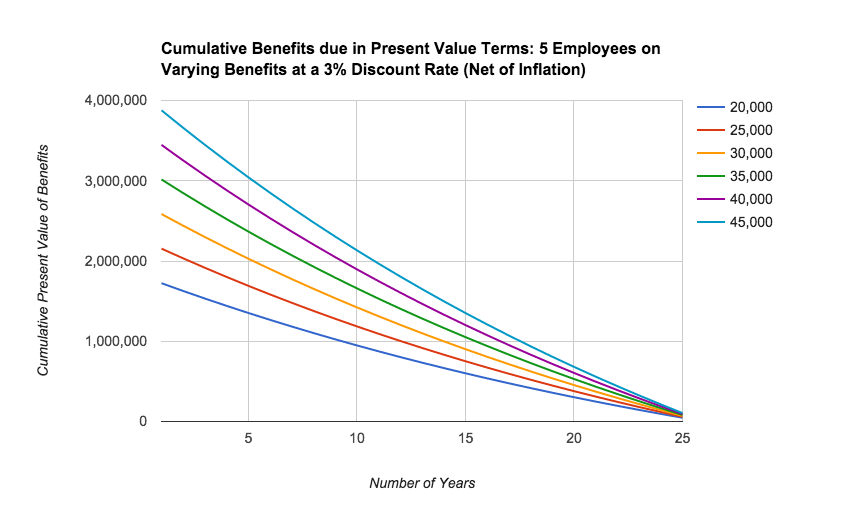
The trend here is a little different. You can see that varying benefits due does have a large impact on the present value of liabilities, but that the relationship is linear. You have to be out by a factor of 2 in your estimate of annual benefit to see the present value of liabilities on the balance sheet out by the same amount.
Note though that the liability recognised on the balance sheet only accounts for service accrued to date. While this will include an estimate for the annual increase in salaries, getting this wrong by a factor of two would be quite a feat. Error margins of 1 or 2% are much more likely but, due to the linear relationship with present value here, this will lead to a misstatement of only 1 or 2%. As we expect errors in factors like this one to have a smaller impact on the liability shown, they probably aren’t so much of a worry for our client.
What have we found so far then?The biggest concern for our client appears to be the discount rate and its components. We’ve noticed that small changes here can lead to a dramatic difference in the outcome of the present value calculation. Compounding the issue is the fact that estimating the discount rate is very difficult to do. It requires consideration of a whole host of factors, in addition to being restrained by reporting standards.
We saw that, over a 25 year period, being out on the discount rate by just 1% could potentially lead to around a 13% difference in present liability value in our example. When you think about this next to the fact that interest rates have ranged from around 17% just over 30 years ago to almost 0% today, suddenly it doesn’t seem so unlikely that even a smart actuary might get the discount rate wrong by 1%, 2%, or even more! Just check out this chart of historical interest rates (data taken from the Bank of England’s site):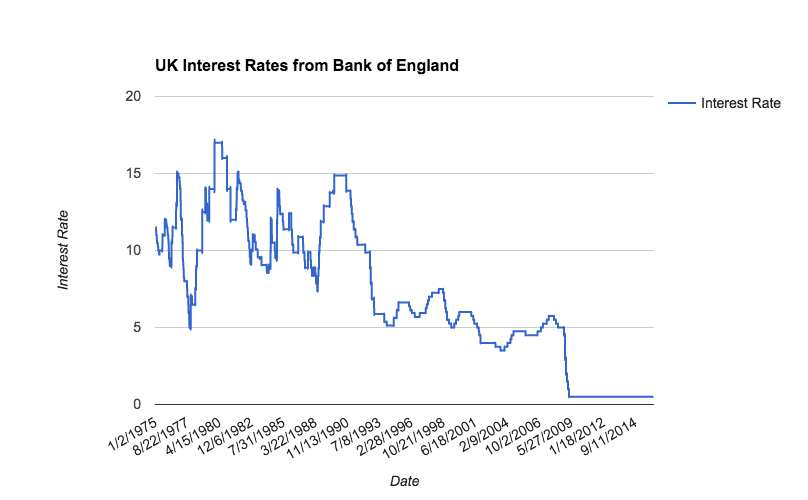
It has been highly volatile (though less so more recently) and I don’t think anyone really saw it coming as it did. Will the current state persist indefinitely? If history has taught us anything, it’s probably that nothing persists indefinitely...a lot happens over a few decades.
The restrictions imposed by reporting standards may even facilitate the use of an inappropriate discount rate, as they require plans to use the current long term corporate bond rate. Should current corporate bond rates not fully reflect future interest rate trends, then you can be sure of future adjustments.
Remember that we also observed the magnifying effect that time horizon had on the effect of a change in discount rate. If the accounts gets it wrong by, say, 1 or 2%, and then on top of this the time horizon is actually underestimated by 5 years as well (feasible given the trend towards longer lives), then there is room for a very significant understatement of the liability.
While I do think the discount rate and its components are the most critical point, the greatest risk comes from what Charlie Munger refers to as the ‘Lollapalooza’ effect. When all of the factors conspire and are out by a little bit in the wrong direction, the observed variance can be markedly beyond what might be expected from considering any variable in isolation.
In Conclusion…Broadly, I think those are a few of the key points to bear in mind. I certainly don’t intend to paint a picture of doom and gloom but it is always best to err on the side of caution with these things. When you consider that total UK pension deficits now sit at just over £300bn and with total liabilities approaching £1.6tn and ever growing, it seems clear that the trend has been for companies to consistently underestimate their liabilities. The situation has been worsening too, have a look at this chart taken from a study by the Pension Protection Fund:
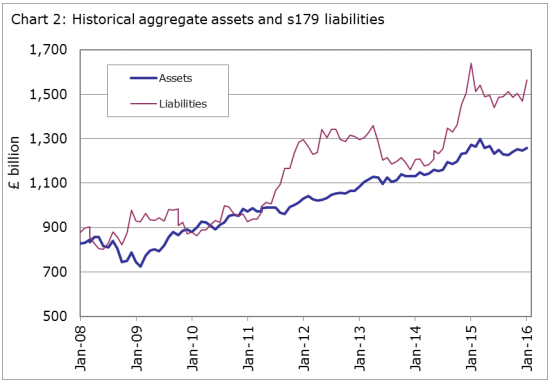
It seems likely that falling interest rates (and therefore discount rates) have played a significant role in the rise in liability present values. Increases observed in assets do come in part from returns on plan assets but if plans are truly earning the few % a year the discount rates suggest, then some of the required increase in assets will ultimately come from company operating profits.
With all that said however, a few simple questions regarding assumptions and a little bit of arithmetic should be well placed to avoid the more obvious traps. Simply taking the time to think about how small tweaks to discount rate assumptions may affect the balance sheet could save you from disaster. If a given plan appears to be in surplus, would it still be in surplus in the event of a 1 or 2% fall in the discount rate? Thankfully, disclosure requirements require that companies perform some sensitivity analysis in the notes to the accounts to help you to ascertain this. They are often quite conservative though so stretching things a little further may be a valuable exercise.
In the final piece in the series, I’ll be applying the ideas talked about so far to a real balance sheet to see what turns up. I’ll look at a company with a famously large pension deficit and that last year did take a large actuarial loss and had to pay up out of shareholder’s funds. Was this a totally unforeseeable event or could some analysis of the actuarial assumptions have hinted at what was to come? I am talking about none other, of course, than our very own BT.
That’s it for now - please do comment with questions and criticisms. Are there any particular signs you look out for when you analyse a pension scheme? Let us know below!
Disclaimer
This is not financial advice. Our content is intended to be used and must be used for information and education purposes only. Please read our disclaimer and terms and conditions to understand our obligations.
2 comments
An informative clearly explained exposition.
So, the largest risk is applying too high a discount rate; and of itself this can cause a deficit in the capital value of the fund.
If we add to this an existing large deficit (e.g. BT) then the capital deficit is nmagnified - as the existing deficit becomes magnified.
This suggests we should be very wary of buying shares in a company with a large existing deficit: large as in Deficit/ Net Asset Value of the company? When looking at the Stockopedia Stock Report, always I look for the Pension Deficit figure.
The mathematics of this article are trivial for someone who is familiar with financial mathematics.
However most people are not in that position. For them, this is an excellent simple introduction to the vital importance of discount rates in computing pension fund liabilities.