Any fizz left in mid-cap beverage stocks?

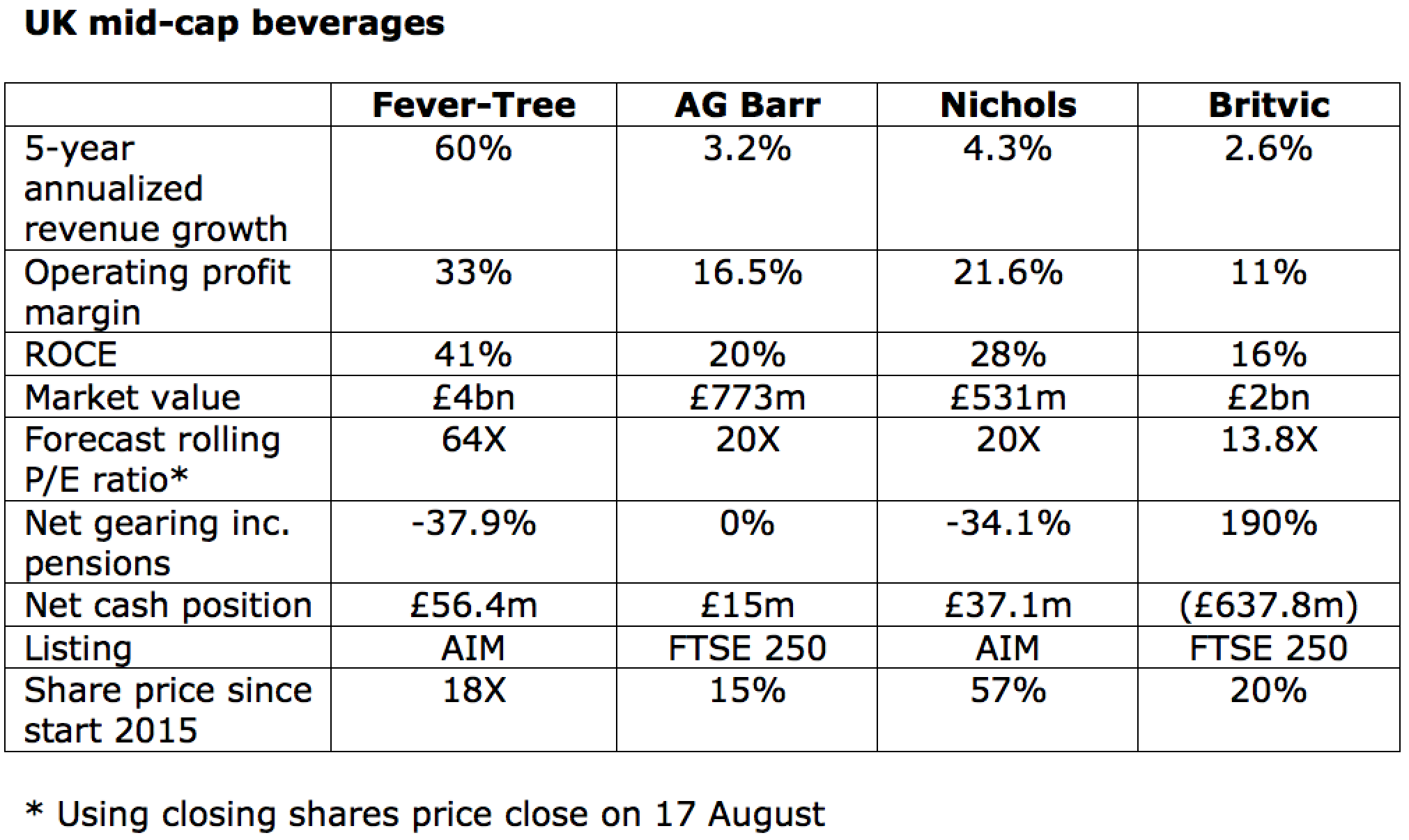
Warren Buffett's long-term investment in the iconic soft drinks group Coca-Cola has paid off in spades. There are currently four mid-cap soft drinks groups listed in London: Fever-Tree, AG Barr, Nichols and Britvic. They have all delivered impressive long-term shareholder returns but have mixed international growth prospects.
Soft drink companies make non-alcoholic beverages and have benefited from strong consumer brand loyalty. In this article I will examine of the strengths of the four UK mid-cap soft drinks groups, their prospects for growth and current valuations.
Sector headwinds include changing consumer preferences and the UK levy on sugary drinks, introduced in April. New distribution channels have also been a challenge with discount supermarkets, for example, copying the fruit drink brand Robinsons.
Shares Awards: If you’d like to help support Stockopedia, you can vote for us in ‘Best Investment Software Programme’ (Category 15) and 'Best Customer Service’ (Category 7) at the Shares Awards. Here’s the link.
AG Barr: IRN-BRU leads in Scotland
AG Barr’s was established in 1875 and its most important brand, IRN-BRU, famously outsells Coca-Cola in Scotland. IRN-BRU sales rose 8% in fiscal 2018, hitting a new record, and is “seen by many as part of the culture of the Scottish nation.”
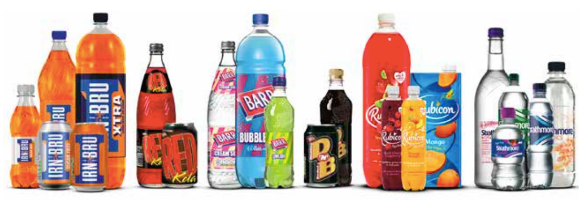
The group launched no sugar IRN-BRU XTRA in 2016 and the sugar content of original IRN-BRU has been reduced by half. Other brands include Strathmore mineral water, Rubicon exotic fruit juice and the fast growing cocktail mixer brand Funkin.
The group also has long-term partnerships with Rockstar, Snapple, Bundaberg and San Benedetto (from January 2018). AG Barr’s share of the UK soft drinks market rose to 3.3% in fiscal 2018 from 3.1% in the previous year.
Group revenue fell in fiscal 2016 and 2017 but increased 8% in fiscal 2018 and is up 5% in the first half of fiscal 2019. Rest of World sales (outside the UK) are based on an “export-led model” and rose 3.8% in fiscal 2018 to £10.9m i.e. 4% of total revenue.
AG Barr’s operating profit margin is solid at 16.5% and the ROCE respectable at 20%. The circa 20X forecast rolling P/E reflects the unassailable position of the IRN-BRU in Scotland and a modest net cash position on the balance sheet.
AG Barr’s brands
Source: AG Barr
Nichols: taking Vimto around the world
Nichols was founded in 1908 and the group’s “iconic” Vimto brand was initially a herbal tonic designed to give drinkers “vim and vigour.” Vimto is now available in 85 countries and has done particularly well in the Middle East and Africa.
Sales of the Vimto brand increased 9% in fiscal 2017 versus a 2.2% sales increase in the UK soft drinks market. Sales of no added sugar Vimto were up 20% and all of Nichols’ brands are exempt from the UK levy on sugary drinks.
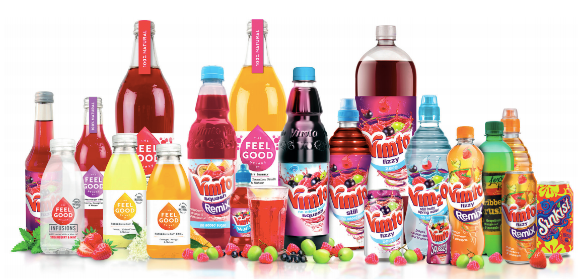
Other brands owned by Nichols include Feel Good Drinks (acquired 2015) and the Noisy Drinks (acquired 2016) brands Starlush and Slurp. The company also produces the Sunkist and the Levi Roots soft drink brands under licence.
Nichols revenue rose 13% in 2017 to £132.8m with UK sales up a robust 11% to £100.8m. International sales rose 20.4% to £32m - 24% of total revenue - with African sales up 20.8% to £12.7m and Middle East sales up 13.4% to £13m.
Nichols is a profitable business with an operating margin of 21.6% in 2017 and a ROCE of 28%. Global instability has recently hit international sales and, with the shares off a quarter from their high, the forecast rolling P/E is currently 20X.
Nichols’ collection of brands
Source: Vimto
Britvic: acquisition driven growth
Britvic’s roots stretch back to the mid-19th century when a chemist in Chelmsford started producing homemade soft drinks. The group’s name is short for the British Vitamin Products Company and Britvic one of the group's brands.
Britvic has grown largely through acquisitions with Tango and R.Whites acquired in 1986. Robinsons was acquired in 1995, French soft drinks group Frutte was acquired in 2011 and Brazilian group Ebba was acquired in 2015.
Britvic also owns Purdey’s and J2O and launched children’s drink Robinsons Fruit Shoot in 2000. Another string to the blow is an agreement to bottle Pepsi products in the UK, which has been in place since 1987.
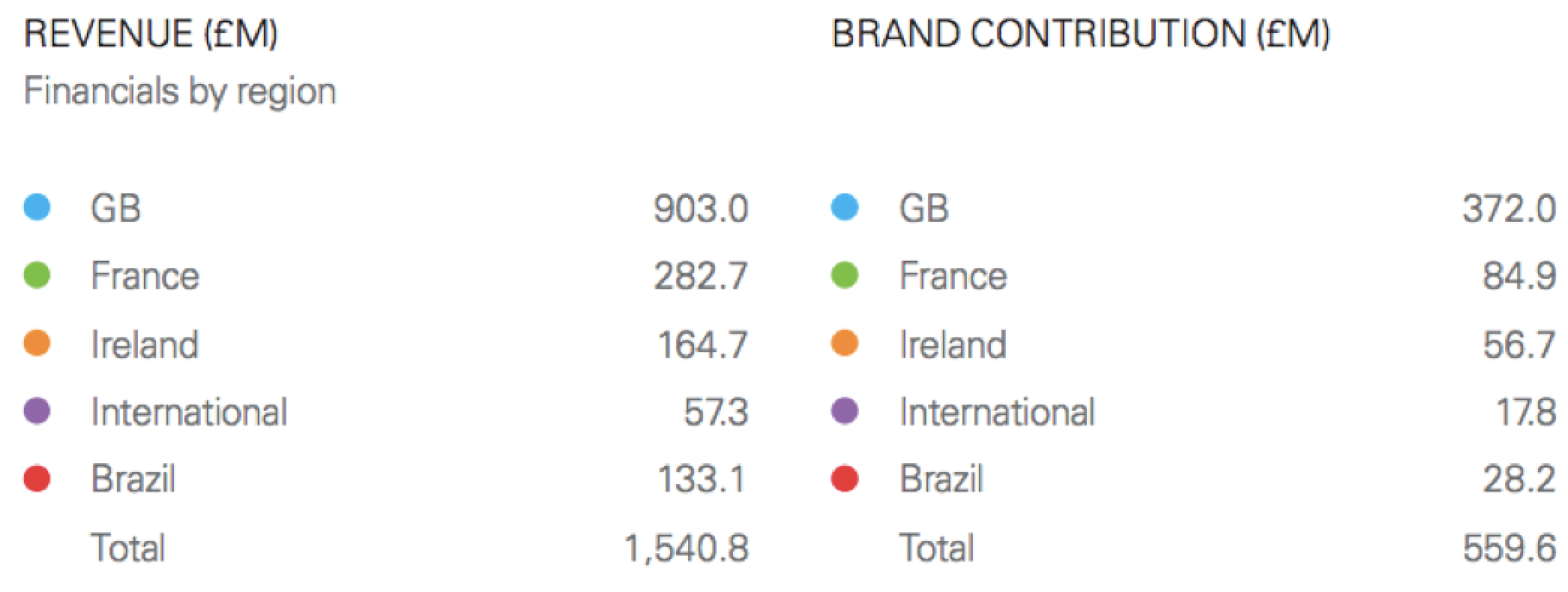
Britvic doesn’t have a global brand that it can take around the world with Robinsons seeing mixed international success. Accordingly, despite a string of overseas acquisitions the group currently generates two-thirds of its profit from Great Britain.
With increasing own brand competition it is no surprise that Britvic’s operating margin is 11% and the ROCE is modest at 16%. The forward rolling P/E is low at 13.8X but the outlook for growth is unclear and the balance sheet has a meaningful net debt position.
Britvic in the year to Sept 2017: Great Britain remains the key driver
Source: Britvic
Fever-Tree: a disruptor in mixers
Fever-Tree was founded in 2004 and before it came along the premium mixer market “did not exist in any substantial form.” The group’s marketing slogan is: “If ¾ of your drink is the mixer, mix with the best.”
The doubling of UK gin sales in the five years to March 2018 has provided a tailwind for UK tonic water sales. Fever-Tree's use of natural ingredients, and relationship with premium spirit groups, has enabled it to steal market share from Schweppes.
Fever-Tree has had little trouble selling its products globally and this sets it apart from the companies discussed so far. UK sales were 44% of the total in 2017, Europe was 30%, the US was 21% and the Rest of World was 5%.
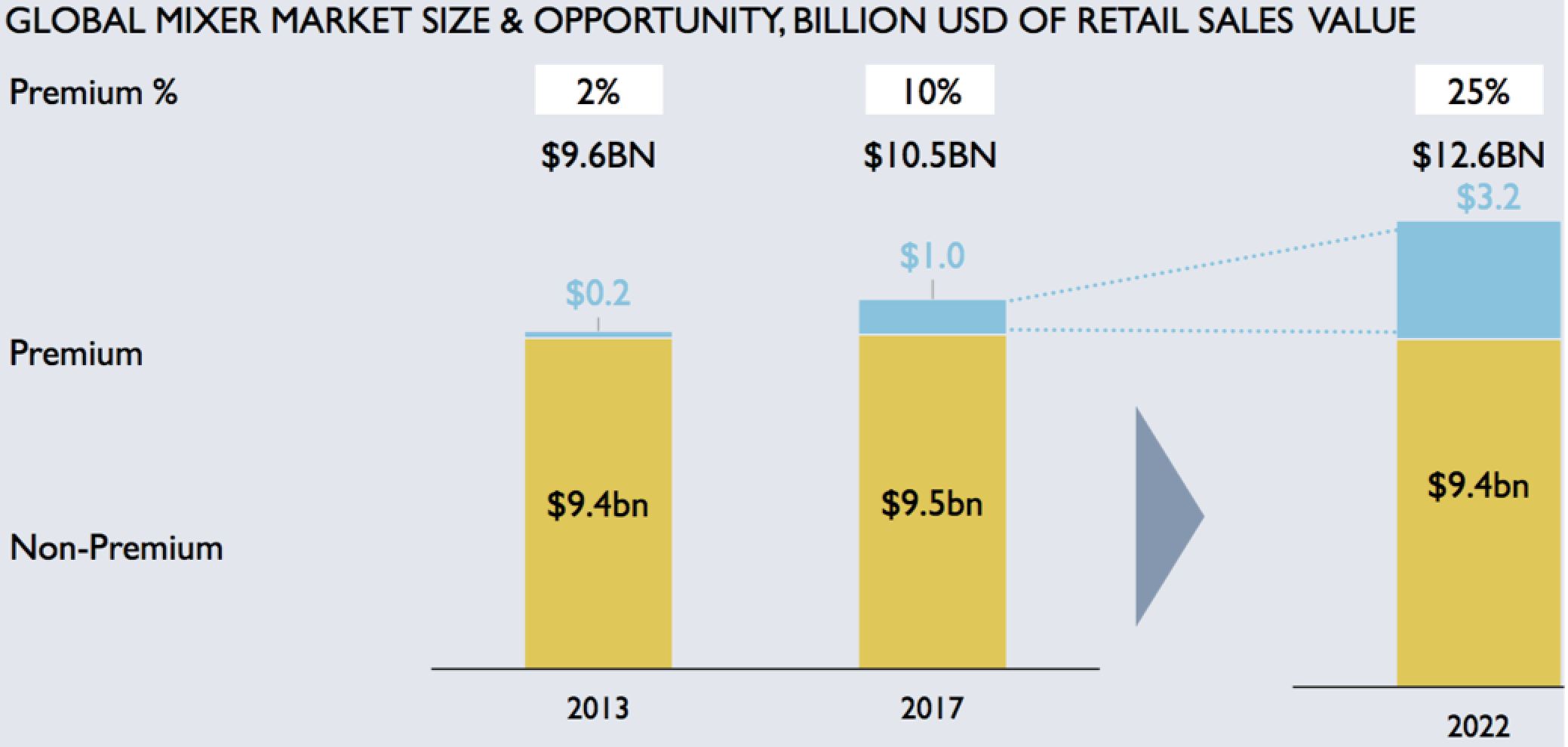
In the UK the premium mixer category has seen its share of total mixer sales increase from 5% in 2014 to 39% share in 2017. Premium mixers had a 10% global market share in 2017 and if this increases to 25% in 2022 we will see a 220% jump in premium mixer sales (from US$1bn to US$3.2bn).
Fever-Tree’s financials are impressive with a 33% operating profit margin and a ROCE of 41% in 2017. The rolling 12-month P/E is circa 64X and the group is now focused on growing sales in the key US soft drinks market.
Premium mixers: the glass remains half full for Fever-Tree
Source: Fever-tree
Summary
Consumers tend to be loyal to their preferred soft drinks brand with Virgin Cola failing to disrupt Coca-Cola in the 1990s. However, Coca-Cola now has to contend with premium and “on trend” new entrants such as Fritz-kola, Karma Cola and Fever-Tree Cola.
UK soft drinks groups need to ensure that customers remain loyal to their key brands. Fever-Tree, Nichols and AG Barr are all delivering on this front but Britvic has struggled in the UK.
The international picture is mixed with Nichols generating a quarter of its revenue from outside the UK. Fever-Tree has significant international potential if it can replicate its UK success on a global basis.
People who buy gin and other spirits are likely to focus on quality rather than their price when it comes to mixers. There is also only room for one mixer brand in bars and for up to three mixer brands on supermarket shelves.
Disclaimer
This is not financial advice. Our content is intended to be used and must be used for information and education purposes only. Please read our disclaimer and terms and conditions to understand our obligations.
10 comments
I'm not entirely sure I would want to buy a couple of long established modest growth companies like AG Barr & Nichols on a PE of 20. Or one with growth barely matching inflation on a PE of 13.8.
A more attractive valuation could get me interested.
The really interesting money would be made spotting the next Red Bull or Monster beverage type growth story. Red bull is of course private, but Monster Beverage has been quoted for a long time. Google charts shows it trading for about $0.01 in 1995 and it's currently on $67 a share.
We may have read the quotes about Warren Buffet saying you can't build a Coca Cola competitor, however we have seen these two companies build profitable businesses on a global scale, in what is only a slightly different market segment.
jonesj - That is a good point. On face value a P/E of 20 looks high for the growth rate. However, I think you also need to factor in the quality. If the ROCE is very high then modest growth also comes with great free cashflow. This is highlighted in the "Invest in the Best" book.
Yes the energy drinks were a huge growth category. The companies that do well seem to find a new category. Fevertree is a good example. These are probably quite rare though. Maybe Nichols can make Feel Good Drinks into a big success. Maybe AG Barr can make cocktail mixer brand Funkin into a big success.
I agree with your overall point that to do well in this area you need a global brand with growth potential. Monster and Red Bull are both great at marketing. AG Barr has an energy drink brand through a partnership: Rockstar.
AG Barr's comments on the Funkin brand have been positive. It seems like a niche area unless we all start making cocktails at home. It is also used in bars I think.
https://www.funkincocktails.co.uk/
Hi,
I'm long on Fevertree and have been for most of the last 3 years. It's been very good to me. I used to drink Vimto as a kid and am interest to take a look at Nichols.
A great, well constructed article. Thanks.
FWIW I agree that sector analysis is interesting and (another!) channel development for Stockopedia (been trying to get Paul Scott hired as a Retail specialist !).
Re soft drinks specifically, I have an interest in this sector from working as an MD/GM and Marketing Director in Soft Drinks and Beverages in emerging markets (Nigeria, Saudi Arabia and Thailand) - although these 3 companies are all UK centric.
For me, Nichols (LON:NICL) and Vimto is the one with most potential as it is a distinctive product capable of being expanded internationally (unlike Irn-Bru which is limited by its Scottishness). One quirk is its link to Saudi where it is absolutely huge as a break - fast drink (ie when you need instant energy that is soft on the stomach and 'better for youafter not eating /exerting yourself) during Ramadan but I think this idea is under-exploited idea globally. Obviously especially in Muslim countries but also, in conjunction with vitamins, elsewhere too - remember when Lucozade was a medical pick me up?
However, in line with the sector-wide thinking, I feel there are some big sector headwinds which make soft drinks riskier than in the past (namely bad for you health vibe ie not just sugar but also acid on teeth, one use plastic, old fashioned drink, distribution costs rising etc). Best hope might be enfolding into Coke or Pepsi distribution network's embrace.
Fevertree is also a high potential but in a very different sector but is surely the greatest marketing story of the past decade.
Thanks Zipmanpeter. I am personally a huge fan of sector analysis. Generally people talk about top down and bottom up investing. But what about looking at sectors? I wrote some articles on sectors in a previous role and they always got a lot of attention. When I write/read sector reports I always tend to learn something.
The questions you are asking are: 1) Is this is a good sector to invest in 2) what are the sector dynamics and drivers 3) which companies are the winners in the sector. So I guess with regard to soft drinks it is a good sector generally to invest in.
Nichols (LON:NICL) - I came to a similar conclusion that this is an interesting company. It is interesting on the Ramadan link. According to one newspaper: "The high sugar level and strong flavour works as a welcome energy boost after a day of no food or drink." It would certainly be good for Nichols if they can make it the drink of choice for the religious festival around the world. It is a distinctive brand.
https://www.bbc.co.uk/news/av/uk-36467997/why-do-vimto-sales-spike-during-ramadan
Sector headwinds - I think most companies have managed the shift to low sugar drinks. Acid on teeth is a good point but you get that from apple juice and orange juice. I think the companies that can shift towards natural ingredients are well placed.
I agree on Fevertree in that it can considered to be in a different sector. It isn't really competing with Coca-cola and Pepsi etc. It is competing with Schweppes in the mixer category. It is also mainly sold to go with spirits. So Fevertree has very different drivers. If you go to Boots, for example, you won't find a Fevertree drink to takeaway.
I also agree that Fevertree is a great marketing story. But if the incumbent, Schweppes, had a poor product then Fevertree was able to get significant customer traction. It started with bars but the spirits companies also wanted to associate themselves with Fevertree.
Tony, Thanks for the positive feedback. I personally find sector type articles very interesting. You are firstly learning about which sectors are good to invest in and which aren't. You are also learning about the drivers of sector success (strong brands, customer loyalty etc). Finally, if you like a sector you are forced to make a relative decision. Which stock (s) in the sector are best given the sector backdrop. When we look at individual stocks it is easy to sell ourselves on a story. What we should firstly ask is if the sector the stock is in is any good and secondly who will be the sector winners.
A.G.Barr (LON:BAG), Nichols (LON:NICL) - I agree with you there they are both reasonable quality companies. Firms that have strong brands/franchises tend to deliver for shareholders.
In case it is of interest some personal thoughts on the stocks. I should caution that I don't have a strong view on the four stocks. On balance the whole of the sector looks attractive but valuations are not bargain basement for three of the four stocks. My thoughts:
A.G.Barr (LON:BAG) - Strong IRN-BRU franchise in Scotland helps reduce the risk profile. Acquisitions appear to be performing well i.e. Frunkin. Appears to be focused on shareholder value with buy-backs a while ago. Limited success outside the UK it appears with only 4% overseas sales (other countries don't get IRN-BRU?). At current valuation it doesn't look like it will shoot the lights out as investment in the medium-term due to limited growth potential. Further acquisitions could provide a boost though. Management looks very good in my view.
Nichols (LON:NICL) - Given the near 25% share price drop from the peak the current valuation could be a buying opportunity. The rating is the same as A.G.Barr (LON:BAG) but Nichols has overseas growth potential. Almost a quarter of sales are from outside the UK. The company also has a robust cash position on the balance sheet. The Vimto brand seems reasonably strong in the UK. This also appears to be a very well run company. The should be able to diversify away from the Vimto brand with the Feel Good Drinks brand appearing to be a good addition to the portfolio.
Britvic (LON:BVIC) - The rating could be a "valuation opportunity." However, it is worth doing a debt adjusted P/E ratio. The latest trading update seemed quite good actually. The current CEO has picked up the pace of innovation. The long-term potential in Brazil could be interesting. An interesting feature is that they have passed through a peak in the capex cycle. Accordingly, capital spending will fall from here and this will help reduce debt. Despite the lower returns than Nichols and AG Barr it is probably still worth looking at. However, I am a bit worried about their acquisition strategy. They appeared to pay a high price for their Brazilian businesses. With the Brazilian economy weak these have not performed well so far. Acquisition driven companies are worth being cautious about. The trouble is they don't have a brand they can take around the world. I think they tried to launch Robinsons fruit shoots in India but gave up on it.
Fevertree Drinks (LON:FEVR) - Agree with you here in that on face value when you look at it the temptation is to say that past momentum cannot continue. However, we really need to look at it on a current market share to potential market share potential. Premium mixers had a 9% market share globally in 2017 and if this increases to 25% by 2022 then premium mixer sales will increase 220%. So that represents significant growth over 5 years. In the UK the pace of growth must slow given that Premium Mixers had a 39% share in 2017. There has also been the tailwind of strong gin sales in the UK. But outside of the UK we could see demand growth continue for Fevertree Drinks (LON:FEVR) for sometime. The crux is how successful they are in the US. But I agree that Fevertree Drinks (LON:FEVR) is a tough one given that it is a high multiple versus the potential. If it stumbles the share price could come back a fair amount.
Good article Andrew like both AGBARR and NICHOLS , in terms of FEVERTREE it has no doubt had a great run not sure if it can continue though , mind you I have been saying that for a while now !!!
Lot of single use plastic in those photos.
I am not an expert on the recycling/environmental aspects. I thought that some plastic is recyclable? The higher-end brands like Fever-Tree and Feel Good Drinks all use glass. Some plastic can't be recycled and may be worse in terms of the taste it gives to the product. Chemicals from the plastic can seep in after a long time period apparently.
Not quite sure on what is environmentally best. Even if you recycle glass/aluminium doesn't that require a lot of energy? Shifting away from single-use and plastic should be a good idea.
From the product perspective, glass bottles seem higher quality. I think this is an issue Schweppes has had with its brand. A lot of its tonic water has been sold in a large plastic bottle. I have never seen a Fever-Tree product in a plastic bottle. My image of Schweppes tonic water is of one of those large plastic bottles they sell. So the brand is permanently damaged in my eyes in terms of quality.
Any soft drink experiences would be great to hear! By way of research I have tried Vimto and IRN-BRU but wasn't a huge fan. But I generally don't drink (sugary) carbonated drinks. I think that Vimto might be a North of England brand in terms of sales given that its started in Manchester.
I love the Feel Good Drinks brand which is owned by Vimto. It is without sugar and uses natural ingredients. http://www.feelgooddrinks.co.uk/ It is absolutely delicious in my opinion!!! The Orange, Passionfruit and Water one is great.
I haven't been a huge fan of Robinsons. Their new Robinsons Refresh'd brand is very good though. I tried Britvic's J2O spritz and didn't like it at all. Britvic has been increasing the pace of innovation under the current CEO and so may get a hit new product at some point. Their capex spending is also set to fall significantly in the coming years.
I quite like Fever-Tree's ginger beer but am not a huge fan of their cola drink. Their lemonade is ok but probably nothing to shout about. Amazing to me that they can be worth nearly as much as the other three UK soft drinks groups combined. I happened to meet someone who used to work at Fever-Tree. The strategy is apparently to continue to release new products. Tonic water was a home run, though, and not sure if there are many more of those for them to go after.
One interesting thing about Fever-Tree is that UK growth has been particularly strong over the last few years. The issue is whether they be as successful in the US and Europe as they have been in the UK? This is the million dollar question. I think it is inevitable that they will grow market share in the US and Europe. This US is the real prize in my view.
The US is the largest single market for spirits group Diageo. Or at least North America makes up almost half of Diageo's profits. It is therefore the key market for Fever-Tree to go after. Diageo's 2018 results fact sheet below. Diageo is one of the world's largest spirits makers.
https://www.diageo.com/PR1346/...
The fund manager Nick Train has a large position in AG Barr. Nichols is one of those stocks that investors like for relatively low risk AIM exposure. Lots of successful smaller company fund managers are in Fever Tree. It was also discussed at Mello 2018 (Boros etc).