Attempting to replicate success - looking for debt turnaround situations

My biggest investing success of the last few years has been Anglo Asian Mining (LON:AAZ) - a gold miner based in Azerbaijan. The combination of steady income, significantly reducing (then vanishing) debt, and the start of dividend payments has led to a complete revaluation of the share by the market over the last three years. I thought it would be worthwhile to try and quantitatively identify the numbers that drove the share price increases, and see if I can find other companies awaiting their own revaluations to invest in. I was also driven by seeing two companies at Mello who presented the same story of debt turnaround. If one can open a position, then have the share price rise significantly, and then the company starting to pay a good dividend, then that's a very good place indeed.
Whenever I reflect on it, I'm always disappointed by the lack of coverage of resource stocks here at Stockopedia. I'd love to see some serious coverage of them in the manner of the SCVRs, looking over the figures and analysing their prospects.
For example, I've always found that mining companies, are much easier to understand that software, fincap or pharma stocks. The basic model is simple - you A) spend years and years spending money and getting nothing back exploring, getting permits, drilling holes in the ground, drawing up a mine plan and getting licenses. Then B) find a lot more money to actually dig a big hole in the ground and buy processing equipment C) actually start producing the stuff and selling it, gradually optimise all your processes, and start to pay back all the money you borrowed, and finally D) once that is stable, go back to exploring at the same time to extend your mine or find a new one before you get to the bottom of your first one. There's plenty of listed companies in each of these phases. I've learnt by experience that the first two phases make for exciting, but very risky investments - much nearer gambling! There are too many risks of complete failure - not getting one vital permit can scupper the whole thing.
Once the finance has been raised and you're into phase C, the risk reduces considerably. There's still the obvious risk of the fluctuating price of whatever it is you're producing (it's much better to be a low-cost producer in terms of effects of this), and a financial risk of running out of other people's money before you're making enough to start paying any back - and indeed it was this perceived risk that I think led to the low point in Anglo Asian Mining (LON:AAZ) 's share price. But once that corner is turned, the risk should reduce considerably. It feels to me that there is a lag before the market fully accepts that the risks are reduced, and that this might be a sweet spot for entering into a new investment.
Let's look at some numbers, running with the example of AAZ (which is now in phase D). One of the good things about Anglo Asian Mining (LON:AAZ) is that it hasn't raised money by dilution - this can be easily seen by looking at the "Average Shares" row on the stock report. This should be a good factor to consider for my screen. Another is the steady revenue - this had been roughly flat since 2010.
So, I've taken data from the historical Stockopedia snapshots for AAZ back to the start of 2015 and chucked them into Excel. The turnaround in the share price started in early 2016 - Personally, I was in too early here, but for once averaging down paid off handsomely.
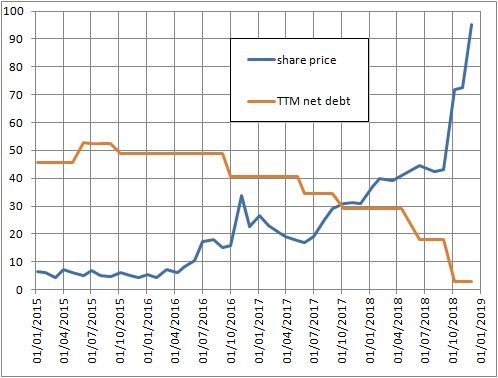
So, my first thesis looks reasonably sound - the share price responds positively to the turnaround in the debt, which from this I would say happened convincingly in mid-2017. Investing at this time would still have given very good returns, at a lower risk than investing soon after the share price had come off its floor.
Let's have a look at the stock rank history:
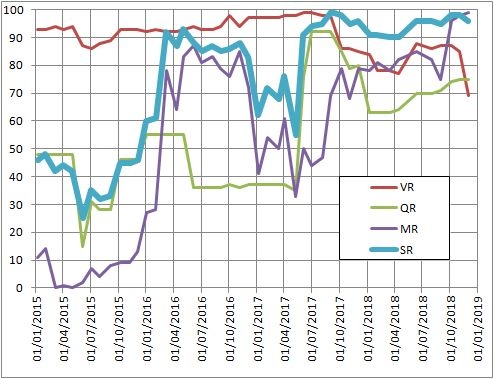
I have to say, I'm hugely impressed by the stock rank here. A rising stock rank does appear to have predicted a rising share price. There are two big rises, the first driven by the momentum rank - which in turn then brings the SR back down again, and the second rise driven by a jump in the quality rank. This does correlate with the debt turnaround so might in some way be driven by that. The value rank has consistently been very high until recently, when the large share prices rises have driven it down. I'm curious about the rise in momentum rank in early 2016 - before the share price had risen significantly. This is perhaps driven by the price having been reasonably stable over the preceding year - it had dropped bumpily down from a peak in early 2011.
So, what factors am I looking for to replicate this success? Here's some to start with:
- reasonably stable revenue
- significantly reducing debt
- increasing stock rank
- stock rank > 80
- steady share count
The stock rank in itself should combine a whole lot of other factors under the cover. I'm not going to look at profit at all, working on the theory that the combination of steady revenue and reducing debt should pick up what I need.
So I tried to make a screen. I've failed on two counts - neither net debt not stock rank have a "n years/months ago" value that I can put in. What is called revenue on the stock reports would seem to be sales in the screening ratios, which is a bit of an inconsistency.
So I've ended up with the following rules:
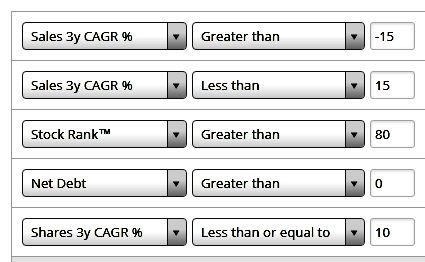
i.e. this pulls out stocks with a high stock rank, steady income, some debt, and a stable share count. I'm not filtering by sector because I reckon these factors could apply across any industry. That's given me 107 shares to work with, from BP (LON:BP.) (Market cap £103bn) down to Tex Holdings (LON:TXH) (Market cap £6.5m). Now I'm going to have to do some rather tedious manual data harvesting to cover what I can't do with the Stockopedia screen. Doing this, it soon becomes clear that many companies are missing the archived report for May, which is annoying. In the end, I've used the TTM net debt and the stock rank from the reports for early December last year. Every company should I'm sure report on net debt at least once a year.
That done, let's filter down those 107 companies:
- exclude those which had net cash 1 year ago. That takes 5 out.
- a reduction of at least 20% in net debt from 1 year ago - i.e. the company has a hope of paying it all off in 5 years. That takes me down to 32 - getting towards a manageable number.
- an increase of at least 20 in the stock rank from 1 year ago. I'm down to 15 stocks - this is a good number to take to the next stage. I'll sort them by debt reduction percentage.
| Company | Stock Rank Now | Sector | Industry | Debt reduction | SR change | Mcap £m |
| Bisichi Mining (LON:BISI) | 81 | Energy | Coal | 94% | 26 | 10 |
| Gateley Holdings (LON:GTLY) | 91 | Industrials | Professional & Commercial Services | 86% | 39 | 147 |
| Augean (LON:AUG) | 80 | Industrials | Professional & Commercial Services | 79% | 25 | 64 |
| OPG Power Ventures (LON:OPG) | 89 | Utilities | Electric Utilities & IPPs | 75% | 38 | 74 |
| Scisys (LON:SSY) | 90 | Technology | Software & IT Services | 63% | 43 | 44 |
| London & Associated Properties (LON:LAS) | 94 | Financials | Real Estate Operations | 62% | 41 | 23 |
| Goodwin (LON:GDWN) | 81 | Industrials | Machinery, Equipment & Components | 61% | 22 | 189 |
| HML Holdings (LON:HMLH) | 82 | Financials | Real Estate Operations | 57% | 43 | 14 |
| Pearson (LON:PSON) | 83 | Consumer Cyclicals | Media & Publishing | 52% | 37 | 7125 |
| Oxford Instruments (LON:OXIG) | 84 | Industrials | Machinery, Equipment & Components | 51% | 40 | 521 |
| Wincanton (LON:WIN) | 97 | Industrials | Machinery, Equipment & Components | 44% | 39 | 315 |
| Morses Club (LON:MCL) | 96 | Financials | Banking Services | 37% | 21 | 171 |
| Walker Greenbank (LON:WGB) | 80 | Consumer Cyclicals | Household Goods | 35% | 31 | 54 |
| U and I (LON:UAI) | 95 | Financials | Real Estate Operations | 33% | 55 | 258 |
| Highcroft Investments (LON:HCFT) | 83 | Financials | Residential & Commercial REITs | 23% | 40 | 47 |
There's a good spread of companies there - but no resource stocks. Those that have had a decent debt reduction (Anglo Asian Mining (LON:AAZ), Rio Tinto (LON:RIO), Anglo American (LON:AAL), BHP (LON:BHP) & Ferrexpo (LON:FXPO) ) have not seen a significant increase in stock rank in the last year. So be it.
The only one of these companies I'm really familiar with and have a position in is OPG Power Ventures (LON:OPG) - who were indeed one of the two companies presenting at Mello who fired off this train of thought - the other was Shanta Gold (LON:SHG), whose debt turnaround progress hasn't really started yet. OPG Power Ventures (LON:OPG) is a bit of a special case - they've managed to divest themselves of most of their debt with a deconsolidation, but what is left ought to fit this turnaround model.
So - I'm going to look at the debt chart on the Stock Report for each of these companies. Here's the pop-up debt chart for Anglo Asian Mining (LON:AAZ) .
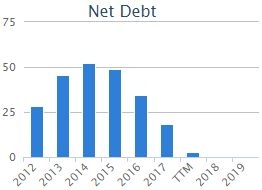
Which of these other companies will show such a clear debt turnaround situation?
Augean (LON:AUG)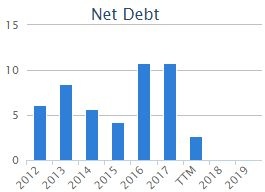 | Bisichi Mining (LON:BISI)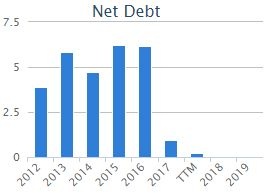 | ||
Goodwin (LON:GDWN)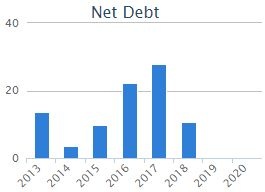 | SPDR BL.BA.UK GILT UETF (LON:GLTY)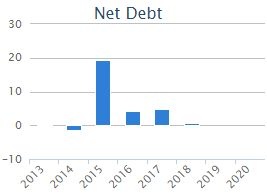 | ||
Highcroft Investments (LON:HCFT)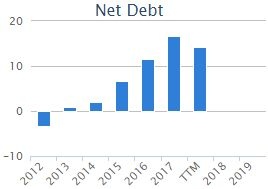 | HML Holdings (LON:HMLH)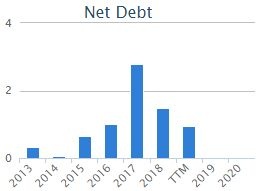 | ||
London & Associated Properties (LON:LAS)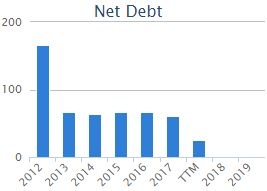 | Morses Club (LON:MCL)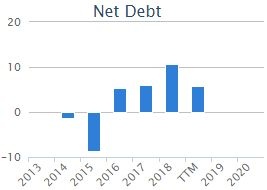 | ||
OPG Power Ventures (LON:OPG)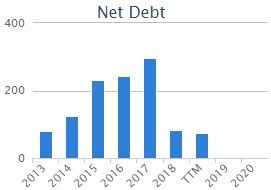 | Oxford Instruments (LON:OXIG)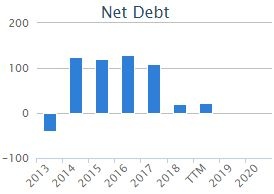 | ||
Pearson (LON:PSON)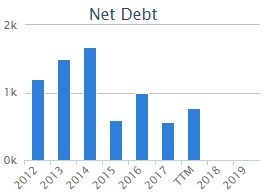 | Scisys (LON:SSY)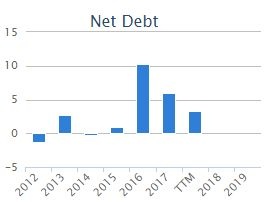 | ||
U and I (LON:UAI)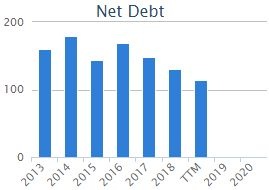 | Walker Greenbank (LON:WGB)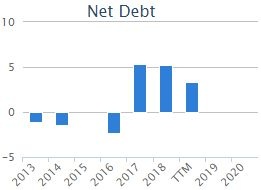 | ||
Wincanton (LON:WIN)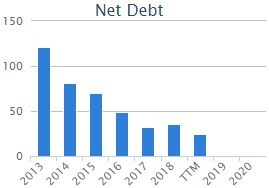 |
For me, the promisingly similar ones here are HML Holdings (LON:HMLH) , Scisys (LON:SSY) & Wincanton (LON:WIN) . One big factor I haven't taken into account yet is the size of the debt, compared to the size of the company. At its peak AAZ's debt was around 8 times the mcap - which is why the rating was so low at the time, and why the transformation in its share price as the debt was paid off has been so dramatic.
For these three - what stands out from the stock reports?
HML Holdings (LON:HMLH) - clearly horribly illiquid. The debt is below 10% of the mcap and it's been paying dividends since 2015.
Scisys (LON:SSY) - also a dividend payer, although it had a break in 2016. Again, the debt is below 10% of the mcap.
Wincanton (LON:WIN) - likewise, the debt is below 10%, although it's only recently crossed that, and has been paying dividends since 2016.
So - none of these three are really similar turnaround situations. Of the rest of the 15, OPG Power Ventures (LON:OPG) and London & Associated Properties (LON:LAS) have debt similar to their mcaps - that is indeed a useful test that I can put in my original screen. Adding a net debt > 50% of mcap rule gets me down to 21 companies, which will make things easier the next time I try this.
So, what about London & Associated Properties (LON:LAS) ? There's been no discussion of it here at all. It passes three guru screens which adds a certain level of reassurance. Looking at the half-year report it "invests in UK retail and other property" but also, coincidentally, has a "substantial investment" in Bisichi Mining (LON:BISI) ! The recent big reduction in debt seems to be mostly due to the recent sale of Brixton Markets. It's fairly clear that it doesn't really fit the kind of profile I was looking for.
So - I've come to the end and drawn a blank. That's not necessarily surprising, or a bad thing. Perhaps I need to loosen my criteria a bit, or perhaps I just need to wait for the turnarounds to turn up. I still think the original idea is sound. It's clear too that being able to report on and screen for changes in the Stockopedia ranks would be incredibly useful.
Disclaimer
This is not financial advice. Our content is intended to be used and must be used for information and education purposes only. Please read our disclaimer and terms and conditions to understand our obligations.
15 comments
Hi Retired Bear
I have been a shareholder in Anglo Asian Mining (LON:AAZ) since 2016 and the price volatility does take a bit of getting used to, although it is better now than it used to be. The shares are very illiquid due to the lack of them - the company has not diluted shareholders, as per the original article above. These days there is sufficient daily volume for people to trade them in smallish amounts and via spread betting (sell the news, react to short-term gold price moves etc.).
This leads to the type of reaction we have had this week in response to the 2019 production and operations update which was excellent, including confirmation that debt will be cleared entirely next month and a signal that the final dividend will be raised again - as per their progressive dividend policy. Alas, one of the downsides with AAZ is that they don't publish full year results until May with ex-divi in June and dividend payment in July. That's just the way it is but does leave quite a gap between knowing the numbers will be good until the actual publication of results.
Shareholders have been promised an exploration update during Q1 (I would also expect to see 2020 guidance published next month, as per usual) which could provide some excitement between now and results publication.
Hope that helps,
Simon
Thanks Simon perfect
Thanks grb a very comprehensive analysis of the frustrations that are "desperately seeking" the next skyrocket. I have recently invested in AAZ as a result of gold moving out of its trading range. It ticks a lot of my boxes and ranks as the best gold/silver stock i can find on the UK market. the recent report was good, unless I have missed something, so why is it still traveling in a southerly direction? Your thoughts would be appreciated
Thanks monty, good to know its not just me! For anyone that is interested, the Hardman note published last week is a great introduction and this interview with the Hardman analyst is enlightening also: https://www.directorstalk.net/interview-anglo-asian-mining-outstanding-cash-generation/
The key things are prodigious cash generation, a 7c and growing dividend, and the chance that it is sitting on a very sizeable discovery indeed
AAZ is indeed a rare beast and is a missed opportunity on here due to not being recognised.
a miner that produces and sells its commodities, with lowest quartile cost of production, nil debt, a board that own 40% of the shares (making them aligned), a growing dividend and fabulous cash flow.
Discounted car flow or graham valuation method both show how much this stock is undervalued
Based on today SP of 120p Graham is 240p and DCF is 220p
The lack of coverage of stocks like Anglo Asian Mining (LON:AAZ) on Stocks does astonish me. You have a company here that is growing strongly, paying a sizeable dividend, with huge cashflow, debt free, relatively recession proof, with all of the Stocks indicators suggesting it is absolutely top drawer, and yet there is no discussion. The AGM last week had about 30 knowledgeable private investors who have seen the share price triple in the last year, a new note from Hardman praising its prodigious cash generation and yet the awareness here is minimal. It is really baffling, especially when so many UK companies are in the doldrums. I am a big fan of investing in the sector where it is easiest to make returns, and at the moment profitable, debt free miners are in a sweet spot. I really wish Stocks gave more prominence to mining companies so others could see this: as it is I feel that there is an inherent bias towards stocks that do not have such great value and growth traits.
The combination of steady income, significantly reducing (then vanishing) debt, and the start of dividend payments has led to a complete revaluation of the share by the market over the last three years.
Precisely that is happening with Ariana Resources (LON:AAU). SInce production commenced just over a year ago over half the bank loan has been settled on schedule and cashflow been steadily increasing. You may wish to take a closer look at it. In addition to current production there are considerable additional resources coming on line in the medium term.
It may have slipped under the radar but Pan African Resources (LON:PAF), a South African Gold producer, could be worth further investigation. Basically, it has gone through a successful restructuring. This involved closing most of its loss-making underground operations at Evander. At the same time, it invested heavily using debt finance in developing its Elikhulu tailings operation. It's now a low-cost Gold producer (Its all-in sustaining costs are around ZAR445,000 per kilo – current Gold price around ZAR582,000 per kilo) with several avenues for further development within its current licences.
In terms of borrowings, it now has some £102 million of net debt (As at the end of 2018) due to be repaid in 2022. However, it had a two-year repayment holiday. The debt repayments have begun this month (April 2019). Importantly, the debt used to develop Elikhulu was based upon the assumption of a Gold price of ZAR16,319 per oz; over the past two years, it has remained largely well above this level. And the price now sits at about ZAR18,098 per oz.
Having successfully delivered Elikhulu on time and within budget, much now rests on the Gold price. And, of course, it's based in South Africa so it has associated political risk. But the most difficult part of the restructuring appears over.
It has been a high dividend payer in the past. But recently suspended its dividend. It's my understanding that it wishes to reintroduce the dividend as soon as is practically possible.
As you pointed out, Stockopedia does not seem to give much attention to resource stocks. That said, many are of very poor quality and present little opportunity for investors. More broadly, in my opinion, it's an area that is inherently risky and capital intensive.
By the way, I am invested in Pan African Resources (LON:PAF).
Oh, and I had better add that I am invested.
Thanks for a beautifully presented piece. I agree that Stocko should have a section on resource stocks and I also find myself agreeing that they can be easier to analyse. This is especially true when there is an increase in demand for the resource or even an increase in its price. Strangely, the market can be slow to react.
Slightly off topic but I'll throw in one teaser for you Trans-Siberian Gold (LON:TSG) . The drawback with this company is that it is 80% held by a Russian investment fund. On the plus side it is one of the lowest cost gold producers, pays fat dividends, its net profits are set to double and its stock rank is 91.
H GRB,
A great post. Well constructed and presented with all the facts detailed. Great work.
I also have also recently been studying how to recognise early, the signs of a company that should start to outperform (based on trying to emulate success I have had with a stand-out stock). Your conclusions were similar to mine.
Often, its different underlying fundamental improvements that are the catalyst for a major SP improvement.
I suppose constant and sustained reducing debt levels is also indicative of strong cash generation and good use of retained capital and prudent financial management. All important factors in a good business. I'm going to try to introduce a similar debt reduction factor into one of my filter screens and see how it pans out.
Thanks again.
Mark.
I held Indivior (LON:INDV) from spinout from RB (getting below 150) and sold earlier this year at 460. Newsflow has brutalised it and sadly I did buy a half position at 180 recently before it was cut down to 100ish today. There's a lot going on but part of the thesis was working off debt rapidly. Its now a turbocharged opportunity but with huge regulatory risks thrown in
I've only skimmed the above article so apologies if I'm off topic. I hold AA (LON:AA.) and Shanta Gold (LON:SHG) from a debt work out perspective leading to high margin business getting re-rerated. SHG is an 18 mth perspective and AA think 5-7 years. The debt load on AA is so preposterous though that it wont shed it in 5-7 years...it just needs to show it has a franchise that's valuable, that it can find top line growth ahead of underlying cost inflation and can payback some of the debt which leads to a 10 bagger from today's price ;) Shanta's a bit simpler and quicker but only 3-5 bags unless gold goes up and holds a few hundred points more and/or there's a transformation in its relationship with Tanzania govt (its on the positive side with them so not ludicrous but speculative to think upside to it like preferential treatment around licensing and taxes).
Thanks for this - really interesting.
I'm also in AAZ since 47p, in part because it had a good stock rank when I was looking.
GFM recently cleared their debt, but zinc prices and poor communication from the board seem to have resulted in a dire share price performance (my view). Maybe worth a look though? They have a good stock rank.
Sticking with resource stocks, CAML took on debt to buy out the Sasa mine. I expect this to gradually reduce and for the SP to increase in tandem (aside from fluctuations in metals prices). They produce copper, zinc and lead, and pay divis. Poor stock rank though - the worst in my portfolio
SLP have been cash positive for a good while, but recently paid their maiden dividend. The market doesn't seem to have rewarded this appropriately (in my view), and they have a great stock rank
CARD recently achieved super stock classification. Debt actually rose in the interim statement, but this was apparently seasonal. If this reduces over the next couple of years, I'm hoping sp increases in tandem. They're also cheaper than their float price a few years ago, despite opening a ton of new stores, and have a very attractive dividend
I think the unusual thing with AAZ is that the CEO lent the company £4m of how own money in 2016 rather than dilute via a fundraising and this is prob because the board own circa 30% of the issued shares. undoubtedly the complete reduction of debt has helped enormously but I also think the company is exceptionally well run with mining costs in lower quartile at circa 530usd per GEO. very exciting times and have held since 2014.