Bioventix plc: A multi-bagging profitable ISDX healthcare stock set for AIM

Bioventix (OFEX:BVXP) specialises in the development and commercial supply of high affinity monoclonal sheep antibodies for applications in in vitro clinical diagnostics. Its client base includes the top five global diagnostic companies.
Bioventix is not, however, a typical blue-sky biotech company. It is profitable, cash generative, debt-free and dividend paying.
Highlights
• Market Cap. £21.4m
• Revenues have quintupled at a CAGR of 13.2% over the last six years;
• Pre-tax profits have increased at a CAGR of 20.3% over the same period;
• EPS has increased 134% since 2009;
• Dividend yield of 3.2%;
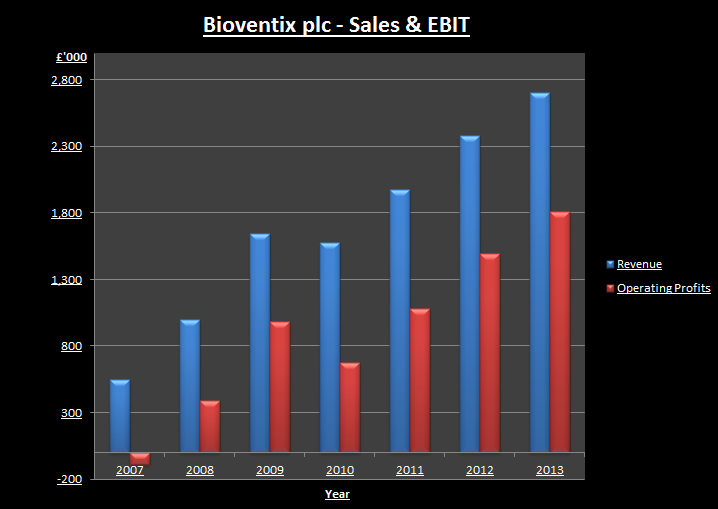
• Operating margins hit 67% in 2013 and are set to go higher in 2014;
• Return on Equity in 2013 was 36%;
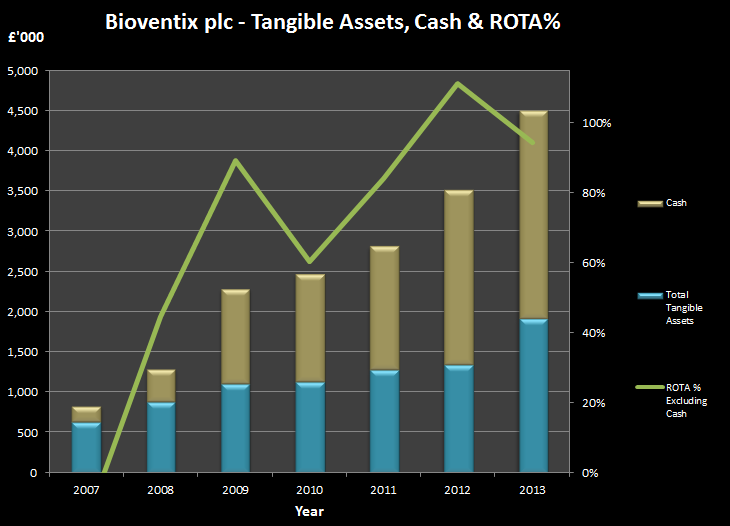
• Return on Total Assets (excluding the surplus cash on the balance sheet) is a staggering 94%;
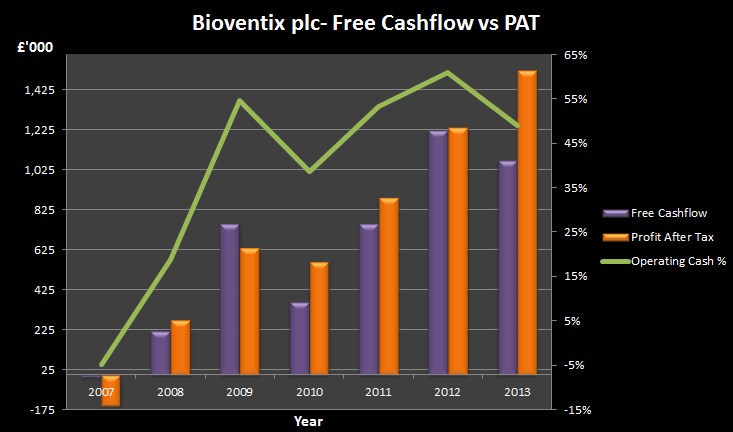
At the current offer price of 450p Bioventix trades at only around 12.5x my 2014 EPS estimate of 35p. This represents an earnings yield of 8.0% which historically has been backed almost 90% by free cash flow.
The annuity style nature of the Company’s revenues (and the development of new anti-bodies) should see EPS grow at between 15% and 20% p.a. for the foreseeable future (at least until 2020 and in all probability well beyond).
What are the catalysts for the shares to trade higher in 2014?
First, the Company is planning a move to AIM from ISDX in the current year. This should mean a more active market in the Company’s shares and a higher valuation.
Second, the Company is holding a big cash buffer. It is actively contemplating a special dividend or raising the pay-out ratio from the current 50%.
Third, House Broker finnCap is assuming only a modest increase of 3.2% in EPS to 32.2p in 2014. I believe EPS will come in much higher at around 35p once adjusted for the costs of the planned AIM listing. finnCap has EPS rising to 37.7p in 2015 but I believe EPS will be higher at 40p or more.
Fourth, despite its cautious EPS forecast, finnCap has a target price of 600p. See the link below to their research.
History
Bioventix was previously an antibody technology laboratory owned by KS Biomedix. In September 2003, KS Biomedix was acquired by Xenova Group plc. In December 2003, a management buy-out was completed. Funding for the MBO was provided by Springhill Bioventures, a biotechnology venture capital fund specialising in bridging technologies and funds between East and West. Springhill, which is closing its fund, sold its entire stake between December 2012 and June 2013 to various UK equity funds, including Miton Asset Management, Henderson Global Investors, ISIS Equity Partners and a group of private investors (including me).
The Business
Bioventix develops sheep antibodies that are used by larger diagnostic companies for clinical diagnostics, a $7bn end market. Sheep antibodies produce better results than either rabbit or mice based antibodies. Bioventix earns fees during the development phase, and a perpetual royalty on sales of any diagnostic that uses its antibodies. Sometimes, Bioventix is paid for the development. In other cases it funds the development based on its own ideas and market intelligence. There are currently six diagnostics assays on the market that contain a Bioventix antibody and contribute meaningful royalties, the most significant of which is NT proBNP, a cardiac marker. There is also a pipeline of other assays which are expected to be launched over the next few years, as well as a development pipeline of new antibodies which have yet to be licensed. Not all deals are exclusive: Bioventix’s vitamin D antibody (vitD3.5H10) for example, has been launched in assays by two companies, and is presently under development by 10 others.
On average it takes one year for Bioventix to create, isolate, purify and clone an antibody. It can take a further two to four years for its clients to develop and validate an assay based on this antibody, and to gain regulatory approval.
Several of Bioventix’s antibodies are currently in use in commercial diagnostic tests. Given the non-exclusive nature of many of the commercial agreements, assays for any given analyte that rely on a Bioventix antibody may have been launched by more than one client. The Vitamin D antibody for example was developed at Bioventix’s own risk and has subsequently been licensed to 12 diagnostic companies, of which two have launched assays to date with more launching test kits in 2014.
The key barrier to entry/change is the regulation of in-vitro diagnostics. Once a company has developed an assay using one of Bioventix’s antibodies, and gained regulatory approval, there is a significant amount of work required in order to change the antibody in that assay, and a new regulatory approval would have to be sought.
Summary Financials 12 months - June 2013 (see graphs and financials spreadsheet in the link below)
Sales £2.7m (2012: £2.38m)
EBIT £1.8m (2012: £1.49m)
Unadjusted EPS 30.3p (2012: 24.6p)
Dividend per Share 14.6p (2012: 11.4p)
Operating Cash Margin 49% (2012: 61%)
Average Free Cash Conversion 86% (2008 to 2013)
Cash £2.6m (2012: £2.18m)
Net Assets: £4.2m (2012: £3.3m)
Weighted Number of Shares: 5.025m (2012: 5.025m)
Graphs Showing Performance Since 2007
The Pipeline
The Company has four antibodies which have been licenced and are expected to reach market between now and 2016.
| Analyte | Market Launch |
| Tacrolmus | Now |
| Progesterone | Now |
| Cortisol | 2015 |
| Troponin | 2016 |
The most important of these is Troponin which is being developed in conjunction with a big 5 diagnostic company. Troponin is useful as a diagnostic marker for various heart disorders, including a highly specific marker for myocardial infarction or heart muscle cell death.
Perhaps the most important fact to grasp about Bioventix is that 75% of its staff dedicate their working day to developing new antibodies which will not reach market until after 2020. All the associated R&D spend is fully expensed each year. The Company is in the process of building deep value for the long term whilst benefiting in the short to medium term from the annuity revenues already secured.
The Negatives
• The Company relies on a very small team of highly educated and dedicated employees and on a very professional, intelligent and experienced CEO (Peter Harrison). He has developed close and trusted relationships with many of the world’s leading diagnostic companies. Revenues through to 2020 would not be adversely impacted by the loss of a key employee but would suffer in the long term.
• The Company is reliant on the diagnostic companies who licence its antibodies to bring assays to the market.
• The shares currently trade on ISDX and are very illiquid. At the current share price none of the institutions who purchased shares in 2012/13 are willing to sell. I think the share price will eventually be forced up to much higher levels.
• In 2017, the Company will lose royalties of approximately £400k p.a. attributable to the licence of its NT proBNP antibody. These revenues should be more than offset by Troponin which should launch in 2016. All new antibodies are licenced on a perpetual basis but some of the older ones were time limited.
• Competitor risk in the area of sheep antibodies is low but not zero. The main competitors tend to be the diagnostic companies themselves using mice or rabbit antibodies. Bioventix’s niche in sheep antibodies gives it a natural edge where there is complexity and a need for highly sensitive assays.
• Limited visibility. Royalties are calculated by the diagnostic companies and are currently reported to Bioventix after the end of each accounting period. More than 70% of the Company's income (represented by royalties) is not known until around two to three months after the relevant accounting period, so Feb-March and Aug-Sept each year. As royalty revenues rise so debtors at the period ends are getting larger but are collected quickly. The risk of a bad debt is very low.
Conclusion:
I believe Bioventix on a risk adjusted basis will be one of the top performing shares over the next seven years. It has something for everyone, whether it be value, growth or quality.
Links:
Bioventix’s Website and 2013 Accounts:
http://www.bioventix.com
http://www.bioventix.com/index_htm_files/FinRes20122013.pdf
Historic Financials Spreadsheet:
http://cl.ly/TDcl
finnCap Initiation Note (September 2013):
http://cl.ly/TDWj
Disclaimer
This is not financial advice. Our content is intended to be used and must be used for information and education purposes only. Please read our disclaimer and terms and conditions to understand our obligations.
4 comments
Is this all your work Boros ?!
Superb small company that has been on my hit list for a few weeks. The bid offer spread was 500/575p when I phoned my broker today, that's a hefty 15% to clear plus charges. Now checking again it is at close 525/625p, that's over19%! ( I was unable to deal on line because it was ISDX). However with the share price rising the way it is, it should not take too long to be in profit and that would make it all worth it. Thank you Boros for sharing this with us.
Cheers from Lightningtiger
No, but I suspect it might coincide with the release of the 2013/14 results in the autumn.
Do you have any idea of when the planned move to AIM will take place?
Cheers
Mike