Boardroom battles and profit warnings: How Superdry went from high flyer to contrarian value stock

On the first trading day of 2018, shares in the fashion retailer Superdry hit an all time high of just over £20. The fast-growing chain was brimming with confidence and there didn’t seem to be any major causes for concern. Yet 17 months later, the value of those shares had fallen by more than three-quarters and the company was in a mess.
A rapid run of events wreaked havoc on the business and its shareholders. From a picture of harmony and global ambition it was sucked into a spiralling trading slump. Its founder Julian Dunkerton, left the business and later fought his way back. But by then (and perhaps before) the damage had been done. Superdry’s market cap has fallen from £1.6 billion to just £370 million, and the recovery effort was on.
While all eyes are on whether Mr Dunkerton can re-find former glories and breathe life back into Superdry, there are some interesting observations about what has happened here. For a start, it’s been a case study on the corrosive effects of multiple profit warnings - and why it can pay for investors to get out of these kinds of troubled stocks as early as possible.
It’s also an example of how a stock’s quality, value and momentum interact with each other. In terms of investment profile, Superdry has made a rapid and well defined switch from being a High Flyer to a Contrarian share. Where once it looked like a pricey, fast moving growth stock, now it arguably resembles a value play. So depending on how you see it, there could be reasons to be cheerful about Superdry... even now.
When things go wrong
Ever since its IPO in March 2010, Superdry shares have had mixed reviews.
On one hand, it was touted as a profitable, fast-growing British fashion group with a lot to like as an investment. On the other, naysayers claimed its brand was a busted flush and that its young ‘influencer’ clientele had long gone, even before it floated.
Within a year of floating, the price had soared from 500p to more than 1800p. But that gain was wiped out over the next 12 months as the growth rate slowed and the company hit distribution problems. Then came the first profit warning.
In April 2012 Superdry had to admit that some of its profit forecasts were off the mark. In terms of seriousness, it looked more like a daft error than a structural problem. But that didn’t stop the shares falling by 38% to an all time low of 338p on the day. The only upside was that the drop put a floor under the price, and the momentum soon turned positive again.
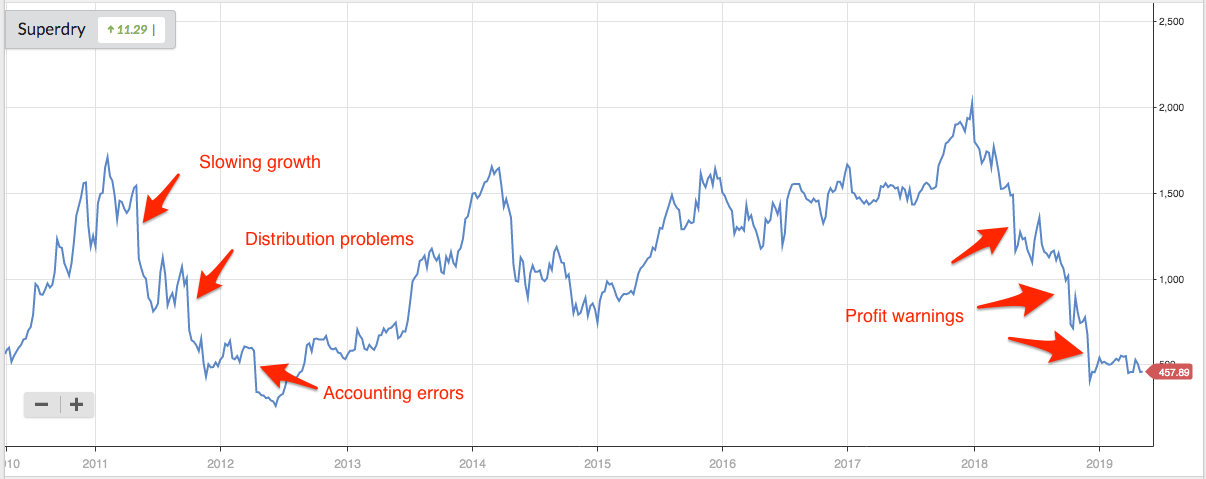
But over the past 18 months the market has been far less forgiving of Superdry’s profit warnings…
Before touching on them, it’s worth a quick reminder that Stockopedia research into the typical profit warning suggests that it can be well worth getting out early on bad news. Our study of 245 profit warnings found that, on average, most are preceded by up to six months of negative momentum.
In addition:
The average profit warning results in an on-the-day price fall of 19.2%
Profit warnings tend to be followed by further price declines for up to three months
Over 12 months, the price generally doesn’t recover
In most cases, companies only issue one profit warning (they don’t always ‘come in threes’)
So how did the past 18 months at Superdry stack up against these findings?
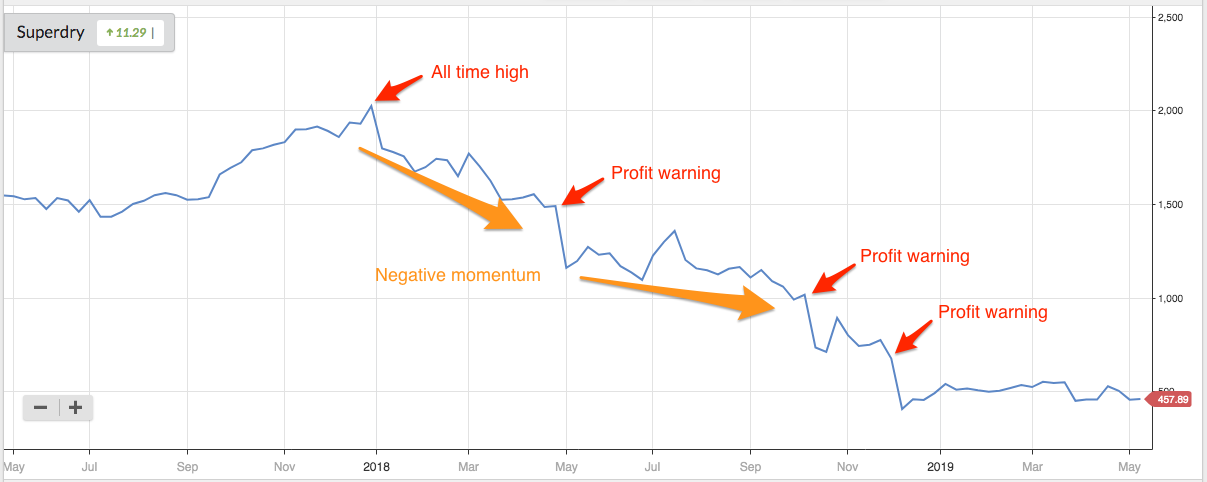
After hitting a high at the start of 2018, the shares had slid by 25% before the first profit warning in May. In that period, the company issued a trading update and, separately, Julian Dunkerton left the business. On the day of the first profit warning, the price slumped by 22% - tallying with what we tend to see with these events.
The next two profit warnings came in quick succession, between October and December 2018. The first, again preceded by months of negative momentum, saw the price drop by 27.8%. The second (and the third in total for the year) saw an on-the-day fall of 40% - taking the price to 405p.
What was happening? The backdrop was that Superdry’s share price was suffering from sustained negative momentum. With each profit warning, the severity of the price drop increased. Investors who were hanging on for a bounce just didn’t get one. In April, Dunkerton won his battle to retake control of the boardroom. But at the current price of 457p, there hasn’t yet been any meaningful recovery in the price over the past five months (in fact, there was another profit warning).
Did Superdry just become a value play?
For owners of Superdry stock, the falling price has been dramatic and disastrous. But when you look at it through the lens of market factors like Quality, Value and Momentum, you can get an interesting new perspective .
Take quality. Based on classic measures of company and financial quality, Superdry has always scored well. In recent years it’s rolled itself out very profitably. Its long term return on capital employed stands at a solid 17% and long term operating margins are 11%. As such, it’s been a very cash generative business. Whether you believe in the power of its brand or not - it seems to have served it well.
On its own, of course, quality is no guarantee of success. Until recently, Superdry’s second strong card was its momentum. Its price doubled from £10 to £20 between 2015 and 2018, helped by earnings upgrades from brokers and a fair wind.
Based on Stockopedia’s StockRank Styles framework, strong exposure to both quality and momentum put Superdry squarely into High Flyer territory. These kinds of businesses can be very profitable investments. But when the momentum crumbles, like it did here over the past 18 months, the de-rating can be swift and painful.
High Flyers that lose their momentum often end up being what we call Falling Stars. They’re the stocks where quality remains intact but their valuations are still stretched despite their falling prices.
That’s not been the case with Superdry. In surprisingly quick time, the declining momentum has given way to a sharp improvement in its valuation. By their nature, these two factors do move in opposite directions: positive momentum can make assets more expensive and vice versa. But in this case we’ve seen a very stark example where the momentum and value ranking scores have flipped (see the 18 month change below), leaving the overall StockRank little changed.
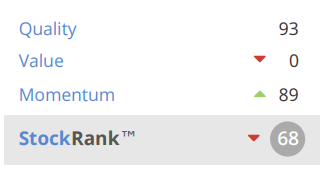
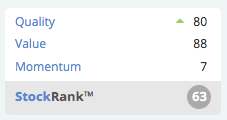
From a factor perspective - ignoring the noise of boardroom bust ups, strategic errors, questions over the brand strength and the high hopes of a founder riding to the rescue - this looks like the makings of a possible Contrarian value play. But that’s a lot of noise to ignore.
What next for Superdry?
Three profit warnings and no guarantee that Mr Dunkerton can salvage the share price mean that the future is far from certain. If you were to follow the findings of our profit warnings research, then it’s reasonable to think that it could be on the ropes for some time to come. Things may even get worse.
But of course, Contrarian stocks like this are perilous by nature - and it's exactly the kind of scary territory that bargain hunters love. It's no coincidence that after its difficult year, Superdry passes the rules for 10 of our Guru Screens - and seven of them are bargain and value strategies. Among those are three of the value strategies based on the approach of the arch-contrarian, David Dreman.
From an investment style perspective, it’s interesting to see how Superdry’s momentum and value exposure have switched. From a High Flyer it now has the profile of a Contrarian value share. This is a positive style - but if the valuation appeal starts to evaporate or if Superdry’s business quality deteriorates, then there could be more problems ahead. But if Julian Dunkerton can regain the faith of the market, and get the business back in shape, then the momentum could eventually return and the shares could be flying high once again.
Disclaimer
This is not financial advice. Our content is intended to be used and must be used for information and education purposes only. Please read our disclaimer and terms and conditions to understand our obligations.
4 comments
Personally, and I’m sure many others are thinking the same, I’ll wait for Dunkerton to get year end out the way and look to buy in, maybe even before results day and dribble in. I’ll probably even set my stop loss around 40% as I think there’s plenty of life left in Superdry as a brand.
I’ll probably learn a good lesson about hubris but my eyes are open to the wipeout risk
Rarely do founders of Businesses make good leaders when these businesses have grown massively, as different skill sets are required to keep the business growing and focus becomes tiled towards logistics, processes and controls rather than outright creativity and product innovation.
Key is the team around Dunkerton as to whether this company will survive. Personally I think the brand has moved into the older generation territory- nothing wrong with that - but it needs to be managed as such and recognize this. So mid 40s dads who might have skirted with M&S now might prefer Superdry. This can still be a profitable market if the company wakes up to this.
I agree re the need to have various skillsets as a business grows. But a 'logistics expert' or a 'manager of controls' is rarely going to inspire a company or customers.
An example of a leader who has, either directly or indirectly masters logistics, processes and controls is Jeff Bezos.
Re branding and target customers - it may not be a bad thing to aim for mid-40s dads. But the other way to consider that is that the brand focus drifted when Dunkerton left.
For consumer brands it is also worth considering who a brand uses for advertising, who it advertises to and who buys - eg luxury handbag brands often use young women and try to appear 'edgy' yet their biggest (in terms of spending power) customers may be a different demographic.
I think there is an important issue that you have not dealt with - management change.
A business such as Superdry needs a passionate leader - not all management is 'by the numbers'. It may sound heresy but I think the market missed the internal loss of motivation at Superdry and the 'dash for growth' by attempting to put the Superdry brand on things that were outside its core area and pumping it into wholesale.