Caffe Nero - tax avoidance allegations - valid or not?

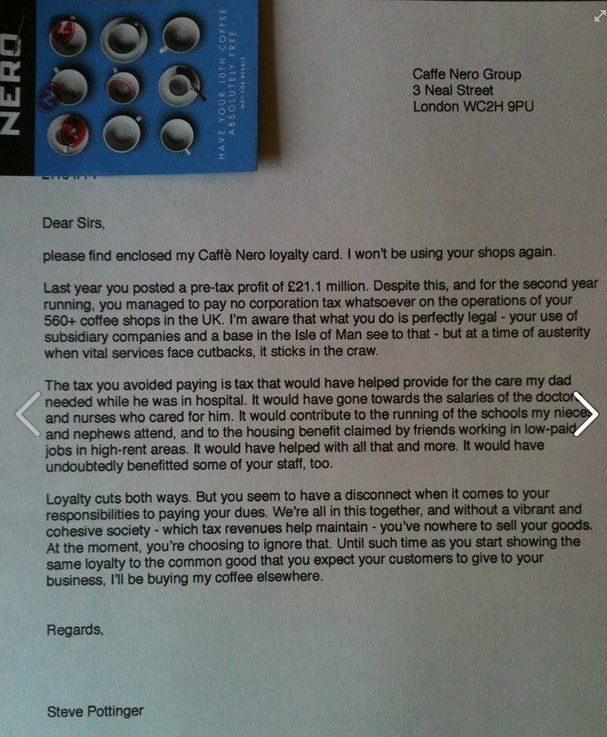 There is a well-written letter doing the rounds on Facebook written by someone called Steve Pottinger, in which he returns his Caffe Nero loyalty card to the company, saying that he will not be a customer any more, due to the fact that the company made a profit of £21.1m, yet paid nothing in Corporation Tax (the UK's tax on company profits, currently charged at 21% of profits).
Groups like "Occupy" have been vocal about tax avoidance in recent years, and rightly so in my opinion. It's a disgrace that international companies treat corporate tax as optional.
Of course it's also a disgrace that the tax system is so riddled with loopholes that it is possible to structure corporate affairs in such a way that tax can be avoided.
However, what interests me is whether we can get to a point where consumer pressure & boycotts do so much damage to companies which engage in aggressive tax avoidance, that they are forced through self interest into paying their fair share in tax? This is an interesting way in which people power, through the internet, could change things for the better.
Some people think that tax avoidance is laudable. I think that is perverse. How on earth are we going to pay for schools, hospitals, and everything else, if everyone is trying to wriggle out of paying their fair share? A social conscience is important, and more people need to develop one. Equally, the tax system needs to be reformed so that opportunities to avoid tax are eliminated.
Anyway, I have often found that previous Occupy campaigns have been ill-informed, e.g. they don't understand the basics about companies being allowed to carry forward tax losses from previous years, etc. Therefore I decided to do a little digging on Caffe Nero's accounts, to see if Steve Pottinger's letter to them is justified or not.
I downloaded the accounts for Caffe Nero Group Ltd (co. no. 4129005), which are clearly the main group accounts for the UK operations of Caffe Nero - the registered office is 3 Neal Street, London, and the principal activity is given as the operation of 519 Caffe Nero branded stores in the UK.
As you can see from the group statement of comprehensive income below (the P&L basically), this group paid nil corporation tax in both years ended 31 May 2012 and year ended 31 May 2013, despite making a pre-tax profit of £19.1m and £21.1m respectively.
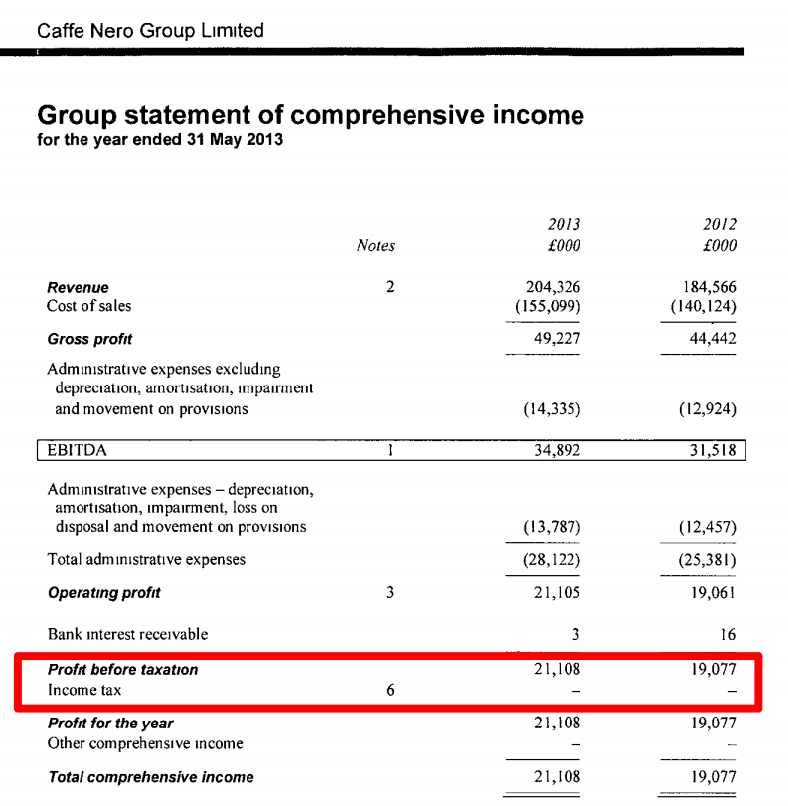
This looks very odd. A UK company, operating in the UK, which is decently profitable, yet paying nothing in Corporation Tax. How can this be?
Note 6 to Caffe Nero's accounts explains how they have reduced their Corporation Tax charge to nil in both years by claiming group relief.
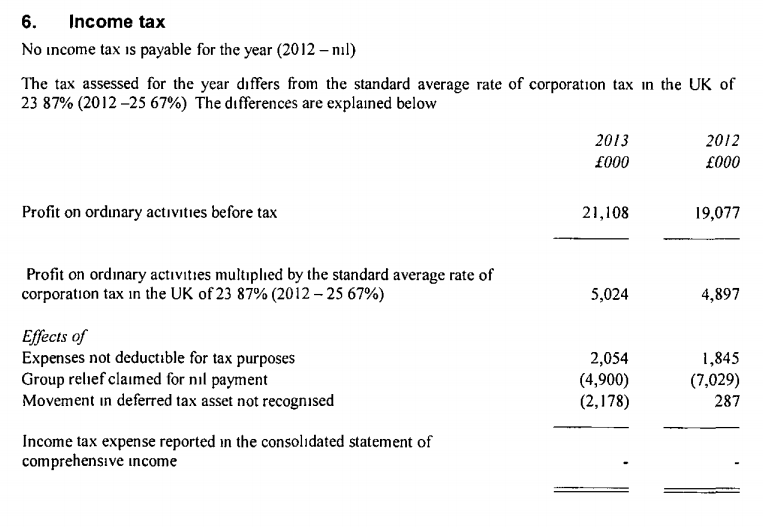
Whilst I have some basic knowledge of Corporation Tax, I'm not an expert in this complex area. However my understanding is that groups of companies can offset profits in one company against losses from another. So presumably this must mean that there are offsettable losses elsewhere in the group?
Note 22 to the accounts from Caffe Nero Group Ltd shows that its ultimate parent company is Saratoga Limited, an Isle of Man company. There is also an intermediate holding company based in Luxembourg called Rome Holdco Sarl. Another company called Rome Pikco Limited is also somehow involved in the group structure.
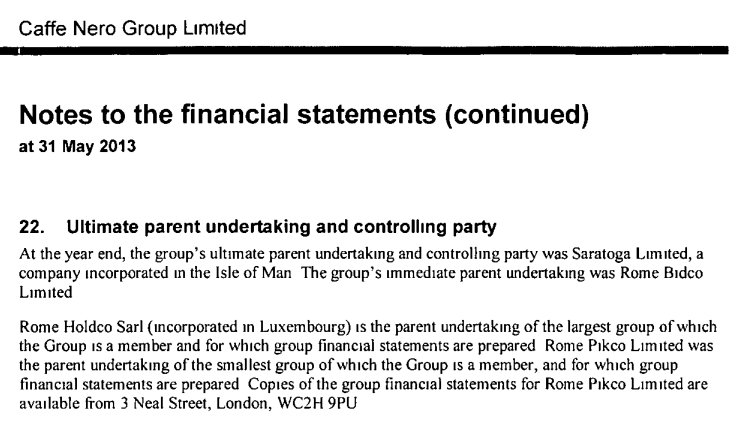
Let's not beat about the bush here - there is only one reason why a UK business would have a complicated group structure using Isle of Man, and Luxembourg companies - which is that they are seeking to avoid paying Corporation Tax.
There was a totally unconvincing rebuttal from the company's CEO in Nov 2012, as clearly this issue has been rumbling away for a while now.
Private Equity often avoid tax by making large shareholder loans, at high rates of interest, to companies they buy. Since interest is tax deductible in UK tax law, that reduces their Corp Tax liability to nothing in many cases. There is evidence of something odd having occurred along these lines, but the other way around at Caffe Nero. Looking at its Group Balance Sheet, there is one glaring anomaly - namely the £105m Other receivables. Since retailers sell products for cash, they don't usually have any receivables at all, apart from some modest rent & rates prepayments. So what could this possibly be? (see below):
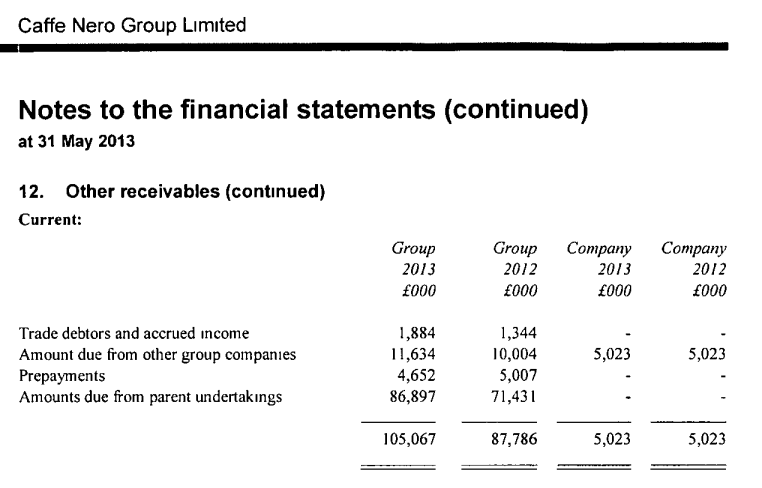
It appears that the holding companies above Caffe Nero Group Ltd ("CNGL") have stripped out its cash through loans from CNGL to its owners. It is not clear why CNGL is owed this money by its shareholders, and it does not appear to be charging them any interest on these loans, if that's what they are?
Overall then, whilst I haven't investigated the trail any further up the group to the ultimate holding companies, it is blindingly obvious that this group has been structured in this way, with Isle of Man and Luxembourg companies, in order to avoid UK Corporation Tax. There's no uncertainty over that, it's glaringly obvious.
Therefore I fully support the boycott of Caffe Nero shops which is being suggested on Facebook.
Consumer-facing companies like this need to learn that they will destroy their own brand reputation, and hence ultimately their own companies, if they structure their affairs in a way which is clearly designed to avoid paying their fair share of tax on profits made in the UK.
I shall not be visiting any Caffe Nero shops again, but instead will be supporting my local, independent coffee shop, whose coffee is much nicer than any of the bigger chains anyway.
It has been suggested that the consumer boycott of Starbucks a while ago just harmed their franchisees. I have some sympathy with that, but nothing will ever change unless & until big companies are pressured by consumers into doing what is right. As regards Caffe Nero, I cannot find any mention of franchisees, so it appears to be a straightforward operation where the company itself operates the stores. So a boycott of Caffe Nero shops should directly affect the party avoiding tax.
I wonder if any readers who are experts on corporate tax could explain how the group relief works. If you can set up an Isle of Man company to own a UK company, then why doesn't every UK company do that, and then nothing would be collected in Corporation Tax?
Why have the politicians and HMRC not taken action against companies structuring their affairs in such a way as to avoid paying Corporation Tax? It seems scandalous to me.
Finally, perhaps the UK needs to follow other countries where interest payments stop being tax deductible? This might reduce tax avoidance schemes, and make it more difficult for Private Equity to continue their largely destructive interventions into the business activities of UK companies.
Surely it is also time for a "reasonable man" test on tax matters - i.e. if a corporate structure has obviously been set up to avoid tax, then there should be a general rule which over-rides the detailed rules, to mean that such arrangements are set aside and full tax becomes payable. Perhaps the reason that our tax system is so full of loopholes is because it has been developed into more & more complicated, detailed rules. There is a strong argument for tearing up the whole system, and starting again with a blank piece of paper, with simple, general principles. Principles cannot be avoided, whereas detailed rules can.
UPDATE:
I have followed the trail further up the group, by downloading accounts from higher up in the group.
The trail is that Caffe Nero Group Ltd (the main operating group of the coffee shops) is 100% owned by Rome Bidco Ltd, which is a financing company, and has an insolvent Balance Sheet, with net liabilities of £195.2m. It has £337m in financial debt, plus it owes CNGL £85.9m.
Rome Bidco Ltd is itself 100% owned by Rome PIKCo Ltd, which prepares group accounts including CNGL's trading activities. This shows slightly higher turnover, and a lower profit than CNGL, which I think is due to the inclusion of some small overseas JVs. So at this level within the Group, turnover is £205.3m, operating profit is £18.4m, but huge financing costsof around £41.5m create a group loss before tax of £23.3m, which of course incurs no UK Corporation Tax. Note that the loss has been created by the enormous interest charges in connection with the leveraged management buyout of Caffe Nero in late 2006.
Rome PIKCo Ltd is itself then owned by Rome Topco Unlimited, which then seems to be owned by Rome Holdco Sarl (incorporated in Luxembourg), and the ultimate controlling party is apparently the Isle of Man company, Saratoga Ltd. I have downloaded the Annual Return for that company, but it does not file accounts in the Isle of Man, so at this point the trail goes cold.
Now why on earth would anybody create such a convoluted structure? Obviously it is mainly to avoid tax. The nature of the debt, is that the interest charges become more & more onerous as you move up the group. That might make sense, because at each tier the lenders have less security. However, it also seems clear that the main commercial purpose of the structure and the excessively high interest charges, is to suck all the profits and cash from the bottom upwards in the group.
That seems to be to enable the group to pay nothing in UK Corporation Tax, and the profits end up at the top of the group in the zero tax Isle of Man. Funny that! Because it's interest, it's tax deductible. However the commercial reality is that intra-group interest charges have simply been used as a mechanism to dissipate profits, thus negating any Corporation Tax costs, and move them offshore. Simple as that. There's no other rational explanation for why this group is structured the way it is.
So as far as I'm concerned, the boycott is on! No Caffe Nero coffees for me, unless & until they disband the current group structure, and begin properly paying UK Corporation Tax on the profits of the operating group company before the debt. Oh and also time to start lobbying Government to remove the tax deductibility of interest costs, which is the crux of how these people get away with paying no Corporation Tax. Remove that loophole, and the game's up for Private Equity, and not a day too soon.
Comments welcomed below please!
Regards, Paul Scott.
Twitter: @paulypilot
Disclaimer
This is not financial advice. Our content is intended to be used and must be used for information and education purposes only. Please read our disclaimer and terms and conditions to understand our obligations.
13 comments
The matter seems to be gaining wider attention: -
http://www.bbc.co.uk/news/business-27291283
Agree wholeheartedly - hence the sentiments in my initial post
I can't add much to this very interesting discussion, because I'm not as au fait with accounting and LBO structuring as Paul & JakNife.
However- a few high-level comments:
1. IMO profitable businesses should all be paying an acceptable level of tax and contributing properly to the upkeep of common assets that they benefit from eg transport links and social support systems.
2. JakNife makes a good point that there are other ways to tax. IMO there is a case for replacing corporation tax with taxes linked to turnover. Removal of many of the reliefs may also be helpful.
3. There is something fundamentally wrong with our tax system if Pfizer ( one of the most tax savvy companies on the planet) is so keen to redomicile its businesses here.
4. Although it creates employment for...err...small numbers of experts, the complexity of corporate structures motivated by tax avoidance seems to me to be perverse and wholly undesirable. The tax system should be aiming to keep matters as simple and transparent as possible!!
Interesting debate!
@JakNife: trying to apportion tax incidence is methodologically flawed I think. In the short term, the loot from a positive supply shock (lower costs, be it tax or anything else) will be dispatched in order of bargaining power (e.g. via sticky contractual arrangements). In the long term, in the presence of competition, nobody makes super-normal profits for very long (or if so could I get some?). If coffee stores become furiously profitable, new entrants will come in until we're back to normal.
@Paul, I'm puzzled that you manage to see the Calais booze case differently. Cafe Nero is arbitraging the price of government services. The main difference is perhaps the degree of consent: in the booze case it may be small enough, and electorally favourable enough for government to knowingly tolerate it, while they probably would like to charge the like of Nero the full corporate tax, and it's maybe more a case of the tax tricks industry running faster than the taxman can patch the loopholes (change the law or apply it better). Appeal to morality may not be enough: if your competitors have lower costs because they avoid tax by a non-negligible amount, you'll have a problem competing and still having any compensation for your effort left. Ideally we want a level playing field where bad players are taken out (though having most players play fairly of their own accord helps make the referee's job easier obviously).
@omh, simple tax is usually simple to avoid. Nobody started with "let's make the tax system as complicated as we can". Many rules are just the product of the cat and mouse game. Sometimes they become too complicated, and a simplification helps getting rid of out of date rules trying to catch long dead mice, but it's unlikely you could have a simple (and stable) system with no avoidance.
While the Cafe Nero setup is likely done to minimise their tax, it is nevertheless legal (and thus avoidance, not evasion), just like you or me minimising our tax bill through a variety of measures. If we live close to the Channel ports, have the time and inclination, and consume sufficient poducts to make a day trip to France worth our while, that is actually little different to Cafe Nero domiciling some of its entity in the Isle of Man.
What's "fund friendliness" if it's not tax avoidance? Hugs and kisses?
Hi Paul,
I’m sorry but I’m not sure that we’re going to find common ground.
“Zero tolerance to tax avoiders” is a difficult policy to interpret, what does it mean? Some people note that booze cruisers to France are tax avoiders – the only reason that they go to France is to avoid UK taxes. Others point out that investing via an ISA is tax avoidance (arguments “but it’s” legal are irrelevant, tax avoidance by definition is *always* legal). It’s also worth noting that investing using spread-bets is tax avoidance. Let he who is without sin cast the first stone!
If you want to read some studies on the Incidence of Corporation Tax then here’s a good start:
http://stumblingandmumbling.typepad.com/stumbling_and_mumbling/2010/04/corporate-tax-incidence-some-evidence.html
Note the claim that comes with paper 3 that “A study of European countries finds that, in the long-run, 92% of any rise in corporation tax falls upon wages.”. The point isn’t just about the level of individual wages but about the total wage bill. You might be right that one company pays only the minimum wage, but the theory would suggest that in that instance *more* individuals will be employed and hence the wage bill goes up in total.
I don’t see how you conclude this: “The fundamental reason why Caffe Nero has structured itself the way it has, is primarily to avoid tax.”
The *fundamental reason* that Café Nero has structured itself, as it has, is so that it can expand and grow using debt finance rather than the shareholder’s limited funds. If you look at the consolidated group accounts (I can email you Rome PikCo’s accounts if you wish) then you’ll see that the consolidated group has borrowed oodles. It just so happens that the interest on that debt is tax deductible but the primary reason that they’ve borrowed wasn’t to get the tax deduction, it was to get access to the bank debt.
Yes there may be something happening with the involvement of Isle of man and Luxembourg but there is no evidence that they are there for corporation tax avoidance. The Isle of Man is commonly used to set up trust structures so perhaps it’s there for one of the shareholders? As to Luxembourg though, you will find Luxembourg involved in so many deals nowadays simply because it’s a very fund-friendly jurisdiction, nearly every private equity deal that I’ve been involved with out late is ultimately owned via a holding company in Luxembourg. It’s not normally there for tax reasons, it’s just because of it’s “fund-friendliness”.
regards,
JakNife
Hi JakNife,
Interesting points, but I agree that we're not likely to find much common ground!
Caffe Nero's debt was taken on to finance the MBO true, but they have structured the debt in such a way that the shareholder loans are on extortionate rates (e.g. 25.125% in Yr.1, 23.125% for Yr.2, and 14.25% thereafter). The commercial substance of charging interest at such high rates, is to suck taxable profits and cashflow out of the UK, tax-free. Indeed, they overcoooked it, and have now forgiven a load of debt resulting in a credit to the P&L lower down the group of £62.6m!
I've downloaded & read the accounts for all the UK companies, Caffe Nero Group Ltd, Rome Bidco Ltd, Rome PIKCo Ltd, and Rome PIK Holdco Ltd, and it's abundantly clear what's happening, as you can follow the interest charges and the cashflow going up the group, tax-free, and ending up in a tax-free jurisdiction. That is the purpose of this structure!
I am in favour of a low rate of Corporation Tax, but I also firmly believe that all companies should pay their fair share of the cost of public services. Clever financial engineering is a bad thing for society as a whole, when people seek to use highly convoluted schemes to avoid tax.
I disagree with you that the structure of Caffe Nero is the same as someone going on a booze cruise to get cheap wine from France. It's not the same at all. One is just arbitraging prices, in a way which the Govt is fully aware of, and accepts. The other is a complex scheme designed to get out of paying a company's proper fair share of their profits in tax.
I think a younger generation of entrepreneurs are taking a different view actually - you often see new, rapidly growing companies that take their social responsibilities seriously, which is great to see. Let's hope that doing the right thing as your default setting once again becomes fashionable, instead of the selfish, grasping attitudes that are all too prevalent in the City today.
Cheers, Paul.
And to be really blunt, I hope very much that everyone in the City has a total re-think about morality, as we're all going to die in a span of maybe 80 years if we're lucky, and the people who are going to be remembered and celebrated are the good people. Not the people who were more sneaky than everyone else & made a bit more money for themselves, selfishly, by tax avoidance.
P.
Surely, the key test is just whether the independent corner coffee shop is on a level playing field with the big players. If not, it's just plain wrong.
(I always thought private equity loaded the balance sheets with loans with a small equity stub was because the interest was tax deductible in the investee, whereas dividends came out after post tax earnings).
Paul,
Two points if I may. Firstly, it is not a coincidence that the incoming coalition reduced corporation tax materially and that four years later corporate UK is booming and hiring people (the highest number of people employed in the UK in all history). Corporation tax is a frictional tax, it results in one of three things:
1. Lower returns to shareholders (and thus lower taxes on investments).
2. Higher prices to consumers.
3. Lower wages to employees either as absolute lower salaries or less people being employed.
If you read on the internet topics about the "incidence of corporation tax" then you will find many studies suggesting that item 3 accounts for over 50% of the true incidence of corporation tax and hence a £1 reduction in corporation tax should lead to over 50p going into the pockets of the workers. Anecdotal evidence suggests that this is what has happened in the UK over the last four years, I have yet to see a proper study but expect one to demonstrate the linkage in time.
Corporation tax can be completely replicated by a combination of:
1. Taxes on investors.
2. VAT and other sales taxes.
3. PAYE and other employment taxes.
Personally I would advocate that corporation tax should be reduced to zero, or to a low level where it is negligible such that companies are not incentivised to rearrange their affairs in order to avoid tax.
Point two (and you should appreciate that there are reasons why I have to write this very carefully and make sure that I only refer to publicly available information).
You have looked at the wrong group accounts.
Cafe Nero is a heavily leveraged group as a result of a private equity buy out. Yes you've looked at the main operating entity but there are at least two *English* companies above it before the shareholding structure leaves England. Its immediate parent is Rome BidCo Ltd and above that is Rome PikCo Ltd.
The public accounts show that there is a lot of debt in those companies, with a name like "PikCo" then you would imagine that PikCo would have subordinated PIK debt. This looks like a common private equity structure where the banks lend low down in the group and hence have security, the mezz providers lend at a level slightly higher and hence are structural subordinated to the banks and then the shareholders get whatever's left over.
The consolidated accounts of Rome PikCo Ltd show group losses for the year.
To the extent that the holding companies claim a deduction for the cost of servicing their debt then that interest will be included in the accounts of the bank that receives that interest. Hence there is symmetry in the tax system, a deduction on one side but an inclusion on the other side. None of that seems unreasonable to me, although you will understand that I may be biased!
JakNife
Hi JakNife,
Some great points in there, thanks very much for taking the time to reply.
My view is that the Coalition made the right call in pre-announcing reductions in Corporation Tax in stages to 20%. However, at 20% it's at a sufficiently advantageous rate that the public should insist on all companies paying it. Zero tolerance to tax avoiders, if the rate being asked is so reasonable.
I'm less convinced by your point about employees bearing the brunt of Corporation Tax. In my view unskilled and lesser skilled labour has so little power today (due to the absence of Trade Unions in the private sector, and an over-supply of good quality cheap labour via our open door with the EU), that the norm is now companies like Caffe Nero paying Minimum Wage (or as near to it as makes no difference), and any benefit from lower corporate taxes is pocketed entirely by the management & shareholders. This is why corporate profit margins are now so much higher than they used to be, as employees are now widely exploited, and the last Labour Govt made it easier for employers to under-pay staff by introducing tax credits & extending housing benefit - thus creating taxpayer subsidies for low paid work, benefiting big companies and their shareholders.
The fundamental reason why Caffe Nero has structured itself the way it has, is primarily to avoid tax. There might be some element in which the different types of debt ranking at various levels might be helpful to them, but when you see Isle of Man & Luxembourg companies involved, you know straight away that the primary purpose of that structure is to avoid tax.
I don't think you would disagree with that!?
Regards, Paul.
Hello Jaknife,
None of us likes paying tax but the reverse side of lower returns to shareholders and employees is the list of benefits taxation brings with all the structures of a modern state.
The complaint against the corporate structure of Caffe Nero and others is that they are designed purely to transfer corporate profit from one tax jurisdiction to another which is more favourable and in which they effectively conduct no business.
The UK will bear all of the social costs of its operations but receive no recompense in the form of corporation tax.
Those paying tax in the UK are effectively subsidising Caffe Nero, Starbucks, Google et al.
I will join the Caffe Nero boycott but they will not notice because I always seek out the small independents anyway!