Car Dealerships, Part 3: Vertu Motors - Drilling Down

See part 1 and part 2 of this series on car dealerships - this post leads on from the discussion in those two.
It might seem slightly odd to focus a post in a series of comparisons on one particular company, but Vertu Motors (LON:VTU) is enough of an outlier to make them both the most interesting company to investigate and the company which can inform us most about how the sector as a whole operates. Last time I went through the DuPont identity with a view to identifying the main differences between Vertu and the pack, but a discussion simply of the differences doesn't give a great deal of insight into why the differences exist. I had a few thoughts on the subject; acquisitive practices, company strategy, sales mix and so on - but also took the fast track and decided to ask management themselves. Where better to get the information than straight from the horse's mouth?
I'm not an expert on the sector - far from it - and nor am I an expert on the business. More cynical investors tend to point toward management being 'professional optimists' - but I do think there's value in hearing what they have to say on a topic if you're unsure about a particular point or idea in general. This doesn't preclude you being cautious and level-headed when considering what the're discussing; it's just more information you can choose what to do with. Since investing is a game of informational asymmetry anyway, I'll take anything that might help me understand what I'm thinking about. I should also say it's not always that easy to speak to management - so that Vertu make it so is a credit to them and their board.
With that preamble, I get on to the meat of the post - what separates Vertu from their competitors, and how is it relevant to us as potential investors?
Strategy
Perhaps the most obvious, and most core reason Vertu might deviate from the pack is strategy - something that management are doing that's fundamentally different from the other listed car dealerships which impacts returns. As was mentioned on Stockopedia and elsewhere, at the most basic level Vertu are simply more acquisitive than their peers. One would expect this would have the effect of reducing returns - it takes time to integrate business in a group and cut costs to a group 'norm', and there's usually a reason the business is being sold in the first place. The graph below shows group revenues rebased to 2009, the most simple indicator of growth.
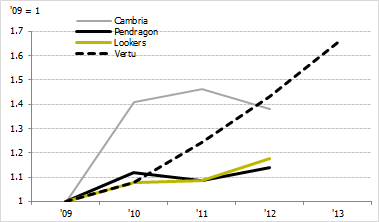
We might also use operating capital as an indicator of 'size', and this shows similar trends - only Cambria differs significantly. There's one even more important point relating to acquisitions though, and it relates not to quantity but quality. Put simply - they buy businesses which aren't doing well. This is a key part of the business's strategy, and has been since inception. From that point of view, for a value investor it's immediately attractive; it makes sense, since it's essentially a microcosm of what we're trying to do as value investors - find assets which are mispriced relative to their potential.
I'd have liked some more figures on performance of old business vs. new business in the annual report, which might illustrate that point, but I was given some intuition on that when speaking to the FD. He talked about the impact of acquisitions on return on capital, and in particular the sort of 'dual' effect of acquiring poorly performing businesses. Since return on capital is, at its core, a comparison of profits and operating assets, buying a loss making business tends to really tank the metric - since you're reducing your profit and increasing your operating capital. You could make the figures look better by simply not acquiring at all, but the plan is to turn these businesses around. There is an ongoing delay in improvements in RoC, then, if the company is continuously acquiring, and given that the pace of acquisition is remaining brisk there isn't really an opportunity for RoC to 'catch up'.
He also gave a sort of timetable for improvement - giving a roughly 4-5 year timespan for an acquired dealership to be assimilated. By that figure, given Vertu's relatively short history, we haven't really seen much settling down yet.
I should note that Vertu's most recently proposed acquisition - along with a large capital raising to both pay for it and give the board capital for more acquisitions - slightly deviates from this trend. They're paying a significant premium to net assets (in a business which itself is valued by the market at about its net assets) for a company which doesn't seem to have that underperforming characteristic. On an earnings basis it doesn't look particularly expensive, though, and some of the decision seems to come down to it being a strategic one, giving the company a 'way in' to the more premium end of the market with Land Rover.
Revenue mix
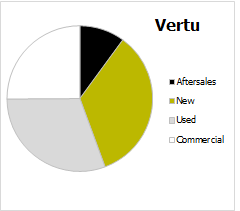 In reality, revenue mix is a part of strategy - it's a consequence of the way the group goes about doing its business. It's something I discussed in some detail in my last post, though, so it deserves some sort of follow up here. To the right is the pie chart I posted last time, showing Vertu's revenues broken down into segments. Much of the reason for the underperformance, I postulated, might be down to the fact that Vertu have a significantly larger tilt towards commercial and a significantly smaller tilt towards aftersales. The first thing the FD pointed out was that this was essentially two sides of the same coin - if you exclude the big commercial segment from total revenues, the aftersales segment represents roughly the same proportion as the other companies. While it's slightly unfair (Cambria don't split off their commercial, so we can't do the same for them) and there is still an 'underperformance' in terms of aftersales, it was also noted that this is probably to be expected. Aftersales will be fairly strongly related to how many cars you've sold in the past, so if an acquired franchise is underperforming, it's hardly likely to be rolling in aftersales profits now or in the immediate future.
Also pointed out was the knock on effects of having a large amount of commercial sales - notably supplier relationships, which the FD pointed out were extremely important. This is something I have the sum total of zero personal experience with, so I can't offer any sort of comment, but apparently manufacturers are among the drivers of consolidation in the dealership industry - they prefer to work with large, relatively homogeneous organisations. This makes sense. It also makes sense that selling £320m worth of additional vehicles (the commercial segment), low margin or otherwise, makes you a more significant player in the minds of the manufacturers.
Aside from that, I note that Vertu have fairly recently disposed of their heavy trucks business, having made a £0.6m operating loss in that section last year. They only had 3 outlets selling these trucks anyway, and the disposal seems a no brainer - it's clearly non-core, so they sold to a company specialising in trucks which can clearly unlock more value from the assets.
In short, it appears I had the causality a little warped. It's not the revenue mix which causes the lower returns in Vertu - it's the strategy the group is pursuing which does. The revenue mix is more of a symptom of that than a cause. As outlets mature, we can expect to see more of a contribution from used and aftersales in particular. Vertu already has a better asset turnover than any of the other 3 businesses considered, so I'm hesitant to suggest much of an improvement in that department, but operating margins might be expected to pull upwards over time. The two are so closely interrelated that separating them in this sense is probably impossible.
The bottom line
I've one more concluding post after this one, but I think this post covers many of the issues of the most interesting stock in the bag - Vertu. The proposition is a very cohesive one; it's a case of the consistent high level of acquisitive growth, combined with the type of businesses they're buying, basically hiding the underlying profitability of the business. Much like Howden Joinery, there's two drivers of growth, not one. There's the active one - in Howdens case opening new stores, and in Vertu's case mostly buying new businesses. But there's also the passive one - improvements in the profitability of the newer part of the estate over time.
With that clarity, the key drivers become more clear:
- Given an ongoing turnaround strategy, confidence in management is key; buying underperforming businesses is only good practice if they aren't underperforming at the end of it! - There is more uncertainty on the part of prospective investors; Lookers, for instance, has made a fairly solid 12-15% on capital in the last 9 years. A track record makes predicting a profitable future easier. - Relating to the previous two, how much of a pick up in returns can we expect? In this vein; how much of the underperformance of the acquired businesses was structural and therefore can't be expected to be tugged upwards?
Vertu isn't a small business - their revenues sit at about 60% of Looker's total and about 35% of Pendragon's topline, and these are big companies. Operating capital is slightly less proportionally, but still up there. If margins/returns do start to trend up towards the sector mean, there is clearly enormous value. The conundrum revolves around weighting those factors against the current share price.
In my next (and final) post, I'll look at the four businesses back together again, and decide how I would invest in the sector. The way Vertu operates, and what I've learned about the business, isn't just relevant for Vertu - it helps us with the strength and weaknesses of the other 3 businesses, too.
Disclaimer
This is not financial advice. Our content is intended to be used and must be used for information and education purposes only. Please read our disclaimer and terms and conditions to understand our obligations.
No comments yet
No one has commented here yet! Why not be the first one?