Charlemagne Capital. Dog with Putin's fleas or value situation?

Charlemagne Capital (£CCAP) 10.5p Mkt Cap £29m EV £14m
With markets up and defying the usual Gexit issues I decided to do a spot of contrarian bottom fishing using the momentum screens (3m RSI <-15, 6m RSI <-25) combined with some basic value parameters PE<16x, ROCE >10% (with all the usual caveats that the PE could well be >15 in some of these companies as the EPS may be disappearing fast). Sometimes this throws up interesting situations (aside from the JQW (LON:JQW) or Zanaga Iron Ore (LON:ZIOC) s of this world) where the baby has been thrown out with the bath water.
I came across Charlemagne Capital, with a StockRank of 97
Charlemagne is an Emerging Markets focused fund manager,
specialising in equities and in particular Eastern European equities. Hmmm popular at the moment !
Why is it potentially interesting?
Mkt Cap = £30m
No debt
Net Cash on B/S at H1 14 = $19.3m = £12.5m
Also like Ashmore (LON:ASHM) it has seeded some new funds from its own balance sheet. The market value of these funds WAS $10m. Given that a fair proportion may be in E European start up funds I think its prudent to haircut this by 35% to account for negative market movements. So $10m * (1-0.35) = $6.5m = £4m
So overall net liquid resources roughly £16m
Therefore Enterprise Value is ROUGHLY £30m - £16m = £14m
OK so what about the funds it manages?
It manages 4 types of funds
Magna: The Magna Umbrella Fund plc is Charlemagne Capital's UCITS fund range. These funds are all managed on a fundamental, bottom-up stockpicking investment process.
OCCO: This is an absolute (hedge) fund targeting Eastern Europe. Max volatility = 12%
Institutional: Charlemagne Capital manages a number of segregated regional and global accounts for its institutional clients.
Specialist: Charlemagne Capital's specialist funds include both long-only funds and closed-end property funds. Illiquid….
The asset gathering record is patchy with good growth in the higher margin Magna retail funds offset by the decline in the lower margin Institutional funds.
| Charlemagne Capital AUM ($m) | |||||
| Yr end 31 Dec | |||||
| 31-Dec-10 | 31-Dec-11 | 31-Dec-12 | 31-Dec-13 | 31-Dec-14 | |
Magna | 589 | 260 | 364 | 560 | 654 |
OCCO | 308 | 444 | 597 | 664 | 525 |
Institutional | 2343 | 1452 | 1526 | 1373 | 966 |
Specialist | 242 | 172 | 145 | 134 | 103 |
Total | 3482 | 2328 | 2632 | 2731 | 2248 |
| YoY Change | -33% | 13% | 4% | -18% |
Source: http://charlemagne-capital-v2.production.investis....
OK, so where is this going?
Fee pressure for the vast majority of participants in the fund management world shows no sign of abating, driven by the fund platforms like Hargreaves Lansdown (LON:HL.) which have increased price discovery via internet distribution and highlighted underperformers. Take emerging market debt investor Ashmore as an example. Its net management fees as % of AUM excluding performance fees have fallen from 97bps in H1 2009 to 60bps today. That's a 38% fall in average fee margins. However Ashmore has been a relative winner in that its AUM has grown from $25bn in H1 2009 to $64bn, an increase of 150%, thus more than offsetting the fee deflation. Thus net management fees have grown from £88m in H1 10 to £133m in H1 15.
If we contrast this with Charlemagne, it hasn't been quite so lucky. From Dec 2010 to Dec 14 its AUM fell 35% to $2248m. Net management fees are 93bps today compared with 72bps in FY10, a +30% rise. Overall net management fees 2009 to 2013 (the latest set of published annual accounts) have risen from $18.6m to $23.9m = +30% in 4 years, or 7% CAGR. Ok, but not great given 2009 saw the markets low point.
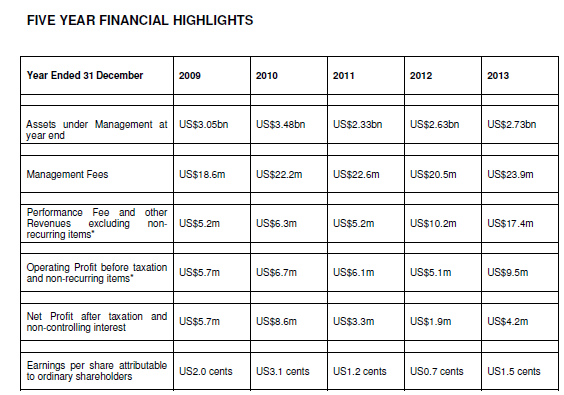
Source: Annual report, 2013
However the comparison gets really interesting when lookingat EBIT margins post fees. Ashmore declared an H1 15 EBIT margin of 67%, Charlemagne Capital (LON:CCAP)declared an H1 2014 margin of 9%. Charlemagne is suffering not so much from feedeflation, rather lack of total fees. EPS was lower in 2013 than 2009 !!!!Good asset managers like $BLK, Ashmore (LON:ASHM), Jupiter Fund Management (LON:JUP), $POLR tend to have EBIT margins above 30%. Insulating themselves to a certain extent from market crashes. There is a lack of flexibility for Charlemagne Capital (LON:CCAP) given lower margins. Given the recent sudden drop in Eastern European markets following the oil price fall and political instability in the region it will be very interesting
to see Charlemagne's H2 revenues and margins, which I fear may see operating profits fall away to nothing.
If you cant beat 'em, join 'em ?
So where does this leave Charlemagne ? Asset flows are under pressure as we have seen, although it has bucked the margin pressure seen by others due to product mix changes. But realistically it is underperforming its peer group in terms of asset gathering and conversion of revenues into profits.
The recent BRIT and Catlin deals in the non life insurance sector prompted me to think of what happens when revenues remain under pressure for a while. Typically some of the more aggressive industry players start to think about consolidation. Putting two businesses together and ripping out costs to drive EPS. Whilst others think of cashing out – if you cant beat 'em, join 'em...
This could also be the case in the fund management world. Recently we have seen Man (LON:EMG) bulk up through a number of deals including the acquisition of NewSmith Asset Management, announced last week.
Deals have typically been done at between 2-4% of AUM, with an average of 2.2% AUM since 2010 (source: Barclays).
If we factor in the net cash and investments, the adjusted market cap is £14m
AUM = $2250m or £1450m
Therefore current mkt cap as % of AUM 1%.
I think a take out of 2.5% of AUM is very feasible. This would equate to £36m. Add back the net cash of £16m = c£52m
Current mkt cap is £29m
So 80% upside.
Looking at other metrics price / sales is also in Charlemagne's favour. Out of 27 M&A deals in the asset management world over the last 20 years where I have seen the revenues only 2 out of 27 were done at less than 2x revenues. The average was 4.6x (source: Barclays). So even if we took the low end of this range and assume 2x revenues: 2x $41m = $80m (£51m). Again I think you should add back the cash to get to £67m total = 130% upside.
Also it could be an advantageous time to do a deal as the asset class is clearly out of favour and therefore an acquiror would be basing the purchase price on a cyclically lower AUM figure.
Where's the catch ?
Well there are potentially 3 main ones in my mind.
1. The structural catch is that Charlemagne isn't a great asset manager. I had a look at some Morningstar tables that show Charlemagne is “ABOVE AVERAGE" for risk (volatility) and its returns have lagged much of the peer group recently. The data also showed it had a lower average market cap per investment than the peers ie its more small cap than the rest. Nothing wrong with any of the above, but if Eastern European markets stay down it is likely
that Charlemagne under performs its peers and there could be fund outflows as a result. I was also surprised that the CEO Jayne Sutcliffe didn't mention performance of any of the funds relative to their benchmarks in the H1 14 interim report (or really in any of the corporate releases). She did reference the lack of AUM as a potential issue:
“The Group remains profitable overall in the year to date, but an increase in AuM is still required in order to ensure sustainable profits on a recurring management fee basis and the likely absence of performance fees will have a significant effect on year end results."
2. The OCCO Eastern European absolute return fund accounted for 63% of Group fees and
performance fees in 2013. It needs to perform ! This is a KEY issue in the investment.
3. The other catch is that employees own 40% of the shares in issue. As a fund manager myself, I know how seriously we ask management teams to think about shareholder value. But realistically it is very hard for many management teams to think about putting the business up for sale when it will inevitably mean large scale redundancies, especially of friends and colleagues, that they may have worked with for many years. Do turkeys owning 40% of the equity being paid a combined $10m of salary in 2013 and $12m of bonus really vote for Christmas?
Invert, Invert
But look at it the other way round. Any acquiror would make cost savings, especially if it was merging investment teams. A 30% cut in work force (ceteris paribus) would save c$7m p.a. based on 2013 costs. That saving alone is a 13% pre tax ROI ($7m cost saving on $52m acquisition price).
You often see businesses being sold when the founder and largest shareholder decides to cash out eg Hugh Willis at BlueBay. When there is not a large controlling shareholder is when things can be left to muddle along. Jayne Sutcliffe is 50 and has been CEO since the float of Charlemagne Capital (LON:CCAP) in 2000. Her and her family own a short 11% of the equity. Another founder and non exec Jim Mellon owns 19%. Between these two they have a
30% blocking stake and effectively will decide the future of the business.
Conclusion
I am quite interested in Charlemagne Capital (LON:CCAP) as it has been a really poor performer recently. Its underlying asset class is hugely out of favour, a dog with fleas is a better bedfellow than Eastern European equities at the moment. The P&L will look pretty poor in H2 and may prompt a cut in the dividend. However it may also prompt management and the board to explore other possibilities to create value. I can see a scenario though that has around 80% upside from here on an agreed take-out. In a business as usual scenario, there is downside, but this is tempered by £12m of cash and £4m of investments on the balance sheet. Alternatively E European equity markets do look “cheap" relative to history. So
you are buying nearer the bottom than the top.
I think my biggest uncertainty is 'Why Now' for management to sell up ? I cant see an immediate catalyst but I can see some value. Therefore on balance I have dipped my toe.
VegPatch
Disclaimer
This is not financial advice. Our content is intended to be used and must be used for information and education purposes only. Please read our disclaimer and terms and conditions to understand our obligations.
No comments yet
No one has commented here yet! Why not be the first one?