Chart of the Day - Relative Strength of Stocks in Sectors

Thanks for the great comments on yesterday's post which showed Swarm Plots of the StockRanks across the market. Someone asked which stocks and sectors have shown Relative Strength this year - so I thought I'd run the numbers and draw something else for your amusement.
If you aren't familiar with Relative Strength let me brief you. Relative Strength is the share price performance any share relative to the market index. In the UK, we use the FTSE All Share as the benchmark and publish a range of these figures on StockReports.
It is calculated by dividing the price change of a stock by the price change of the index for the same time period. For example you'll find scenarios like this:
- A stock falling by 20% versus an index rising 20% would lead to a Relative Strength of -33% (0.8/1.2-1)
- A stock rising by 100% versus an index rising by 30% would have a Relative Strength of 54% (2/1.3-1)
Relative Strength has been proven, time and again in so many academic studies to be highly predictive of future returns - so we use both 6 month and 1 year Relative Strength as key components in the Momentum Rank. I know it's strange, but strength tends to persist. If you are interested, I've written on the best timeframes for momentum indicators before.
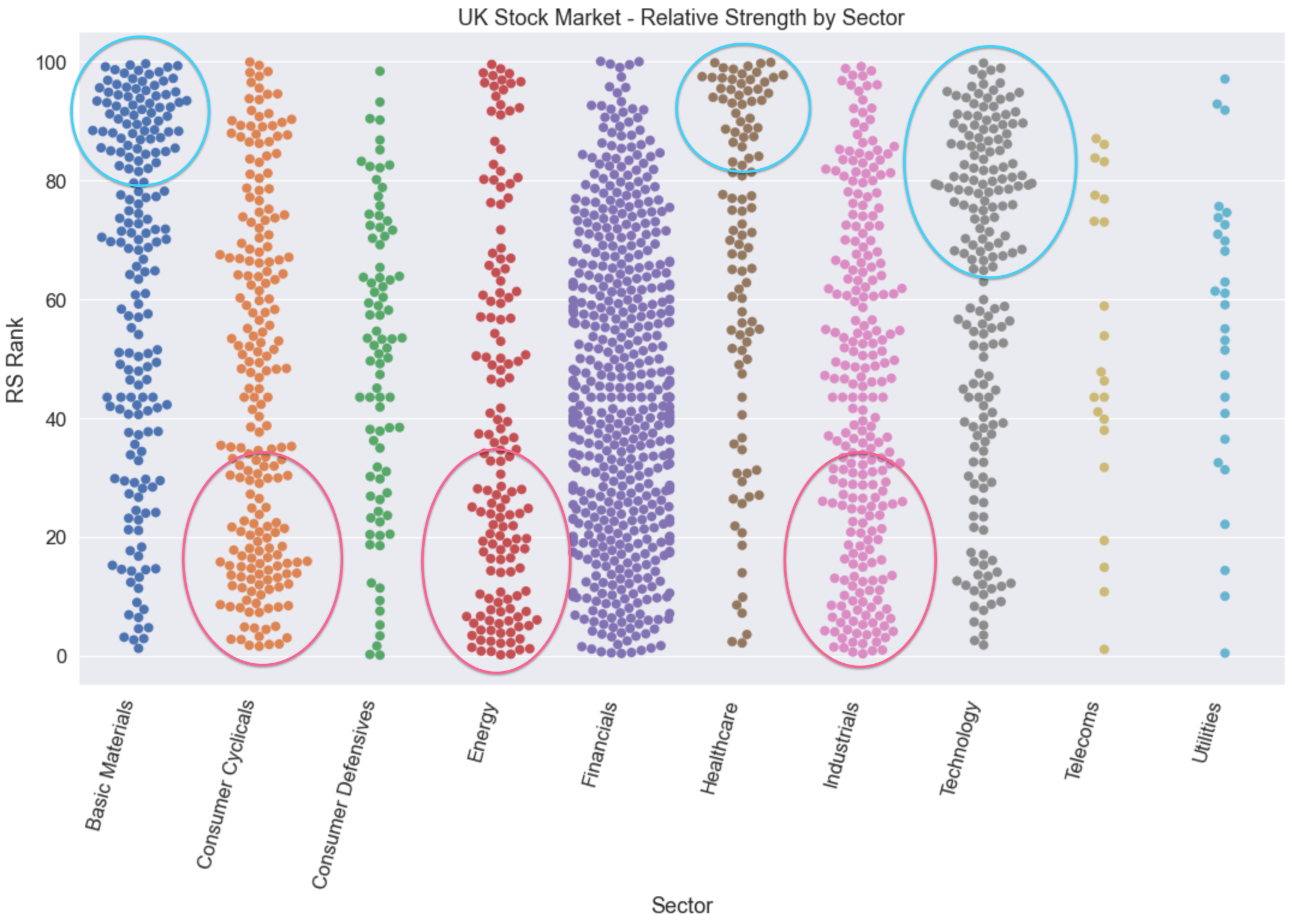
For the following chart I've ranked a composite of the 1 year and 6 month Relative Strength numbers for every stock in the market split by Sector - it's in the vertical axis as "RS Rank".
You can immediately see a few takeaways:
- Circled in Blue - strong relative strength in shares in the Basic Materials (hard assets), Healthcare (Covid) and Technology (work from home) sectors.
- Circled in Red - weak relative strength in Energy (who is driving?), Consumer Cyclicals and Industrials (due to the real world, cyclical nature of their businesses).
Of course, these generalities don't tell the full picture. There are pockets in these sectors that have contrary results.
- The pocket of high strength Energy stocks are mostly Renewable Energy.
- The Financials sector has very little high strength action at all (this does worry me as financials can be leading indicators)
- There are pockets of strength in the Consumer Cyclicals sector - mostly from durable goods companies benefiting from consumer spending.
If you do want to screen based on these insights... it's pretty straightforward. I've made a screen here to demonstrate how to use ranked relative strength and a sector filter - click here to view and/or copy it.
Do share your comments below
Disclaimer
This is not financial advice. Our content is intended to be used and must be used for information and education purposes only. Please read our disclaimer and terms and conditions to understand our obligations.
11 comments
Wondered if the RS line got added to the charts ? I don't seem to be able to find it but I'm a beginner when it comes to using the chart features. Any help appreciated.
Good article, Ed. Relative Strength was a big feature of Stan Weinstein's book and so a useful indicator imo.
Very often the market leaders set the pace and finding strong stocks early on can be great for both traders and investors.
thanks Nick. I made fuller reply on your PCA thread. Sector misclassification annoys me e.g TSTL makes disinfectant for medical equipment / hospitals yet is classified in Industrials whereas it should be in Healthcare. The powers that be need to devise a more cunning classification system - maybe incorporating PCA or, God forbid, common sense....
Is there anyway relative strength can be added to the charts you provide? When screening it's good to see this on a chart and whether it's trending up, or down?
We are planning on adding this line, and a few other indicators in the next iteration of charts development.
Is their a way of identifying stocks that are correlated within each sector / industry group? E.g within metals & mining sector gold play stocks should be more correlated than gold versus aluminum. If so this would allow potential identification of lagging stocks within 'hot' sector and give actionable pointers
You can use correlation directly as a way to groups stocks together. I wrote a short post about using principal component analysis to explore this a while ago. It showed how stocks in a sector do generally have a strong correlation with each other, but as you say gold miners tend to behave more like a play on gold than a play on mining:
Visualising Diversification using PCA (or "Why FRES is not a miner"!)
A good proportion of these stocks are described as “momentum traps”. A loser indication. Interested in your view on that.
Well Momentum Traps have the StockRank fingerprint:
i.e. the only factor going for them is Momentum. I'm not a fan of Momentum Traps - but some do have a tendency to perform well.
I strongly prefer high momentum paired with either Value or Quality... i.e. high QM or high VM. (which often have the style of High Flyers/Turnaround). 2 factor strategies may perform more consistently. This year's NAPS Portfolio uses QM and VM.
But it's worth noting that 25 stock portfolios built from the pure Momentum Rank has actually been the very best performing StockRank strategy over the last 7 years in the UK. About 18% annualised by my back of an envelope calculation.
It would be interesting to add in the negative RS over the same periods to hammer home how some industries have fallen off a cliff - travel for instance.
The vertical axis is a Rank - so the negative RS companies are dotted at the bottom of the chart. All the hard hit consumer cyclicals and industrials create the clusters at the bottom of the chart.