City of London Investment Group: a quality play on emerging market value?

City Of London Investment (LON:CLIG) is a pioneer in the Emerging Market closed-end fund (CEF) space. Its long term outlook, consistent investment processes and proven track record of outperformance has attracted a stable base of institutional clients and fund inflows over the years.
Following great success in the early 90s as an emerging market specialist, CLIG used its CEF knowledge to expand into other areas. Today, the group markets five CEF strategies:
- Emerging Markets CEF - the original CLIG product that has been marketed for decades
- Frontier Markets CEF - an extension of the EM core equity product that focuses on the smallest or pre-emerging markets with high growth potential
- Developed Markets CEF - targeting global developed markets
- Opportunistic Value - a global, bottom-up, high-conviction fund
- Tactical Income - a multi-sector fund focused on generating tax-efficient income for US investors
On top of this, CLIG launched two Real Estate Investment Trust products in January 2019 that focus on emerging market and global REITs.
Given last year’s stories of star fund managers and style drifts, it is reassuring to hear CLIG discuss its investment process:
We have always strived to develop and nurture an investment process which does not rely on 'star' fund managers, but rather upon a series of analytical procedures that can produce repeatable and sustainable first or second quartile performance versus our peers.
This process seems to work. According to the company, CLIG’s cumulative total return since inception through 31st December 2019 was 540% (14.5% per annum) compared with the 152% cumulative return for M1EF over the same time period.
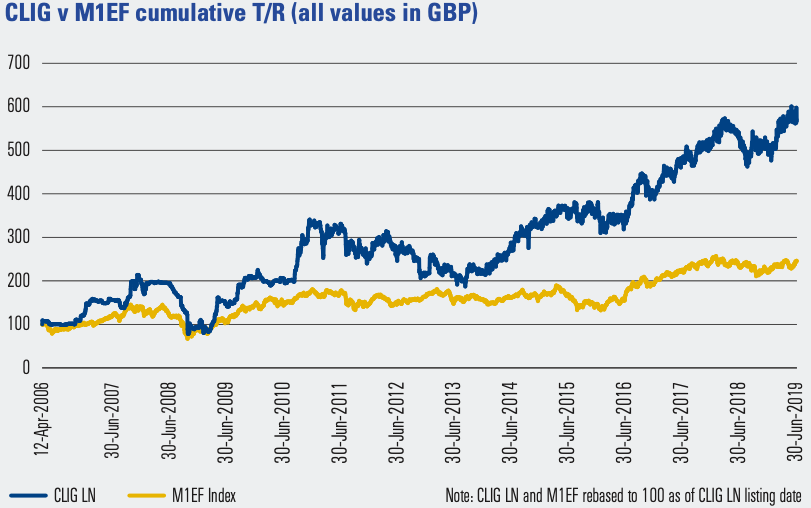
Source: FY19 Annual Report
Given the group’s process-driven multi-decade investment track record, its shareholder-friendly corporate culture, modest valuation and strong quality metrics, the early signs are promising that CLIG could be a good long term investment.
Valuation
CLIG is a small cap financial Super Stock with extremely high levels of long term profitability and returns on capital.

It also generates a lot of cash and pays out a generous forecast dividend yield of 6.25%. Management has an encouraging attitude towards shareholders as shown in the Chairman’s Statement of the FY19 Annual Report:
Your Board attaches great importance to providing shareholders with a generous but stable flow of dividends, balanced by a policy of prudential capital management.
The group has established a solid history of dividend payments since listing in 2006 (including a special dividend last year and periodic share buybacks).
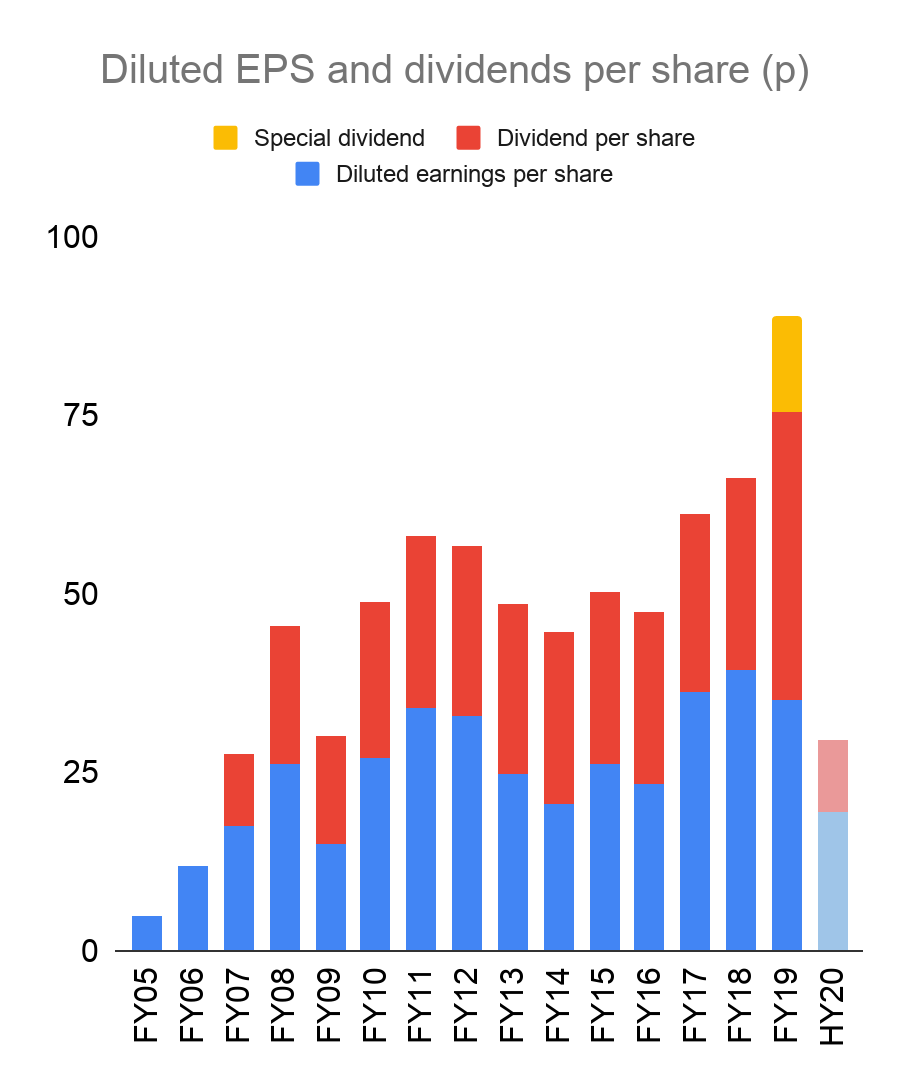
Given CLIG’s quality characteristics, shareholder-friendly culture and modest valuation, I feel this financial small cap is worth a closer look.
The story so far
The City of London Investment Group traces its roots to Olliff & Partners, a London-based broker established by Barry Olliff in 1987. This outfit specialised in closed-end investment trusts, a market sector in which Olliff had more than 20 years of experience. Soon after, Olliff set up City of London Investment Group.
Olliff has just retired but he remains an important figure for the group. CLIG’s new chief executive (and long time employee) talks of the “Olliff DNA”: a mix of financial prudence, reporting transparency and attention to fiduciary responsibilities.
According to the group:
Olliff has been a pioneer, making an outstanding contribution not only to the development of CEFs to a wider investor audience but also in blazing a trail of high standards in corporate governance and transparency in the management of client assets.
For many years, CLIG stuck to this niche of emerging market CEFs but more recently it has expanded, with success, into developed markets and other areas. In fact, this diversification of product range is now CLIG’s main business development strategy.
These days CLIG applies its investment process to Developed markets, Frontier markets, Opportunistic Value (formerly Global Tactical Asset Allocation) and Private Equity via closed-end funds. The most recent addition to its range is a Real Estate Investment Trust (REIT) strategy that will focus on emerging market and global REITs.
Overall FuM were up 6% in FY19 principally due to fund inflows from these newer strategies.
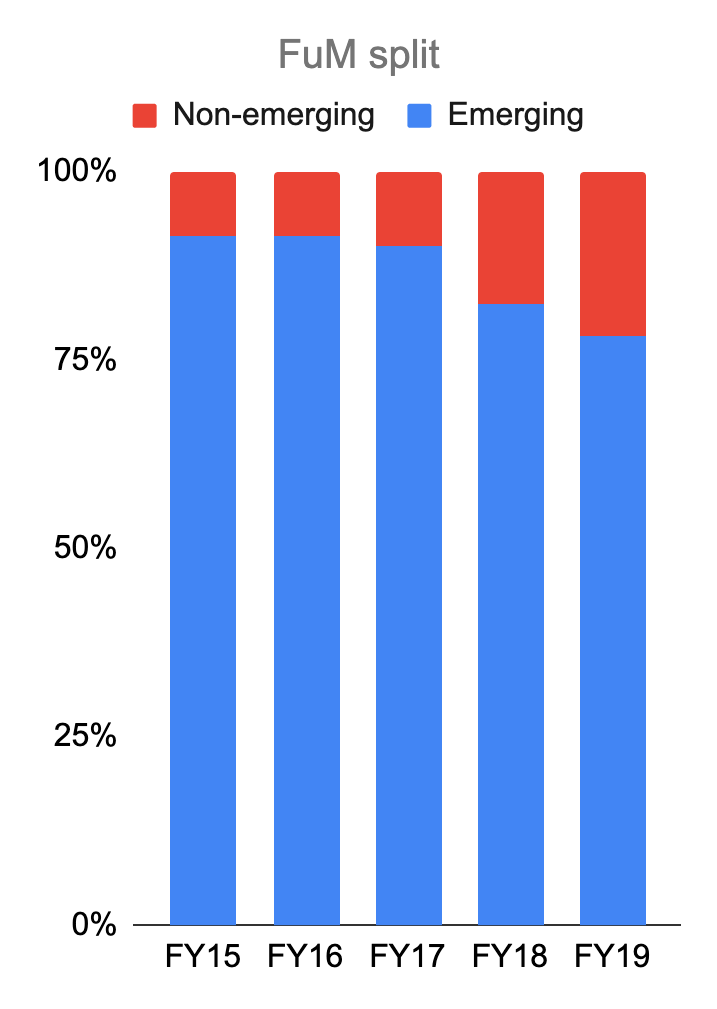
Breaking this out into greater detail, we can see that Developed continues to increase its share of total FuM. This is partly because the strategy has been up and running for more than five years now - an important milestone that means it pops up on more institutions’ radars.
CLIG is optimistic that its Opportunistic Value strategy can make a similar breakthrough.
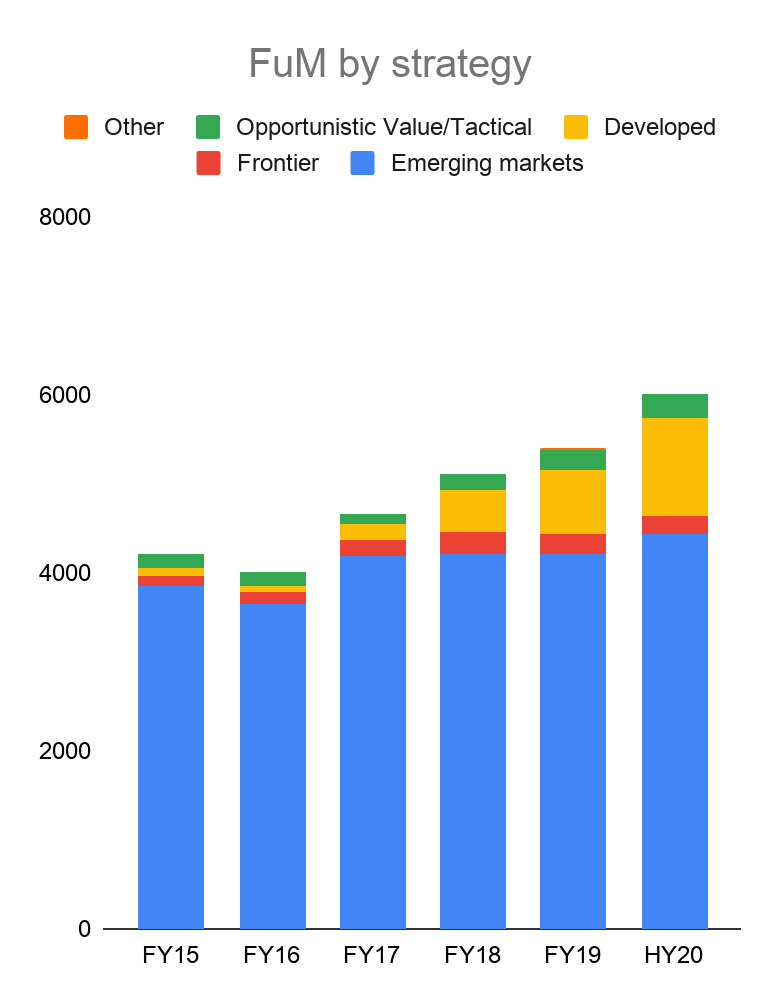
It is still very early days with the group’s foray into REITs but it says this area has so far performed well. The group is optimistic about raising assets here in the medium term.
A three year (or even potentially five-year) record will be necessary to gain significant traction with a number of clients and consultants in the US market.
The group says this strategic diversification will necessarily lead to lower margins. In general, the emerging market strategy commands higher fees than the non-emerging market strategies (with the exception of Frontier). We can see this in the numbers. It will be a small price to pay if the group can increase its funds under management (FuM) at a healthy clip.
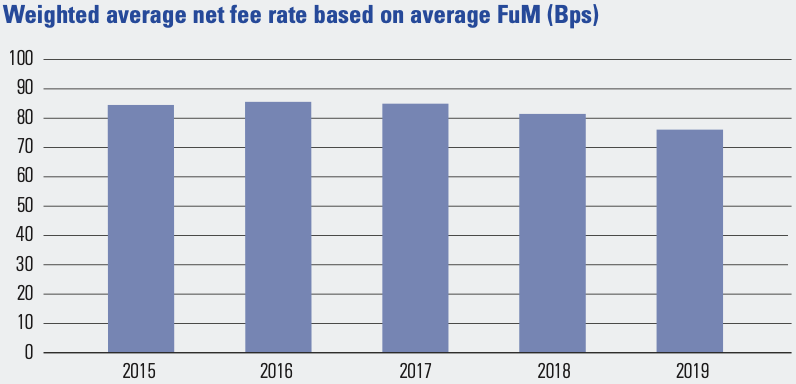
Source: FY19 Annual Report
Rolling with the punches: market cycles and long term growth
One important point to meet head on is the inherent cyclicality and volatility involved in investing in emerging markets. Although CLIG is diversifying its revenues, the fact remains that nearly three quarters of FuM come from this area of the stock market. You can see below the downswings in revenue and profit.
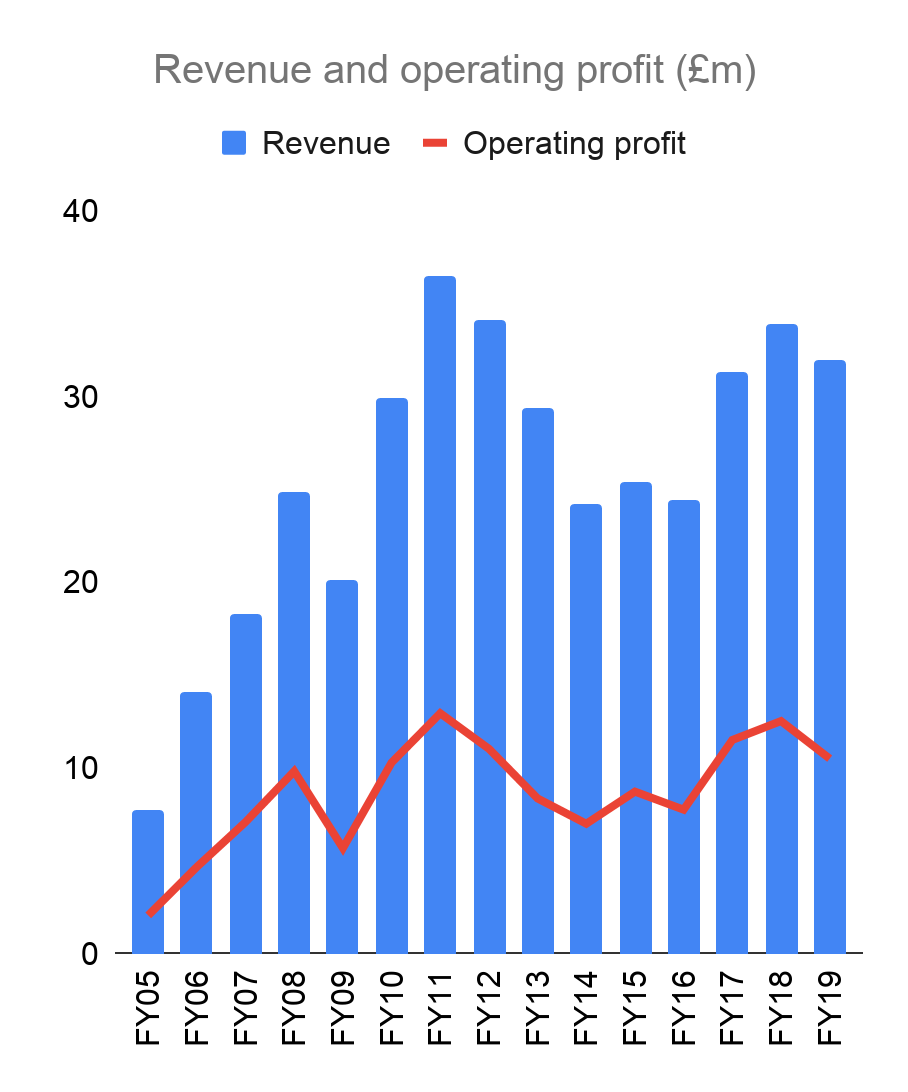
I personally see no issue with cyclicality if the business is profitable and sensibly run for the long term. Many cyclical companies grow and prosper in time. As Buffett says variable earnings “don’t bother us in the least.” After all, “Charlie (Munger) and I would much rather earn a lumpy 15 percent over time than a smooth 12 percent.”
And CLIG is eerily close to a lumpy 15%: according to the company, its cumulative total return since inception through 31st December 2019 was 540.3% (14.5% per annum) compared with the 152.1% for M1EF over the same time period.
There are a couple of signs that suggest to me CLIG has what it takes to ride out cyclicality and grow in the long term:
- A consistent and fundamentally sound value-led investment philosophy built on identifying funds that trade at discounts to their underlying holdings,
- An appreciation of long term corporate culture and company stewardship (no “big bang” acquisitions here),
- A history of financial prudence, net cash and a tight eye on operating costs,
- Strong operating and free cash flow generation, and
- A flexible dividend policy.
Low cost base
In the company’s own words:
We do not work in expensive offices and when we travel we do not stay in five star hotels. We do not need expensive offices to undertake our work and most of the time we are in a hotel we are there to sleep rather than it be a part of our lifestyle.
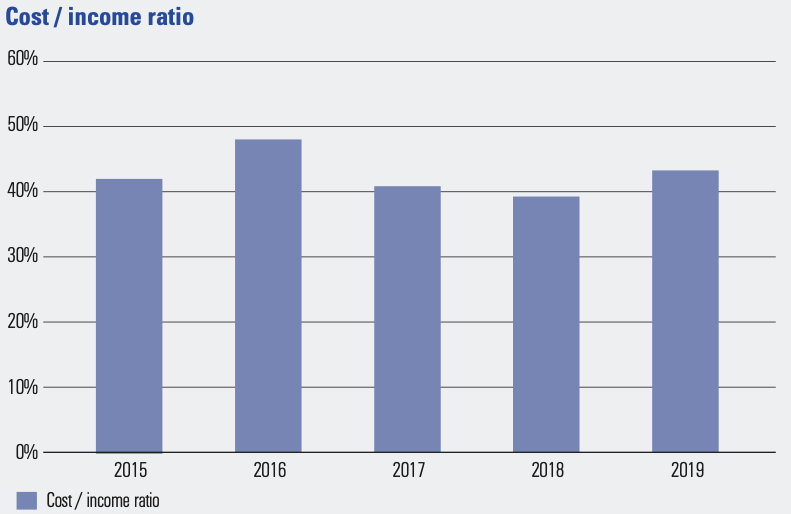
Keeping operating costs down means more cash for shareholders. CLIG publishes a cost / income ratio chart based on fixed overhead and net fee income. One of the advantages of maintaining a low ratio of costs to FuM is the potential for operational leverage.
Thoughtful dividend policy
CLIG pays a 6.24% forecast dividend yield. These payments to shareholders are an obvious attraction and, after a flat period, have been marching up in recent years.
The group’s HY20 statement (covered in more detail below) shows an 11% increase in its interim payment to 10p “which rewards our shareholders while providing sufficient reserves either to weather unforeseen setbacks or take advantage of opportunities that may arise to further expand the business.”
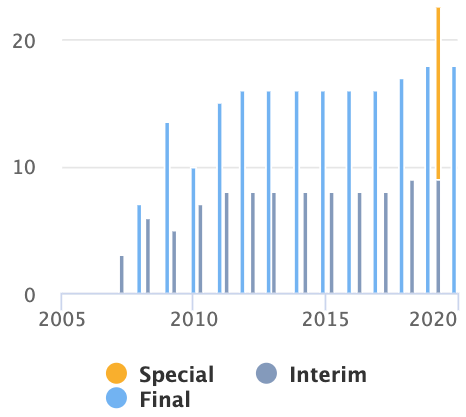
The group’s dividend policy was introduced in 2014 and is reviewed every five years. It was designed to be flexible given the potential volatility of CLIG’s income as a result of EM exposure. It aims for dividend cover of c1.2x on a five year rolling basis and the board takes into account both next year CLIG budget and market outlook when determining the current year’s payment.
Current trading and outlook
CLIG’s recent half year results show encouraging business momentum. Some of the key figures:
- FuM up 30% year-on-year to $6.0bn (£4.5bn)
- Revenues up c11% from £15.6m to £17.3 million and net fee income up 13% to £16.4 million
- Profit before tax up 21% from £5.2m to £6.3 million
- Diluted earnings per share up 22% from 15.9p to 19.4p.
In terms of individual strategy performance, all strategies save for Frontier outperformed their benchmarks in the period:
- The EM strategies outperformed on average by 0.75% relative to the MSCI EM Index,
- The Developed strategies outperformed on average by 3.5% relative to the MSCI ACWI ex US,
- The Opportunistic Value strategy outperformed on average by 2.2% relative to the blended MSCI ACWI/Barclay’s Global Aggregate Index,
- The Frontier strategy underperformed on average by 5% relative to the S&P Frontier 150 Index, and
- The Emerging Markets REIT and International REIT strategies posted a positive six months in relative and absolute terms.
Diversification
The rate of diversification appears to have increased. CLIG notes record inflows to its developed products which provide “an important and growing contribution.”
The Developed CEF product “came of age” with growth of more than 50% in FuM in the six months to December 2019 to US$1.1bn. FuM for the Opportunistic Value strategy also grew by 16% to US$270m, raising diversified products to 26% of total assets.
The two REIT products that were launched at the start of 2019. The strong relative performance of the two strategies over their first year bodes well for the future.
Outlook
CLIG says: “with a healthy forward pipeline of new inflows, the prospects for further growth in 2020 are encouraging.”
The group also gives some useful commentary on wider macro economic conditions:
The artificial stimulus afforded asset markets over recent years through so-called quantitative easing has created its own longer term concerns in terms of some hair-raising equity valuations, notably in the global technology sector, as well as private sector debt leverage. However, in general terms, emerging market ratings are now well below developed markets, with many having the additional protection of strong foreign exchange reserves. Central banks will need to tread very carefully if and when they decide to reverse their balance sheet expansion in order to avoid a crash landing but we continue to believe that the prudent use of closed-end funds, offering assets at a modest discount to their underlying value, will serve investors well over the longer term.
Additionally:
Prudence would always dictate caution against investor complacency in these seemingly benign conditions and it is true that the stretched valuations in the technology sector, to name one example, are somewhat reminiscent of the dot-com asset bubble at the turn of the century. Valuations across much of the CEF universe, particularly in the EM space are far from stretched and it is this value protection that gives us cause for relative optimism. This is not to predict a sudden value arbitrage from “tech” to “value” investing but it is worth reiterating that the gains made by CLIG in 2019 owe more to a prudent and value-orientated investment style than to asset bubbles of any kind.”
KPIs
CLIG has changed its key performance indicators as a result of changes in its business mix. Changing KPIs can be a signal for further research but these new measures seem sensible to me - certainly you’d think shareholders would be happy with these results:
- Compound the T/R of a CLIG share, through a cycle, by 7.5% to 12.5%, on an Annualised basis. OR
- Double the Cumulative T/R of M1EF, through a cycle, where M1EF is the most relevant Emerging Markets Index.
For both KPIs, a cycle is defined as a rolling 5-year period, so even the lowest hurdle of the first KPI would be a total return of nearly 50% over five years. For reference, CLIG’s cumulative total return was 91.55% for the five years to the end of 2019 (13.9% per annum, meeting the first KPI).
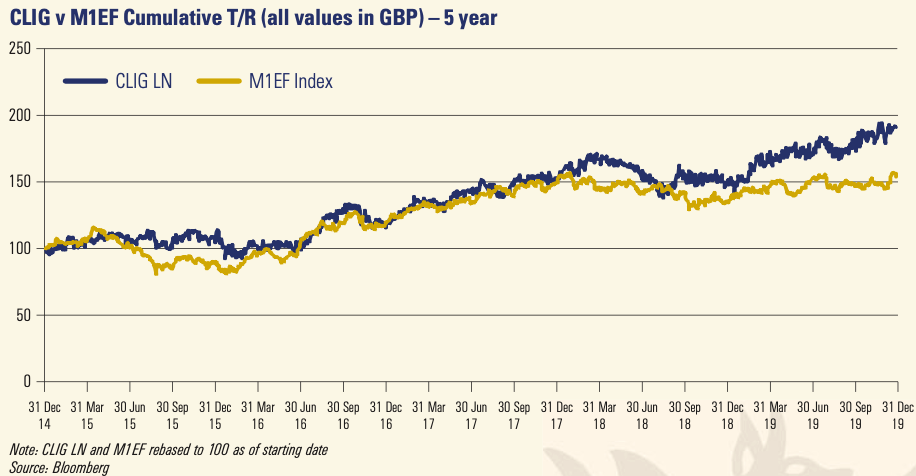
Source: HY20 Report
Risks
Some risks that come to mind (note this list is not exhaustive - if anything occurs to you, leave a comment):
Key person and culture risk
Key staff might leave. Much of CLIG’s value may be in its people, processes and culture. There is no guarantee that these will remain constant. The group has historically been able to hold onto its workers, however.
Emerging market risk
The group is exposed to emerging markets, which can be more volatile and riskier than developed markets. They also tend to offer higher growth rates. CLIG is diversifying into different areas and products.
Technology, IT / Cybersecurity & Business Continuity Risks
The Group actively maintains a Disaster Recovery (DR) plan. All offices maintain backups of all local servers, applications and data. The US replicates its backup to the UK and vice versa.
Regulatory and legal risk
The CFO & finance team keep abreast of any changes to relevant listing rules and accounting standards. Both Compliance & Finance receive regular updates from a variety of external sources including regulators, law firms, consultancies etc.
Conclusion
I’ve seen enough here to be left with a positive overall impression of CLIG - not just in terms of its quality profitability characteristics as a stock, but its modest valuation, strong cash generation, attractive dividend yield, value-driven investment process and exposure to a diverse range of financial markets.
Although the group faces cyclicality, it has proven its ability to generate high returns on capital over long periods of time and appears to be sensibly run for the long term. In diversifying its product mix and expanding into other financial markets, the group has a clear growth strategy. It is beginning to see real success in Developed and other areas.
With the group founder Barry Olliff stepping down, perhaps risks are heightened slightly but the transition has been managed over a period of years and a long-time employee has taken the reins. It’s worth remembering that Olliff is still to sell 500,000 shares at 450p, 475p and 500p.
Over the past decade CLIG has delivered its shareholders over 12% pa total return. Diversification is creating shareholder value by increasing FuM and making a more robust company. At 458p, on a forecast PE ratio of 11 times and paying out a forecast yield of 6.25%, CLIG appears to offer compelling value given its strong quality attributes.
Disclaimer
This is not financial advice. Our content is intended to be used and must be used for information and education purposes only. Please read our disclaimer and terms and conditions to understand our obligations.

11 comments
Great numbers, One of the strong ones I found using screens so purchased a few months back. Looking to get more if it stays under 450. However that target may lower if they are hit by China's virus slowdown.
thks for the research Jack - very clear.
I am a holder for 2 reasons:
1 - a recent excellent presentation by Richard Griffiths showed clearly the long term (20yr +) success of EM investing. I think that as it becomes better known that Chinese GDP is only years away from being largest in world this will only increase investors awareness to have EM exposure. I think this gives CLIG a competitive advantage over the medium term to win mandates, as well as the fact that their fees will benefit from likely higher rates of return in the longer term from EM. The fact that CLIG are boringly conservative and modest in their approach is a much added attraction for many I think.
2 - the chart has broken out of a 10 year resistance on the third attempt. this is a classic sign of strength and indicates further upside. the real benefit though is that it provides a very clear sell signal if it returns below the break out level. thus as a holder I feel that I am only exposing myself to a loss of 10% whilst having a very good chance of divi led upside. of course a market crash would probably eliminate such a safety net but again i think it is very likely CLIG would do everything do maintain their dividend and thus the downfall of CLIG is likely to be somewhat protected.
Holder. Cautious Investor.
Cheers, I think "boringly conservative" often stands a good chance of outperforming... I get the impression from a couple of comments here that this might be the type of company that attracts longer term shareholders, which can be a surprisingly rare thing.
Did you see this presentation online or in person? If online do you remember where?
CLIG share fell from approx. 270 to 220 in 2012 mainly because one of it's major clients left to take it's trading in house. I think that the major price support is probably just under 300.
I first bought it in 2012 and share the opinion that it is a good well run company. I'm also waiting for a buying opportunity.
CLIG was an investment i held until 2015 but although it provided a good income it was rather disappointing regards its growth but i do regret selling it at a slight loss as i am considering buying it again at about 25% above the price that i sold it - such is life
I've been a fan of CLIG for about three years now, to the extent of about 5% of my portfolio (which exists to provide my income) . I regard it as part of my emerging market diversification.
It's been a bit of a bumpy ride if you look at the 3 year graph, but certainly I've been very happy over the past 15 months or so. And in the bad times the high dividend kept me sweet.
My simple analysis shows an annual return of about 9% . (Most of this has been in dividends extracted over the three years. Strictly, I should allow for the timing of each dividend in my calculations, which would increase the 9%)
One good point worth a mention (and this is from previous research and not checked) is that the company does not run a bonus-driven culture; it's company profits, and dividends, which incentivise the staff. I'm sure there is a substantial staff share interest.
It might be stating the bleedin' obvious but I like a company which needs to keep the dividends high to reward its staff and encourage them to make money for the benefit of all shareholders. ( Shame there aren't more like it, but it's only really viable in smaller companies where the staff are very close to the profit-making).
My only issue is that the buy/sell spread has always been comparatively large. As I write, it's 2.6%. That's over 40% of the first year's dividend. It's been higher.
I hold this company and have done so for a few years, re-investing the dividends. The compounding affect has really started to work here for me.
I like the way they are clear and straightforward in their reporting, linking senior remuneration to factors I can understand and agree with. I also appreciate their focus on costs and control, not always the case with these types of business ! I was concerned when Barry Oliff stepped back a while ago but his influence over the business remains and they retain a focus on shareholder return.
It can be a little bit volatile and I would consider stepping out at 500p, if reached, and then waiting for a re-entry point.
Interesting - I had begun to research this stock today as it came up in my screen a couple of weeks ago so nice coincidence. I came to similar conclusions - just slightly nervous on something so heavily exposed to emerging markets at (what must be towards?) the end of the economic cycle. The Buffet point is good one though....
On my watchlist for now as I am fully invested and can't see any obvious sales.
Looking at the last recession, the share price dropped more than 50% which supports my nervousness...
I bought it in the last recession and rate the company highly. I intend to buy in again during the next downturn....
Yes, even though City Of London Investment (LON:CLIG) is diversifying into other products and areas the fact remains c75% of FuM are in emerging markets... Reading through the accounts did show an encouragingly long term and shareholder-friendly view, but you would have to go into this stock knowing that volatility over the years is likely.
The EM exposure can be a strength as well though - I wonder how many UK investors are invested primarily in UK stocks and therefore already have a lot of country-specific risk? Home bias is fairly established in academic lit & studies... For those people, a company like CLIG might be worth a look precisely because of its diversified EM exposure as a useful fit in their portfolio.
DYOR, of course