Colefax (CFX): Doing the right things

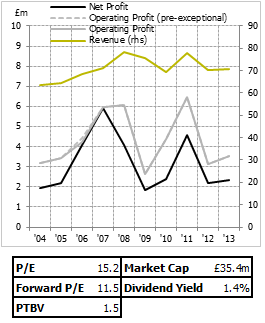 Colefax (LON:CFX) is a company that's been on and around the radar for a few years; I know Richard Beddard took a plunge a while back, and I recall vaguely giving them a once over way back when the Victoria debacle was going on, as I wondered how similar the companies were. Not that similar, I should hastily add, though I suppose they're in the same loose vein of work. Colefax are a producer of high-end fabrics and wallpapers - take a quick look at their website if you want a general idea of what sort of stuff we're talking about. Given the curtains look about twice as tall as I am, I fairly readily surmise I'm not exactly their target market, anyway..
Those characteristics - high-end, lower volume and higher margin products - seemed to insulate them reasonably well during the recession, though not completely. The company has made a profit as far as back as the annual reports on their website go (12 years), and while the peak boom years of 2007 and 2008 do represent the real highlights of the company's performance, the performance on the whole is pretty resilient. Resilient but unexciting, it's probably fair to say, as revenues over the last 10 years have increased an underwhelming 10% (presumably volumes are down given inflation), hitting a peak of just over £78m in 2008.
Two questions immediately jump to mind, then, as possible points of interest. Firstly, do we expect revenues to recover? Are the revenue declines simply recessionary? Given the nature of their product offering (i.e. premium), I don't mind hypothesising a recessionary dip that'll come back up when consumers start spending a bit more freely. I'm hesitant to do that with undifferentiated, volume-driven goods which can be easily substituted among competitors, since volume gains usually get eroded by margin declines as competition works its magic. Secondly, what have returns done over the last 10 years? Do we see a trend? This hints at the competitiveness of the business as a whole.
On revenuesThe majority of the revenue decline seen in the business, by nature of the way they operate, comes from the US. That's where the group sells most of their fabrics, and the company noted in their last annual report that sales were still '21% below the peak achieved in 2008'. Again, presumably that's in dollar terms and not volume. Given the group earns 45% of its revenue from the US, a simple return to peak sales equates to a 9% increase in revenue. If we hold administrative costs constant but scale up distribution, marketing and CoGS costs (a fairly conservative assumption), you get to a £1.5m increase in operating profit. This feels like a reasonable bullish scenario for the next year or so if the US economy continues to improve, particularly with regard to housing, but I don't think it represents a 'cap', particularly if the group is talking about figures in sales and not volume terms.
The EU picture appears more negative, probably because the green shoots of recovery are looking both more anemic and more hesitant. EU and UK revenues are both down on 2008, with the UK figures down a rather worrying 28%. Still, I'm not sure this is hugely surprising - demand for Colefax's products, like many other home furnishing related lines, is basically correlated to the overall level of activity in the housing market. It's when people move house that they splash out. While, as I said at the start, I think their position insulates them from some of this - they do mention that the high level of activity in the London market (presumably where lots of their higher-end customers reside) offsets some of the decline elsewhere.
Having read both of these paragraphs, you might well be wondering how, if both of their major markets are down over 20%, the group has managed to keep revenue decline down to only 10%. It's not the rest of the world figures - these are roughly flat. Rather, it's the effect of currency translation; the far stronger US dollar post financial crisis means that each unit of revenue derived in the US translates to a greater pound sterling value. I don't like making predictions on the direction of the currency markets, but this feels like a bit of a double-edged sword; it hedged their profits as everything went pear-shaped and the US 'reserve currency' saw inflows, but if the UK and Europe see a recovery - or even a return to normality - I can't help but feel like that's a trend that'll reverse. If it works out this way, all potential gains are moderated.
Returns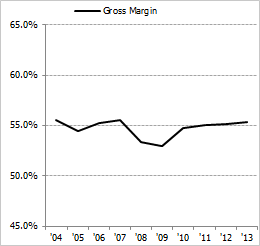 Returns, for their part, have trended slowly downward. The company's operating capital has grown by a compound annual rate of 3.6%, and since operating profits have failed to keep pace, RoC has fallen. There is quite a clearly differentiated turning point and, unsurprisingly, it's 2009 - average RoC pre-'09 comes to about 12%, while post-'09 sits at roughly 8.4%. These are material differences; if the company returns to earning its pre-recession figure on its currently installed asset base, there's scope for about a 50% increase in operating profit from last year's figures. How this happens is another question entirely; but it looks likely, if it were to happen, to come simply from sales growth. The company has an extremely tight grip on gross margin, which sits perennially at about 55%.
They also say, though, that they reckon they could get operating margin to 10% in the medium term - though they note the obvious stumbling block, which is that revenues would need to be considerably higher than their current level to achieve this given their cost base.
Aside from the potential revenue growth in their core markets, the group says it's looking to expand in the rest of the world - China, for instance, which seems an obviously lucrative place to be selling the sort of thing Colefax are. I don't like taking positions on the likelihood of their success, though, since I have nothing to base that probability on. Who are their competitors? What are their competitors doing? There's certainly a huge amount of potential there, but there's also the possibility the group sinks millions on a far East venture that never ends up paying off.
Governance/conclusionIt does strike me, though, that Colefax have done right by shareholders over the last few years with their choice of financing options - as they've experienced exceptional cash inflows, they've been buying back a large number of their shares. There are about 20% fewer shares in issue than there were 5 years ago. This strategy makes sense for a fairly mature company; the alternative is they plough all of the money into riskier investments, like the China story, at a much faster pace. I suspect there's a limit to how much time is a substitute for money when trying to move abroad.
There's a cap to the potential buybacks, though, as the effective stakes of each director increases with a buyback - and given the CEO owns 4.4m shares, he's not too far short of the 50% soft limit I presume he'll be staying under for legal purposes.
Still, I'm not sure we're close to that stage. The last few years' cash flow figures have been bolstered significantly by improvements in working capital which the company would be hard pressed to keep delivering, though I should say that their sizable cash pile; £7.6m; gives them a little wiggle room if they felt like continuing. Some of this cash pile is likely to be needed by the company for working capital purposes during less flattering times of the year - I sort of take it as a given that the year-end figures give a very generous picture of the reality of working capital requirements - but at least some of it, given historical trends, looks likely to be excess.
This dampens the valuation slightly, but the company isn't really that cheap. I don't think it's expensive though, either. At the current price I'd feel better holding Colefax than most of the companies I look at, but it's not really compelling enough to make me shift things to make room for it in the portfolio.
Disclaimer
This is not financial advice. Our content is intended to be used and must be used for information and education purposes only. Please read our disclaimer and terms and conditions to understand our obligations.
No comments yet
No one has commented here yet! Why not be the first one?