Covid-19 Sector Reviews: Consumer Services

The Consumer Services sector has been one of the hardest hit by the global pandemic. The full-scale lockdown, which lasted for 7 weeks here in the UK, and continued social distancing measures currently in place, have taken their toll on all consumer facing services activities.
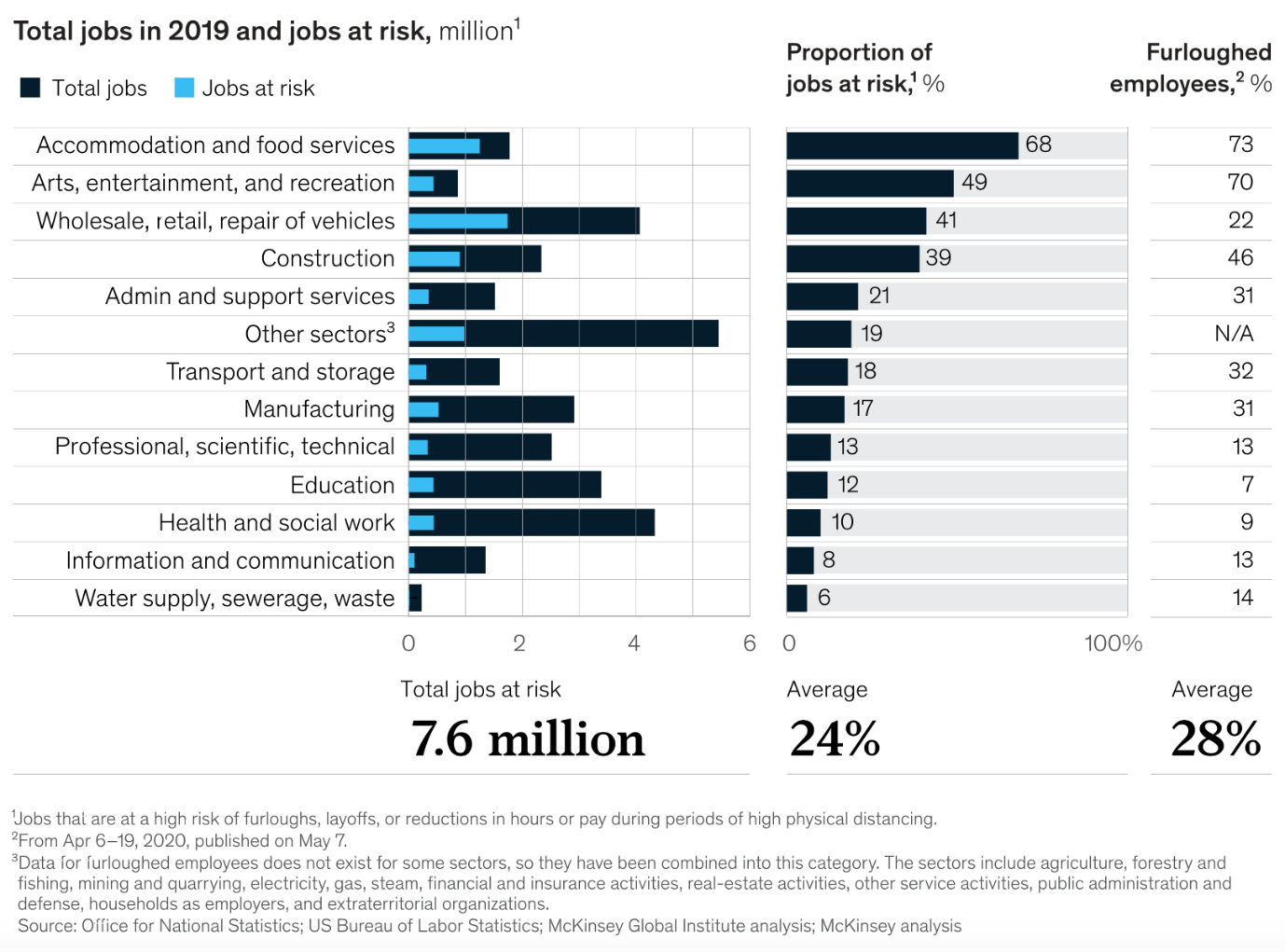
The impact upon the Food & Drug Retailers, General Retailers, Media and Travel & Leisure industries has been far worse when compared to other sectors. Research carried out by McKinsey has shown just how disproportionate the effects will be on employment within different sectors of the economy. As can be seen by the chart below, Accommodation and food services, along with Arts, entertainment, and recreation are expected to experience the worst job losses of any sectors.
Unsurprisingly, the Consumer Services FTSE All Share sector benchmark has fallen by -24.7% since the start of this year, slightly worse than the -20.1% fall in the FTSE All Share. However, with the economy slowly re-opening and talks of Boris Johnson reconsidering social distancing measures, the Consumer Services sector may offer plentiful opportunities in the event of a return to some form of normality.
This article will examine the Consumer Services sector and its industry groups in some more detail, highlighting the performances of the industries so far. The article will also assess the industry groups from a valuation perspective and take a look at the top-ranking stocks within the sector to evaluate how these companies are adjusting to the current climate.
Performance of the Industry Groups
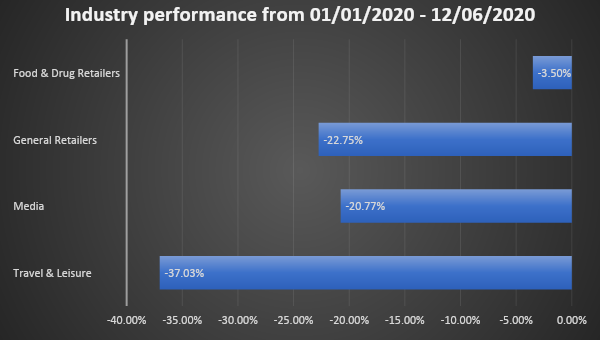
The best performing industry group since the turn of this year, by quite some margin, has been the Food & Drug Retailers, witnessing a minor -3.5% fall. Indeed, when panic started to kick in at the end of March, Food & Drug Retailers were the first to benefit, with people stocking up on essential goods. This led to a record £10.8 billion worth of sales for British supermarkets in March alone.
However, most Food & Drug Retailers have, so far, failed to translate the substantial increase in revenues into bottom line profits. Sainsbury’s, for example, has predicted a £500 million hit in profits due to the additional costs it has incurred as a result of the pandemic. Supply chain issues, and a fall in merchandise and clothing sales combined with social distancing rules and the costs of safety equipment provision to staff, have offset the grocery sale gains. As a result, the company now expects profits for next year to be broadly flat.
Nevertheless, there have been some standout performers within the Food & Drug Retailers industry group. Whilst the traditional supermarkets have seen their share prices fall or stagnate, online grocery retailer Ocado has seen its share price appreciate by an astonishing 54.7% since the lockdown began. Demand for online grocery deliveries has soared as more and more people have opted or been obliged to stay home, with Ocado seeing its sales grow by over 40% year on year. With this trend expected to continue, it may be worth considering which Food & Drug Retailers are best positioned to respond to changing consumer behaviour.
General Retailers have fared far worse than Food & Drug Retailers. The FTSE All Share benchmark for General Retailers shows declines of -22.75% since the turn of the year. These falls can be mainly attributed to high-street retailers who have seen their sales almost entirely vanish. Marks & Spencer, Frasers and Next have seen their share prices collapse by -51%, -29.7% and -27.7% respectively.
The high street has seen declining rates of footfall for quite some time; however, the pandemic has greatly accelerated this trend. Below is a graphical representation of the change in footfall across UK high streets from January 2019 to April 2020.
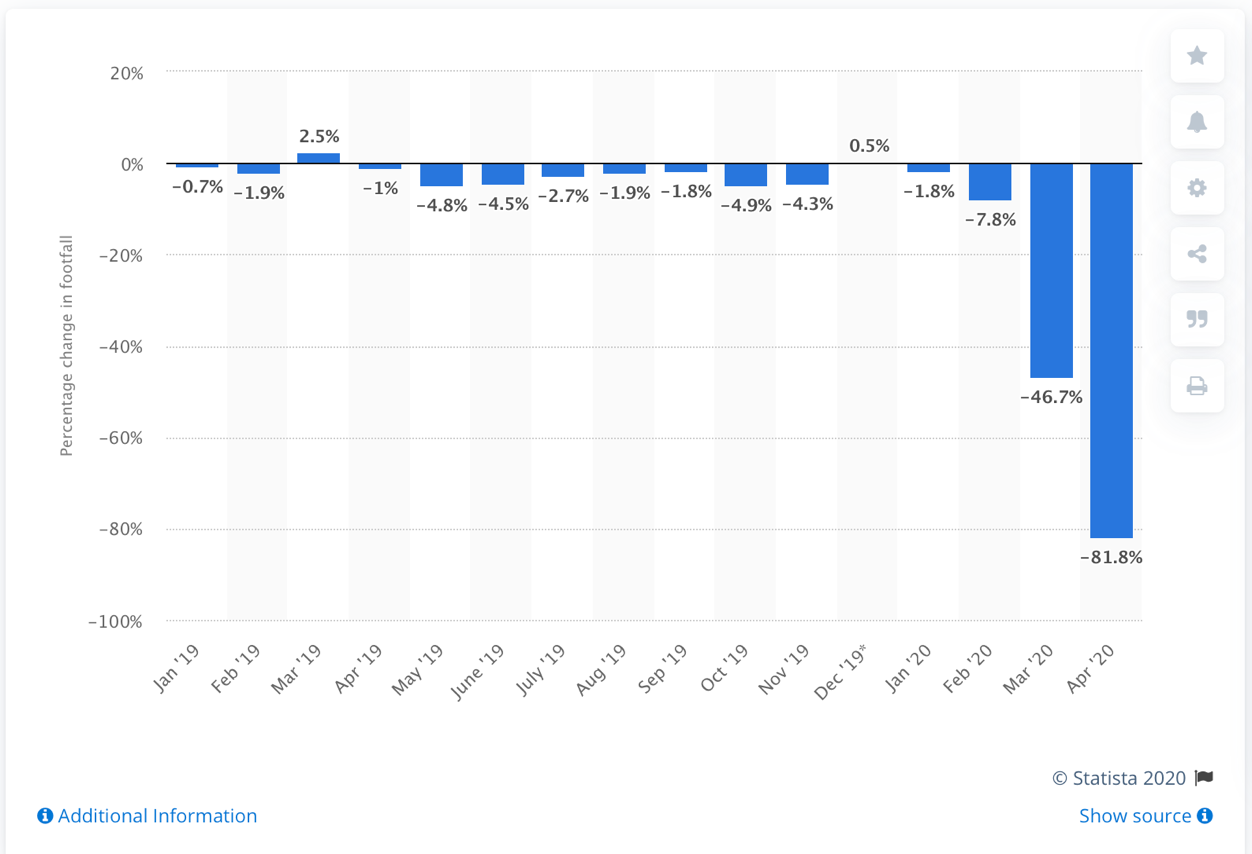
Established high-street retailers have continued to struggle whilst online retailers have flourished. In fact, one of the top performers in the General Retail industry has been online electrical goods retailer, AO World. The company CEO, John Roberts recently commented “In terms of online shopping behaviour, I believe we have seen five years accelerate into only five weeks”. The share price has risen by over 60% since January, reflecting the optimism on the company’s new outlook.
In this digital age it is vital that General Retailers adapt their businesses to adjust to consumer’s evolving shopping habits. Conventional high-street retailing will most likely never see a return to its former glory. The pandemic has heightened the need for digital transformation and companies which do not take the necessary steps to achieve this are at risk of becoming irrelevant or extinct.
The Media industry has performed slightly better than the overall Consumer Services sector, dropping by -20.77%. Whilst comparison sites such as Moneysupermarket.com and Goco Group, formerly Gocompare.com have remained resilient, traditional media companies have suffered. ITV and WPP have been some of the worst affected companies in the media industry, each seeing their share prices almost halve since the start of the year.
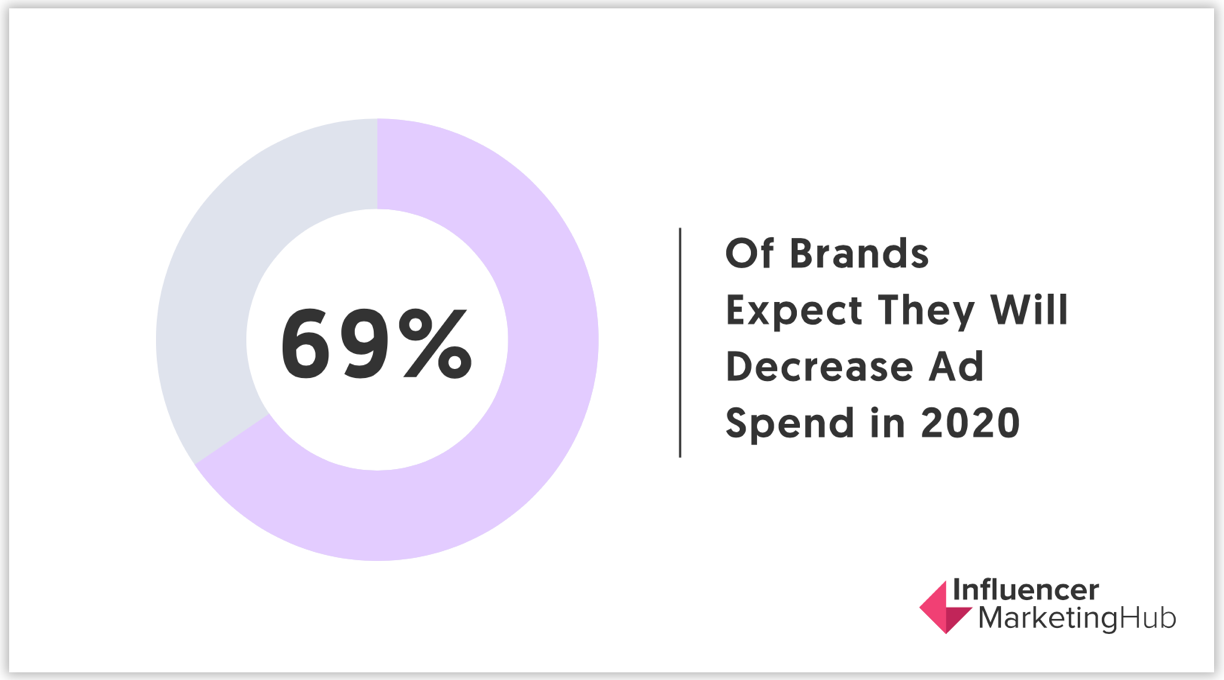
The reliance on advertising revenues has negatively impacted earnings. ITV reported a 42% drop in advertising revenue for the month of April and WPP, the world’s largest advertising company, expects to see more short-term damage. Indeed, research carried out at the end of March by Influencer MarketingHub shows that vast majority of companies expect to reduce their ad expenditures over the year.
A -37% fall in the Travel & Leisure industry makes it by far the worst performer in the Consumer Services Sector. The FTSE All Share Travel & Leisure benchmark tracks the performance of airlines, travel agents, transportation, hospitality, entertainment, fitness and gambling companies. As things currently stand, this is the industry which has endured the steepest declines since the start of the pandemic.
The best performers of these industry sub-sets have been gambling firms, which have seen an increase in online gambling revenues offset the loss of sporting revenue. Paddy Power and Betfair owner, Flutter Entertainments, has seen its share price appreciate by 13.8% since the start of the year, whilst online bingo operator Gamesys has risen almost 20%. With the Premier League returning this weekend and most European leagues already back in action, this could provide an additional revenue boost to gambling firms, though these revenues may cannibalise online gambling revenues.
Though the impacts on airline companies have been well documented, some of the worst performers of the Travel & Leisure sector have been restaurant chains. Restaurant Group, which owns Wagamama and Frankie & Benny’s and SSP Group, which operates Burger King, Starbucks and Yo Sushi! concessions have both seen their share prices more than halve.
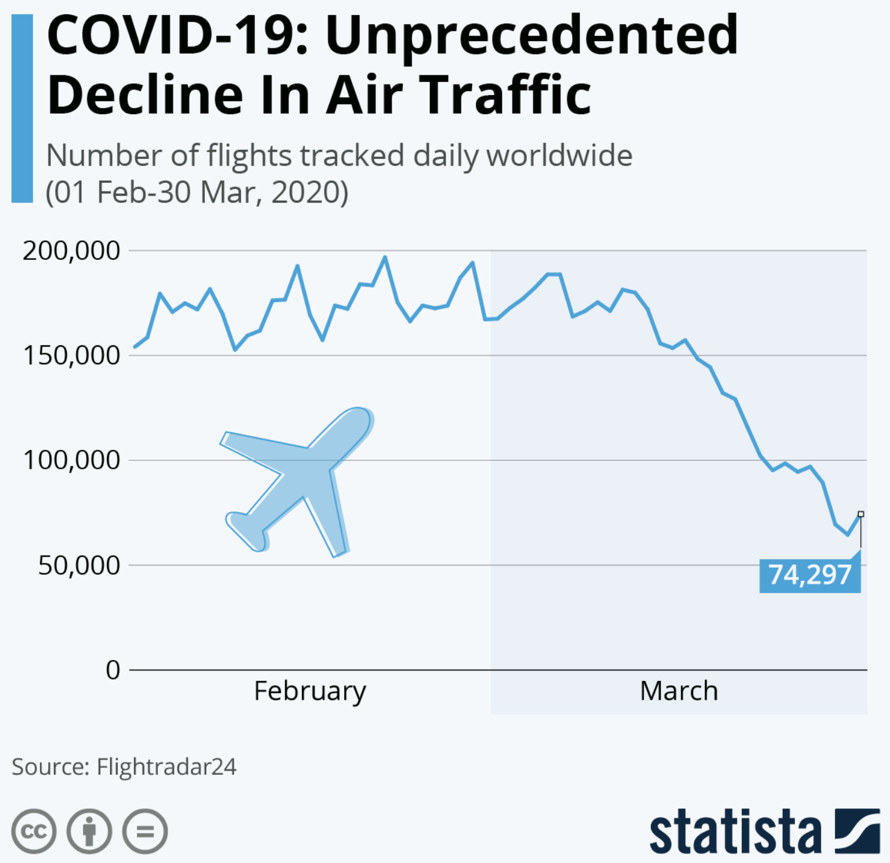
Entertainment venues have also been drastically affected by the pandemic. Cinema Group Cineworld has seen its share price plummet by over 65% since January. However, with the economy gradually re-opening there, if social distancing measures are relaxed, there could be some attractive value propositions within the Travel & Leisure industry. Cineworld for example is reopening its cinemas across the UK on the 10th July, albeit with socially distanced seating and staggered start times. It is worth noting that airlines and travel agencies may have a longer road to recovery though, with air travel not expected to return to pre-Covid levels until 2023-2024.
Valuation of the Industry Groups
Industry Group | ||||
Median Ratio (Forecast) | Food & Drug Retailers | General Retailers | Media | Travel & Leisure |
P/E Ratio | 13.71 | 15.64 | 16.67 | 19.35 |
EPS Growth | -7.06 | -7.59 | -2.71 | 5.07 |
Dividend Yield | 4.34 | 2.71 | 3.3 | 2.77 |
Food & Drug Retailers appears to be the industry which offers most appeal for value and income investors. A 12m rolling forecast P/E ratio of 13.71 is well below the 16.66 average for the Consumer Services sector and a forward dividend yield of 4.34% eclipses all other industry groups as well. However, the median earnings per share contraction of -7.06 highlights the current difficulties of translating surging revenues into profits.
Many of the additional costs that Food & Drug retailers have incurred have been one-off or exceptional charges though. Expenses on setting up plastic screens at tills or reformatting stores may impact upon profitability for the next year, but not in the years to come.
General Retailers are expected to experience the most profound earnings per share contractions (-7.59) of any industry within the Consumer Services sector. Whilst the forecast P/E of 15.64 is lower than that of the Media and Travel & Leisure industries, the forward median dividend yield of 2.71% is the worst in the sector.
The Media industry offers a more enticing 3.3% dividend yield and a smaller earnings per share contraction of -2.71. However, this will cost investors a higher premium, with the media forecast rolling P/E currently at 16.67.
For those pursuing growth strategies, the Travel & Leisure industry still seems to offer the best prospects. The industry is the only one in the Consumer Services sector to achieve EPS growth, which stands at 5.07. However, the median P/E ratio is the highest of all the industries, at 19.35. Furthermore, the forward dividend yield of 2.77% may not be enough compensation for taking on the risk of investing in an industry under such uncertainty.
Consumer Services: The Top-Ranking Stocks
In this next section I will take a look at the top 3 ranking stocks from the Consumer Services FTSE All Share sector benchmark.
Kingfisher (LON:KGF) – General Retailers
Share Price: 215.9p
Market cap: £4.29b
StockRank: 99
B&Q and Screwfix owner Kingfisher’s recent share price growth has seen the company propelled into the FTSE 100 in the most recent quarterly rebalancing. The company has been able to benefit from the UK Government categorising home improvement stores as essential and with individuals stuck at home able to spend more time on DIY projects and making garden improvements.
There has been a multitude of factors behind the 74% resurgence in the company’s share price since its March lows. A fourfold increase in e-commerce since mid-March, combined with promising signs of improvement from store re-openings has appealed to investors. Furthermore, confirmation that the company has sufficient liquidity headroom to withstand a prolonged period of reduced sales, with access to over £3 billion in liquidity as at 12th June 2020, has also provided further support to the company’s share price.
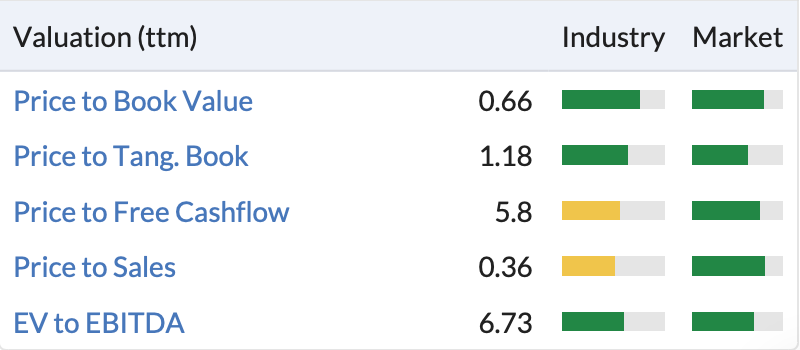
These strong all-round fundamentals have given Kingfisher Super Stock status with the company’s StockRank currently at 99. It is interesting to note that despite the share price surge, the valuation remains relatively cheap. The company currently trades on a Price to Book well below 1, providing investors with a solid margin of safety. In addition to this the company continues to generate substantial free cash flow. Free cash flow per share has been growing at a compounded annualised rate of over 10% in recent years.
The company very recently released its 2019/20 full year results, which confirmed that underlying sales jumped 21.8% year on year from its second quarter, sending the shares up over 6%. A new 8-point step plan ‘Powered by Kingfisher’ has also been devised to focus the business on key strategic priorities. The strong performance and strategies in place have led Thierry Garnier, Chief Executive Officer to state that “Kingfisher is well positioned within a home improvement market that is resilient and has attractive long-term growth prospects. We have strong market positions and distinctly positioned retail banners that address diverse customer needs. These are major strengths in a world that is so volatile and uncertain.”
Halfords (LON:HFD) – General Retailers
Share Price: 170p
Market cap: £353.2m
StockRank: 98
Investors who bought into Halfords during its March lows would have been rewarded with a staggering 228% gain within the space of 3 months. The automotive and cycling products retailer was another to benefit from the Government’s labelling of the company as an ‘essential’ retailer. This allowed stores to remain open, albeit under a ‘Dark Store’ model where customers place orders directly with staff rather than browse for items.
Since Transport Minister Grant Shapps has encouraged the uptake of cycling as an alternative means of getting to work wherever possible, the shares have maintained a strong upward trend. Halford’s is currently the UK’s biggest cycling retailer, holding around a 25% market share in addition to its market leading position in E-scooters.
With Government plans to improve cycling layouts throughout the country in order to tempt people to avoid public transportation, there are strong foundations on which the company can grow its top and bottom line.
In the company’s early May trading update it announced that it had experienced better than expected sales during the lockdown period. As a result, profit guidance would now be towards to upper end of the previously guided range of £50-55m for its full year results.
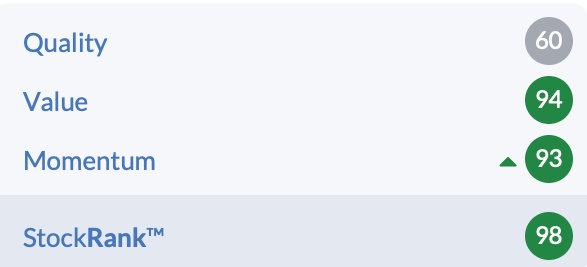
The strong financial performance has been reflected in the company’s share price, with the Momentum Rank currently at 93. However, the valuation still seems to be intact. The price to free cash flow is remarkably low at 3.3 as is the company’s price to sales ratio, which current stands at 0.31, hence the 94 rated Value Rank. It is also worth mentioning that, whilst the quality metrics may seem poor at first glance, the margins and returns on capital are superior to most companies in the industry.
Domino’s Pizza (LON:DOM) – Travel & Leisure
Share Price: 319.2p
Market cap: £1.57b
StockRank: 89
Domino’s Pizza has been a relatively strong performer throughout the pandemic, falling by a much smaller amount in March when compared to industry peers and recovering at a much faster rate. Pizza demand has shown no real signs of slowing with people forced to the confines of their homes.
In a very recent trading update, the company announced that like for like sales in the UK grew strongly in the first half of the year. Not only has the order count improved, but the average number of items per order has also risen, leading to much higher sales.
However, the share price dropped by just under 6% after the company highlighted that, as a result of the significant changes it had to make to its business model to ensure that colleagues and customers remained safe, costs dramatically increased. In fact, the additional costs incurred have “more than offset the benefits from the increased sales” and as a result the company expects EBITDA for the first half of the year to be “slightly lower year on year”.
Nevertheless, the company still remains 18.9% above its March lows and potentially now offers a more attractive entry point for investors, if the company manages to keep costs under control.
The company has a proven track record of sales and EPS growth and has consistently achieved market beating levels year in year out. Its 3-year compound annual growth rate for sales and earnings per share are an impressive 12.1% and 37.8% respectively.
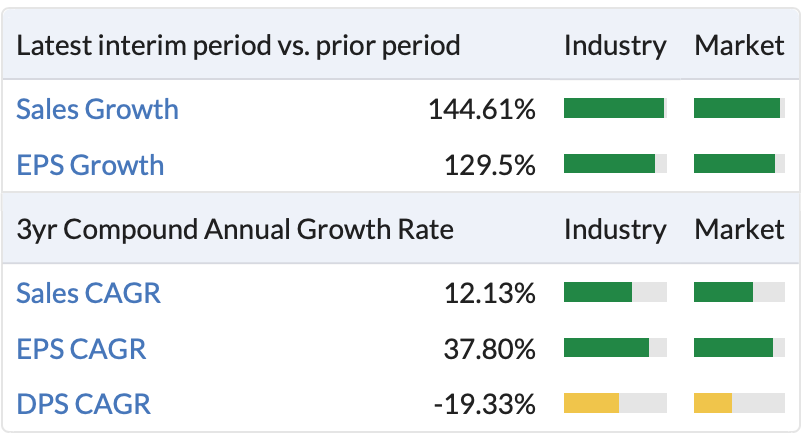
Furthermore, although the valuation may seem a bit stretched, the company boasts very impressive quality characteristics. The return on capital is over 30% and operating margins are a solid 14.2%in an industry where margins are usually wafer thin. With the historically strong price and earnings momentum, Domino’s Pizza has all the attributes of a High Flyer.
Conclusion
From the performance of industry groups and their relevant constituents there is one main recurring theme. Industries with the ability to move operations online and reduce the need for direct consumer interactions have performed substantially better than their peers. Moreover, industries or sub-sets of industries that have been classed as ‘essential’ by the Government and received full support for the continuation of business activity have also inevitably performed comparatively better than other non-essential industry groups.
The Consumer Services sector has truly been one of the worst affected by the pandemic. Retail sales have plummeted and restrictions on movement and socially distancing rules may be around for some time yet. The most recent outbreak in China shows that only the development of an effective vaccine will lead to any resemblance of the pre-Covid world.
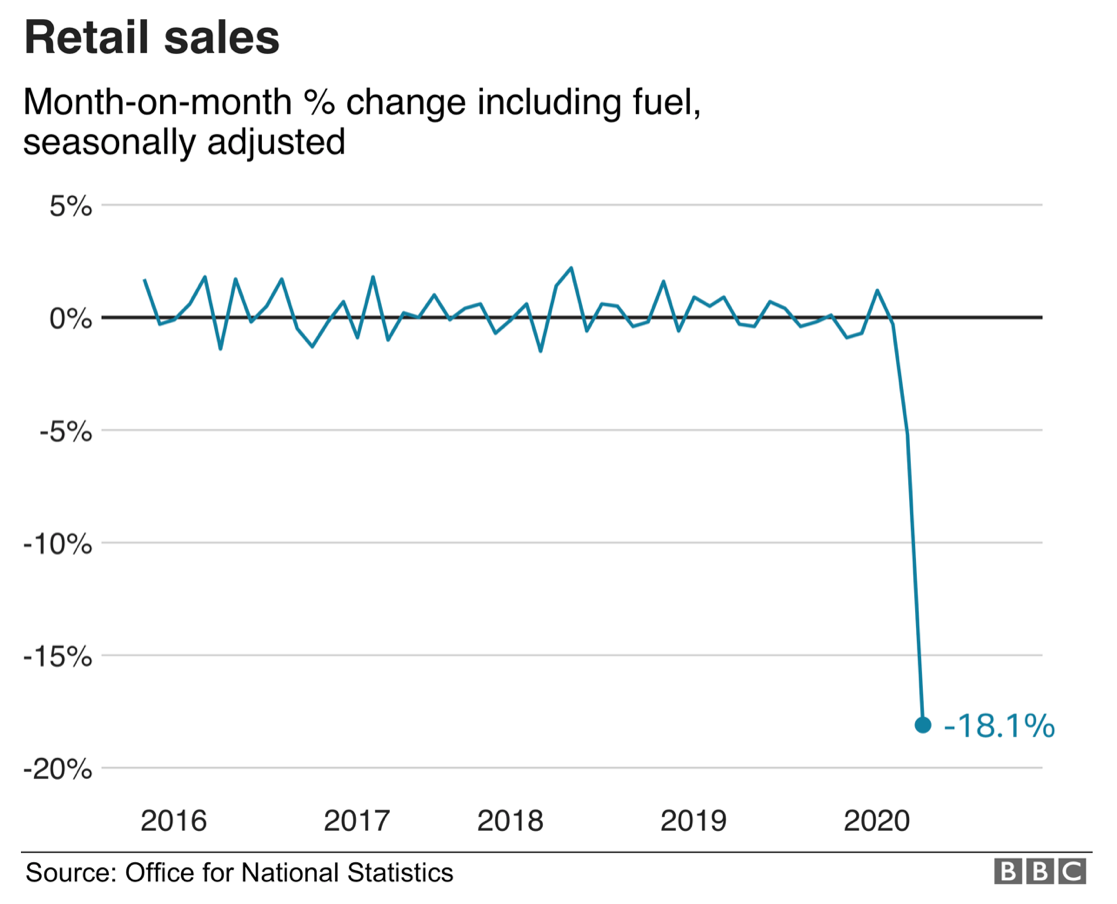
Morgan Stanley expects retail sector earnings to fall by 62% this year and 33% in 2021. Higher operating costs and lower levels of demand may have to be endured for a period in excess of 12-18 months.
Whilst the outlook looks bleak for the likes of general high-street retailers, airlines and transport companies, investors taking a longer view may be able to find companies selling at prices well below their intrinsic value. This proved to be the case in March and plenty of marked down companies have soared since. The market has a tendency to over and underreact greatly in times of volatility, which offers a plethora of opportunities to patient investors.
Conversely, online retailers, media and at home entertainment companies are set to continue their stunning performances as the pandemic goes on. Though valuations may appear excessive in some cases, growth rates are often underestimated, and the pandemic has propelled some of these companies to new heights. Identifying innovative companies at the top of their field, that are able to scale their e-commerce operations can prove to be a very rewarding strategy. One doesn’t need to look much further than the success story of online fashion retailer Boohoo.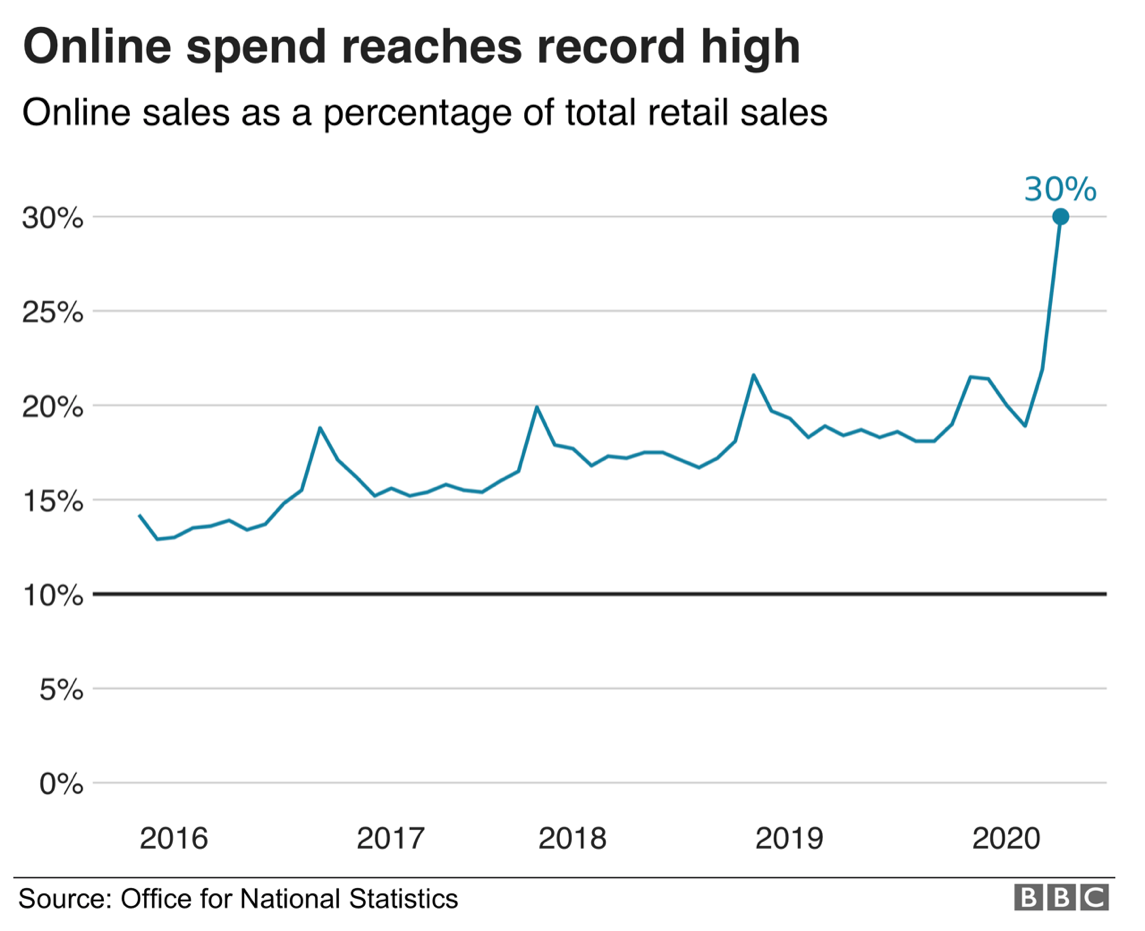
It is also worth bearing in mind that plenty of companies within the Consumer Services sector have been unable to provide forward guidance due to the uncertainty surrounding the impacts of Covid-19. However, certain industry groups carry better forward visibility than others. Food & Drug retailers will be able to more accurately quantify the impacts of the pandemic on business performance, and update guidance accordingly, thereby allowing investors to get a better idea of the risks/reward factors at hand.
Much will depend on the Government’s approach to relaxing social distancing measures in the Consumer Services sector. Many companies simply will not be able to operate profitably under 2m distancing rules and could go bankrupt within a matter of months without Government support. However, as the Roman proverb goes, “fortune favours the bold” and with high risk and uncertainty comes bombed out valuations and potential multi-baggers. Plenty of due diligence is required to try and find the right ones though...
Stay safe and safe investing!
Disclaimer
This is not financial advice. Our content is intended to be used and must be used for information and education purposes only. Please read our disclaimer and terms and conditions to understand our obligations.
7 comments
thanks for this. Very comprehensive. One thought I had was what’s the value of Price to Book in this situation? Book is historic cost less depreciation and these assets are now likely impaired. There are other companies that capitalise as much cost as they can which inflates both profits and book values.
What a valuable contribution. Just read your Bio and hope we get more of your in depth insights. Great first article.
Great read
Really interesting, thanks.
Great article Keelan...Good stuff there .Keep up the good work
Excellent article and insight into the sectors. Thank you.
Thought provoking for challenging, changing times.