Daniel Nickols Interview: On the hunt for small-cap growth

Daniel Nickols has been running the Old Mutual UK Smaller Companies Fund since January 2004. In that time he’s forged a reputation for adept stock-picking in both up and down markets. Indeed, his £1 billion fund is one of the best performing in its sector over the past five years, with a 122.4 percent cumulative return.
Daniel and his team of seven portfolio managers and analysts hold around 100 positions in the fund. And while he insists he’s largely agnostic as far as investment style goes, he’s clearly focused on hunting down explosive small-cap growth shares.
Fast growing smaller companies can be highly rewarding yet extremely perilous investments. Navigating this terrain has been a career-long specialism for Daniel, who speaks with an air of calm but also deep enthusiasm for the types of companies in this part of the market.
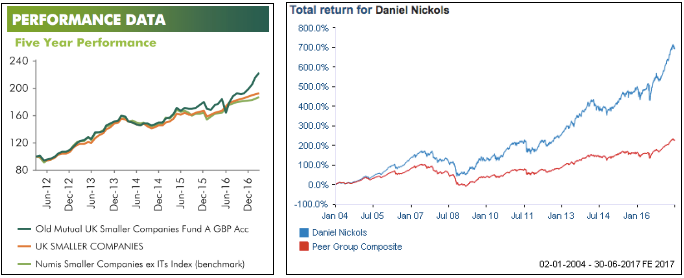
One of the eye-catching features of his approach that he’s previously tilted the fund allocation based on his assessment of the economy (and its future direction). So at times it has been positioned using top-down and bottom-up analysis.
But Daniel is very much a stock-picker. And from that perspective - as he explains - his team are looking for three key attributes in a stock. What ties those attributes together is the view among many investors that small-caps just don’t get enough research coverage. Using that as a starting point it’s possible to study forecasts and find errors and likely areas where the market is underestimating companies. With a process for doing that, Daniel’s successfully built a fund for all conditions...
Daniel, the Old Mutual UK Smaller Companies Fund has been very successful over a long period. At over £1bn, how challenging is it to manage a small-cap fund of that size?
With small-caps, it’s as much art as it is science. In terms of managing the number of positions, over time we’ve typically had between 90 and 110 within the smaller companies portfolio. That range of holdings has been more a function of just trial and error and experience than a scientifically targeted number.
I would readily admit that I’ve benefitted massively from having a great team around me all through my career at Old Mutual, and not least my former boss, Ashton Bradbury. He left the business at the end of 2014 and I owe a huge amount to him. In practical terms he showed me just how to go about running portfolios in this part of the market. What you’re seeing is an evolution of those learnings.
The fund grew rapidly in the period up to 2006, and it was at that point we took to decision to put in place caps on how big it could become. Relative to the market and available liquidity, it’s probably no bigger now than it was then. I don’t think the investment universe has changed so radically in nature that it has become impossible to manage - far from it. Obviously I would say that, but the numbers that we’re delivering demonstrate that it’s possible to run a large-ish fund in this part of the market.
What route did you take into fund management?
The world that I graduated into was very different from the more structured universe that you have today. I was immensely fortunate and went to Cambridge and did an arts degree and then found a route into the City. I didn’t quite fall into it, but I did some accountancy and I always fancied the idea of being involved in the equities space. I started in that world as an equity salesman in Birmingham at a firm called Albert E. Sharp. After three years I had an ‘internal client’ in the firm. There was a smaller companies fund that was managed by the private client part of Albert E. Sharp. I interacted with the manager of that portfolio a lot and I went over to work on that fund. So it was more of a natural evolution.
Apart from specialising in smaller companies, have you developed a particular investment style over the years?
One of the key things I think I’ve learnt over time is the need to be pragmatic about what you’re prepared to look at. To pigeonhole yourself as a ‘growth’ or a ‘value’ investor is likely to result at some point in a potentially protracted period of underperformance when the conditions don’t suit that particular style of investing.
I do fundamentally believe that you’ve got to approach what you do flexibly. You’ve got to try and make sure there’s a consistency between the top-down environment and the sorts of companies you are looking to invest in. For that reason I’m genuinely pragmatic about the sorts of businesses we’re prepared to look at.
What are the parameters that you’re working within with the UK Smaller Companies Fund?
In terms of the companies themselves, the basic rule is that at the point of initial investment the company has to be no bigger than the largest company in the Numis Smaller Companies Index.
That index was formerly known at the Hoare Govett Smaller Companies Index. It’s recognised as a key smaller company benchmark and it’s the one we’ve always used internally here. It represents the bottom 10 percent of the market by value.
In terms of latitude, the IA [the Investment Association] rules stipulate that we must have at least 80 percent in stocks that are no bigger than the largest company in the Numis index. When a company grows to the point when it is bigger than that, we don’t have to sell it immediately. We can take a pragmatic view and crystallise gains from that company when we feel the investment case is more fully realised.
Some of your larger positions - Fever-Tree, Boohoo.Com, Purplebricks, Burford Capital - have done very well over the past year. What guides your decision-making when it comes to holding or selling those types of positions?
At all times, the question we’re continually asking ourselves is: “Where does our return come from?” In very simple terms, notwithstanding how well those shares have performed, the reason we continue to believe they command a place in the portfolio is that when we go in and analyse the forecasts and what they can achieve over the course of the next two or three years, our strong belief is there are things that confirm the share price upside.
Bluntly, we do think there is upside risk, and in some cases material upside risk, to extant forecasts. That is the central consideration for us. If we didn’t think that, then those positions just wouldn’t be there in that size.
Your approach is really about taking advantage of inaccurate research and forecasts for smaller companies. That’s always been an argument in favour of small-cap investing. Do you ever see that situation changing?
Economically, I don’t think there’s ever likely to be a situation where there are the resources for enough people to make a sufficiently good living producing unbiased, objective, high quality research in this space. And more so with the changes that regulations like MiFIDII will bring as well. If anything, that increases the pressure on the sell-side.
It may sound paradoxical, but that will help us incrementally, to be honest. There will be enough research out there for views around valuation of a particular company to coalesce, but qualitatively I think that information will be less good than it is today.
Tell me about your process. What do you and your team look for in company?
In terms of what we’re looking for, at a stock level, ever since I’ve been associated with this desk, there have been three key attributes that we’ve been looking for. They’re what we believe are capable of delivering a powerful investment case, although they’re not intended to be mutually exclusive.
The first would be trying to find stocks that can deliver sustained, above-average earnings growth. And by that, I mean cash-backed earnings growth - because there is that qualitative link between reported earnings and cash flow. By that, we mean businesses with a novel product or service, or businesses that sell into a specific niche, growth market. It means they can deliver that growth over a multi-year horizon in a way that’s not a particular function of the wider economic environment.
In the small-cap world there are a lot of businesses with those attributes. Fever-Tree was a classic example. Its product - this premium mixer idea - didn’t exist until Fever-Tree came along and presented it to the market. So, it’s almost self-generated growth and it’s a great example of the unique qualities that you can find in the UK small-cap space.
The second dynamic comes back to the relative paucity of research coverage in our space. There is an ongoing opportunity to find stocks that can deliver positive earnings surprises. So we spend a lot of time looking at the structure of sell-side forecasts and trying to understand the assumptions that are behind the key modelling sensitivities and trying to find instances where those assumptions are just wrong.
It doesn’t have to be rocket science to do that, and meeting company management teams will help you in that endeavour. No management team will ever say the forecasts are wrong but they will help you to understand what the prospects divisionally for their business typically are. If you then relate that back to the structure of market forecasts in a common sense way, you can fairly often find instances where forecast numbers for companies are too low.
The third attribute is trying to find businesses that we think can be re-rated relative to the market. That’s often because there’s some catalyst to change the way that the market might look at a business - such as a new management team or new strategic direction.
Those are the three key attributes that we would be looking for.
In the past you’ve combined stock-picking with a more top-down macro assessment. How has that worked for you?
The UK smaller companies world is a very multi-faceted space. People try to label it as being overwhelmingly domestically driven. At a very high level there’s maybe some truth to that. If you look at the earnings of FTSE 100 companies, for example, I think it’s about 70 percent overseas driven, and 30 percent domestic. The Numis Smaller Companies Index, on the face of it, is something like 40 percent international and 60 percent domestic.
But because there is a far wider array of companies available to us in this space there is a lot more you can do to create portfolios that are not necessarily driven by the UK economy in isolation.
I think because of the fundamental growth orientation of a lot of relatively immature businesses that you might find in our space, again the vagaries of the UK economy don’t necessarily have to permeate the portfolio that far. It’s not like we can get away from the UK economy entirely at times when we might want to. But there is a huge amount of stock-specific stuff that, in aggregate, means the portfolio isn’t necessarily that sensitive to what happens here in the UK.
To come back to the wider question about what you should do about the macro. Bluntly, you have to accept that the range of possible outcomes economically is quite wide. And where that’s the case, why take major bets? If you don’t feel you can necessarily add value in terms of postulating how the economy might move forward over the course of two or three years, just don’t take those bets.
Now is a classic case in point where, from a sector perspective, our portfolios don’t necessarily have major tilts in them. They’re quite neutral in terms of sector positioning. Where we’re trying to add value - and looking back at what we have delivered, where the value has come from - it’s been very much the stock picking level, rather than from sector or thematic tilts. That’s what we’re deliberately trying to do at this moment in time.
Smaller companies are naturally unpredictable, which makes life difficult for investors. How have you come to terms with that?
My career has been going long enough to have suffered several instances of getting things very, very badly wrong at an individual stock level. The basic rule would be where we think we’ve got something fundamentally wrong, and our investment thesis is fundamentally flawed, and there’s no chance of ever doing anything to recapture any value, then you just have to take the pain and move on as quickly as you can.
Thinking back over my career, early on I remember having a big position in something called NSB Retail, which fell 70-80 percent in one day. More recently, five or six years ago we had a holding in Blinkx, which is now known as Rhythm One, and its then business model was exposed as being fundamentally flawed. We had to accept the logic of that and lost a lot of money. So we sold and moved on.
Over time, given the growth of the desk, we have become material shareholders in certain companies. In those instances we can and do look to work with management teams and give them our opinions and views as to how they might move forwards. But it’s all done on a case-by-case basis.
If we think an investment case has fundamentally broken down and there is nothing we can do, then it’s futile to stand on the side-lines and try and take some sort of remedial action from there. If there is something constructive we can add, and the investment case is still fundamentally attractive, then we will absolutely work with the board and the management team.
More broadly, how important to do you think it is to meet with and engage with management teams?
It’s really important. I think the opportunity we have is that, in contrast to the large cap world where a lot of interactions are quite stage managed, we get to meet in less formal settings and conduct meetings to our agenda and understand the conceptual drivers behind a business in the way that we want to. Again, that’s one of the unique features of working in this space.
When you look at the market now, and the performance of your fund, what is your reading of where valuations are?
In aggregate, I don’t think UK smaller companies are particularly richly valued, certainly relative to the market. The Numis Smaller Companies Index is trading at about a 1 P/E point discount to the FTSE All Share.
There has been something of a polarisation in valuations. A lot of growth stocks have become expensive, while companies with lesser growth prospects have relatively de-rated quite a long way. So there is a bit of a polarisation going on, but again it really comes back to the case-by-case analysis. Our portfolio is trading at a reasonable premium to the Numis Smaller Companies Index. The Numis index trades on a 12 month forward P/E of just over 14x, and our portfolio is on about 18x.
But we believe we’re getting the benefit of materially faster earnings growth than the wider market is set to deliver. The incidence of forecast upgrades reflecting in the consensus for the underlying businesses is certainly coming through over the course of this year. So we believe for calendar 2017 the portfolio, based on consensus numbers for the companies (not our numbers), should deliver earnings growth of about 18% as well.
There is a judgement in all of this that runs along the line of this: The world is a place of reasonable, if not spectacular growth right now. Clearly the UK, with political and Brexit-related uncertainty, has its own issues to contend with. I think that in the immediate moment we’re in an environment where some of the highly rated names, just looking at how well they’ve done, may well give back a little bit of that performance. But in in terms of thematically where leadership might lie, I think that genuine growth stocks can continue to trade at somewhat elevated multiples provided that they are delivering good growth. And in our world we can find companies that do just that.
IPOs have slowed up over the past year, but presumably you are seeing companies coming to you. Are you confident about the pipeline for new listings?
In a word, yes. A key part of our job is interacting with and keeping abreast of developments in that pre-IPO space. In terms of headline numbers, there have been fewer IPOs over the course of 2016 and 2017 to date than there have been in the preceding two or three years. But we are undertaking a lot of pre-IPO activity and meeting with companies that are potential candidates for IPO at some stage. A good number of those are absolutely things that we would consider for inclusion in the portfolio at the right price. So there should be a good stream of opportunities that arise from that source.
Individual investors are always at risk of becoming too emotionally involved in their stock selections. Is that something you’ve had to learn to manage as well?
When things go well, it’s gratifying. One of the things that Ashton Bradbury taught me was that ultimately you are buying a share, you’re buying something that’s inanimate in a way. Falling in love with companies, getting too close to management teams is not necessarily a positive thing to do. To have that sense of detachment and objectivity is very important.
Inevitably the time comes - and hopefully in a positive scenario - where we do have to move on from a company. It will have become maybe too big or it will have achieved the full extent of the re-rating that we think is possible. So being willing to move on and look to the next opportunity is the right way to be - rather than having some sense of attachment to something that isn’t truly objective.
One of the very valuable things here is that we’ve got a big team; we’ve got seven people. That helps because what you specifically want to encourage is that people furnish you with the other side of the argument. You want to be challenged so you don’t just retreat into a comfortable view about something. Having dissenting voices around and having your view on a stock challenged is immensely valuable.
Looking at your fund right now, which companies particularly impress you?
We wouldn’t have companies like Fever-Tree and Boohoo.Com in the top ten unless we still felt a high level of conviction about them.
One that is coming through, and it’s more of a developing position, is Blue Prism. On the face of it, this is optically a hugely expensive stock. But I do think it’s one of those quite rare examples of a genuinely disruptive UK technology business. It’s a software business that operates in the so-called field of robotic process automation. This is the automation of basic administrative tasks - things that if you can do at speed in an error-free way, can become very, very powerful.
There is a lot of evidence to suggest that this business is a genuine global leader in its particular field. The reason we are excited about this is that, again, when we go away and interrogate the numbers we see the prospect of really good upside versus the market’s understanding of this business. So that’s something that’s emerging as a larger position for the fund, but I think it’s one that can add a lot of value over time.
Finally, looking ahead, are you confident that the fund is well placed to keep delivering?
I think I can feel pretty sanguine about the prospects for the portfolio because we’ve spent a lot of time putting together a collection of what we think are really strong ideas. I think they stand perhaps one removed from the uncertainties that we face domestically. That’s either because the business models are unique, at relatively early stages of their development or they don’t really have the UK itself as a key driver of their particular opportunity.
So I think the portfolio can continue to deliver really good levels of earnings growth from the companies it holds. And while the portfolio does stand at a bit of a premium to both the wider market and the immediate smaller-cap indices, I still think we can make really good, positive progress through stock-picking.
Daniel, thanks very much for your time.
Disclaimer
This is not financial advice. Our content is intended to be used and must be used for information and education purposes only. Please read our disclaimer and terms and conditions to understand our obligations.
7 comments
I use AIM shares in attempt to mitigate IHT.
Could comments about a particular AIM share indicate if they qualify for Business Property Relief (BPR).
Hi - the guidance on this is notoriously muddy ! It's tricky for Stockopedia (or anyone for that matter) to offer a definitive list of AIM stocks that would qualify under the BPR rule. That's because HMRC only make a judgment on exemptions when the tax falls due.
You do hear people talk in broad terms about AIM stocks qualifying for BPR, but there are some known exemptions (which I'm sure you know). Anything investing passively in land or other assets is unlikely to count, neither will Reits, investment trusts, dual-listed stocks, or holdings in a fund. An investor also needs to hold the position for at least two years.
Beyond that, it's down to individual judgment I'm afraid.
Thanks for that Ben.
Mrken.
johno,
I deplore the first name only familiarity that politicians seem to automatically use now, such as 'Jeremy said to John about Teresa'. I guess it is meant to denote that they are all part of the 'In Crowd'. However FYI a quick spin of the mouse wheel to the top of the page shows Ben to probably be Ben Hodson of Stocko (that's Stockopedia) and Paul to be Paul Scott a regular contributor to same. HTH,
Garth Nicholson
Good article. Who's Paul and Ben for that matter?
Ben,
Interesting interview with a fund manager who has done very well over the last 5 years. I see that their Top 10% holdings are largely growth/momentum companies, that have done well in recent times. Perhaps another notable case of small company Buy high/Sell higher. Ian
FEVERTREE DRINKS PLC 4.7
PAYSAFE GROUP PLC 4.0
ASCENTIAL PLC 3.9
BOOHOO.COM PLC 3.9
CLINIGEN GROUP PLC 2.5
MICRO FOCUS INT 2.5
JOHNSON SERVI ORD 2.4
RESTORE PLC 2.3
SMART METERING SYST 2.3
ONESAVINGS BANK PLC 2.2
Total 30.7%
It would have been interesting to know if during some temporary downside they lend their holdings to short sellers.
Isn't that a useful thing to know? Also, I will go with Paul and avoid Blue Prism - where is the cash-based earnings here?