Didn’t buy XP Power? 13 potential high return bowls to consider now

As subscribers are well aware, Momentum is a powerful driver of stock market returns, and one we take seriously at Stockopedia. There are two sides to the Momentum coin:
- Mean reversion: The first is a long-term mean reversion in share prices. Investors forget the power of capitalism at their peril. As management and shareholders are incentivised to turn around poor-performing businesses, while the successful face increasing competitive threats. This tends to be reflected in a reversal of share prices over periods of around three years.
- Underreaction: However, over shorter periods, 6 months to a year, winners tend to keep on winning, and losers tend to keep on losing. When a business starts on a medium-term trajectory, investors are slow to update their priors. It is common market knowledge that companies issuing “ahead” statements tend to see these repeated and that “profits warnings tend to occur in threes.”
When these effects align, they can be a powerful force, and many approaches aim to combine them, such as the Stockopedia Turnaround QM strategy. Quants are in on it, too, and research papers highlight how momentum strategies can be improved by avoiding “stale momentum”; stocks that have been rising for so long that corporate mean reversion starts to affect returns.
Last year, Ed controversially concluded that bowl-shaped graphs could be one of these combinations. The idea is that an accelerating turnaround in a stock that has been underperforming for about 3 years may see the share price return to previous highs, generating strong returns for investors who jump aboard once that turnaround is clearly in place.
However, there are a couple of common pitfalls that bowl-lovers tend to make:
- Too short a time horizon: It is tempting to draw a bowl on any short-term recovery. However, to take advantage of the underlying effects, the bowl has to start around three years ago. Drawing a bowl around a much shorter-term recovery is likely to have a much more variable effect.
- Forgetting about dilution: If a company has had to issue a lot of shares to shore up its balance sheet during a turnaround, it would be foolish to expect it to return to previous share-price highs, as this would represent a much higher market cap.
- Lack of rigour: one weakness of investing based on chart patterns is that we can sometimes fit a particular shape or line to any chart. Therefore, I introduced the mathematical concept of a bowl shape (the parabola) and the R-squared figure, which measures how closely a chart fits this shape.
Using the screening tools to form an initial list and then checking the dilution and R-squared values, I came up with a list of possible bowl candidates. Those that looked like they had decent upside and a reasonable bowl-shaped graph were:
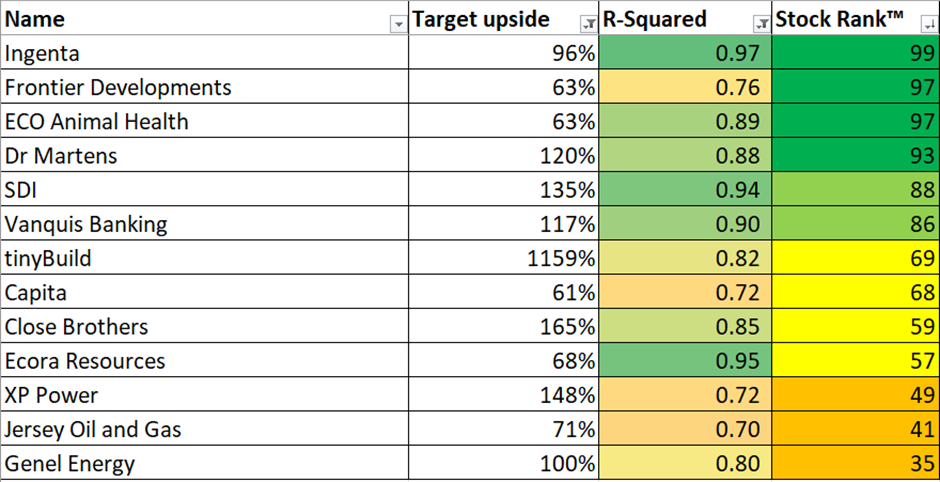
How did the bowls perform?
To be honest, perhaps not as well as I expected, at least compared to what I calculated was the upside if the bowl patterns were completed:
| Name | Target upside | Bowl R-Squared | Stock Rank™ | Return since Nov25 |
|---|---|---|---|---|
Ingenta (LON:ING) |
96% |
0.97 |
99 |
-2% |
Frontier Developments (LON:FDEV) |
63% |
0.76 |
97 |
-11% |
ECO Animal Health (LON:EAH) |
63% |
0.89 |
97 |
10% |
Dr Martens (LON:DOCS) |
120% |
0.88 |
93 |
-20% |
SDI (LON:SDI) |
135% |
0.94 |
88 |
-2% |
Vanquis Banking (LON:VANQ) |
117% |
0.90 |
86 |
-1% |
tinyBuild (LON:TBLD) |
1159% |
0.82 |
69 |
28% |
Capita (LON:CPI) |
61% |
0.72 |
68 |
11% |
Close Brothers (LON:CBG) |
165% |
0.85 |
59 |
7% |
Ecora Royalties (LON:ECOR) |
68% |
0.95 |
57 |
46% |
XP Power (LON:XPP) |
148% |
0.72 |
49 |
100% |
Jersey Oil and Gas (LON:JOG) |
71% |
0.70 |
41 |
-44% |
Genel Energy (LON:GENL) |
100% |
0.80 |
35 |
-17% |
The average return has been 8.0% since I wrote about these at the start of November, and although this compares favourably with the 5.7% return for the UK-focused FTSE 250 over the same period, it is lagging some of the possible returns I highlighted if the bowl-shape completed. Its performance also lags that of some other trend-following strategies, such as clear trends that Ed has written about recently.
What went wrong?
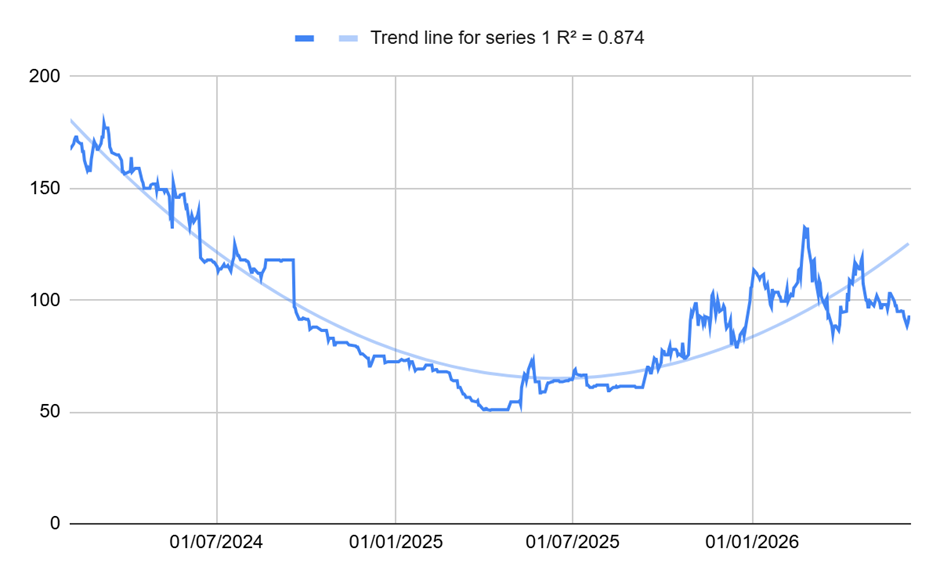
This may be partly about timing. Some of the companies have seen the bowl shape of their chart weaken and become noisier, but remain largely intact with a still high R-squared:
Ingenta (LON:ING)
SDI (LON:SDI)
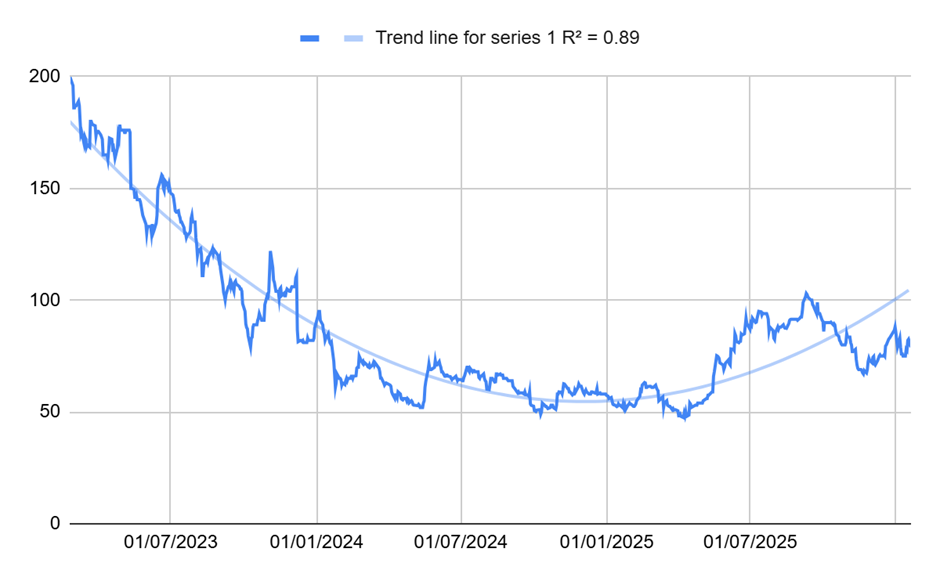
Many of these did well for a time but have suffered over the last three months, and I don’t think we can rule out the War in Iran having a disproportionate effect on individual investor sentiment for some of these, even if there has been no downgrade in prospects. Illiquidity at the lower end of the market can also contribute to exaggerating these moves. So, if confidence returns to smaller companies, we may see them return to winning ways.
The big winner was XP Power (LON:XPP), which is more of a mid-cap name and interestingly has pretty much completed its bowl-shaped recovery, despite very little sign of recovery in corporate performance:
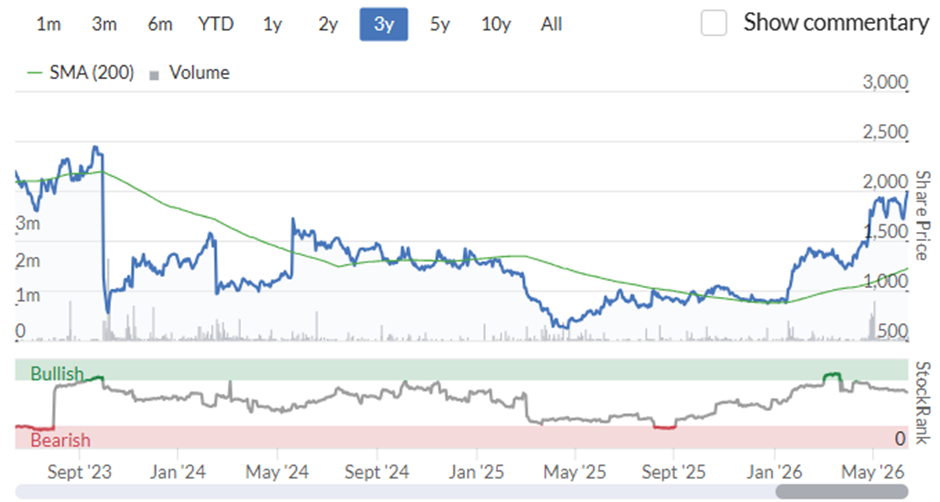
This wasn’t the smoothest of bowls, but being a more liquid stock, it was more exposed to institutional buying. Institutions are often willing to think longer term when it comes to recovery stocks.
Given that many of these stocks underperformed for about 3 years, and have only started to recover over the last year or so, I should probably give the strategy longer to run.
Updated Screen Results
Here were my screen criteria (check out the original article for the rationale behind these):
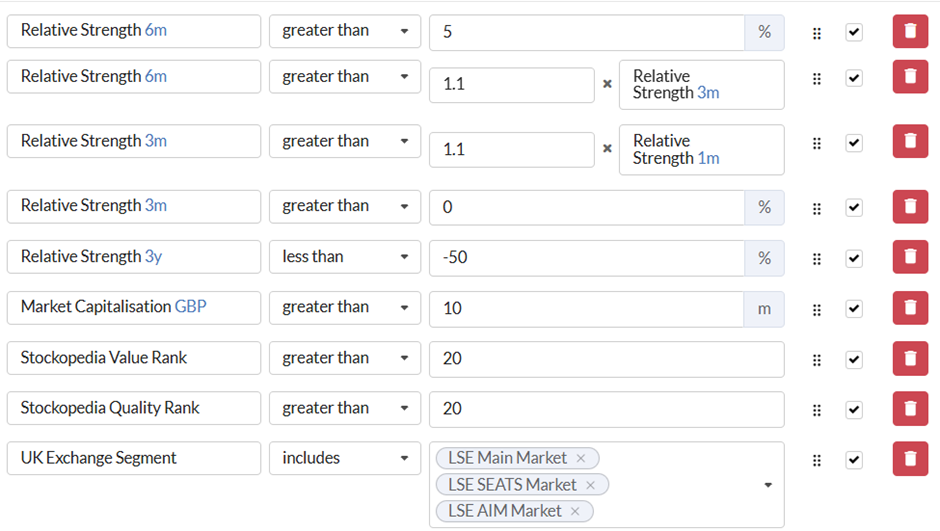
This only generates about 8 results at the moment, so I’ve broadened my criteria to look for companies that have fallen by only around 35% or more in the last year (so have at least 50% upside if they return to past share price levels). This gives a slightly better 13 results to check out. Here’s the list:
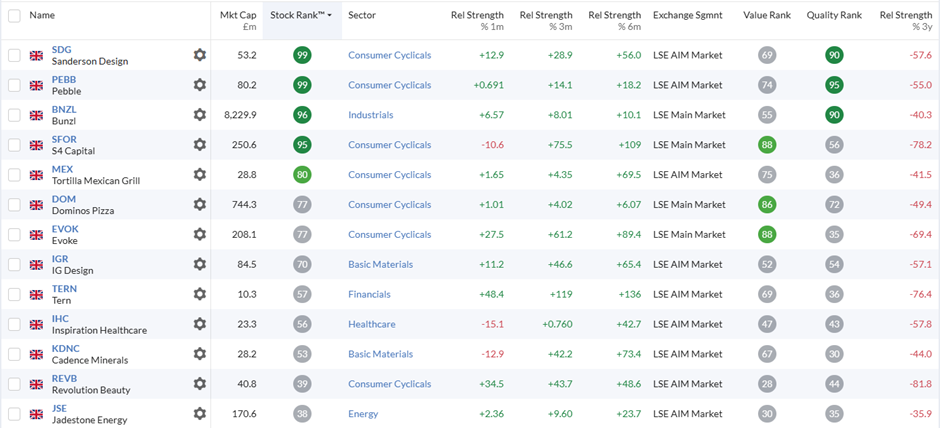
Shareholders in several of these have faced significant dilution, so I will exclude them. Plus Dominos Pizza (LON:DOM) & Evoke (LON:EVOK) are not yet showing signs of bottoming (at least on a mechanical curve fit), so I exclude those.
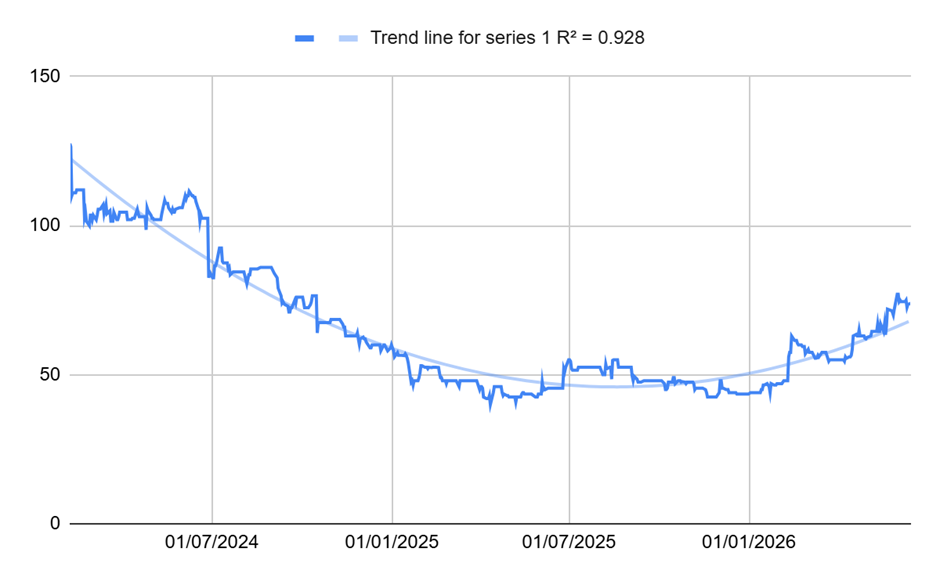
Calculating the R-Squared for the rest, we have a new bowl champion, Sanderson Design (LON:SDG):
An updated list
I can combine the existing bowl list and add in any new bowl candidates to produce a new set of stocks to follow.
Given that Ecora Royalties (LON:ECOR) and XP Power (LON:XPP) have largely completed their bowls, I will exclude these, but keep any others where the upside looks good and the R-squared suggests a good bowl shape remains. Here’s the combined list:
| Name | Target Upside | Bowl R-Squared | Stock Rank™ |
|---|---|---|---|
Sanderson Design (LON:SDG) |
72% |
0.93 |
99 |
Bunzl (LON:BNZL) |
44% |
0.88 |
95 |
IG Design (LON:IGR) |
165% |
0.88 |
71 |
Ingenta (LON:ING) |
101% |
0.88 |
98 |
Dr Martens (LON:DOCS) |
300% |
0.86 |
89 |
Close Brothers (LON:CBG) |
149% |
0.84 |
47 |
Inspiration Healthcare (LON:IHC) |
115% |
0.84 |
57 |
Genel Energy (LON:GENL) |
172% |
0.82 |
32 |
SDI (LON:SDI) |
138% |
0.81 |
78 |
Vanquis Banking (LON:VANQ) |
112% |
0.79 |
73 |
S4 Capital (LON:SFOR) |
286% |
0.75 |
95 |
tinyBuild (LON:TBLD) |
1246% |
0.74 |
36 |
Frontier Developments (LON:FDEV) |
205% |
0.70 |
96 |
I think one thing that stands out from this brief review is that investors can’t just buy one stock whose chart is following a bowl shape and expect it to outperform on any given timeline. However, a portfolio approach of owning stocks with positive momentum characteristics could well pay off. Especially if investors combine this with other positive characteristics like a high overall StockRank.
If subscribers think they have spotted their own high-return bowl – a company whose share price has performed poorly over the last 3 years but is now showing an accelerating recovery – feel free to post them in the comments. Readers can test the R-Squared for their idea by making their own copy of the following Google Sheet.
[Disclosure: Mark owns shares in Ingenta (LON:ING) & Jadestone Energy (LON:JSE)]
Disclaimer
This is not financial advice. Our content is intended to be used and must be used for information and education purposes only. Please read our disclaimer and terms and conditions to understand our obligations.

4 comments
This is really interesting, thanks. Should Tinybuild have been excluded due to the dilution in 2023? Share count practically doubled. I'm not sure the target upside has accounted for this?
The dilution definitely impacts the upside. However it is still so large that returns would be very strong if it returns to a peak market cap. Overall, I’m not a huge fan of tinyBuild (LON:TBLD) (see my recent look on the DSMR). It’s not obviously cheap and the sector is really boom or bust. There’s always the chance that they will be at the start of a new boom, and investors will get carried away again!
We were long term holders of Sanderson Design Mark but sold recently on the bowl bounce. I regret selling it, it's on my buy back list when/if a serious market setback happens.
I actually sold recently, too. The price looked like it had got ahead of itself and my reading of the results suggested that the price strength was at least partly due to the EBT buying shares in the market, and that will end fairly soon it appears.
When the share price was sub-50p you could argue that the licencing side and cash easily covered the market cap. With the price 70p+ on a pure valuation basis, you have to assume a turnaround in the core fabrics/wallpaper busienss, and I'm still not 100% convinced by that.
However, management were back out presenting at Mello earlier this month so must feel they have a story to tell again. Plus there is no doubting that medium share price momentum is with it now, hence the clear bowl-shape. What I am not sure is if this is really due to a sustained turnaround in propsepcts or purely due to some short term but agressive buying by the EBT, that will soon abate.