Epwin: Value or Value Trap in Housing?

I am pondering whether or not to invest in the construction-related small-cap Epwin (LON:EPWN), which has a market cap of £134m.
This manufacturer of PVC frames for doors, windows and fascia (including cladding, guttering and decking) fits my quantitative criteria for deep value, with a Stockopedia composite Value rank of 95 out of 100.
Figure 1: Epwin high Stockopedia Rankings

Value attractions: EV/EBITDA under 5x, P/FCF under 10x, 7.3% dividend yield
Most of the key valuation ratios are very cheap relative not only to the market, but also to Epwin’s direct quoted competitors in the construction space such as Safestyle UK (LON:SFE) and Eurocell (LON:ECEL).
Figure 2: Epwin valuation ratios look cheap
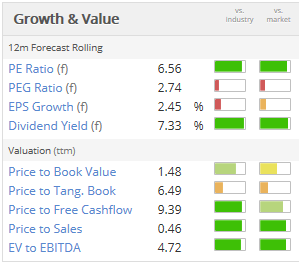
The high 7.3% dividend yield is backed by a free cash flow yield of over 10%, while one pays a EV (Enterprise value)/Sales multiple of 0.5x for an operating profit margin of over 8%.
The low EV/EBIT valuation is a strong contributor to Epwin’s 97% Magic Formula score, giving it an A+ score. So far, so good then.
Quality also high: driven by strong return on capital and free cash flows
The 90 Quality rank is attractive too, with a relatively high Piotroski F-score of 7, high return on capital and solid free cash flow at c. 10% of market cap generated per year in 2014, 2015 and 2016.
There is still some net debt on the balance sheet of £21m, but this represents only a net gearing level of 23%, which is comfortable.
Broker view (Edison Research): internal improvements to fuel positive profitability trend
Edison Research (analysis paid for by the company) seems to give a cautiously positive outlook on Epwin (but should perhaps be taken with a large pinch of salt):
“Trading in the first four months of FY17 has been in line with management expectations and our estimates are unchanged. In flat RMI markets, Epwin is focusing on operational improvements (eg in fabrication) and marketing initiatives (eg branding and range development of window systems and canopy products, plus greater co-ordination across group companies). H117 will benefit from an extra five months of National Plastics trading and we expect Fabrication & Distribution to show a more robust y-o-y performance. Market commentary is cautious, but as outlined in our recent note, Epwin has a number of internal initiatives underway to further improve the business and mitigate near-term input cost pressures.“
Key Risks: Housing and construction slowdown
Safestyle UK (LON:SFE) recently mentioned in their half-year trading update (July 18) that, while their order intake was +2% year-on-year,
“[industry] FENSA statistics for the five month period to the end of May 2017 show a market decline in volume terms in excess of 10%”
This statement, coupled with marked weakening in UK housing market sales volumes in recent months, has provoked a sharp sell-off in all these construction-related shares, including Safestyle UK (LON:SFE), Eurocell (LON:ECEL) and Epwin (LON:EPWN).
Have trends changed that much since May?
Epwin’s own AGM statement (May 23) reported that:
“Trading for the first four months of the year has been in line with expectations”
So the real question regarding Epwin is: have industry trends worsened so much since late May that the 20% share price drop since that drop is warranted?
UK consumer outlook: not great, overindebted
To add to these specific concerns is a more general one: UK households have taken full advantage of near-zero Bank base rates to take on more debt – not only mortgage debt, but also car loans, unsecured loans and of course student debt.
With a housing market that may not see further house price advances, or could even see price falls in the near-term, and an overindebted consumer, are the salad days well and truly over for the UK home improvement industry as a whole? The share price of Kingfisher (LON:KGF) would certainly seem to indicate this,
Conclusion: Still undecided…
All in all, despite the obvious value attractions of a company that has generated a 10% free cash flow yield each year for the past 3 years, and that offers a forecast P/E ratio (if those consensus forecasts can be believed) below the prospective 7.3% dividend yield, there are obvious reasons for this rating in the form of risks to the double glazing industry.
But given the clear industry and macro risks in the near-term, my cash remains on the sidelines as I am still undecided as to whether to take the plunge or not. If industry sales fall sharply, then Epwin will be caught up and the positive operational gearing (higher profit margins from higher sales) could go into reverse quite quickly.
Or have the shares simply overreacted to the one piece of news from competitor Safestyle, which has suffered perhaps more from a company-specific rather than industry-wide problem?
Epwin’s share price seems to have stabilized at around 96p, down from a May high of 127.5p and with a broker target 97% higher at 185p. Tempting, but…
Views are welcome!
Disclaimer
This is not financial advice. Our content is intended to be used and must be used for information and education purposes only. Please read our disclaimer and terms and conditions to understand our obligations.
4 comments
EPWN.L looks interesting. So in a comparison to Safestyle I note the following:
* Safestyle has revenue growth whereas EPWN is stagnated on revenue. I think Safestyle is stealing market share with their higher marketing spend.
* Despite stagnant growth of revenues, EPWN has faster operating income growth. Those are probably just operating efficiencies, so they are not likely to continue.
* Safestyle has better operating and free cash flow growth, which is suggesting to me that EPWN's earnings growth may be an accounting maneuver that doesn't come through to cash.
* Safestyle is basically incapable of bankruptcy. EPWN has enough debt that in a severe recession they might have stress.
* Safestyle has much better earnings metrics: ROA, ROE, and ROIC are all about double EPWN.
EPWN has a price to sales of only about 0.4. Seems very cheap here. I am inclined to let a recession develop and see where the shares go, but I am believing that maybe around a price to book under 0.8 that it might be close enough to a bottom to make it worth a shot.
Am I missing something major here? What about customer risk? What percentage of EPWN's customers are consumers and what percentage are large accounts? Maybe there is a financial stress issue with one or more of their large accounts?
There's no asset backing here (Price/Tangible book 6.5x) so we're left to assess Value on metrics from the P/L account.
For cyclical stocks, Ben Graham would have advised looking at a 10 year average of net profit rather than the latest number, which may well prove to be a cyclical peak.
2012-2016 the average net profit for Epwin (LON:EPWN) is 40% lower than last years number. Hence all of the other Value ratios are not as attractive as they appear.
I guess the real headwind for the company is not just a possible demand slowdown but also supply (pricing) pressures resulting from growth in industry capacity.
So for me this is a 'cheap' stock that will likely remain cheap other than in the event of some corporate action.
After pondering over this one myself, I have to be disciplined and sit on the side lines. As you mention they have just lost 10% of their revenue. Also they have reported for some time now that the RMI market has been flat, and they are also mitigating some of their prices due to the weak Sterling.
I quite liked the company at these levels but there's to many negatives for me at the minute.
A recovering strong RMI market would tempt me back in, but I'm not sure what the catalyst will be for this.
Sean
I trust the pondering whether or not to invest in this stock is over - the stock having dropped 20% over profit warning for end of year (31 Dec), Since the AGM the Group has noted changing circumstances within its customer base affecting two of its customers, each accounting for around 5% of the Group's revenue. One has significant funding issues and is undertaking a strategic review, whilst the other has sold its plastic distribution business which is principally supplied by Epwin, to a competitor of the Group. The implications, if any, of these matters remain unclear at this stage.