Five winning African oil stocks: a Hormuz blip, or a lasting trend?

Eighty percent combined gains over the last 12 months. Six-month relative price strength above 90%. A 50-day moving average comfortably outstripping the 200-day average.
We might be talking about a hot sector like data centre suppliers or hyperscalers. But we’re not.
We’re talking about a basket of African oil and gas companies, a historically overlooked and under-allocated cohort.
Last week Ed Croft outlined the 20 UK listings with the clearest, strongest upward momentum right now. Five of them were Africa-focused oil and gas companies - lesser-known explorers and producers (E&Ps) that specialise in finding new assets or reviving old ones.
Trump, Hormuz, the global fuel crisis.. You know how these companies got here. But where they go next is the really interesting bit. Are this burgeoning quintet built to keep winning? And will this trend tail off when (or if) the Strait finally reopens?
Let’s dig into each of these themes in detail, starting with the companies.
The five companies on Ed’s list
Name (Ticker) | StockRank | R² (trend clarity) | P/E | 1-Year Price Gain % | Mkt Cap £m |
Seplat Energy (LON:SEPL) | 95 | 0.97 | 20.6 | 175% | 3,470 |
Capricorn Energy (LON:CNE) | 97 | 0.91 | 4.4 | 41% | 235 |
Pharos Energy (LON:PHAR) | 93 | 0.88 | 11.5 | 32% | 116 |
Afentra (LON:AET) | 65 | 0.84 | 3.1 | 67% | 167.6 |
Tullow Oil (LON:TLW) | 74 | 0.82 | 2.6 | 15% | 244.1 |
As you can see from the market cap, this isn’t a homogenous index: in fact, the quality rank varies from 83 to 13.
What they all have in common is staggering momentum. The group’s 12-months returns are practically double the UK-listed energy sector as a whole (taking the FTSE as a benchmark).

But which are demonstrating the potential for long-term performance, beyond the current crisis in Iran? Here's what to know.
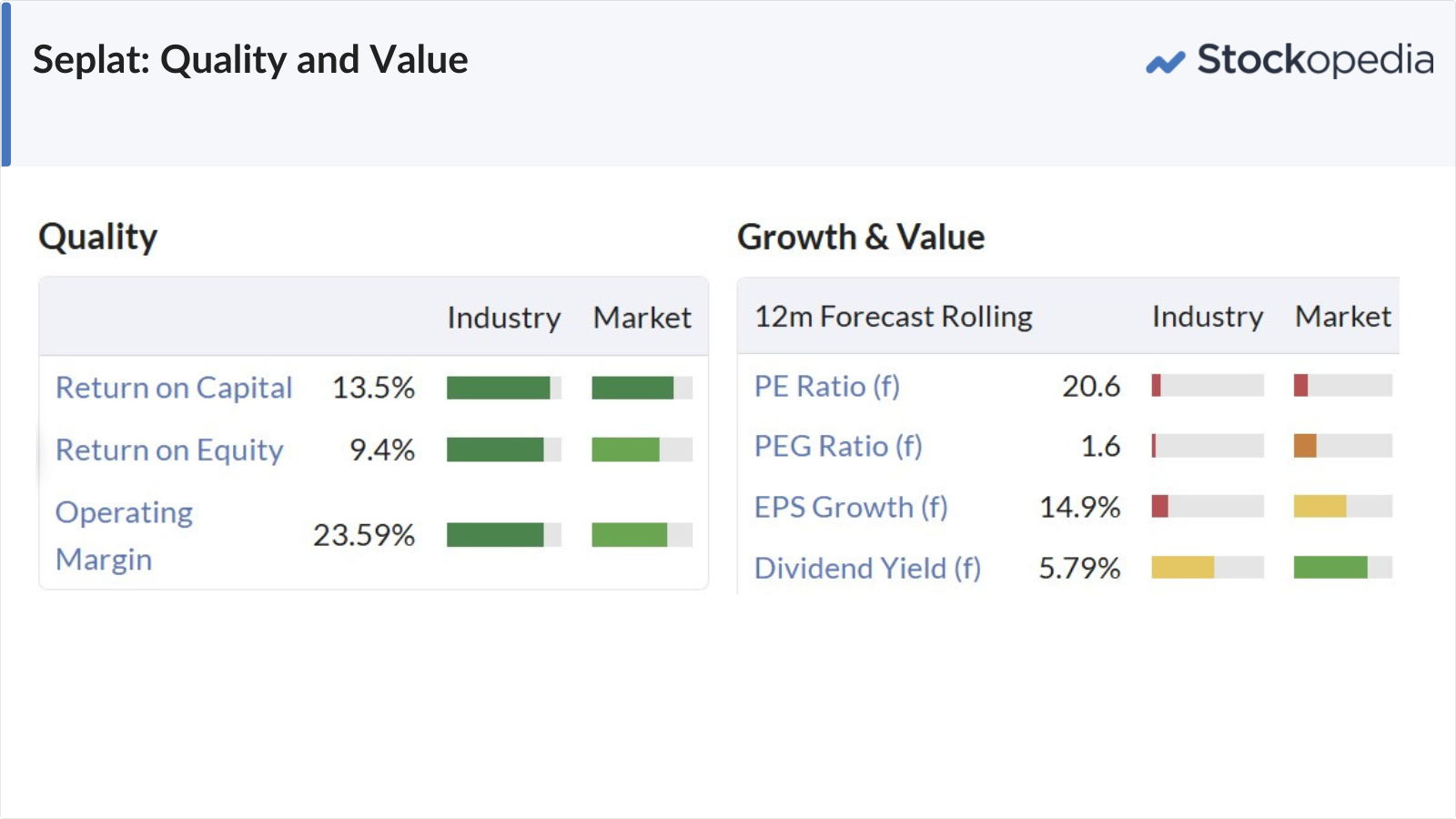
Seplat Energy (LON:SEPL)
Quality Rank 80 | Value Rank 54 | Momentum Rank 98 |
This Nigeria-focused E&P is current member of the NAPS portfolio thanks to its amazing 2025, which saw revenues rise by 144%..
An aggressive acquisition programme is at the heart of the growth story. Seplat acquires divested assets from oil and gas majors and improves their efficiency; the centrepiece is a near-$1.3 billion acquisition of ExxonMobil's onshore and shallow water business, completed in late 2024.
Even after this acquisition, the company reported a 275% increase in net cash and a 25% reduction in net debt in FY25. However readers may find the P/E slightly high.
Pharos (LON:PHAR) and Capricorn (LON:CNE)
Quality | Value | Momentum | |
Pharos | 41 | 90 | 96 |
Capricorn | 83 | 67 | 99 |
Both these oil and gas producers are active in Egypt’s Western Desert. And while there are clear differences - Capricorn’s footprint is far larger, while Pharos also operates in Vietnam - both generate strong free cash flow by exploiting mature fields.
This strategy has been hampered by Egypt’s state-owned petroleum agency and its massive payments backlog; Capricorn’s receivables balance still stood at $86m at the end of 2025. However both companies recovered a significant amount of money last year, and while both reported net losses in FY25, their cash positions are robust: $40.2 million for Pharos, $103 million for Capricorn.
It's also worth noting that Capricorn has received multiple unsolicited proposals from an investment vehicle tied to the Saudi-based Cafani Group. This reflects both the group’s strong cash position and its efficiency (production costs equate to just $5.4 per barrel of oil right now).
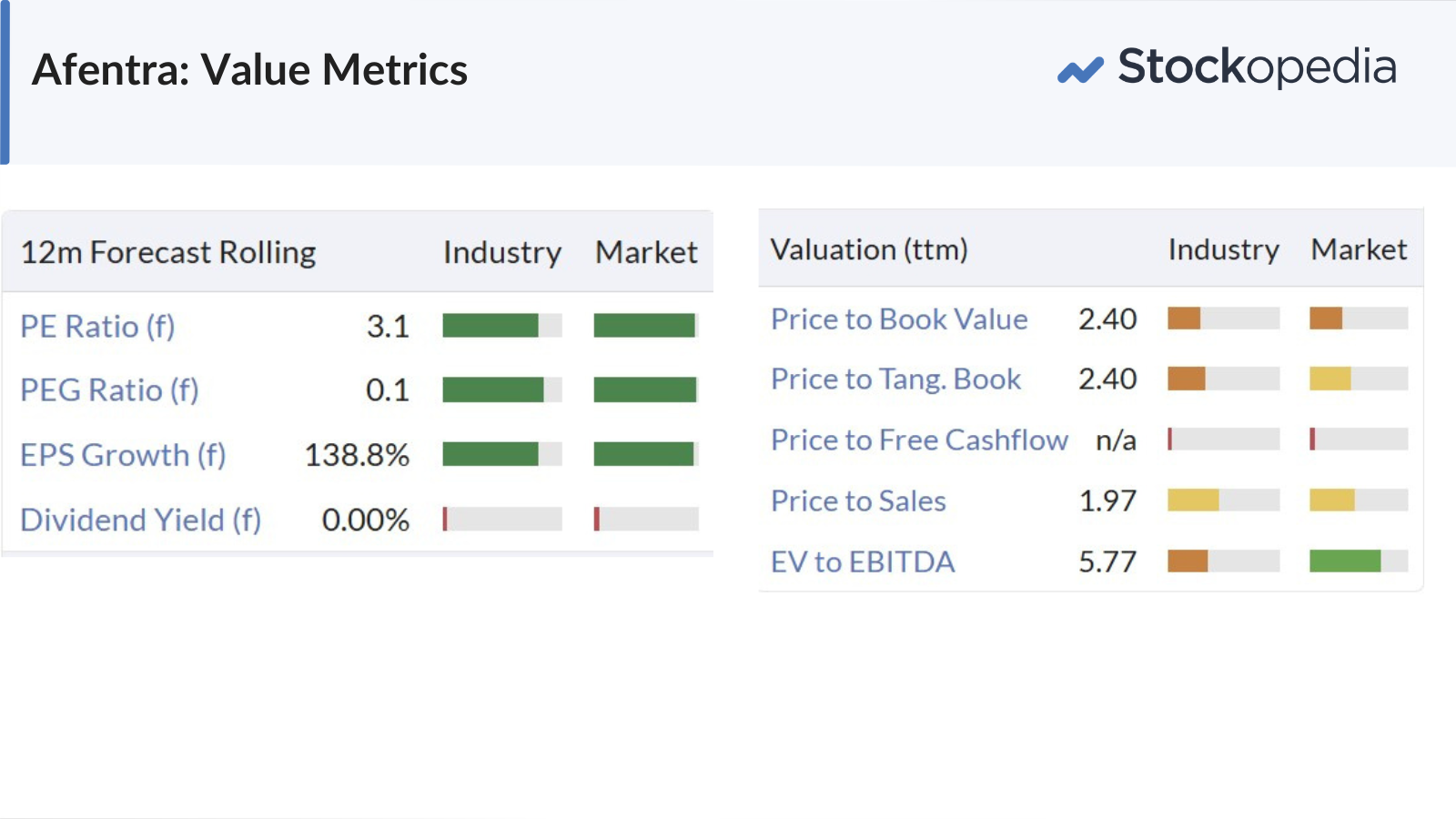
Afentra (LON:AET)
Quality | Value | Momentum |
53 | 43 | 85 |
This Angola-focused E&P strives to achieve value-driven growth by revitalising legacy assets. In fact the company aims to triple its cash generation by 2028 through a $200 million investment programme, powered by extensive borrowing.
Net debt currently stands at $12.6 million. However, this is down from $21.8m at the end of 2025 and represents a debt-to-EBITDAX ratio of only 0.25x. The company has also secured a $125 million pre-payment facility to provide long-term funding.
The value metrics don’t look great at first glance, but this is partly due to oil and gas accounting rules (oil is not considered an asset until it is extracted) and partly due to Afentra’s strategy of buying overlooked assets at a discount.
Tullow Oil (LON:TLW)
Quality | Value | Momentum |
13 | 97 | 84 |
$1.35 billion in debt, $129 million losses in 2025… the headlines aren’t great. But there’s context.
Tullow’s problems date back over a decade to a voracious exploration programme which left the company over-exposed when the oil price fell. Net debt stood at $3 billion in 2019, so the current figures represent something of a turnaround.
The 2025 losses can be directly attributed to this deeper problem: in its attempts to free up cash, Tullow has resolved to focus solely on Ghana and sell off assets in Gabon and Kenya, leading to a sharp fall in production. However at the end of April Tullow forecast annual production at the higher end of its outlook range, after a strong start to 2026 due to improved operations and an active drilling programme.
Now, the broader picture
Some readers may have already reached their verdict: the fact that four of these companies posted losses in 2025 demonstrates that when Hormuz reopens, they'll be left stranded on the wrong side of the supply chain.
It's impossible to downplay the geopolitical context. The Trump-Tehran stand-off has strangled the world’s energy artery and frozen around 20% of global oil supply. This has sent the price of Brent crude soaring (the 52-week trading range is fluctuating between $58.72 and $126.41) and forced importers to look for havens.
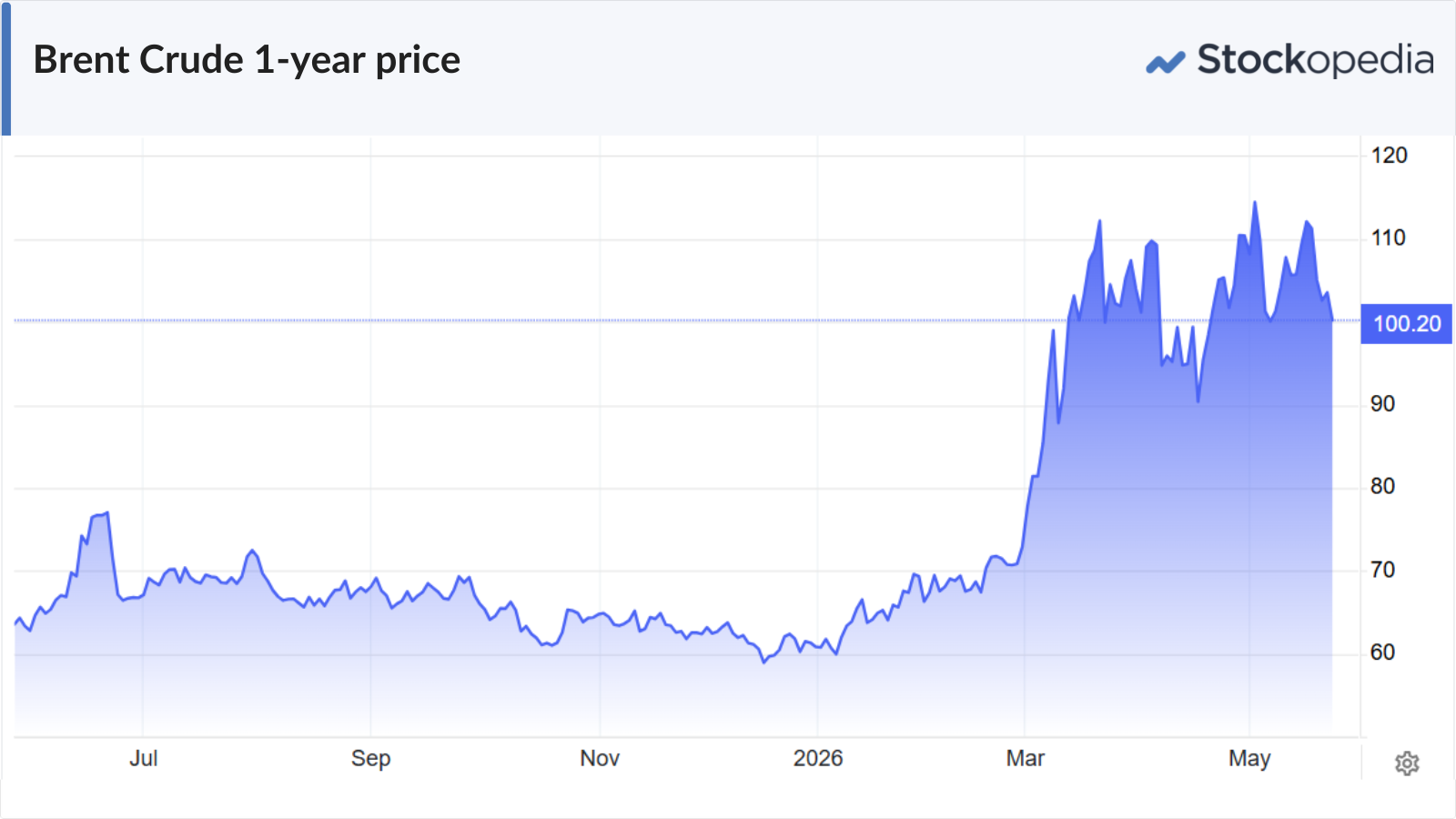
Source: Trading Economics
But there’s more to this than merely a short-term supply chain snafu.
On one hand, the African oil and gas boom predates the Iran crisis. Production is soaring, investment is flooding and huge new refineries are springing from the ground. On the other hand, the Hormuz closure has created what the International Energy Agency as “the largest supply disruption in the history of the global oil market”.
There’s a world in which the fuel importers feel compelled to seek greater diversification, and Africa becomes a permanent solution. Will this bullish narrative play out though? We should consider both its principal components.
The demand-side case
Bullish sencario: The world takes this as a ‘never again’ moment
Every corner of the world has been caught in the Hormuz chokehold. The Philippines has declared a national energy emergency; countries in Southeast Asia have told people to work from home; even the wealthy West is facing a cost of living crisis.
This isn't just figures on a chart either. It’s images of ideological enemies, bombing ships and laying mines. We’re not talking about an economic crisis that can be fixed overnight, but a military crisis that will take months to clear and could create a premium for diversified, non-Gulf sourcing.
Africa’s vast Atlantic coastline allows energy companies to bypass the Middle East entirely. What’s more, despite its vast oil and gas fields, Africa has imported almost all its refined fuel up to now. The reason? A chronic lack of refining facilities. However, the construction of huge plants like Dangote in Nigeria and Lobito in Angola will soon allow the continent to power itself.
Premiums for seven-day war risk cover in the Middle East Gulf region are now up 10-fold on where they were before the US and Israeli attack on Iran… US nexus tankers have attracted the nickname of missile magnets. Lloyd’s List, March 11
Bearish scenario: We go back to the Gulf. Like we always do
The 1973 Yom Kippur war led to an Arab oil embargo. The Gulf War of 1990-91 created vast global shortfalls. In the 1980s, ships passing through Hormuz were bombarded with missiles as Iran and Iraq tried to cripple one another’s exports.
And yet each time, the world has returned to the Gulf for its fossil fuels.
Why? Because the infrastructure is more established. The entire oil and gas supply chain is built around the Gulf; this imperative has survived the Arab Spring, multiple US incursions and regular weaponisation of the oil price.
And then there’s the cost. Right now, it’s four times more expensive to produce oil in Nigeria than in Saudi Arabia. The new refineries may close this yawning gap. But that’s still just a thesis.
The supply-side case
Bullish scenario: The Majors are leaving bargains behind
Major oil companies are divesting their African operations and pouring their money offshore as they race to cleanse their environmental reports. This is leaving bargains for indigenous companies.
Our featured quintet are at the arrowhead of this trend, picking up mature, cash-generative businesses with skilled local workforces. Take the Seplat-ExxonMobil deal: the acquisition added 409 million barrels of oil equivalent to Seplat’s reserves, worth $41 billion at current Brent Crude prices. Quite a return on a $1.3 billion investment.
The Majors won’t be coming back to the land; deepwater projects, with their lower cabon density, are considered vital for ESG. This means more bargains, more reserves… more profits.
Bearish scenario: These assets are cheap for a reason
Oil theft remains a frustratingly common problem across Africa (Renaissance Capital Africa found that transmission losses from production stations to terminals peaked at around 90% between 2020 and 2024) and this chronic problem causes serious pipeline damage, exacerbating the corrosion that blights Africa’s ageing infrastructure.
Nigeria’s petroleum minister has highlighted the issue himself, saying that “part of our problem is that pipelines that were traditionally transporting our crude were built in the 1960s and the 1970s… even when we can produce, evacuation is a big problem.”
The Majors aren’t just racing for green. They’re quitting Africa because it poses challenges that other regions do not. And those challenges aren’t going anywhere.
Now, over to you
We've laid out the arguments. If you find them interesting, be sure to do your own research. As Ed wrote in his article, clear uptrends often persist for 6-12 months. But trends driven by bottlenecks and volatility offer no guarantees.
If you’re looking for a piece to read next, my colleague Mark will be writing a more in-depth Stock Pitch on one of this quintet tomorrow. Meantime, if you’ve already researched any of these companies… why not tell us what you’ve found?
Disclaimer
This is not financial advice. Our content is intended to be used and must be used for information and education purposes only. Please read our disclaimer and terms and conditions to understand our obligations.
7 comments
This gets 4 comments and one or two by a muppet (me). Shame on the resource.
Thungela Resources (LON:TGA) should be flying but Mr Market is nervous. And rightly so. Space Exploration Technologies (NSQ:SPCX) is a risk but Africa seems to be a basket case forever. Comments lol.
Capital (LON:CAPD) is popular here as a support industry and has recently been on sale.
Just a heads up, Capital provides drilling rigs to the mining sector, mainly in Africa. These rigs are completely different to rigs used for Oil & Gas.
lol. More coffee Jeeves.
Who would be the support plays ?Halliburton Co (NYQ:HAL) Slb NV (NYQ:SLB) and shippers maybe.
IMO There is no better buy in the Oil and Gas Sector than Serica Energy (LON:SQZ)
What about the North Sea windfall tax I hear rightly you say - I say, Serica have turned this completely on its head. Sure other companies get taxed on North Sea Oil to a point where it is not economic to operate maturing assets and it would be no surprise for BP to exit the North Sea entirely. However Serica are able to offset the windfall tax by using tax losses on North Sea CAPEX - what that means in practice is that where others see an exit, Serica sees an opportunity.
2025-26 was a dreadful year on paper, but Triton has emerged stronger and with dual compressor operations looks to be a robust platform that has a new well (Belinda) to prolong its life which defers decommissioning costs. Holders will be glad to realise that Triton no longer carries the entire bulk of the output workload, instead its role is now to provide the cash to infill drill other sites, which is a low carbon approach to the growing need for energy security.
The recent Nordic Bond issue suggests a high degree of confidence in management, as a 7.875% unsecured $300 Million loan implies that a robust financial plan is in place - because the money isn't needed to restructure debt as is the case for Tullow Oil (LON:TLW), the money is dry powder for the right opportunity.
Other catalysts in view include a move to a main listing, completion of the Spirit acquisitions and a Capital Markets Day (CMD) is set for next week (2nd June) . So as Jesse Livermore might say - don't look at an investment through another traders spectacles, do your own research, and if possible make some time to listen in to the CMD.
Summary: despite Seplat Energy (LON:SEPL) having had a better run since the start of the year, Serica Energy (LON:SQZ) should be a strong contender for the O&G section of your portfolio.