FTSE-100 Yields Go Through the Roof

The collapse in confidence in the UK equity market has seen the dividend yields in the FTSE-100 reach unusual, perhaps even extraordinary levels.
It’s not so obvious when you look at the median figures. According to Stockopedia, the median yield in the FTSE-100 is now 4.4% (trailing) or 5.1% (forecast).
Another approach is to weight the index by market capitalisation. This helps to reflect the fact that some of the biggest companies are also the biggest dividend payers.
Take a look at the iShares FTSE 100 ETF (ISF), for example. This tracks the FTSE-100 Index, which itself is weighted by the market capitalisation of each company’s free float.
The “distribution yield” (trailing yield) on this fund was recorded as 7.7% on Thursday, March 12th.
(For what it’s worth, the trailing P/E ratio and P/B ratio for the fund on that date were 14.4x and 1.4x, respectively. Both metrics suggest lots of “value”, if the past is some guide to the future.)
Investors are pricing in large dividend cuts, that much is clear.
And while it’s impossible to know for sure what other investors are thinking, it looks to me as if the market is pricing in an extended period of difficulty. In other words, investors are working on the basis that dividends won’t recover to their previous levels for an extended period, or financial distress at several FTSE-100 companies will completely ruin the value of their existing equity.
In this article, I’m going to look at the four FTSE-100 companies with the largest forward yields, based on the existing forecasts. I’ll try to gain an understanding of the risk level at each one and the vulnerability of its yield.
Please note that it can take time for analyst consensus forecasts to catch up with reality, so the forward yields here should be taken with a very large pinch of salt (especially in this period of uncertainty and very likely downgrades).
Evraz (EVR)
Market cap: £3.3 billion ($4.1 billion)
Forward yield: 15.6%
This describes itself as being among the top steel producers in the world. Operations are global but are focused on Russia.
Football fans might be interested to know that this is a key asset of Roman Abramovich, whose investment vehicle owns around 29% of the shares.
While Abramovich himself isn’t on the board of Evraz, two of his close associates are: Eugene Shvidler and Eugene Tenenbaum.
The company’s recently published numbers for 2019 showed free cash flow of $1.45 billion and a small reduction in net debt to $3.4 billion. However, the reported profitability of the group collapsed by 85% to just $400 million. Lower steel prices were blamed.
The steel price was indeed under some downward pressure in 2019. Here’s a chart of the steel price in Shanghai:
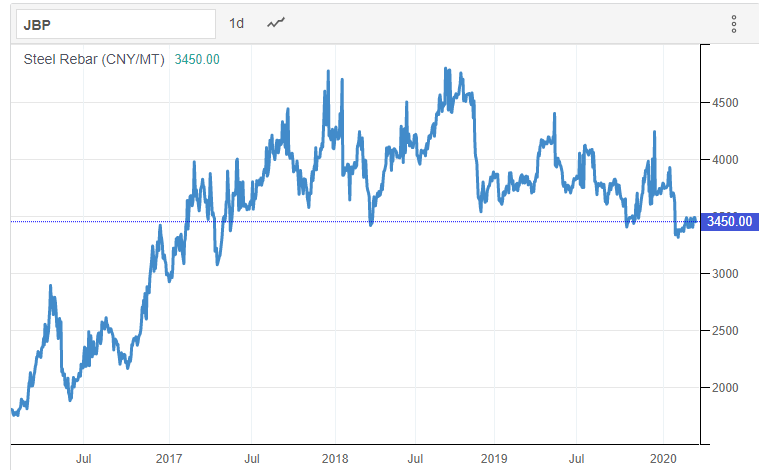
The contraction in Chinese and global economic activity, if it leads to further contraction in the steel price, could make it very difficult for Evraz to show good numbers this year (and until the steel price recovers).
The company is considered to be junk by the credit rating agencies, and will need to proactively manage its debt load.
For these broad reasons, I would have little faith in the long-term sustainability of the forward yield given for Evraz.
Imperial Brands (IMP)
Market cap: £13.0 billion
Forward yield: 15%
Imperial published a gloomy profit warning on February 5th, in which it warned that its next-generation products (NGPs) were struggling. The subsequent equity market panic has seen its shares slide by a further 25%.
NGPs are the new forms of tobacco or nicotine consumption: vaping, heated tobacco and oral nicotine.
One of the big problems for Imperial is that its flagship vaping brand blu was marketed in the United States with flavours like “Strawberry Mint”, “Peach Passion”, “Mint Chocolate” and “Cherry Swirl”.
But the US Food & Drug Administration has targeted vape flavours which it thinks are targeted at children, and Imperial was forced to write down the value of its flavoured inventory which could no longer be sold.
News reports of lung injuries associated with vaping may have also played a role in weakening demand (although “illicit” vaping products, rather than blu, may be responsible for the majority of such injuries).
There may also be some brand-specific problems with blu and certain other parts of the Imperial portfolio. The result is that Imperial’s net revenue from NGPs is set to be “significantly lower” this year.
By contrast, Imperial’s core tobacco brands remain very powerful and had a good start to 2020. Revenue generation and market share from tobacco remain very resilient.
I must admit that I don’t understand why the market is quite so bearish on tobacco shares and has put them at these extraordinarily cheap levels.
Indeed, for a couple of years now, I’ve been holding British American Tobacco (LON:BATS), and scratching my head as to why it remains so cheap.
Imperial is even cheaper than BATS, and one of the reasons seems to be its weak position in e-cigarettes.
No discussion of Imperial would be complete without mentioning its significant net debt position: £12 billion. But unlike Evraz, it is investment-grade – each of the agencies gives it a weak investment-grade rating.
Stockopedia classifies Imperial as a Value Trap. While it’s not my top pick in the tobacco space, I do think it should provide plenty more puffs for its shareholders, even if forced to rely purely on its core tobacco brands. Dividend cover is forecast to be 1.3x, implying that it has some wiggle room to afford the planned pay-out this year.
Carnival (CCL)
Market cap: £8.0 billion ($9.8 billion)
Forward yield: 14.2%
Carnival is the largest cruise company in the world and one of the high-profile corporate casualties of the coronavirus crisis.
In February, the Diamond Princess cruise ship, owned by Carnival, was quarantined off the coast of Japan. An 80-year-old passenger from Hong Kong had sailed one segment of its journey before disembarking and later learning that he had Covid-19.
Nearly 700 out of 3,711 passengers and crew on the Diamond Princess ultimately got the virus, and this resulted in several deaths. Cruise passengers are typically retired individuals and are more vulnerable to the disease than younger cohorts
Another Carnival cruise ship, the Grand Princess, is currently quarantined off California.
Besides the risk of illness and death from contagious disease, cruise ship customers have faced the terrible inconvenience of being trapped in quarantine for weeks on end.
Last week, the Carnival brand Princess Cruises (whose operations include the two ships mentioned already) announced “a voluntary and temporary pause of its global ship operations for 60 days”. The President of Princess described it as “perhaps the most difficult decision in our history”.
The announcement suggests that Carnival itself will bear the costs associated with this move. Customers and travel agents will, as much as possible, be protected.
Financial statements for 2019 show borrowings of $3.8 billion as of November 2019, offset only fractionally by cash at hand.
The debt comes in a variety of forms: export credit facilities (ship financing), bank loans and publicly traded notes, with maturities extending all the way out to 2031.
Carnival discloses that “substantially all of our debt agreements contain one or more financial covenants”. These covenants relate to debt service coverage and various balance sheet ratios.
The trading update on February 12th (which now feels like ancient history) acknowledged that Carnival didn’t know what the full financial impact of Covid-19 would be.
I doubt that the Coronavirus episode marks the end of the cruise holiday industry as we know it, but I also don’t know if Carnival might trip on one or more of its debt covenants this year. If operations must be suspended for longer than expected, will the lenders have a problem?
So I am probably not brave enough to dabble in CCL shares at this moment.
As for the CCL dividend, it’s hard to imagine that it is left unscathed by this crisis.
Royal Dutch Shell (RDSB)
Market cap: £85 billion ($105 billion)
Forward yield: 14%
This oil and gas giant has been a bedrock of the FTSE for many years, and in my experience has usually been its largest component. But the Shell market cap is now eclipsed by Unilever and HSBC.
Economic contraction (reduced demand) and an OPEC price war (increased supply) have simultaneously emerged to wreck the oil price in recent weeks.
Even a huge producer like Shell is ultimately a price-taker in this market, as Saudi Arabia and other Middle East producers, Russia and the US shale industry determine global output and prices.
Shell’s famous dividend might be about to come under pressure like never before.
The chart below shows net new borrowing each year versus shareholder rewards (dividends plus buybacks). When both figures are positive for a year, Shell can be accused of paying its shareholders with borrowed money:
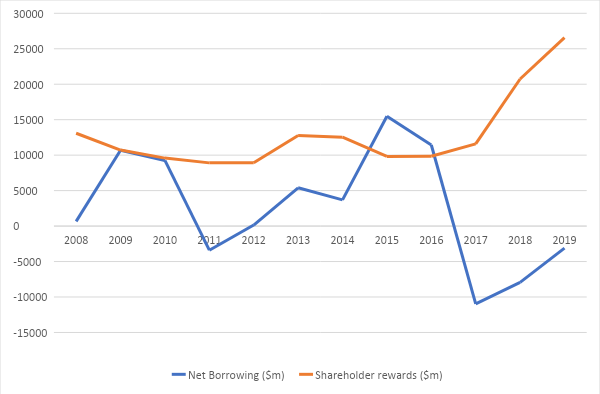
The chart shows that in the last few years, Shell has succeeded in paying out huge shareholder rewards while also paying down its debts (i.e. negative net borrowing). This has been achieved through high operational cash flows and through running down its cash balance.
With oil back around $30 a barrel, last seen in 2016, I wonder if we will see Shell borrowing to pay its dividend again – just like we saw in 2016.
As is the case with the other stocks I’ve reviewed in this article, Shell is heavily indebted and carries net debt of around $79 billion.
Summary
This has been a brief overview of some of the FTSE-100 stocks whose forward yields have exploded higher as a result of the recent sell-off. All of them are vulnerable to dividend cuts, all of them are leveraged, and all of them are subject to major risks beyond their control. Perhaps the market consensus is pricing these risks correctly.
When I look at the broader FTSE-100 index, I continue to see value in the collective – I don’t think the long-term value is so very different to what it was a few weeks ago. That said, placing a large bet on any single one of the risky giants mentioned in this article is not something I’d be very eager to do. If I had to pick just one of them, it would be Imperial.
Disclaimer
This is not financial advice. Our content is intended to be used and must be used for information and education purposes only. Please read our disclaimer and terms and conditions to understand our obligations.

17 comments
Investors have priced in a lot of bad news, that's true. But have they priced in enough?
The UK government's plan implies that people will have to self-isolate for about a year. That means that restaurants, hotels, etc go bankrupt. Some of them can withstand a 3-month shutdown of their business; none can withstand a 1-year shutdown. That means a lot of people who had secure jobs last month will be unemployed, unable to pay their mortgages and rents. Not good news for landlords either. A lot of people will default on mortgages and business loans; maybe enough to take down some banks with them. This could be a lot worse than 2008.
Other governments' plans are similar, some vaguer and more disguised by waffle.
Carnival's "temporary pause of its global ship operations for 60 days" is a sick joke. Can you imagine a realistic scenario in which Carnival avoids bankruptcy? I can't. Who's going to buy a cruise in a world where you're advised to stay at least 1.5 metres away from other people? Have you seen what happens at a tourist destination when a big cruise ship docks? It's like a central London tube station in rush hour.
Self isolate for a year, who is going to do that? I thought it was for about 3 months to slow the spread down so the hospitals could cope. How's the Govt. going to bail out all these companies, if it helps the airlines then why not everyone else? Travel agents, Hotels, pubs, restaurants, non food shops etc. no end of companies will be effected.
We will see if Italy's self isolation works, it has been 1 week, in theory the cases should start to go down after 2 weeks, this will give us a better idea of what is likely to happen here. Italy's problem is it is mostly in one region. The UK it more in London but then quite widely spread across the country. My thought is this will peak after about 2 months then slowly decline. Not convinced this will come back stronger next winter either.
Carnival (LON:CCL) shares were 20% up on Friday.
You're entitled to your opinion of course, but it's not supported by recent analysis of policy: https://www.technologyreview.c...
That says, social distancing that is completely different from self isolation. Self isolation is staying in you house/flat and garden if you have one. I had to do it for 10 days, I would not want to do it for much longer especially in summer. But there are doing in Italy and Spain.
The Govt. changes it's tune every few days.
Sadly these sky high dividends are becoming empty promises as companies default on their promise to pay share holders. see my post on this: https://www.stockopedia.com/co...
As someone who has a small pot (but a relatively large percentage of my portfolio) in Royal Dutch Shell (LON:RDSB), I am not unduly worried at this point for them. They seem to have some wiggle room in how they work the dividend around the current crisis. The plus side appears to be the US and Iran are so busy dealing with the virus that they seem to have lost appetite for baiting each other.
Personally, based only on my intuition and some work related activities related to the pandemic, I am expecting (hoping) for the following
Very sharp reversals could occur if someone comes up with a drug that works and later a vaccine. Unpredictable and some airlines might be on the brink of bankruptcy by then. Don't spend money you can't afford to lose I guess
Very illuminating article. Let’s have a straw poll of members opinions on how long this bear market lasts and the level of the ftse at the turning point. It’s remarkable how accurate the collective opinion turns out.
Michael C - My age group will remember "the fickle finger of fate"
Sounds like yours is working fine - Made me chuckle on another dark news day
Aviva's the one for me I think. I nearly bought it on Friday afternoon but my finger wouldn't move when I told it to press send. It just froze. My finger is the only part of me that is a successful investor. When I invest using my diminutive brain it often goes wrong. But, so far, when I have let my finger make the decision it's all worked out OK. I'll try my finger out on Aviva tomorrow.
I bought on the 9th thinking a 10% yield was good ! now down circa 60p a share !
Looking at Stockopedia's charts for the Footsie, RSI(14) is 14.62. I don't know if that's a record oversold position, but I wouldn't be surprised if it was.
You have to go back to 1996 to see Royal Dutch Shell (LON:RDSA) this low (as far as I can tell). Even though oil has gone to $30 a barrel over the last decade, stock prices were never this bad. It's difficult not to see it as a "buy".
I do not hold.
As I said on my personal blog, it is plausible (although I wouldn't bet on it) that the S&P500 could half from here. It's on a PE of 17.9. A PE and earnings contraction wouldn't make such a fall impossible.
To be honest, though, I have no idea what's going to happen. Although everyone could have seen that the US markets were high and its economic policies dubious, I doubt that anyone would have predicted what we're seeing now. As the saying goes: "predictions are hard, especially about the future."
I suspect that companies will cut their dividends given the currrent environment - especially those with high payout ratios.
There was an article in the FT's Lex column at the weekend about oil company dividends - they reckoned that if Shell cancels its scheduled share buyback and its capex then it will be able to maintain its dividend.
Hi Graham, just wondering if Aviva came into your considerations when writing this article; currently yielding about 12%.
Hi there, I might have covered Aviva but it has a lot of competition in the high-yield stakes! I'm flabbergasted at how many of these big companies are now yielding 10%+.
Thank-you for a balanced article.
As posted elsewhere, oil has recovered significantly in the past. How long it takes and if we are at the bottom are the questions.
Brent is up 6% today to 35$ish. Four years ago it dropped to 27$
Nevertheless the price of RDSB is so low I have initiated a position:
Year
Event
Increase in oil price one year from low
1986
Saudi market share war
79%
1988
Oil glut
58%
1991
Global recession/Gulf War
5%
1998
Asian crisis
136%
2001
Global recession
46%
2008
Global recession
135%
Average
76%
Year
Event
Decline in oil price
Duration of decline
1986
Saudi market share war
-67%
82 days
1988
Oil glut
-44%
295 days
1991
Global recession/Gulf War
-57%
90 days
1998
Asian crisis
-60%
484 days
2001
Global recession
-53%
290 days
2008
Global recession
-78%
119 days
Average
-60%
227 days