GuruScreens - upgrades and downgrades - September 23rd

We’ve all missed out on a stock because we thought it had gone up by too much. It’s just counterintuitive to buy a stock when the share price has shot through the roof. The aim is to buy low, sell high, right? But what if the share price keeps going up? The interesting thing is that stocks have a tendency to ignore the laws of gravity. Shares that have gone up have had a historical tendency to, on average, keep going up.
It seems that when prices move in one direction the allure of not missing out in an uptrend or of throwing in the towel in a downtrend is too great for investors to shy away from. This was the hard lesson I learned with one of the companies that I’m going to discuss today.
Crawshaw
I remember thinking long and hard about buying shares in Crawshaw (CRAW) back in January 2014, when the company traded at around at 16p per share. What put me off was the fact that the company had more than quadrupled since January 2013, when you could buy Crawshaw for just 3.5p. The company also had a high P/E of 27 and was 11% higher than the brokers’ target price. Take a look at the StockReport from January 2014.
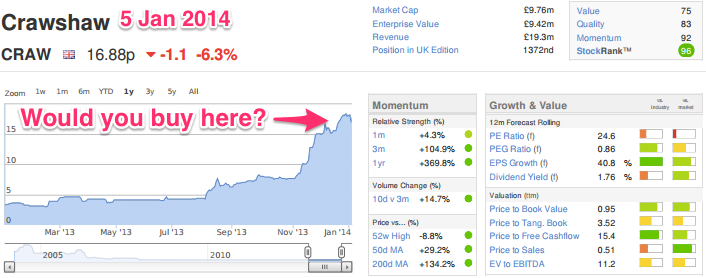
Look at what happened next.
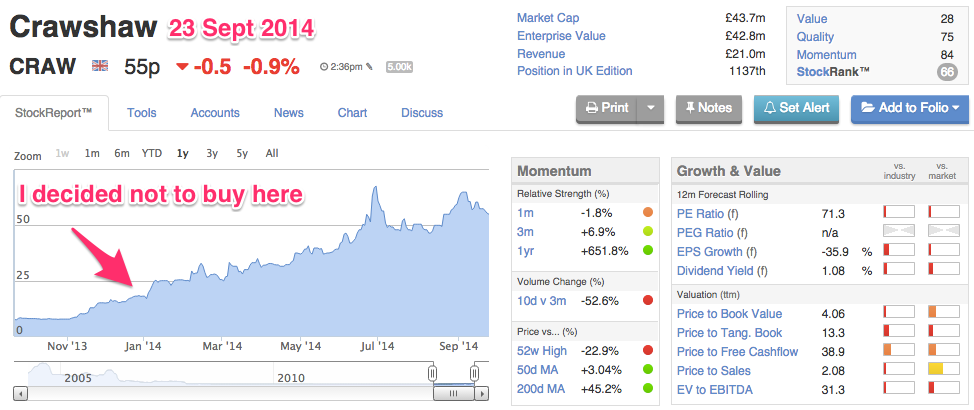
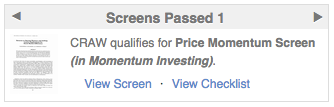
I’m quite annoyed because Crawshaw now trades at 55p. If I bought the shares back in January 2014, I would be up by 343%. That’ll teach me to look at broker forecasts. With this strong share price momentum, it is hardly surprising that the company has recently qualified for Stockopedia’s Price Momentum Screen.
Crawshawis a butchers chain based in Rotherham. The firm buys surplus meat from supermarkets at a discount, which enables Crawshaw to provide customers with supermarket quality meat at discount prices. It seems to be a winning formula. Earnings grew by over 300% in 2013 and more than 80% in 2012.
The company has a P/E ratio of 39 on a historic basis and 71 on a forecast basis. What has driven Crawshaw’s share price to such lofty heights? This interesting article from John’s Investment Chronicle mentioned a job advert placed in the FT by an ”AIM listed value food retailer based in the North of England” looking for a new “highly energetic and entrepreneurial CEO”. The responsibilities of the incoming CEO would need to:
- “Rollout 10 stores in Year 1 and 20 stores Years 2, 3, 4, 5, as well as bespoking certain stores for its target market”
- “Initially expand the retail operations in the North of England but ultimately expand it nationwide.”
Can Crawshaw sustain this dynamic growth? Perhaps the biggest risk is that the company falls out with one of its supermarket suppliers and is no longer able to offer supermarket quality meat at discount prices. This would dent Crawshaw’s business model. Would this spoil the growth story?
Dividend Aristocrats

Admiral (ADM) and Amec (AMEC) have both enjoyed poor share price momentum over the last twelve months. Admiral’s share price has been in decline since mid-August, when the firm’s half-year figures revealed that earnings growth in the UK had been driven by reserve releases. Amec has also faced problems. 60% of the group's revenues are generated in the Americas, so the strong pound has contributed to revenues falling by over 6% during the last twelve months.
Nevertheless, both companies qualify for Stockopedia’s Best Dividend Screen. Over the next twelve months, both companies are expected to support dividend yields of 4.4% (Amec) and 7.6% (Admiral) respectively. Investors should always be careful of companies that have high yields because their share price has fallen. Share price trends have had a historical tendency to persist.
However, while there may be red flags around momentum, both companies seem to have the requisite cash to support high yields. Indeed, Amec’s operating cash flows (71.5p: TTM), were higher than the dividends the company expects to pay out in 2014 (45.1p per share) and also 2015 (48.2p per share). Similarly, Admiral generated 123.1p in terms of operating cash flows over the last twelve months. This is higher than the dividends the company hopes to pay out in 2014 (99p) and 2015 (94p).
Both companies are interesting because they have paid dividends for the last ten years (through the recession) and have grown the dividend for the last nine years. Companies with growing dividends could well be signalling confidence about their future earnings. They also tend to be stable businesses, which are well positioned in their industries and are able to perform throughout market cycles.
Disclaimer
This is not financial advice. Our content is intended to be used and must be used for information and education purposes only. Please read our disclaimer and terms and conditions to understand our obligations.

2 comments
The issue here is that the broker forecast appears to have been wildly too pessimistic. So the people who spotted that, and carried on buying at what seemed to be an apparently irrationally high price (anything above 15p), have cleaned up - hats off to them!
Of course the company now has to continue delivering forecast-thrashing profits! If it doesn't, then the share price could come back some of the way. It won't come down all the way of course, as the company wisely took advantage of the share price strength to raise enough cash to finance the next stage of store roll-outs.
The lesson I've learned from missing this stock (despite friends being in the stock at the ground floor) is that I shouldn't place too much reliance on broker forecasts, especially for micro caps.
I made an even bigger mistake with Crawshaw. I bought in March 2013 for 5p and sold six months later for 8p. I thought I was pretty clever at the time, but this was actually my costliest ever investment decision as it went on to 10 bag in less than a year.