Heart, Club, Diamond, Spade - what type of investor are you?

There are many ways to reach success in the stock market… but just like in politics, other people’s methods are often disregarded at best, and attacked at worst. Traders think Investors are boring old stiffs while Investors think Traders are mindless morons. You often see different classes of investors mocking each other’s blogs - technical analysis articles attracting the wrath of the ‘serious investor’ while intelligent stock pitches often just plain ignored by the trading community.
I’ve long felt that this dichotomous labelling of “investors vs traders” is counter productive. It’s just like trying to shoe-horn everyone’s political views into the ‘left vs right’ political spectrum. The reality is that people’s behaviour is much more nuanced than this and it’s time we found a better lens.
So in this article I’m going to propose a more unified understanding of investor archetypes that I hope helps bridge the divide.
The Four Investor Suits
I once spent six months as a professional poker player, mostly online, but with regular excursions into real world tournaments. Multi-tabling at poker quickly becomes a grind which is why I moved on but this love of gaming has been with me throughout my life and informs my view of markets.
It was while exploring some gaming resources after some recent battles with my kids that I came across Bartle’s Taxonomy of Game Player Types - a deceptively simple system that classifies online game players as one of four archetypes (explorers, killers, achievers, socialisers). Bartle imaginatively maps these four classifications to the four suits of a card deck. It’s a very simple model, but has been very broadly adopted by gaming enthusiasts.
I swiftly realised we could adapt this model to investor types. The more I thought about it, the more I realised it could help avoid the simplistic divisiveness of the “investor vs trader” war.
So here goes.
Let us analyse investors according to 2 simple dimensions.
- Action Dimension - from ‘active’ to ‘passive’.
- Decision Dimension - from ‘systematic’ to ‘discretionary’.
Active investors like to deal frequently, often holding shares between days and months. Passive investors prefer to hold their shares over longer timeframes from months to years.
Systematic investors tend to use rule-based, objective approaches to buying and selling shares based on theory or experience. Discretionary investors tend to use their own subjective decisions when buying or selling shares based on judgement, common sense or intuition.
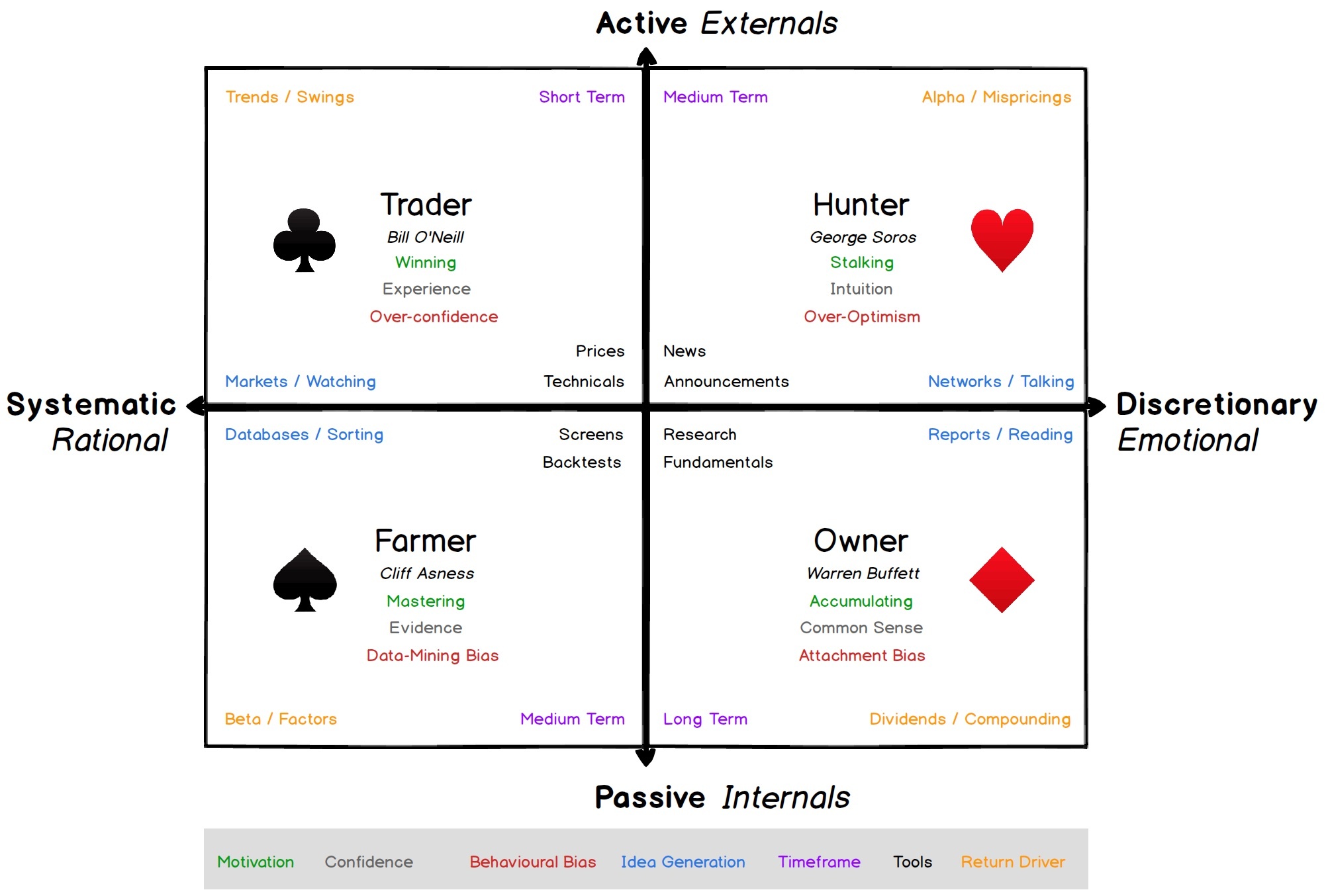
By applying these two dimensions as axes on a grid we can map out four investor archetypes: Trader, Hunter, Farmer, Owner. As we’ll see, each of these investor types maps very well to one of the four card suits - Clubs, Hearts, Spades and Diamonds.
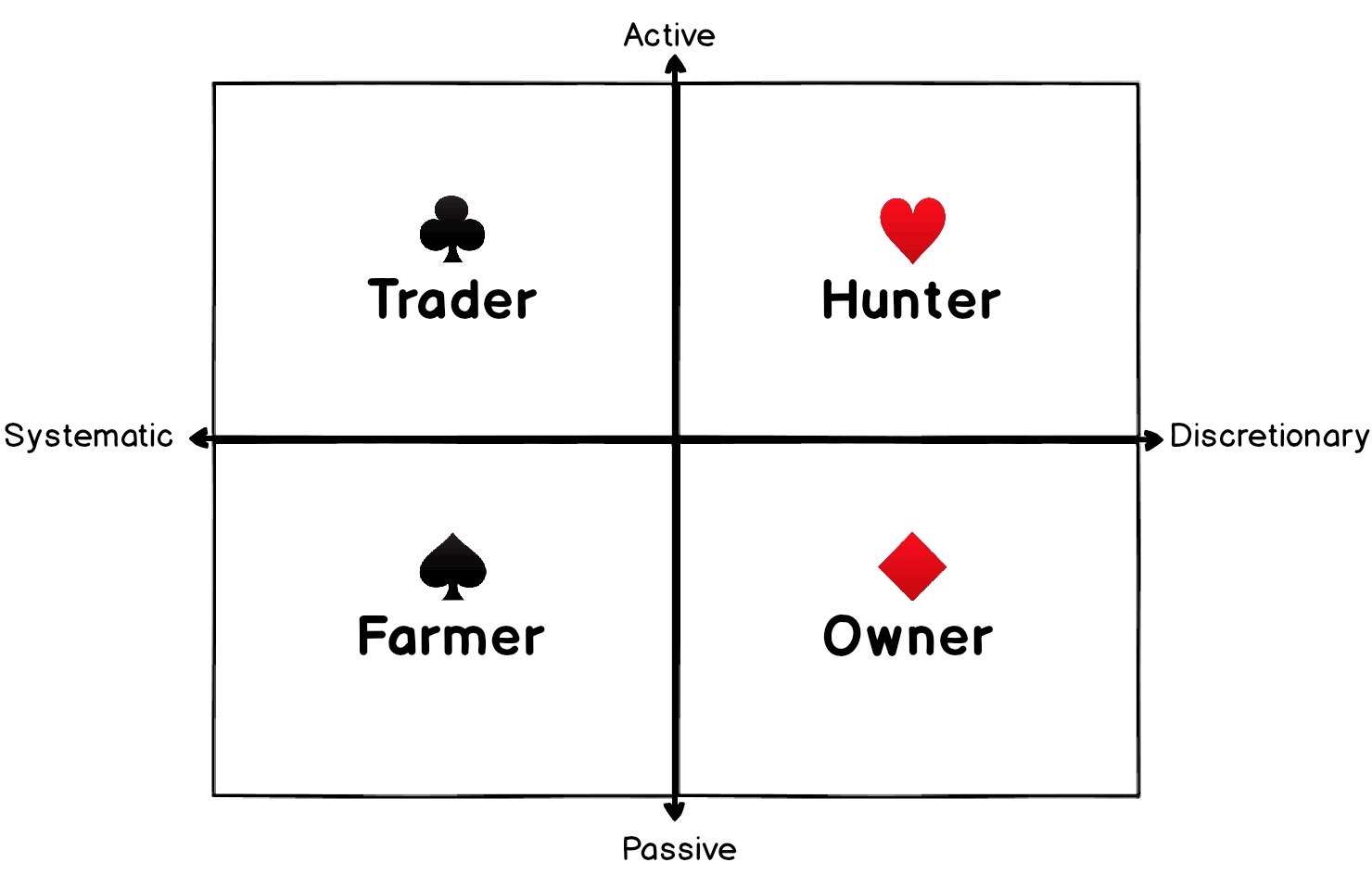
The more I’ve thought about it, each of these archetypes:
- profits in the market from a different set of return drivers
- holds positions across varying timeframes
- has a different core motivation
- gains decision confidence from different sources
- favours their own set of idea generation tools
- suffers from a different set of behavioural biases
- can be represented by different ”card royalty”.
So I’m now going to delve more deeply into each of these archetypes, explain the terminology and hopefully encourage a dialogue. My hope is that this might help everyone come to respect each other’s different approaches to the market.
1/ The Trader - Clubs
The trader is one of the most active and dominating of the archetypes, best represented by the suit of clubs. The trader seeks return drivers through trend following and swing trading, often across shorter term timeframes. They often have a keen motivation to win which is why so many ex-sports players are attracted to trading practices. They keenly watch market action to identify entry/exit points, favouring practice & experience as a source of decision confidence. They are most likely to behaviourally suffer from the illusion of control and over-confidence that may lead to over-trading. Trader royalty include Mark Minervini, Bill O’Neil as well as countless others.

2/ The Hunter - Hearts
The hunter is the most social and emotional of the archetypes, and thus best represented by the suit of hearts. They seek mispricings as return drivers to generate alpha. They often invest over medium term timeframes to allow these mispricings to correct, and have a keen motivation to stalk the market. They are keen socialisers, listening to networks of smarter investors to generate ideas, favouring their intuition as a source of decision confidence. They are most likely to suffer from confirmation bias due to a tendency to collect supporting information as well as a tendency towards over-optimism. Hunter royalty include George Soros, and even our very own Paul Scott.
3/ The Farmer - Spades
The farmer is a pretty rational type best represented by the suit of spades. They seek beta return drivers through factor investing techniques. They often invest anywhere from short to long term timeframes depending on the factors targeted and are motivated by harvesting market rewards. They tend to generate ideas by sorting the market through the use of databases and gain decision confidence through theory and evidence. They are most likely to suffer from data-mining bias in their techniques as behavioural biases. Farmer royalty include quants like Cliff Asness and James O’Shaughnessy. I classify myself very much in the farmer camp.
4/ The Owner - Diamonds
The owner is often archetypally the older and wealthier investor best represented by the suit of diamonds. They seek the power of compounding and dividends in high quality stocks as return drivers. They often seek to buy and hold over very long term timeframes and are motivated by accumulation. They generate their ideas through reading annual reports and financial statements analysis. They gain their decision confidence from perceived common sense and good judgement often learned from years of experience. The major behavioural biases that flaws the owner is attachment bias which leads to the opportunity costs of loss-aversion. The King of owner royalty suit is Warren Buffett.
It would be great fun if everyone reading this can take a quick one-question survey to identify which suit they most strongly feel aligned to. Click here to take part.
| Classification | Trader | Hunter | Farmer | Owner |
| Suit | Clubs | Hearts | Spades | Diamonds |
| Royalty | Bill O'Neil | George Soros | Cliff Asness | Warren Buffett |
| Return Driver | Trends / Swings | Alpha / Mispricings | Beta / Factors | Compounding / Dividends |
| Timeframe | Short Term | Medium Term | Medium Term | Long Term |
| Sense | Watching | Listening | Sorting | Reading |
| Idea Source | Markets | Networks | Databases | Reports |
| Motivation | Winning | Stalking | Harvesting | Accumulating |
| Confidence | Experience | Intuition | Evidence | Common Sense |
| Bias | Over-confidence | Confirmation bias | Data Mining Bias | Attachment Bias |
“Which type is best?”
The interesting thing about the archetypes is that they are all valid. There are proven investors that have used each approach to generate fortunes. Not through luck, but through the skilled development of their style, managing their biases and by targeting specific return drivers.
All the return drivers mentioned in each quadrant are proven empirically to generate value. Trends/swings, stock picking alpha, beta harvesting, compounding dividends - each are valid approaches. I hope the above analysis helps encourage a more nuanced take on the dichotomous and often disrespectful “investor vs trader” battle. Ultimately all investors are traders…. each buys and sells, they just have different timeframes and approaches to the market.
There is a balance to all things
It’s also worth understanding that markets often reflect the output of all the players within them and will adjust to correct any imbalance. Whenever any current investing approach becomes too much in ‘vogue’, it may mean there are greater opportunities in other styles.
I remember back in the dotcom bubble when every Tom, Dick and Harry became a “Trader”, and long term fund manager “Owner” investors lost their jobs for being old fashioned. What goes around comes around - the traders went bust and there were years of good fortune around the corner for traditional approaches. I’m sure that in this current era where so much money is moving into factor-based ETFs (the “Farmer” archetype) that at some point the pendulum will swing too far once again.
Know thyself
Of course, all these suits are archetypes and I’m sure only a few people find themselves fitting neatly into a single category. Many may reflect that they have migrated from suit to suit over time, and I wouldn’t be surprised if most people see themselves as having both a major suit and a minor suit.
Experience tells me that the majority of investors begin their journey firmly as a Heart - in the “Hunter” category - which also ironically can be the most dangerous.
While I’ve always generated my ideas from data, when I started investing I validated them online through bulletin boards, which led to huge over-optimism and resulting over-exposure. I’ve since learnt from my early mistakes, and have found a process that handles my own emotional attachment better. I’ve migrated firmly towards the “Farmer” approach and have replaced the heart with the spade.
I’d be fascinated to hear the community’s comments on these ideas and I hope regular commenters will share their own major and minor suits. I would welcome any comments to improve the model or other traits that you consider associated with the suits.
Here’s a bigger schematic of the idea and please do take the poll - Click here to take part:
Disclaimer
This is not financial advice. Our content is intended to be used and must be used for information and education purposes only. Please read our disclaimer and terms and conditions to understand our obligations.
39 comments
This is a fun article and I suspect unnervingly accurate.
The Investment Journey is a long road & each change of direction starts with a single Step which may be many or relatively few, until the next Fork. I started very many years ago after drawing compound interest graphs and looking for a way to get 6% + from my money; investment was the answer. Long before PC computers or the availability of data I settled for investment trusts ( having started with the w/e FT back pages & not having the time to chart the prices of individual stocks, as off for fun weekends). With the creation of the PC & reliable data sources I immersed in Technical Analysis before chucking 90% overboard & concentrating on what worked for me & mastering the trading of Fx. which became just too time consuming in front of the screens. I did dabble with individual equities but despite having studied Accountancy within a Business degree I did not have a feel for forensic analysis of Company Reports. Eventually the Investment Gods shone in my direction & I spotted an article in the FT ( which I continued to have delivered) eulogising the virtues of 'STOCKOPEDIA' for which I signed up immediately. Yet a completely new direction in Factor investment; it took time to gain confidence in the approach during which time I also avidly read Paul Scott learning what exactly to look for in company reports. This rather long winded intro to my style, which will be becoming obvious, is a melding of all the above. I identify stocks; research the fundamentals; take a view on the business; check the main Factors and then enter & Exit using Technical Analysis. As an Octo' I can already see that my next direction clearly will be for holding Diamonds.....and thanks to Ed for his creation & too for every ones daily comments.
I'm a farmer. Or rather, "harvester". ("Farmer" sounds too much like hard work: factor-driven approaches can be really low-effort.) My minor suit is "thief": I try to benefit from the brains and work of the good hunters by stealing their ideas. (Thieving as an approach is also really low-effort.)
Hi Ed, Doyne Farmer (formerly Santa Fe Institute now Institute for New Economic Thinking) has done some work on this. It's called "Market Ecology in Finance".
https://www.youtube.com/watch?v=D0tRSDQ2wAI
Agree with your article!
From experience I have made far more money as an owner than experimenting with the other strategies. Games Workshop being an example. This is because returns are NOT normally distributed 10% of your portfolio is shockingly bad. 10% is shockingly good. And the other 80% trundles along - the long term owner benefits the most from this non Gaussian distribution because over time the 10% that turn into multi baggers become a larger and larger share of the portfolio.
That talk is very interesting, mainly because it is such an unusual "take" on finance. The Q&A session at the end is also very good, with some exploration of the morality of the financial system too.
Basically he views different trading strategies as if they were different species competing with each other, so they get locked into predator-prey relationships and he even uses the Lotka–Volterra equations which describe how predator-prey population evolve, to understand where excess volatility might come from.
His other main point is that although markets are efficient to "first order", there has to be a small amount ("second order") of inefficiency to provide the "food" for arbitrageurs to be able to maintain that efficiency. (I paraphrase slightly.)
So it's an interesting watch and gives a different perspective - although I don't think I'll try to become an arbitrageur on the back of it!
Farmer here. I used to be more like a hunter. It is so easy to get wrapped up in the business of investing that it dominates one's thinking. The "cure" for that is to have outside projects. Mine is for programming. I now have less time to look at shares because I have other interesting things to do.
My approach now is to review my shares on a montly basis using the stock ranks. I kick out the shares that are not up to the grade, and look for replacements. I generally do this by rotating on Gurus Screen styles, and picking those in the 90's. What could be simpler?
I do have some LTBH, and I like the idea of it. However, I think it's easy to misjudge a company, though, which means it's difficult to stick to.
My parents have a tiny portfolio of shares that are LTBH. They have performed well. Some companies can definitely surprise you. If you held Unilever since 2000 you'd be up 444% (ex divs). The Footsie is up only 15%.
It lead to wondering to whether I should throw in the towel and just go LTBH; but I found my approach more profitable. So I'm sticking to that.
If the two scales are considered spectra then on the horizontal I'd be a trader with a hunter shadow. The logical rules can only take me so far.
Purity of type may be hard to achieve.
80 trader 20 hunter, best or worst of both worlds.
Thank you Ed for this thought provoking article.
To be a successful trader/investor after you have had some experience you realise that one suit is not enough just like in poker winning hands can be just one suit or hybrid. More importantly the successful investor has to be a chameleon who can change his colour/style of investing depending on the market phase. We must adapt our style and expectations to both bull and bear markets.
Just like in golf depending on your lie (rough or fairway) you will need to use an iron, metal wood or hybrid club to give yourself the best chance of success.
Ed,
a very interesting and useful article. BTW the website and underlying software whilst not infallible is a fantastic resource for investors.
Thanks
Betjeman
Interesting comments on Myers Brigg. 23 years ago I led 8 strong headed general managers and wanted to map out, through discussion by monthly all day meetings, a 10 year view of our business. I was assisted in this task by a consultant who also did a Myers Brigg test on all of us. I was amazed how accurate the assessment was in my own case but found my colleagues had the same accurate view of their own assessments. As expected my general managers were equally balanced with 4 extroverts and 4 introverts!
So personally I would not disparage Myers Brigg if my experience is anything to go by.
Paul
It's not about disparaging the method, it's about looking at the evidence. I've been involved in behaviourial psychology for over a decade and Myers Briggs is simply not reliable; the theory states that people's personalities are stable, but it turns out they're not. That's not surprising because if you go back to Carl Jung, where it all started, he simply made it up. At the time there were no better methods but continuing to use M-B given the current state of knowledge is akin to using astrology to make predictions or the four humour theory to treat disease.
But people always believe that their particular set of experiences generalise, regardless of the statistical evidence that they don't. And countering that belief is what Stockopedia is all about.
timarr
I bow, and accept, to your knowledge that Briggs Myer is no longer the cat's whiskers. At the time, 23 years ago, I thought it was.
Paul
Nice article...I fall into the Hunter category and have done well. Your comments seemed pretty spot on as to how my brain tends to look at things and am constantly "stalking" the market. I am fortunate that my job in the industry allows me to closely follow the markets on a day to day, minute by minute basis. Otherwise, I don't know how anyone could be a successful "hunter" investor type by just casually or occasionally following the market.
As we all know, the story in almost anything can change materially at the drop of the dime when you least expect it, and being nimble and quick is the only way to be either a trader or a hunter when things go against your thesis.
Thanks for the article...fun little read that simplifies this nicely and make a lot of common sense. Sometimes you have to know your own tendencies and weaknesses and accept them if you want to be a truly successful investor. I am a very very big proponent that "discipline trumps conviction" over the long run. Don't let your own over-confidence or biases force you to take risks you'll regret....that applies to ALL investor types.
Can you redo this using the Tarot?
What I have tried to do over quite a time is to follow a core/satellite approach. In the core portfolio I am an owner - mainly of investment trusts and large caps. However, interestingly a few stocks have graduated from satellite to core. In this category come RPC and Cineworld which have so far done well for me. Also the residue of an energy portfolio which I built up in the early years of this century. Fortunately much of this got taken over or sold but I must confess to an attachment bias and the remainder is on "a final warning" Also I have held Griffin Mining through thick and thin. Most of that time it has not felt like the only 100 ranked share in the Stockopedia UK universe and I see that today it has reverted to type with quite a sharp fall which is unexplained as I write. I hope this is just a correction because if nothing goes wrong this year's results could reward patience and I did top up earlier this year when the ranking looked so promising.
The satellite is quite a bit smaller but necessarily takes more time but I enjoy the involvement. Basically, here I am a hunter but one who tries to ensure I am looking at well stocked hunting grounds through farmer type analysis. Although over the last couple of years I have found (and also missed) a fair number of opportunities at the moment I feel that the game is thin on the ground and comments here suggest that others feel the same. We are a bit like Breughel's "Hunters in the Snow" but as is also said the most dangerous times are when everyone feels super optimistic.
Thanks for another interesting article.
MH
The other poker adage that comes to mind is ...
"If you've been sat at the table for 20 mins and you don't know who the fool is then it's probably you"
This makes me think of The Hunter style.
How many investors truly have the talents to dissect a company and know it and its context inside out?
I suspect there are many fools trying to play at those tables.
Thanks all for the great comments!
If anyone has any other classification models in different domains I'd love to hear about them.
The Political Compass is one of my favourite 2 dimensional classification systems - getting beyond pure left/right thinking - https://www.politicalcompass.org/
Hi Ed.
On the topic of other classification models, in a previous life I was pressed by my employer into taking on an Executive Coach as part of a management training initiative. This made quite extensive use of the MBTI system (Myers Briggs Type Indicator). In essence this involved ploughing through an extensive Q&A on attitudes to a number of different scenarios, lifestyle choices, learning preferences etc. to determine my personality profile.
Despite my initial scepticism, I was quite astounded when the coach gave me a 40 minute "dissection" of my personality type that was uncannily accurate (I'm "ISTP" for the record, one of 16 basic types based on binary choices of 4 different criteria). Indeed, accurate to the point of being quite unnerving in that it challenged a large number of preconceptions about how my brain was wired. While I have since found it really useful to have this insight, it did backfire slightly on my employer as the coach and I concluded that I was completely unsuited to my then line of work and subsequently resigned and left the City. Best thing I ever did!
Gus.
I've been on both sides of Myers Briggs and it's the biggest load of tosh out there (and the underlying psychological theory is suspect in the extreme). People answer against the stereotype they already have of themselves (much the point iwright 7 was making in post 7 above).
360 degree analyses, where peers as well as the individual answering give a much more interesting view of personality types, in particular where the subject's view of themselves is widely at odds with what everyone else thinks. It can also reveal interesting differences between what managers and subordinates perceive about the individual.
Although quite how you'd translate that into this type of analysis I have no idea ...
timarr
Hi Timarr.
As suggested in my opening remarks, I went into the executive coaching process with a fair bit of scepticism. Over the years I had also been on both sides of the recruiting process both as a candidate and as a hirer/firer taking and reviewing numerous psychometric, peer/manager/subordinate reviews, IQ assessments, aptitude tests etc.. Every year we seemed to get a new and improved methodology out of the HR department to try and make the process more "scientific".
Myers Briggs may well be a load of hokum. I suspect I just got lucky with the coach I was hooked up with. Rather than reinforce my preconceptions/self-stereotype she gave me a totally different insight into how I am wired. Irrespective of whether the methodology was flawed the outcome, for me at least, was successful.
Gus.
I quite like the MBTI personally. I've drifted from INTP to ENTP over the years.
It's very useful in understanding the differences between people. I've been reading Ray Dalio's Principles recently and Bridgewater use MBTI (and other profiling tools) a lot.
e.g. for every P you should have a J - you'll get more done.
https://www.16personalities.com/free-personality-test
Ed
It's based on Jungian theory. You might as well believe in homeopathy or economics or IQ tests or some other radical New Age craziness.
It's fun, but it's not remotely valid.
timarr
I don't think you will find any scientific backing for the MBTI analysis. You might as well look at horoscopes. But then I'm a typical Virgo.
The one personality model that I know of that does have some scientific basis is the Big Five or OCEAN model.
https://en.wikipedia.org/wiki/Big_Five_personality_traits
That's right. Trait analysis - and there are several models, but OCEAN is the best known - has stability across time, whereas personality type analysis such as MBTI isn't stable from hour to hour.
timarr
Thank you for the interesting article. It has a lot of commonality with the social styles quadrants that have been used in sales training along the lines of being a versatile salesperson. These techniques are used to understand what type of people you are dealing with, what your own natural style is and how you can become more versatile to adapt the way you interact with clients to get better quality communication and thus hopefully their business.
So, to take that comparison a bit further......
I think there is a case for being a versatile investor. Change your style to suit the type of market opportunity you are examining. E.G. Large and mid cap stocks in mature industries may suit the investment style of the farmer and owner best. High volatility stocks may suit the trader style more. Young, high growth, small cap companies, perhaps in an industry where you have some specialist knowledge may suit the hunter more.
It may be beyond most of us to adapt our techniques to have success in all four of the styles but as long as we use the right style for the right situation then perhaps that helps with having a balanced portfolio and we can use more than one style. So, we can have a mix of value and growth stocks, or market cap, or volatility etc. in our portfolio as long as we use the appropriate style to select and manage them. So, it depends on your own mindfulness to some extent. Manage your thought processes to manage your style to adapt your thinking in the most appropriate way to analyse a particular stock.
There is a book called `The Poker Face of Wall Street` by Aaron Brown that tries to combine poker playing styles with investing/trading.Recommend reading even to people who have never played poker
Hi Ed, interesting piece, although I'm not a poker player. Well as you would expect I couldn't be anything other than an Owner personally, although given my previous working background in a quantitative / behavioural finance fund management house & the wonderful ranks etc now available to private investors, I also do more farming these days too so that's my other suit. Using Stockopeda spade to dig for diamonds to own as it were.
Regards
Jamie @Compoundincome
Compoundincome.org
Interesting idea. It would be interesting to couple this with a questionnaire about the actual habits of investors, because I'll give you very good odds that there's a discrepancy between the way people believe they invest and the way they actually invest.
Me, diamond. Unless there's a correction in progress. Or there's been a major correction. Or I wake up in a bad mood ...
timarr
timarr - To make the distinction between belief and actual investing styles it is necessary to analyse what type of shares you own and/or what style has done best for you in the past?
Otherwise a responses to a questionnaire is only going to reflect your belief. Having said this I don't think we should be completely fixed in our views when figuring out what works best.
@timarr - I completely agree and was thinking the same thing. There have been 268 answers so far to the poll and here's how it splits. I'm actually surprised that so many self-identify as "Farmer" and so few as "Hunter". I think if we did the questionnaire you mention we'd find a much bigger number in the Hunter archetype.
Interesting comparison with Poker, Ed.
It is well known that there are four types of poker players:
Loose aggressive
Tight aggressive
Loose Passive
Tight Passive
However, there is a lot of evidence that you have to be aggressive in Poker to win in the long run (because you have two ways to win a pot) so both the passive styles tend to lose money. It is relatively easy to make a little money at an amateur level by being Tight aggressive (because most others players are too loose and/or passive) but the best players in the world- the professionals- tend to be Loose aggressive. This style of play requires the most judgment and experience but is the most profitable.
Would you care to comment on this, Ed? In particular, although it might be possible for the four types of investors you identify to make money, surely some approaches are much better than others, or at least much easier to follow for an amateur?
The aggressiveness within poker and aggressiveness with investing are two different beasts.
At the poker table my behaviour can influence those grappling for the pot and ultimately push others off the winnings.
Unless I have a very very significant amount of equity my behaviour at the stock market has negligible effect upon the market.
it is incredibly difficult to successfully play a loose aggressive style in poker, but makes good TV. Nobody wants to watch a rock going FOLD, FOLD, FOLD. But in my experience that is what I do with lots of stocks that cross my path. They don't pass my filters.
Many chumps watch the loose aggressive poker players on TV and try to emulate them and bust themselves as the key attribute of the loose aggressive player is being able to read when it's time to let go. In investing terms, this for me is linked to the idea of cutting your losses and move on.
Personally in poker terms I was generally a ROCK, playing the best hands in order to:
1) minimise erosion of my capital by playing too much
2) only entering the tussle with the best odds of success
3) in poker terms others at the table 'should' learn to respect my presence in a hand (whether or not I had the goods)
The risk was that I would get over attached to my apparently winning hand only for someone to have hit a monster with poor starting cards. The lesson ... don't get over attached.
Not sure if that helps or adds anything
I would say that the four poker styles that you mention above map closer to some of the styles that Lee Freeman-Shor mentions in his book "The Art of Execution". This is as there are broadly two "winning" styles and two "losing" types in his analysis, whereas in Ed's classifications above they can all be profitable.
Mapping the style across, I would suggest:
Loose Passive - In poker, these players play to many hands so their average hole cards are weaker. As they are not fully aware of the quality of their hand compared to the rest of the table, these players will continue to call any bets all the way the showdown with anything. These are the fish of the poker world. In the investment world, this lines up with the "rabbit" style - when the stock they hold falls they continue to hold it indefintely, married to their stock and "calling" to the river with no plan in place.
Tight Passive - In poker they are patient and will wait until they have a good hand, but then fail to bet it aggressively enough when it comes along. This maps to the "raider" style - when a "raider" has a winning stock, they want to take a profit straight away, not running their winners for larger returns.
Tight Aggressive - A winning style, the rock of the poker world, you are playing a textbook game. In the investing world I think this maps to a combination of the 'assassin' & 'connoisseurs' - you are cutting your losses short and trying to run your winners.
Loose Aggressive - As you are playing substantially more hands than the table average, you are generally entering with a weaker average starting cards. For this strategy to be successful you need to be greatly talented and more skilled than the other players around you. If you are not then you can easily lose your shirt as you start the hand statistically behind. In investing these are your 'hunters'. They buy stocks as their share prices are falling as they know that the business is fundamentally worth more. Effectively, they are outplaying the market. When this goes right you can make huge returns, but if your analysis is wrong you lose your shirt!
HunterFarmer
Ed
Fantastic article thanks. It really chimes with some thinking I've been doing over the last few months about my own investment style.
I suspect that many losing investors are those that can't categorise themselves and flit from one style to another. As you say, know yourself and apply an investment style consistently.
I see myself primarily as a farmer. My concern here is that farming is primarily about ranking - you buy the best stocks at the current time - but run the danger of investing at the wrong time in the cycle. I know you are doing some work on this at the moment and look forward to the results.
I therefore run two very separate portfolios - a farming portfolio and an owner portfolio with the intention that the latter grows relatively over time to provide retirement income. I try to approach each portfolio with a different mindset.
Really like the analysis Ed. I'm Owner by head and Hunter by (appropriately) heart - either way its all red.
What interests me most is combining the methods. For example, filtering using a Farmer approach but generating entries using Trader understanding with a Hunter mentality. It seems to me that a blended technique should be more successful than the sum of the parts.
Ed,
Interesting piece. For each personality archetype I have taken a stab at suggesting their most likely "winning" investment style:
Trader M + Q High Flyer
Hunter M + V Turnaround
Farmer Q + V + M Super Stock
Owner V + Q Contrarian
No back and white with this though. I veer most to Farmer so now focus on Super Stocks with some High Flyers, but its taken me a long time to work out the styles that I am most comfortable with and therefore best at. Ian
Interesting Ian,
I buy mostly QM stocks (some of which might well be Superstocks) but I have noticed as I've read Minervini that his turnover of stocks is too busy for me. He feels twitchy and it takes a lot of time to give that degree of attention.
So I'd say I'm a Farmer (systematic) but less active than a Trader and less passive than a hands off farmer (e.g. year rebalancing)
It's good to reflect on one's style.
Best of luck
Phil
Interesting article, Ed!
I am the king of spades with a little crush on the queen of diamonds. ;-)