High flying mid-caps that are leading the market in 2020

In the eyes of many investors, the valuation of a share is a key factor when it comes to deciding whether or not to buy it. After all, some of the biggest names in finance - from Buffett to Klarman to Greenblatt - insist that the way to make money in shares is to buy them when they’re marked down, mispriced and out of favour.
Sure enough, there’s no argument that value investing is a well-proven strategy. But it ignores a section of the market that almost always looks pricey - and in some cases looks terribly expensive. So does that mean that highly-rated, richly-priced shares are worth avoiding? The answer is not if you switch up some conventional investing rules and look for factors, other than value, that can generate the outperformance you want.
Two other factors that have been shown to be predictors of stock market profits are ‘quality’ and ‘momentum’. And when you mix strong quality and momentum in shares that appear expensively-priced, you enter the territory of High Flyers.
Why do High Flyers soar?
High Flyers are the shares that many of us would love to own. They’re the shares that always looked appealing but rarely looked cheap. They’re found among the market’s most successful multi-year compounders, ranging from big household names to little-heard-of specialist corporations. Often, they come with well defended business models.
Despite their expensive prices, High Flyers soar because of a blend of quality and momentum that drives them forward. They’re not infallible - and they can fall sharply if and when they slow down - but until that happens the returns can be eye-catching.
Company quality - which covers solid profitability, efficiency and strong and improving finances - is highly desirable for many investors. It can be a byword for resilience and dependability, and the market pays up for it.
In turn, momentum - both in terms of price and earnings acceleration - is one of the most powerful return drivers in the market. When quality interacts with momentum, more and more investors buy in and bid up prices. Success begets success, and as momentum builds in high quality stocks, they can soar.
Over the past decade we’ve seen this High Flyer process play out right across the market. For instance, drinks giant Diageo, which has tripled in price over ten years, has almost always ranked in the most expensive quarter of the market - and it still does. The same goes for the fashion brand Burberry, which has quadrupled in price over a decade. It’s another high quality stock that has, often, benefited from persistent momentum despite a rich valuation. Among many others are names like Rightmove, Fevertree Drinks, Dart, Next, Relx...
Tracking at Stockopedia shows that a strategy which blends high quality and momentum has paid off over the past six years. A regularly refreshed portfolio of high QM shares handily outperformed - albeit in generally benign market conditions - and had a very strong finish last year.
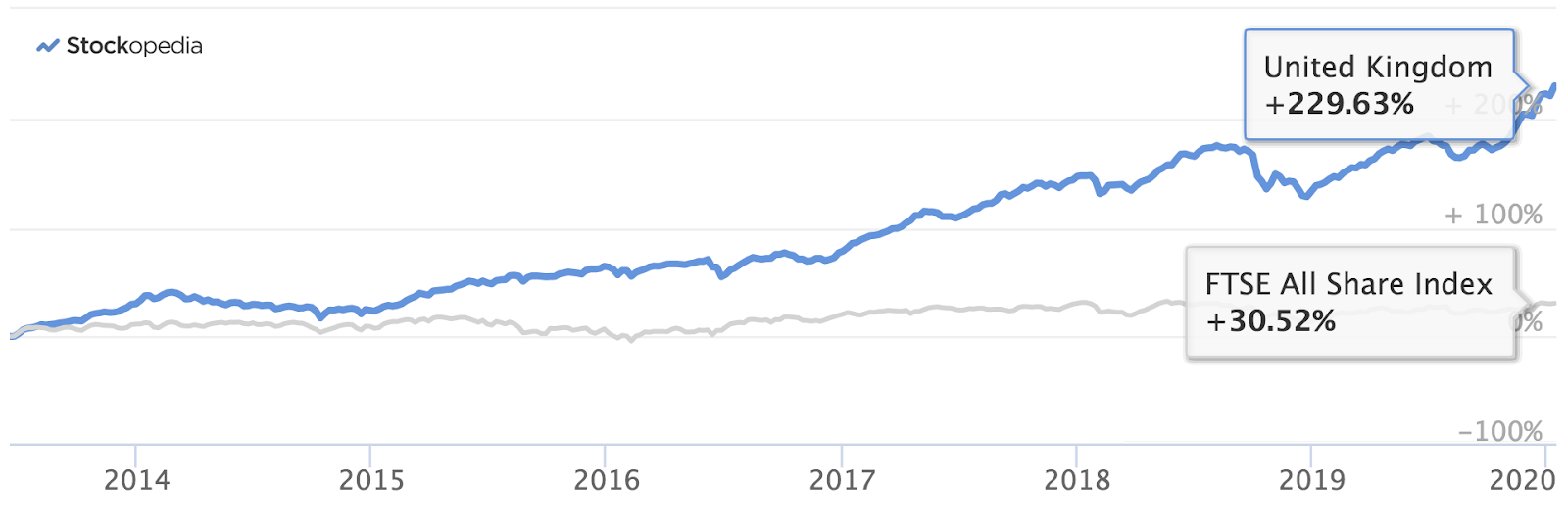
Top QM Rank shares (portfolio rebalanced quarterly), minimum market cap: £10m, June 2013 - January 2020
With this in mind, here’s a screen that picks up on the High Flyer theme by taking a look at high quality and momentum (but apparently expensive) mid-caps that are leading the market. In terms of volatility, it uses the RiskRatings to exclude the most conservative and most highly speculative shares - focusing instead on Balanced, Adventurous and Speculative levels of historic volatility.
This list is sorted by their proximity to hitting new 52-week highs. It gives a flavour of which shares the market is favouring during the early weeks of 2020. Industrials and Technology stocks have been some of the biggest recent movers, with language translation specialist SDL, digital services business Kainos and power products company XP Power all currently trading at new highs (the full screen is here).
Name | Mkt Cap m GBP | StockRank Style | Risk Rating | Value Rank | Price vs 52w High % | Sector |
578.5 | High Flyer | Adventurous | 30 | 0.000 | ||
996.9 | High Flyer | Adventurous | 8 | 0.000 | ||
702.1 | High Flyer | Adventurous | 23 | 0.000 | ||
1,698.6 | High Flyer | Balanced | 17 | -0.142 | ||
399.2 | High Flyer | Adventurous | 11 | -0.435 | ||
890.8 | High Flyer | Speculative | 19 | -0.546 | ||
678.9 | High Flyer | Adventurous | 15 | -0.800 | ||
2,413.4 | High Flyer | Adventurous | 14 | -1.14 | ||
480.8 | High Flyer | Adventurous | 10 | -1.15 | ||
1,259.9 | High Flyer | Balanced | 20 | -1.40 |
Lessons from High Flyers
While valuation is a key consideration for many investors, it’s certainly possible to find outperformance in more expensive-looking shares. High exposure to a blend of quality and momentum can propel some stocks for extended periods - delivering stunning profits despite their apparently high prices.
The risk of course is that momentum can fade, and when it does the prices of high flying shares can fall sharply. So this is a strategy that needs careful attention. Paying a higher price for better quality shares on the move is a proven strategy of playing two very powerful drivers of returns in the stock market. High Flyers won’t fly high forever, but they can deliver stunning returns over long periods.
Disclaimer
This is not financial advice. Our content is intended to be used and must be used for information and education purposes only. Please read our disclaimer and terms and conditions to understand our obligations.

7 comments
Can someone with knowledge of AlphaFX's business kindly breakdown what happened today please? Thank you
It is always a good idea to check news when a share price moves dramatically, today there are 2 announcements, here is the main one: https://www.stockopedia.com/share-prices/alpha-fx-LON:AFX/news/alpha-fx-group-plc-covid-19-trading-update-urn:newsml:reuters.com:20200330:nRSd9626Ha/
very good report .i like it
Just to add to the discussion.... Buffett talked about buying some 'cigar butts with one last puff' when he was an early value investor but later switched to 'buying great companies at a reasonable price'.
My take is the market really pays up for EPS growth. Value can be a trap if the stock is cheap but has no growth prospects. Likewise high PER stocks on a long term growth path are great investments. I've read various studies which show PER values, when used in isolation, are a poor predictor of future price.
Of course you don't want to overpay for a stock. Jim Slater tried to approach this with the PEG ratio i.e. divide the prospective PER of a share by the estimated future growth rate in EPS.
I tend to use PEG on high PER growth stocks to gauge if today's price is reasonable.
Most of my trades would fall into QM, sharp falls happen, some unannounced but more often than not little clues appear before calamity.
Triggers I take note of are reducing margins, incremental debt without incremental earnings, momentum easing, receivables growing faster than revenue. I find that these generally give you the opportunity to put your stock on alert some months ahead of sudden price falls, but obviously not always, I've been searching antique shops for years trying to find a crystal ball, alas to no avail.
I like this approach - one thing to also look at is the MACD for the stock - as the lines cross 0 from above is a good indicator of a time to think about taking profits
Thank you for an interesting article.
I started out about seven years ago thinking I wanted to be a value invested in the classic meaning of the phrase but think I am at the moment definitely a quality/momentum investor (Boohoo (LON:BOO) Bioventix (LON:BVXP) Xp Power (LON:XPP) Games Workshop (LON:GAW) Fevertree Drinks (LON:FEVR) Treatt (LON:TET) ) and the way that value has(nt) performed over the past decade it is a good thing that I was sucked into this area.
As you say the danger is that with this strategy when momentum fades (FEVR) paper profits can evaporate rapidly. This happened with me with Fevertree where my holding halved in value because of the fall in price. It is therefore very important to have a sell discipline in place to capture the gains created by share price momentum. But maybe that is true of all investing?