How to avoid the high-testosterone mistakes made by hedge fund managers

It would be easy to assume that the brightest minds in high-stakes professional trading don’t suffer from the same behavioural mistakes as regular investors. But that’s not actually true. Research shows that high testosterone - which has traditionally been a ‘must-have’ in hedge fund management - is actually responsible for some of the worst decisions.
It turns out that some classic alpha male attributes can lead to risky and potentially costly choices. Among them are picking ‘lottery-type’ stocks, hanging on to underperforming trades and selling winning positions too soon.
These are some of the classic hallmarks of overconfidence, which leads to rash decision making and overtrading. These problems can affect private and professional investors alike - although women, for biological reasons, are apparently better at resisting them.
The trouble with hedge funds
In Warren Buffett’s latest letter to Berkshire Hathaway shareholders he spends time reflecting on a 10-year charity bet that finished in late 2017. As part of the wager, he predicted that a low-cost index fund would outperform the results of most investment professionals over time.
His bet was taken up by a fund advisor called Protégé Partners, which went head-to-head with the index fund by selecting five funds-of-hedge-funds. In total, Protégé’s capital ended up being spread across more than 200 hedge funds.
To cut a 10-year story short, Buffett won this bet long before it finished. In nine out of the 10 years the funds-of-funds as a whole trailed the S&P index. Not only that, but in every one of those years they charged costs at an average of 2.5 percent of assets.
As Buffett remarked: “Making money in that environment should have been easy.” But the hedge funds still managed to underperform overall, while charging high costs for the privilege.
Costs in the hedge fund industry have long divided opinion. The typical ‘2 and 20’ fee model (2 percent on assets and 20 percent on outperformance) has come under pressure in recent years, but the fees are still controversially high. So it’s little wonder that this promotes a testosterone-fuelled environment that attracts strong characters with forthright views.
If your face fits…
High testosterone, of course, is linked with a number of benefits. They range from increased physical strength and fearlessness to higher military rank and superior executive leadership. But some research has also found that it can lead people to make irrational risk-reward trade-offs. Indeed, a new study suggests that high testosterone could actually be problematic in investing.
Work by researchers from the University of Central Florida and Singapore Management University found that high-testosterone hedge fund managers “significantly underperform low-testosterone hedge fund managers after adjusting for risk”.
To figure this out they used what’s known as the facial width-to-height ratio (fWHR). This is an increasingly used measure in behavioural research because a high fWHR has been shown to be a marker of high testosterone.
The team went on to investigate the performance of 3,228 male hedge fund managers over a 22-year period. Between the top and bottom deciles in the sample (based on the fWHR), those with high testosterone underperformed those with low testosterone by a notable 5.8 percent each year.
What causes the underperformance?
In the words of the researchers Yan Lu and Melvyn Teo, “testosterone can shape trading behavior and lead to sub-optimal decisions”. In particular, the underperforming hedge fund managers apparently had a stronger preference for lottery-like stocks, and were more likely to succumb to the disposition effect (of holding underperforming stocks and selling winning stocks).
Both of these behavioural traits are well known for being a drag on investment performance. For a start, stocks that promise lottery-like payoffs tend to have a statistically low success rate. Yet the blistering gains they very occasionally generate are enough to seduce investors hoping for huge profits in short order. (This was the key finding of research in this area back in 2009).
In Stockopedia’s StockRank Styles framework, lottery-like stocks are known as Sucker Stocks, because they tend to have low exposure to Quality Value and Momentum. In other words, they tend to be low financial strength, relatively expensively priced and deteriorating. But they almost always have a great story behind them, which is often enough to win the loyalty of a large following.
Stockopedia users will know the chart below well. It shows the overall returns of regularly rebalanced baskets of stocks based on their exposure to those three Quality, Value and Momentum factors. The deciles with the lowest exposures - those that are more likely to lottery-like Sucker Stocks - consistently underperform.
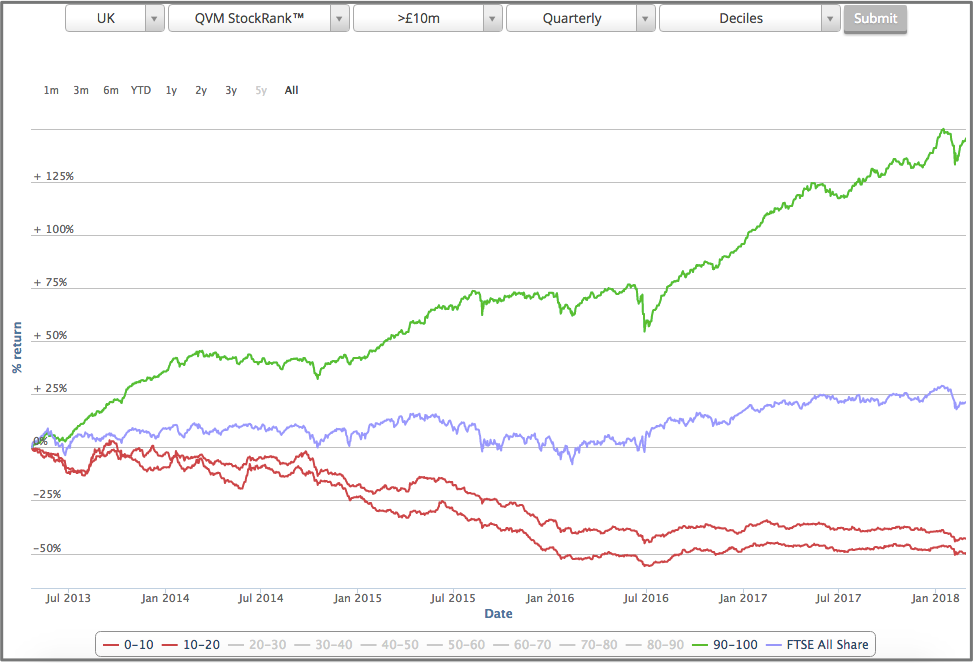
You can find the StockRanks Performance portal here
In addition to lottery-like stocks, the disposition effect is regularly highlighted as a damaging investment mistake that can destroy both self-esteem and profits. We’ve written about this in the past, but the disposition effect is linked to how, as humans, we make choices between risky prospects and how we categorise them based on different outcomes.
In the context of investing, these theories show that investors treat the probability of a loss differently to that of a gain. As a result, they irrationally sell winners and hold losers even though it often makes no economic sense and is tax inefficient.
The disposition effect has been studied at length - and there’s an extensive summary of that work here. Much of it has pinpointed specific mental drivers for not running winners whilst clinging on to losers. They include regret aversion, mental accounting and a lack of self-control.
Resisting alpha male tendencies
The upshot of all this is that some of the traits you’d assume to be desirable in professional fund management could actually be counter-productive. The mould of the traditional hedge fund manager as testosterone-fuelled, super-aggressive, competitive and instinctive are features that actually provoke some of the best known investing mistakes. So trying to imitate the same buccaneering style could well be an error.
An interesting postscript is the finding of a study back in 2001 that found men tend to trade far more than women. The research by Brad Barber and Terrance Odean looked at the trading accounts of 35,000 households at a U.S. brokerage. It discovered that men traded 45 percent more than women and racked up more damaging tradings costs as a result. They blamed this almost entirely on overconfidence. While there was no mention of testosterone in that study, it’s very likely that hormones played a big role.
Disclaimer
This is not financial advice. Our content is intended to be used and must be used for information and education purposes only. Please read our disclaimer and terms and conditions to understand our obligations.
18 comments
Interesting article Ben. The underperformance of Hedge Funds/actively managed funds seems to be so widely publicised (by the likes of Buffett) I find it extraordinary that people continue to pour money into hedge funds rather than invest themselves if they have the inclination or simply investing in a low cost index fund or even using something like Ed’s NAPS method. Maybe they are all looking for the next Warren Buffett.
I also suspect that the performance of the individual hedge fund Investor will be worse than the performance of the actual fund, based on the fact that “investors” (I use the word loosely) tend to pile in to hedge funds at the top of the market and pile out of the fund at the bottom.
I for one, if I do not continue to significantly out perform the market, will simply liquidate and invest in a broad range of low cost indexes or a NAPS based portfolio once it has proved itself as a sound method for investing over several years.
You might want to read Testosterone Rex by Cordelia Fine for a thorough scientific debunking of the testosterone theory of finance. It’s the 2017 Royal Society book of the year. She also has an article in this weekends FT.
https://www.ft.com/content/dffca01c-1017-11e8-8cb6-b9ccc4c4dbbb
That is a within group comparison... They would need to include controls from the general (non fund manager) population.
The FANGs (Facebook, Amazon, Netflix and Google/Alphabet) have dramatically outperformed the S&P 500. Given the size of those companies they probably represent 12-14% of the index. So, if you don’t hold those companies it is going to be very difficult to outperform the S&P500.
So, then the question is, how do those companies score on the conventional QVM methods? I don’t pay for access to the US data but I would guess that they may not score well on value and so may not rank in the top deciles of the Stockranks for the USA. If that is the case, I would not expect the Stockranks to beat the S&P500 while such a large amount of performance is concentrated in a small number of companies that have characteristics that make them unlike ‘typical’ companies that can be rated reasonably accurately with the Stockranks methodology.
So, a viable strategy might be to hold 15% of a US portfolio in the fangs and use the Stockranks to select the best of the rest.
(Some would also include Apple in the FANGs)
Hello ... It could be that the international investing/ trading community regard the US economy as more
sustainable and efficient than that of the UK , and thus more investible / tradable . Don't you think ?
1 The US economy should probably be regarded as more efficient & sustainable, since they don't have a marxist opposition doing well in the opinion polls. The opposition are the same lot who needed an IMF bailout in the 1970s.
2 The US also has what is at present the global reserve currency. That will increase it's credibility. Whilst it remains the global reserve currency.
3 Investors tend to have a "home bias". So US people will invest disproportionately in the US.
An interesting article especially in the light of the present woes of a certain high profile 'superstar' fund manager.
He must have a very wide face.
Look at the 80 and 90 QM bucket there. I suspect that value is a penalty in the US market (when Q and M are strong).
an interesting article and Ben always bring a different perspective for the investing... thanks Ben.
Ben, good article. You used the UK version of the QVM performance chart. I wonder what happens with the QVM effect in the US? Somehow, S&P seems to be beating most of the QVM deciles which is strange - unless the benchmark does not correspond to the QVM universe which must be the case given that the lowest market cap in SP500 is probably much higher. Interested to know your perspective on the QVM for the US market. Is the market too efficient? Is SP500 the "wrong" benchmark?
https://www.stockopedia.com/stockranks/performance/?exchanges=NYQ%2CASQ%2CPCQ%2CNAQ%2CNMQ%2CNSQ&field=_QMScore_lo∩=350&period=1&buckets=deciles
yep - that's what keeps me worried. if we are saying QVM effect is not persistent in the US - do we understand why?
One factor in the difference between UK and US performance may be that over the last 3 years the S&P is up +30% whereas the FTSE All Share is up +7%. So although the top decile performance in the US and UK are both up over 30% over 3 years it looks a lot less impressive when the index is also performing that well.
I wonder if you need to be the absolute Alpha male, to trade other people’s money ? I know I’m ultra careful before I hit the buy button with my money
Ben another thought provoking article - Thanks.
Reminds me of the Fidelity study of their top % gain account holders, to try to identify the traits of their exceptional investors. When they contacted these account holders a common thread was that they had forgotten about the account altogether. Needs some judgement/luck in the initial selection though.
Still,being old is probably an advantage in acquiring that trait :-]
I think there was another common thread in that another best forming group of fund holders were those that had died and their beneficiaries had not claimed the funds!