Imperial Brands ditches its dividend policy - where to look for double-digit payout growth

News this week that Imperial Brands is ditching a long held policy of hiking its dividend payout by 10 percent every year didn’t come as much of a surprise.
For many years, the blue-chip that used to be known as Imperial Tobacco has been a stalwart income share. It has been part of the UK’s dividend landscape, with big, reliable and growing payouts (assuming you could stomach its ‘sin stock’ status).
But as the market for cigarettes has changed, so too has Imperial’s ability to keep up with that policy of double-digit payout growth. The market has long suspected that there was trouble ahead. Imperial’s share price has halved over the past three years. In part, that’s pushed up the yield on the stock from 3.6 percent to 9.8 percent.
It looked attractive, but it had the tell-tale signs of a dividend trap.
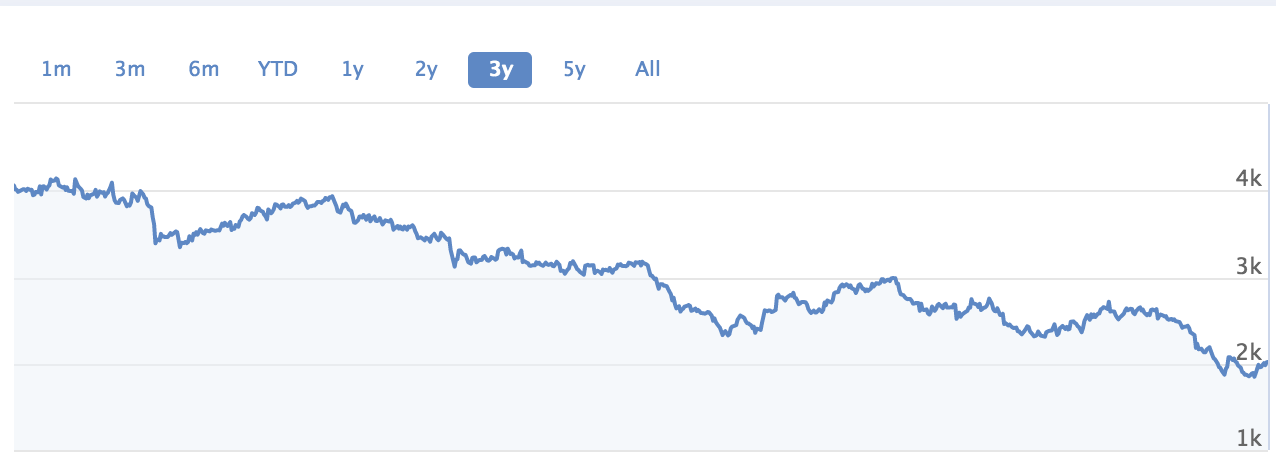
To put a stop to this price decline, and get the bad news into the open, Imperial has uncoupled itself from its previous policy. From 2020, rather than a guaranteed 10 percent rise each year, payouts will be linked to earnings growth. This is a major change of gear for a business that was once a cash cow. It’s now having think more innovatively about where future cashflows - and the associated dividend payouts - will come from.
From an investment perspective, changing market conditions haven’t yet washed through Imperial’s financials. But while the dividend growth rate has remained intact in recent years, its dividend cover (its ability to cover the payout from current year earnings) has turned negative - and that was one of the early warning signs.

In practice, Imperial may remain a solid income growth stock. As long as the payout continues to rise (even if not at the same 10 percent rate), it’ll likely stay one of the market’s popular ‘dividend achievers’.
But for investors looking around for other options, there is a club of stocks in the market that have managed more than 9 years of dividend rises with a long run average growth rate in excess of 10 percent. The Dividend Achievers screen that we track is one of the better performing income screens over five years (although these screens have had a tough time over the past 12 months).
I’ve copied the spirit of that screen and added a few inputs: including positive dividend cover (more than 1.4x), payouts forecast to grow over the next financial year, and reasonable (but not excessive) yields of between 3 percent and 6 percent. You can see that screen here.
Name | Mkt Cap £m | Yield % | Dividend Growth Streak | DPS 10y (compound annual growth rate) % | DPS Growth % Forecast 1y | Dividend Cover |
3,360 | 5.4 | 9 | 31.3 | 2.5 | 3.0 | |
4,812 | 4.7 | 9 | 30.7 | 5.5 | 1.8 | |
1,589 | 3.3 | 9 | 20.5 | 40.7 | 2.4 | |
128.9 | 3.2 | 9 | 17.6 | 4.3 | 2.3 | |
1,791 | 3.2 | 9 | 17.1 | 7.2 | 1.7 | |
1,156 | 4.7 | 9 | 16.7 | 8.2 | 2.5 | |
1,263 | 3.6 | 9 | 15.5 | 6.6 | 1.6 | |
4,109 | 3.2 | 9 | 15.4 | 5.7 | 1.9 | |
2,934 | 4.1 | 9 | 15.2 | 4.5 | 1.4 | |
409 | 3.0 | 9 | 14.6 | 4.1 | 3.0 |
Most of the shares passing these rules belong to mid-cap stocks, and there’s certainly a cyclical and more sensitive flavour in the sectors that they come from. Beyond that, they’re fairly diversified, with the housebuilder Bellway and packaging group DS Smith up there with firms like the marketing specialist Cello Health, homeware retailer Dunelm, Pizza chain Domino’s, engineering group Meggitt and social care services business Caretech.
Stocks like these, with track records of well-supported dividend growth hold a lot of appeal in parts of the market. Conservative yet progressive dividend policies are attractive to long term investors who look for the kinds of compounding gains that dividend growth can offer. Things do change of course, and dividend growth can falter. As we’ve seen at Imperial Brands, even the biggest companies are susceptible to the business cycle and changes in industry conditions. Even so, dividend growth can be a pointer to stocks that are confident in their earnings potential and their capacity to deliver rising payouts into the future.
Disclaimer
This is not financial advice. Our content is intended to be used and must be used for information and education purposes only. Please read our disclaimer and terms and conditions to understand our obligations.

10 comments
Am I misinterpreting the future dividend payment policy? As a recent holder of Imperial Brands (LON:IMB) my holding attracts the current dividend rate of circa 10% giving total payback of my investment well within 10 years if reinvested and maintained
The dividend annual rate of increase has been 10% per annum giving an anticipated 11% in the next full accounting year and 12.2% the next. No mean feat and understandably difficult to maintain. To my reading the company is not seeking to reduce the dividend itself but reduce the annual incremental upward adjustment.
Therefore it could be assumed the rate of increase might only be 5% to 7.5% on top of the current rate generating 10.5% to 10.75% in the subsequent year and so on.
To me this still holds the share as an impressive dividend payer and the examples given above pale by comparison. Until the company announces it is reducing the dividend itself this appears a very attractive share to hold.
Once the share has been bought the dividend in payment to me is measured against that purchase price and in years to come continuing to receive double digit returns on that investment serving to reduce my initial purchase cost seems a sound investment as the likelihood of a total share price collapse seems unlikely and would have triggered a sale before then anyway.
One point to make about stockopedias dividend cover figure is that it seems to use report EPS. IMB has had high amortization charges in the past few years in relation to the acquisition of tobacco assets from Reynolds which has deflated its accounting profitability. If you look at IMB's FCF, it has generated ample cash to pay its dividend (for example last year its dividend payout ratio was 69%). Whether that can continue in the short to medium term is a different question.
Hold Imperial Brands (LON:IMB) and I was happy to hear this announcement. While a 9% yield (not at my cost, but cest la vie) I don't think they need to offer double digit growth to keep investors.
I wholly agree though when looking at dividend cover I am looking at operating cash flow and free cash flow per share, not just earnings. Personally I'm not a fan of investing in companies that are materially increasing share count while also paying big dividends (although I make an exception for REITs (given legislation) and investment companies in general.
Unclear on where acquisitive companies would sit - one could argue they are sector focused investment companies, especially in the buy and build space
Interesting to see that DS Smith (LON:SMDS) makes the list of Dividend Achievers with an impressive track record of dividend increases.
In YE 2019, they paid out £187m in dividends to shareholders, but in the same year asked shareholders to cough up £1,000m (net of expenses) via a rights issue to part pay for an acquisition.
You could argue that it is financially inefficient to take with one hand and give with the other, but I think it reinforces the extent to which companies see their dividend track-record as an important part of the narrative.
In fairly short order, the rights issue will all be forgotten, but the impressive record of growing dividends will (all being well) persist.
It's for the same reason that companies will often maintain their dividend (or dividend growth policy) even at the expense of depleting cash reserves in a bad year.
If there's an investment lesson at all there, it is probably to look with a good degree of caution at companies that break a strong dividend record. (To be honest though in most cases i can think of the market sees the writing on the wall well before the company cuts the dividend - although in other cases the market predicts a dividend cut that never comes)
I agree totally Gromley.
I think it's poor for some companies to pay dividends, when they are also issuing shares to raise money for various purposes. At least some of their investors will have to pay tax on the dividends. Then there are all the costs for raising capital.
I think one recent example discussed here raised a large sum of capital, yet paid out about 20% of it as the dividend.
Perhaps I should be slightly more tolerant of the companies who raise capital for rare but intelligent acquisitions, on the basis that they only need large sums every few years, so perhaps it is more efficient to distribute it when not needed.
However, I see no sense at all in paying dividends, then raising capital to shore up a balance sheet.
It seems some companies put the appearance of keeping a dividend ahead of shareholder returns.
brilliant thanks Wildshot
I cant have been the 1st to see it as a shorting opportunity, find a high pe company and short just before market close on the day before ex div. has anyone tried it
ambrosia,
It's never a certainty either way. Years ago I bought a pile of stock about to go ex-dividend and collected a good payout. The stock then rose and I sold out for more profit. It was total luck, I only had a rudimentary idea of the way things generally work.
this might be a stupid question but its divident related related so i'll ask it anyway
the ex-divident date, what is the cut of point? if you own that stock in the morning but sell during the day who gets the divident, at what time in the day or indeed what day is the register taken and its decided who owns the payout?
Is it as of the div date shown youll have to wait another 6 months to eligible for a payout, so if you brought on the day you get nothing.
for example Caledonia mining is exdiv 11/7/19 (today), it has a high PE ratio and is down 2%, is that people selling now their payout is assured
could be a good strategy if youre looking for companies to short
thanks in advance
Hi ambrosia,
The cut off for dividend entitlement is the market close of the day before the ex-dividend day. So in your example of 11th July being ex dividend day, if you held the share at the market close on 10th July then you are entitled to the dividend. If you bought the share at any point on 11th July you are not entitled to the dividend.
Most shares (not all) on the UK stock markets go ex-dividend on a Thursday.
The dividend of a company is paid to shareholders on the register at the close of business the day before the ex-dividend date. As soon as the market opens on the ex-dividend date, the share price is adjusted for the dividend (goes ex-dividend) so any new shareholders do not get the dividends. Conversely, a shareholder can sell the shares at any time on the ex-dividend date and onwards and still receive the dividend on the pay date. As the shares are adjusted for the dividend, normally an adjustment is made as well to the trade when shorting the shares which usually offsets a large portion of the potential gain. The ex-dividend strategy focuses on buying shares that are likely to have a more constant price (i.e. the price moves back upwards after a short time following the ex-dividend date) so one can buy the stock, receive the dividend, then sell the stock for more or less the same price, pocketing the dividend as profit.