In the doghouse - How Provident Financial showed the risks of high yield stocks

Disastrous profit warnings are rare in FTSE 100 companies. Yet the recent price collapse at consumer finance group Provident Financial showed that they’re not immune. Announcing a barrage of bad news, Provident cancelled its interim dividend and said its full year payout was unlikely. For a £2.6 billion stock with a yield of 7.7 percent, this was bad news for income investors and a reminder of how much care is needed with high yield strategies.
Yield is understandably one of the most important considerations for income investors. It’s the go-to measure of how much bang-for-your-buck a stock will give in terms of dividend payouts against the price paid for its shares. The higher the yield, the bigger the attraction - but there’s a catch…
Very high yield is one of the biggest warnings of a vulnerable dividend. Exceptionally high yields are often found in shares that have been marked down by the market. A tumbling share price will naturally drive up the yield on a share. But if that falling price reflects concern about the company’s future earnings, then it could be that the dividend is at risk. For the unwary, the high yield lures them into a dividend trap.
From this point of view, Provident did show signs of being a dividend trap. Analysts had been cutting their earnings forecasts aggressively since the spring and the company warned in June that it was likely to miss profit targets. In the latest warning, the profit outlook was slashed because of ongoing operational problems.
But while some voiced concerns about Provident, others felt the problems were overblown. The fund manager Neil Woodford argued that its difficulties were short term and that the dividend was ‘unlikely to be affected’. He still supports the company. But more broadly, it’s likely that the trailing yield of 7.7 percent (8.2 percent forecast) was enough for many to overlook Provident’s problems.
Indeed, while high yield can point to concerns, it’s also the cornerstone of one of the most popular dividend strategies around - Dividend Dogs. Provident had been a member of this exclusive club of shares in recent months, so it was likely to be on the radar of income investors. But it ended up showing how vulnerable the strategy is to problems.
Understanding the risks of Dividend Dogs
Dividend Dogs are the highest yielding large-caps in the market. It was a term coined by Michael O’Higgins and John Downes in their book, Beating the Dow. Their strategy aimed to buy the 10 highest yielding stocks in an index of leading shares - like the Dow Jones or the FTSE 100 - and then hold them for a year.
The simplicity of the Dividend Dogs approach is a big attraction to investors. In theory, the highest yielding stocks are usually out of favour for some reason, and their depressed share prices push the yields up further (hence why these are ‘Dogs’). But the all-important trade-off is that their size and financial muscle means they’ll likely recover and come back into favour - paying off for their shareholders.
But there are risks with this approach. In the UK, the bulk of dividends in the FTSE 100 have traditionally come from a group of stocks in just a few sectors. So buying the top 10 yielding shares in the index could leave an investor highly exposed to sector-specific trouble. You only need to see the pressure on dividends in recent years in sectors like energy, mining, banking and supermarkets to know the risks of over-concentration.
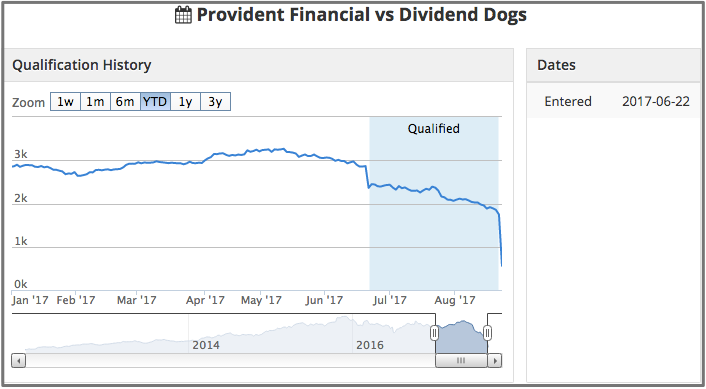
In addition, the Dividend Dogs strategy offers very little in the way of safety nets that might pick up the sorts of problems seen at Provident. In fact, as you can see from this chart, it was only after Provident issued its first profit warning in June - pushing up its yield from 4.4 to 5.5 percent - that it qualified as a Dividend Dog. This was arguably an increasingly dangerous time to own it - and certainly didn’t offer the sort of rock solid dividend sustainability that many income investors want.
Dealing with those dangerous dogs
Dividend strategies typically fall into one or a combination of three key approaches: high dividend yield, dividend growth and dividend safety. Ahead of the problems that emerged at Provident earlier this year, it had a decent track record of dividend growth and the payout was reasonably well covered.
So arguably, it was the high yield itself in recent months that was the biggest warning of problems. The falling price drove up the yield as the market fell out with the stock. As a result it had a higher yield than some of the best known high yield shares around, including BP and Royal Dutch Shell. This makes it a classic case study in one of the most well-drilled risk warnings associated with dividend stocks - be wary of very high yields. They can often be a mirage and one of the early warning signs of a dividend trap.
One compromise it to look for slightly lower yields in potentially safer companies, which is more of a focus in ‘quality’ dividend strategies like Quality Income and Best Dividends. Incidentally, this is one of the main conclusions made by Paul Scott in his assessment of the Provident debacle. His rule of thumb is to look very carefully when the yield on a share is over 6.0 percent.
As for the Dividend Dogs strategy - before the Provident crash we were seeing a solid 9.2 percent return (before dividend payouts) over the past year from a version of the strategy tracked by Stockopedia. Typically the screen rules drive it into the arms of some of the biggest and best-loved dividend stocks in the market. In terms of price performance, it does suffer periods of downward pressure, but the yields help insulate it from downturns. Just occasionally though, it can misfire with a false positive that ends in a dividend trap. Fortunately, these cases are rare.
Click here to see all the Dividend Income strategies tracked by Stockopedia
Disclaimer
This is not financial advice. Our content is intended to be used and must be used for information and education purposes only. Please read our disclaimer and terms and conditions to understand our obligations.

12 comments
Provident Financial (LON:PFG) only lost out because of a poor operational decision (to replace agents with F/T employees), NOT due to over lending/credit quality issues. PFG Rationale was good - lower cost, more controlled and more effective plus able to also provide support to other PFG businesses - but missed with the crucial human element. Being an agent was flexible (hence some only chose to work 2 days/wk) and more respectable (self employment vs paid "collector" as I am sure the new FTE PFG staff are made to feel..
Personally, I am OK with these regulated high interest rate businesses - if rates are capped/stopped, many will lose any access to debt. A real problem ESPECIALLY if you "deserving poor" ie locked out of mainstream loans but regular enough to pay back over time. I agree some people will undoubtedly be buying inappropriate loans (and some planning to default !) but such actions are a price of a free society. The need will be met as it has throughout history. Better it is done with some oversight - with "sin regulation" creating excess profits (which is why Woodford was in both PFG and NSF, hoping for tobacco-like returns.....a share category I would never buy. Everyone has their principles)
Consequently, just bought Non-Standard Finance (LON:NSF) who have snapped up a few hundred of the best PFG agents over June / July.
These will no doubt carry a fair chunk of their old clients back in Nov/Dec when blocks on them recruiting wear out. Non-Standard Finance (LON:NSF) also no 1 in branch based non-standard lending and no 2 in Guarantor loans (lower interest for Person A because Person B backs them to be good it) after a expensive but good purchase in early Aug.
But the free market should be able to do that - after all if they over lend then it is they that will ultimately lose out bearing fruitless unnecessary time and expense in chasing the resultant bad debt
I was coming from the issue from the perspective that the loan was "essential " to the recipient, if that is the case than Provident is better than "man with baseball bat"
The wider point you allude to is where availability of credit to those financially illiterate creates a circle of dependence that often ends in financial disaster, on that point I agree wholeheartedly. The issue for regulatory authorities is ensuring essential loans are available as widely as possible whilst minimising the opportunistic exploitation of naive borrowers for non essential purchases. That balance seems elusive at best.
Yes these customers are poor risks but that wasn't my point. That is from the company's point of view. I was considering the poor customers, desperate, financially illiterate and cynically exploited for those reasons by this sort of lending which is far more likely to make their situation worse, not better.
I think that taking financial advantage of those whose lives are most fragile and least able to cope with debt at such gigantic vig, stinks. And the fact that it is better than baseball bat sharks, just, as you say, does not justfiy what they do.
And I'm not an ethical investor in general.
Stephen
If those APR figures are so high but the business is not making standout returns then they must reflect the risks associated with lending to those with poor or no credit history? Obviously the CEO creamed some of it off in ludicrous pay but the point still stands.
Not an investment for me but preferable to amateur loan sharks with baseball bats...just
...Provident was a specialist lender to lower credit score customers...
Specialist lender? That's euphemistic, you mean loan shark, lending at astronomic vig to poor people who could least afford it.
Quotes from their published figures:
Representative 535.3% APR
They also own Satsuma loans:
Representative 991% APR
Scum
There are clearly dangers in going for a high yield without understanding the risks involved. Provident was a specialist lender to lower credit score customers. The mistake Provident seemed to make was to assume this segment could be serviced and collected in a similar way to higher score customers and they thus reduced the amount of face-to-face payment collection which is important to this segment. They changed their business model without fully understanding the risks involved in change. I am mystified why Neil Woodward, who likes Provident, did not fore-see the danger of this business model change.
In its early days, the Motley Fool UK followed the dogs strategy for a five year test based on the O'Higgins ideas. I know all about it because I wrote the regular reviews of the strategy as well as writing a lot of other content for them.
At the end of the five year run, we abandoned it as a crock of shite. It lost seriously, both in absolute terms and relative to the FTSE100 it was attempting to beat. Furthermore it was quite obvious a long time before the end that it was never going to deliver the expected 20%pa return but in the event it delivered no positive return at all, but a highly negative figure.
To be fair, others have reported good returns for different periods so my conclusion is that it is too unreliable. It works if you hit a good streak, and cripples you if you don't. But that's no good because of the large variation in the range of outcomes from what I've seen, making it too risky.
What is desirable for a mech is that it has a good chance of delivering over any long term period, evidenced by a much narrower range of outcomes. Consequently I can't endorse the dogs strategy for people seeking a mech.
One further point which can confuse some people into thinking the dogs is an equity income approach. It's not, rather it is a regular annual trading scheme whose aim is wholly capital gain. The confusion arises because it selects high yielders but HY in this case is just a selection filter and not intended as a means to the end of deriving an income like a proper HY portfolio. That typically has very little or no trading and the over riding purpose of providing an income to the investor, without seeking capital gains as the main object.
Anyone who wears a black polo definitely has something wrong with them.
I think this article is correct in saying that Provident Financial showed signs of being a dividend trap. I find it surprising that Neil Woodford thought the dividend was safe, I hope there is nothing wrong with him as he is now appears to be failing even in areas where he has displayed expertise in the past.
I do not know about Dividend Dogs but I am a High Yield investor
In my strategy Provident Financial Group was disqualified from the moment of the first profit warning which surely indicated a serious concern over the dividend. So it never qualified for investment in my view
Interesting, but not my style of investing.