Is International Consolidated Airlines heading for a crash landing?

Almost exactly one year ago, I asked whether I should buy British Airways owner International Consolidated Airlines (IAG) for the SIF portfolio. Remarkably, one year later IAG has popped up in my stock screen again.
Last year, I decided not to add to the stock to the portfolio. Coming just a few days before the EU referendum, this decision has helped me avoid a loss. The shares slumped after the Brexit vote and didn’t start to recover until late October. Had I sold in December after six months, in line with last year’s portfolio rules, I’d have logged a 10% loss.
However, IAG’s recovery has continued and the shares are now worth more than 600p. That’s about 20% more than when I last looked at the stock a year ago. Remarkably, the firm’s recent IT fiasco hasn’t dented the share price. Perhaps this is because the rumoured £80m cost of the IT failure is peanuts to a company of this size.
Or perhaps investors believe that British Airways has a sufficiently entrenched position to hang onto its customers, however badly it treats them. Any underlying issues facing the firm’s brands have yet to hit sales, so the market may be ignoring this risk.
Luckily, my job here is not to try and judge IAG’s operational performance. It’s to assess the firm’s financial profile and decide whether I should add the stock to my rules-based Stock in Focus portfolio.
Not straightforward
This FTSE 100 group currently has a StockRank of 98 and a StockRank Style of Super Stock. Stocks with these characteristics have historically tended to outperform the market, although there’s no guarantee this will continue.
This stock also qualifies for nine of the long Guru Screens which model the investing strategies of famous investors. Several of these screens have delivered annualised returns of more than 20% since they started running on this website. The only fly in the ointment is that IAG also qualifies for two short-selling screens. Should this be a concern?
In the remainder of this piece I’m going to look at the bull case for the stock and investigate why IAG qualifies for these short-selling screens. Should I steer clear of the stock, or is it a buy for the SIF Portfolio?
It’s still cheap
Rigorous cost management, rising passenger numbers and a well-timed oil market crash have made airlines more profitable than they have been for years. IAG is no exception.
Sales have risen by 21% to €22,567m since 2013. But the group’s underlying net profit has risen by 362% over the same period, from €430m to €1,900m. Looked at a different way, IAG’s underlying operating margin has risen from 4.1% to 11.2% since 2013.
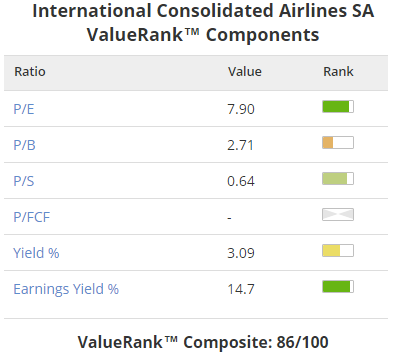
Despite this, the market has been reluctant to reward the firm’s success with a high valuation. IAG has a trailing P/E of 7.9 and an impressive earnings yield of 14.7%. These factors have helped the stock earn a ValueRank of 86.
One potential concern is that free cash flow has been negative every year since 2011:

Stockopedia figures are calculated by Thomson Reuters from IAG’s accounts. But the airline reported free cash flow to equity of €2,055m last year, up from €1,481m in 2015. How can this be?
The difference is down to cash pension contributions, restructuring costs, provisions and movements in working capital. IAG excludes these from its FCF calculations, but they resulted in a net cash outflow of €660m in 2016 and of €1,215m in 2015:

IAG has an actuarial pension deficit of €4.7bn and has committed to deficit reduction payments of €4bn over the next 10 years. In my view these aren’t really exceptional costs and should be included in free cash flow calculations.
Mixed quality?
The stock’s QualityRank of 78 is fairly high. But if you look at the components of this score (click here then click on the rank numbers) you’ll see that the only real highlight is the Piotroski F-Score of 9/9. This fundamental health score is weighted heavily in the QualityRank algorithm, thanks to the broad range of factors it covers:
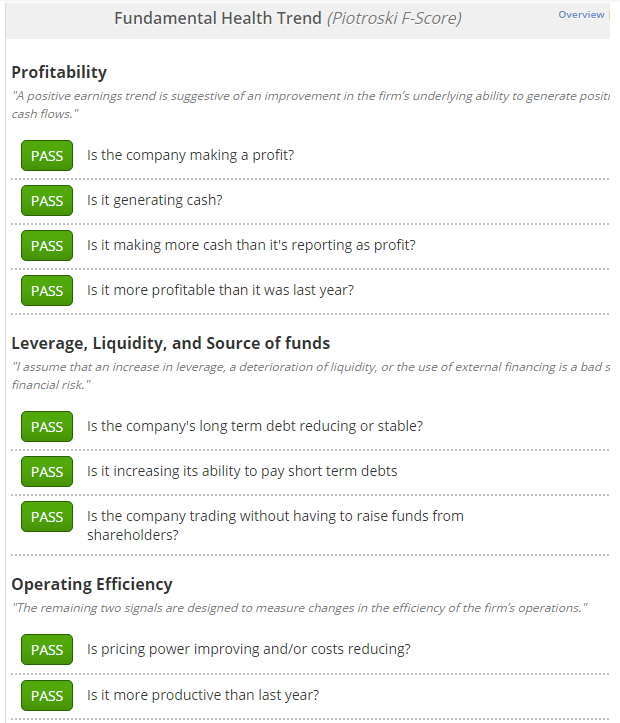
IAG’s weak historic profitability means that many other quality factors are less impressive. The group’s five-year average return on capital employed (ROCE) is only 6.5%, while its five-year average net margin is just 3.3%. I believe this stock has some way to go to prove itself as a good long-term investment.
Flying momentum
IAG’s MomentumRank is strong, at 87. Both price momentum and earnings upgrade factors appear to provide support for further gains:
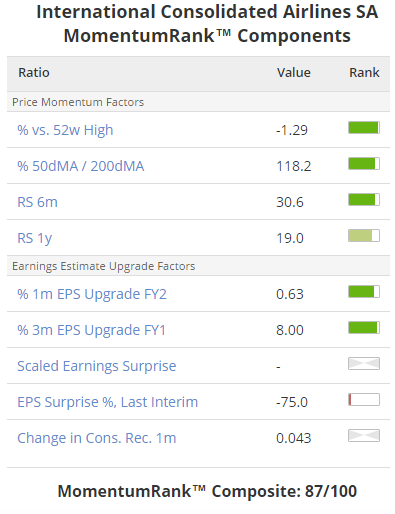
The share price is within a whisper of its 52-week high and relative strength is also positive. First-quarter performance was strong, with adjusted operating profit up by 10% to €170m. This prompted a round of broker upgrades:
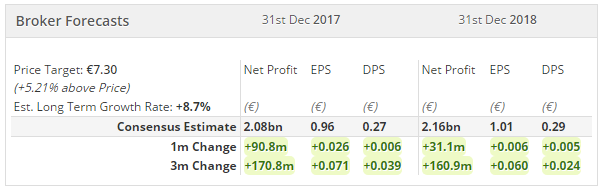
These rising earnings forecasts could encourage buyers, given that the stock now trades on a forecast P/E of 7.2, with a forecast yield of almost 4%.
Should I short IAG?
To be clear, I’m not short IAG and I’m not suggesting anyone else should be either. However, the firm’s appearance in two short-selling screens cannot be ignored. So let’s take a closer look.
Altman Z-Score screen: The Z-Score uses several balance sheet ratios to assess the likelihood of a company becoming financially distressed. IAG scores poorly with a score of 1.23, below the 1.8 threshold above which a company is considered in good health. However, more than 200 companies currently qualify for this screen, including names such as GlaxoSmithKline, National Grid and Rolls-Royce. I’m not sure it’s of much immediate value to us on its own.
James Montier Trinity of Risk screen: This is more interesting, in my opinion. Only eight companies currently qualify, and IAG is the only big cap. The rules specify three ratios:
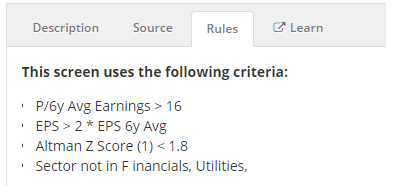
These rules correspond to three risks: excessive valuation, unsustainable earnings and financial distress. The logic seems to be that a sharp rise in earnings or valuation is often unsustainable, especially when it’s combined with warning flags for financial distress.
My verdict
So is IAG a house of cards that’s about to collapse? My view is that the inclusion of the firm in these two short screens is a result of two factors. The first is the chain of acquisitions which have accelerated IAG’s growth since 2011.
The second factor is that this cyclical industry is enjoying serious tailwinds from passenger growth and falling costs. At some point, I expect one or both of these tailwinds to reverse. But that could be several years away yet.
In my view, it’s probably too soon to bet against airlines. So with fingers crossed and some misgivings, I’m going to add IAG to the SIF Portfolio this week. As always, please let me know what you think in the comments below.
Disclaimer
This is not financial advice. Our content is intended to be used and must be used for information and education purposes only. Please read our disclaimer and terms and conditions to understand our obligations.

7 comments
As a previous regular user of BA I think they have gone to far with their cost cutting and feel the service has suffered and their competition has improved.
I understand that their focus is on business and premium passengers and it should be as premium cabins have the greatest reward for the airline but non true business passengers that want a premium cabin now look elsewhere and is it just a matter of time before this filters to the real business passengers? Their business offering also does not match the price they charge. Finally their reward program is really has become so lean its hard to call it a reward program at all.
Saying that they seem to be fully booked most of the time so nothing has happened yet.
Based on the fact that I am a fan of BA and even I am moving to other airlines means that I wont be investing in them.
Sorry no techinical analysis just don't like them that much anymore to invest.
I agree completely about the BA cost cutting - they are now like an Easy Jet Heathrow operation but with much higher fares and grumpier cabin crew.
It's an industry wide issue - as Ryanair are finding out the hard way staff will vote with their feet when opportunities arise.
Since this article was written BA have announced plans to reduce their pension cost of living increments from RPI to CPI subject to court approval, and Michael O'Leary has said that he regards the IAG group structure as completely untenable post Brexit.
The check in systems fell over again this morning.
http://www.telegraph.co.uk/business/2017/08/02/british-airways-apologises-total-chaos-heathrow-due-system-failure/
Roland you are only as good as your data. I was looking into this one and contacted ED (around R&D spend for them)only to find that they had restated their accounts and constantly do so and by doing such certain years don't match, 2011 I believe.. I now don't the email with the details....
I also read that theres a true possibility of planes sitting on tarmac "Ryanair 'will have to suspend UK flights' without early Brexit aviation deal "..How true this is I Don't know..... https://www.theguardian.com/business/2017/apr/06/ryanair-uk-flights-brexit-deal-wto
Personally I,m overweight on Law firms now... These £500-£700 per hour!! corporate lawyers need to redraft hundreds of laws/contracts for businesses because of brexit.. There books are full now for years...... Gately Holdings PLC looks cheap and is rated well and I have BUR (Litigation which is huge)
Totally agree with the above. Their mismanagement and handling of the recent IT debacle would make them un-investable for me, and whilst they may not have felt any immediate significant impact, customers tend to have long memories, and share their poor experience with multiple other people. If given a choice of airline, I would now avoid them in preference of other carriers, and I am sure many others will be similar.
What the shares may do, who knows? The chart looks good, and the fundamentals are decent, so maybe it continues its upward trend? Its not for me though.
TT
Not one for me.
1. The pension deficit.
2. I can't look past the IT debacle and the customer service issues that arose. The mess that is their IT structure will bite them again at some point without significant investment. A failure like that just should not be possible. Their management structure is not the one needed to fix this, or really even understand the issues that they have. There isn't the appropriate board level IT function and management don't seem ready to fix that. I think they have gone too far in cost cutting, leading to the concerns you mention about unsustainable earnings.
Hi John,
Thanks for your comment. Personally, I agree with you re. the International Consolidated Airlines SA (LON:IAG) IT failures. Speaking as someone who used to work in enterprise IT support, I cannot see how such a large-scale fiasco would be possible if suitable processes and controls were in place.
This is one of the points I tried to make in the article. For some reason, the market has ignored recent events. This could just be a cynical but realistic view of IAG's size and strength in its core markets, or it could be a short-term view that will soon come back to bite investors.
We don't know. But the fundamentals do look good and based on current and recent performance, the stock isn't expensive and has decent momentum.
Beyond that, it's all conjecture, which is why I've ignored the risks and added the stock.
But as I say, I do have some misgivings about IAG.
Regards,
Roland