Kooth: Market misdiagnosis?

I'm continuing to use my cheap growing companies screen as inspiration for Stock Pitch articles. Looking through the screen results, another platform business stands out as being particularly cheap on historical measures, with an EV/EBITDA below three. Kooth (LON:KOO) has appeared undervalued for a while (its three brokers rate it a Buy, with price targets from 250p to 330p, against a current share price of 132p), so I own shares in the company. But perhaps I'm missing something. A Stock Pitch article is a great way to get to the heart of the matter.

[Disclosure: At the time of publication, I hold a long position in Kooth.]
The Pitch
Kooth is a UK-headquartered provider of digital mental health services, founded in 2000 and listed on the AIM market in September 2020. Its StockRank is a relatively modest 65, held back by a middling Value Rank of 49. Despite this, the stock looks cheap on earnings measures, just that the algorithms are picking up the lack of yield and the relatively high Price to Book. However, these don't look out of place for a platform business looking to scale, suggesting this is a company that punches above its Stock Rank.

It operates two distinct but complementary platforms:
- In the UK, Kooth.com and Qwell.io are commissioned by NHS England, local authorities, and increasingly by bodies such as the Department for Work and Pensions, providing free, moderated, clinically accredited mental health support to children, young people, and adults. Kooth is the longest-standing digital mental health provider to hold UK-wide accreditation from the British Association for Counselling and Psychotherapy.
- In the US, Soluna is a youth-focused digital mental health platform commissioned by state governments, currently operational in California, New Jersey, and Michigan.
The cornerstone of the business is a very large four-year Californian contract awarded in July 2023 to provide digital mental health services to teenagers and young adults. The unsuccessful bidders were not revealed but are widely believed to include at least two large US healthcare providers. For a plucky Brit to win out in the US over large-scale local opposition is a rare feat.
The implementation of their Soluna platform, which went live in the Golden State in January 2024, was transformational for the business, leading to revenue roughly doubling in FY24 to £66.7m as the contract ramped up. The company went from loss-making to reporting EPS of over 20p in 2024. £11.8m of free cash flow was generated in this landmark year, leading to net cash of almost £22m, a level largely maintained despite a period of heavy investment and a modest share buyback.
While Soluna has won contracts in other US states, none have had the reach of the statewide initiative in California. This meant that revenue plateaued in 2025 and remained essentially flat on a constant-currency basis. Adjusted EBITDA came in around 10% ahead of analysts' expectations, but still declined by 28% on the prior year. The market is starting to worry about the renewal of this contract. However, the need for adolescent digital mental health support is not going away. Some children wait years for CAMHS support following referral in the UK. Without some form of early intervention available, the long-term cost to taxpayers and society is going to soar. Whether the Californian contract is renewed or not, the demand for the services Kooth provide will continue to rise, and the market they are going after is huge.
The Big Picture
It is clear that if the California contract is renewed and the company continues to win a place in other US States' mental health strategies, the shares are materially undervalued, even without expansion to new territories. So the current market concern centres almost entirely on the risk that the California contract ends in FY27. After all, California accounts for approximately £45m of Kooth's £63m annual revenue, so if it is not renewed, the business shrinks dramatically. There are several reasons to think that the market may be overpricing that risk:
- Key endorsement: By the end of FY25, over 144,000 young people had registered on Soluna in California, ahead of Kooth's target. The platform has established over 1,400 institutional and community partnerships, and LA has directed all youth-serving county departments to integrate Soluna. In March this year, California's Health and Human Services Agency, Department of Health Care Services, and Department of Education sent a joint letter to every Local Education Agency in the state endorsing it. This is not the profile of a contract about to be cancelled.
- Independent clinical evidence: Northwestern University's evaluation of Soluna found significant and sustained improvements in psychological well-being among users. Kooth has also received URAC accreditation in the US and BACP accreditation in the UK. Cancelling an intervention that has been proven to work and replacing it with an unproven platform, or leaving a void, is not the kind of risk government departments want to take.
- Diversified US expansion: Kooth secured its first US contract renewal in New Jersey, surviving a change in state governor administration; a significant proof point of institutional entrenchment rather than political dependence. It then added Michigan ($2.6m ARR) post-period-end. Each new state win adds recurring revenue with low marginal cost on an already-built platform.
- UK growth: Kooth signed 14 new UK contracts in FY25, with increasingly diverse funding sources including the Department for Work and Pensions. Soluna is expected to launch in the UK in H2 2026, opening a new growth channel with minimal additional cost, given that the platform has already been built.
- Downside protection: Even without California, Kooth is profitable; the UK business alone generates revenue and margin. With over half the market cap in cash, the downside is cushioned.
Going Deeper
Beyond the market's fascination with the California contract risk, lies a cheap, performing business:
- Valuation mismatch: At the current share price, the company trades on an EV/Sales ratio of 0.2x. This is very low for a business generating 73% gross margins. For example, Talkspace, a US digital mental health peer, was recently subject to a bid at 3x sales and 26x EBITDA. Kooth trades at a valuation that's pretty much a tenth of that acquistion price.
- Recurring revenue: Annual Recurring Revenue of £60.6m at year-end provides 96% coverage of FY26 revenue estimates before the Michigan contract kicks in. In the US, the company is certainly subject to State budget cycles. However, every contract win adds to a recurring revenue stream.
- An AI moat: Kooth has been collecting clinical mental health data for 25 years, giving it a structural advantage in the current AI environment. Ethically grounded AI models trained on verified clinical data are increasingly valued by public health commissioners, and Kooth is actively deploying AI to improve practitioner productivity and platform functionality.
- Improving free cash flow: EBITDA isn't always a great measure for companies that capitalise development spend on intangibles. In Net capex fell from £7.0m in FY24 to £4.5m in FY25, reflecting the maturation of the California platform build-out. Forecasts from Singer see free cash flow rising from £1.8m in FY25 to £4.5m in FY26 and £6.6m in FY27, as the opex investment cycle normalises. The FCF yield at the current share price is forecast to be well into double digits, a standout figure for a healthcare technology company.
- A sentiment overhang: As well as the market fretting over the key contract renewal, sentiment doesn't appear to have recovered from the H1 results last year. When these were announced, the company surprised the market with a significant marketing spend, giving a large H2 weighting. While revenue was a slight miss due to FX impacts, full-year EBITDA came in ahead of broker forecasts. Despite a bounce following the FY results, the share price has not yet fully recovered from these unfounded concerns.
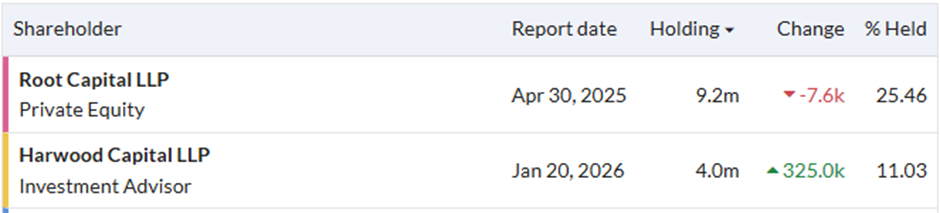
- Active shareholder register: The two largest holders are Root Capital and Harwood. The Root Capital holding is a stub from listing, and appears to be held in Root Capital II Fund, which has been in disbursement for some time and may even be the fund's last holding (Root was renamed ScaleUp in 2021). I'm sure this fund would be amenable to an exit at a level close to the current broker price targets (as they have reduced at this level in the past). With Harwood well known to be an activist manager, there looks to me like a deal to be done once the California contract outcome is known, if one of the US healthcare tech providers wants to scale up in a growth area.
What The Brokers Say
All three covering brokers rate it a Buy, with price targets ranging from 250p (Cavendish) to 330p (Canaccord Genuity). The consensus target is at least double the current share price.
Singer describes the situation as one of "asymmetric returns potential", flagging that with over half the market cap in cash and a profitable business even in the absence of California, the downside from current levels is materially cushioned. They value the shares on just 0.2x EV/Sales and 2.3x cash EBITDA, calling the stock "deep value territory".
Canaccord notes the valuation disconnect, arguing that the current price implies zero or negative value for the California contract. They use the Talkspace bid at 3x sales as a real-world reference point for what the market pays for digital mental health assets in an M&A context.
Cavendish, who initiated coverage in March 2026, makes the most nuanced argument: that the investor community has not yet updated its mental model from 'will California be renewed?' to 'on what terms?'. They flag the direction by the Los Angeles County Board of Supervisors and the joint statewide agency endorsement as evidence that Soluna is now infrastructure, not a pilot. Their target of 250p represents the most conservative of the four, explicitly modelling a renewal at around 70% of current California ARR.
The Bear Case
The risks are real and could have a material impact on the business:
- Extreme concentration: While there are signs that the risk of the California contract may be overblown, there is no doubting the impact on the company if it is lost or renewed on significantly worse terms. Around £45m of the £63m total revenue derives from that single state contract.
- US Policy: Kooth's US business is funded through state budgets that are themselves partly dependent on federal Medicaid and public health allocations. Federal healthcare programmes can be a political hot potato, so while state-level support for Soluna appears strong and bipartisan, a significant reduction in federal health funding could have a negative impact.
- Foreign exchange: With the majority of revenues earned in dollars, but reporting in Sterling, FX moves will always give revenue and earnings volatility.
- Short-term earnings weakness: FY25 EPS of 8.3p represented a 60% decline on FY24's exceptional 20.6p, driven by higher direct marketing costs and amortisation. FY26 forecast EPS of 7.1p represents a further decline, before cost reductions see FY27 EPS rebound.
- Governance: In October 2024, California Healthline reported that Kooth picked up a $15,000 tab for the director of California's Mental Health Services Oversight and Accountability Commission, and three commissioners, to travel to London in June 2024. The trip coincided with the official actively lobbying California legislators to protect Kooth's contract from a proposed $360 million budget cut. Kooth denied any wrongdoing, but even if this was simply a normal part of best-practice sharing, the optics are poor, and show a level of naivety.
- Pennsylvania early termination: In October 2024, Pennsylvania's Department of Human Services terminated its $3 million contract with Kooth early. Some of the concerns centred around the anonymity of clinical practitioners on the platform and the role of parents in teen mental health recovery. While it was a relatively small contract, it shows that political rhetoric can cause real policy changes.
The Bottom Line
The market has decided that there is a high risk that the California contract will end in FY27, with a knock-on impact on the business's ability to grow elsewhere in the US. There is strong evidence that the risk of this is overblown. The embedded infrastructure is strong, and competitors will struggle to wrest this contract from Kooth without significant expenditure. Especially as a joint letter from three key Statewide stakeholders publicly endorsed the Soluna platform just last month. Cancelling the contract and leaving a void in digital mental health for teens would lead to much higher state spending on mental health services in the long term.
The most likely outcome appears to be that the renewal will happen, but at somewhat lower terms. It would be naïve to think that if the contract is not renewed, investors will escape unscathed. However, with a £21.8m net cash balance that is forecast to grow further, a profitable UK business and a number of smaller US contract wins being implemented or expanded, there is value here even without a Californian renewal.
Some investors may not be able to cope with the binary nature of this outcome, but overall the risk-reward ratio certainly favours the holders at the current price.
[Disclosure: Mark owns shares in Kooth (LON:KOO)]
Disclaimer
This is not financial advice. Our content is intended to be used and must be used for information and education purposes only. Please read our disclaimer and terms and conditions to understand our obligations.

9 comments
I would never invest in Kooth. I have written about this in the past so not wanting to cover old ground.
The risks IMHO are far too high. If it was investigated again by journalists I am sure they would find it similar to the past-unacceptable practices taking place.
Where have you written on this? I scrolled through your Stocko activity but couldn't see anything recent.
All psychotherapists should be weighing every decision they make against their ethical framework with principles such as Do Most Good (Benifience) & Do Least Harm (Non-Malificence) and on occassion that often that impacts upon their practice as they give primacy to their clients, e.g. not working too much means improves the depth of client contact but reduces income.
This primacy doesn't sit well will capitalism and typically therapists working in a for-profit organisation find their ethical practice compromised by accountants. It's hard enough for therapists to uphold their ethical frameworks in not-for-profit organisations.
Interesting article.
My first instinct was to click on the link to the cheap and growing screen. As a long term holder of Legal and General I was a bit surprised to find its inclusion. A reasonable dividend stock for a buy and hold investor - but I couldn't describe it as cheap and growing.
As regards Mental Health, I was struck by this recent survey carried out by the BBC...
Hundreds of GPs have told the BBC they have never refused to sign a patient off work for mental health issues.
https://www.bbc.co.uk/news/art...
Clearly something is unsustainable. The concern is that the money to support such services comes from a very small number of providers and could dry up at some stage as the funding mechanism for Mental Health is inevitably reviewed.
As a trained psychotherapist the arrival of for profit organisations in the provision of mental health services is disheartening. Many therapists train for many years, are highly discplined, ethical and dedicated practitioners. No counsellor or therapist is ever going to get rich in this career but that's not what motivates most.
To see companies turning the screw on therapists fees to turn a profit whilst therapists, often single women who will never be able to secure a mortgage, struggle to keep their heads above water is in my opinon despicable.
Trying to extract a pay rise from a commercial Employee Assistance Programme is practically impossible. Believe me I've tried. Hearing organisations like Better Health promoting their business whilst screwing therapists ... erm ... makes me angry. I've had EAP's tell me that they need to keep the fees reasonable for clients due to the cost of living crisis failing to note that their therapists are equally under pressure.
Health Assured was owned by Bet Fred owners and fought hard not to give pay rises to staff. Imagine therapists working with clients with gambling issues and the misery that brings only for Bet Fred owner to profit from both angles.
Also the idea of tieing return to work with therapist performance is also deeply repugnant to most therapists. It's not our job to get clients back to work. Our job is not to have an outcome in mind for our clients. It may well be that the client does go back to work after sessions but that should never be the therapists goal.
Capitalism and the support of the most vulnerable don't belong together in my opinion.
Hi Phil,
I appreciate your personal perspective, and I largely agree with some of your concerns. However, I take a slightly different perspective when it comes to something like Kooth.
One of the biggest issues is that Psychotherapist is not a protected title. So you can work hard doing the four-year Psychotherapy Masters and do your Supervisor-reviewed practice hours to get UKCP accreditation, yet someone down the road can do a year's counselling course, and call themselves a Psychotherapist and charge exactly the same. Most clients have no idea the difference in professionalism and service they will be getting.
As you say, therapists don't go into it for the money, so the ones that really care will have done the work to be UKCP accreddited, even if it's not the route to maximise earnings. However, making Psychotherpist a protected title where only those with the appropriate level training and experience would go a long way to removing those who claim to be helping but do active harm, IMO.
And I agree that even when organisations do deal with only fully accredited Psychotherapists, they don't always recognise the value of the work.
However, all of the examples you mention are not the market that Kooth are working in. They are offering immediate early interventions for a teenager who is struggling with something and giving them some tools and support to help them. The study data suggests that most find this helpful. However, it is not a replacement for CAMHS or able to help those with the most serious cases where long-term talking therapies are going to to be needed. However, with a 2-year+ wait following a CAMHS referal, doing nothing for two years often means a condition that would see recovery becomes entrenched.
Yes, it would probably be better if we didn't need Kooth at all, and everyone who needed it would get a CAMHS appointment within a couple of weeks. However, the immediate cost of this would be huge. Staff shortages in many trusts are such that CAMHS are offering £60k+ salaries and relocation expenses for each role.
Kooth probably costs each NHS trust just over £100k/pa so roughly equal to one CAMHS FTE once you include all employment costs. However, the Kooth fee can cover a couple of thousand CYP with emerging mental health needs, far more than an extra CAMHS FTE.
So overall, Kooth provides value for money for taxpayers. It is not, and doesn't intend to be, a replacement for CAMHS. However, NHS trusts use it becuase it works for early interventions, provides value for money, and is an immediate solution to a rising need. Other countries may have different health systems but the same dynamics mean that the opportunity for growth is huge.
As investors, I don't think we always have to choose between a good business and one doing good. Kooth is not perfect, but so far, it appears to be both these things.
Cheers,
Mark
Hi Mark,
Look I'm sure Kooth have talented therapists who do great work with young people.
I also fully agree that protected titles should be introduced, it protects clients and the investment I made in my training. I also agree that
1) there are some people who are not qualified
2) there are some poor counsellors as there are poor bricklayers, financial advisors, nurses, doctors, etc.
however it is very easy to check if someone has undertaken the training in a public register.
https://www.bacp.co.uk/search/...
The market place is not full of unqualified counsellors, if be surprised if it's more than 10% and it's probably less than 5%.
Anyway .. if there was a decent, well funded child and adolescent mental health service (and adult service) they would not be recruiting individuals with inappropriate training. The therapists supporting that service would all be highly qualified with additional training focused in working with children and young people on top of their core training of adults. All told at least 6 years training.
Now let's talk about the job itself. Many therapists don't work full time. Why? Not because they are lazy but rather ploughing into the intensity of a client's life for 40 hours a week isn't feasible. It's a recipe for burnout and compassion fatigue. Yet many therapists who work for organisations are expected to see at least 5 clients a day as a minimum (my max in my private practice is 4) and often the clients they are seeing are triaged so they are seeing the most distressed. Also if anything distressing happens in a therapist's life, a breakup, a bereavement, relationship difficulties or the client's story touches their own they often have to step away from a client or pause their client work entirely in order to protect the clients.
These human factors don't sit well with a commercial enterprise in my opinion.
The solution is to fix public sector mental health services rather than to let it fail and then say "Oh isn't the private sector great they've patched a hole and offer good value for money". Tesco own brand beans are good value for money ... do you buy them?
At present I would never work for CAHMS, a GP surgery or an NHS mental health team. The pressure on therapists, the lack of support, the sick organisation syndrome destroys therapists and in my opinion dulls their ability to truly meet each client at a meaningful and therapeutic depth. Why? Because it's exhausting to wade waist deep into a client's distress. I do that willingly because for me that's the job but I can't do that if I'm seeing in excess of 20 clients a week.
It needs to be totally restructured. Increased awareness of neuro diversity (which is great) has already increased pressures on all mental health services and it's only going to get worse if the fears around AI job losses come to pass. Issues of identify, self worth, meaning and purpose will explode in society and people won't have work and so won't be able to pay for private therapy. Young people are already asking "What's the point? Which career direction is safe?"
I think young people have a lot to be angry about especially in comparison to the 60+ sector of society with : final salary pensions; affordable housing vs salaries; jobs (or careers) for life, free further education, etc.
They are also probably one of the most passive generation of young people ever. They should be shouting from the rooftops as should their parents and grand parents.
I'd suggest a wealth tax but that isn't going to be popular here. The risk is the wealthy find a private sector solution, the wealthy pay for admission to a private unit and the rest of the general public struggle, get stuck for years, damage their kids and society suffers.
I hope readers never have to find public mental health care for their family. It is a highly distressing experience that can go on for weeks.
There are many things to criticise the Welsh Assembly Government for but one of the most forwards thinking things they have done in recent years was to introduce schools based counselling to every secondary school in Wales in 2010. They led the way. It takes real courage for a government to make decisions that have no short term gain but a perceived long term result. Now all children in Wales will think "If I'm struggling I'll speak to a counsellor". It's a great long term investment in society.
This is the forward thinking that we as a nation should be doing.
Allow young people to access free counselling in school without having to seek parental approval (sometimes they can be the issue being discussed in counselling).
It has also allowed more empathic ways of relating to permeate education where teachers are under pressure to achieve results.
For me I want to see us drive our public sector to be better and not to carve things up for private sector companies like Kooth.
All we seem to hear about nowadays is mental health issue problems affecting our young in ways they never seemed to before smartphones and interest in the boy scout and girl guide movements were guaranteed to teach life skills that parents often lack themselves. This leads as Mark points out to a real shortage of treatment facilities for these "disorders" and with shortage a chance of some potential profitability from Koo in the not too distant future. If the company gains traction in the US, we can see nightly that their services are required immediately through every age of society and success is assured. For our own more carefully spending, though no less needy NHS they are very well placed indeed and judging by the list of institutional investors I will be joining Mark with an amount of my own invested in their progress. Thanks very much for the excellent tip.