Lost out with Woodford? Here's why DIY investing makes sense...

Neil Woodford is one of Britain’s best known fund managers. But after a striking run of poor performance, the gravity of which is hard to overstate, these days he’s making headlines for all the wrong reasons.
This week Mr Woodford slammed down the shutters on his Woodford Equity Income fund, almost five years to the day after launching it in 2014. After months of outflows and seemingly endless bad news from the portfolio, Woodford’s played one of the few cards that any fund manager would choose. By gating the fund he’s stopped the redemptions for now, but a lot of damage has already been done - and the future is unclear.
For some, the warning signs around the Woodford Equity Income fund have been in plain sight for some time (more on that shortly). But there are going to be many others - including owners of it - who’ll be left wondering how on earth this has happened...
After all, Woodford is one of the biggest names in UK money management. He’s got a huge profile in the financial press and major support from fund platforms like Hargreaves Lansdown. In fact, Hargreaves only dropped the fund from its top Wealth 50 after it was suspended this week.
Moreover, his fund was supposed to be a solid, value-focused ‘equity income’ strategy - nothing exotic there, you might think. Woodford had a long track-record of decent returns (largely at Invesco Perpetual) pursuing just that approach. He made his name as a contrarian over more than a decade, holding high yielding blue chip stocks while everyone else was buying (glamorous) dot-coms. So what changed?
Back in June 2017 the size of the Woodford Equity Income fund hit a high of £10.2 billion, but has since fallen to £3.7 billion.
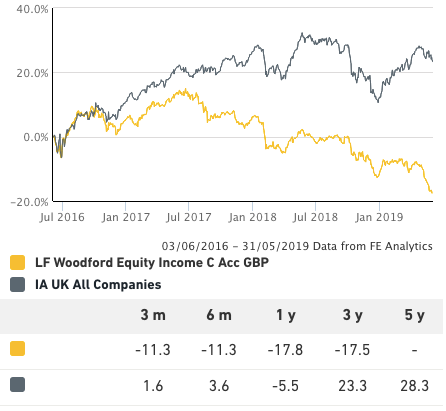
Unsurprisingly, the financial press has gone to town on picking over the causes and consequences of this, but here are a few reasons:
One issue is that while he’s been running this fund, Woodford’s value-focused philosophy has been at odds with what’s been working in stocks. Over the past five years equity income has generally been out of favour, while growth and momentum have led the market. Back in the early 2000s, he made a mint when conditions were completely the opposite. And while it’s likely that value investing will come back into favour eventually, it could be a long wait. As John Maynard Keynes once wrote: “The market can stay irrational longer than you can stay solvent.”
From the start of his fund, Woodford has also been committed to longer-term ownership and engagement with his holdings and taking larger stakes in them (John Kay even wrote about this on the Woodford Funds website). As such, he’s stuck with, and even built stakes in businesses that have hit trouble and issued profit warnings - and most haven’t recovered. Count among them companies like Provident Financial, PurpleBricks, the AA, Capita and Kier. This leads to questions about whether the strategy has magnified the risks of behavioural errors like overconfidence, confirmation bias and the disposition effect (holding losers and selling winners).
Another issue seems to be that Woodford introduced a number of smaller, speculative holdings to the fund. This gave it a venture capital feel, especially because some of the assets weren’t even quoted. As the performance fell and redemptions sped up, the fund was forced to sell down its most liquid holdings whilst being stuck with the harder to shift illiquid positions.
Latterly, it seems to have dawned on Woodford that his exposure to these kinds of assets had to be unwound. That forced him into exotic manoeuvres to try and steady the fund and ensure it remained in line with regulations.
This has echoes of the open-ended real estate funds that came a cropper after the EU referendum in 2016. Back then, investors took fright and sold out of those funds, causing a massive headache for the managers who couldn’t easily liquidate their real estate assets. In much the same way, Woodford’s unquoted holdings are hard to mark to market, and consequentially hard to sell on.
But perhaps the overarching issue here is that like all fund managers, Woodford is just as susceptible to ego, luck, conditions and, ultimately, underperformance as anyone else. Whichever way this debacle pans out, it shows that there’s no such thing as a ‘safe pair of hands’ in active fund management. Time and time again, research suggests that handing your money to a fund manager is absolutely no guarantee of outperformance. Even with a market hero like Woodford, there’s still a possibility of it ending badly.
While DIY investing isn’t for everyone, this episode is a reminder that fund managers are not the easy answer when it comes to the stock market. Saving the management charges and taking control with a long-term personal strategy is a perfectly realistic alternative. And after this week’s mess at Woodford Funds, it’s likely that many more will see things the same way.
Disclaimer
This is not financial advice. Our content is intended to be used and must be used for information and education purposes only. Please read our disclaimer and terms and conditions to understand our obligations.
34 comments
https://citywire.co.uk/investment-trust-insider/news/link-admits-errors-in-reporting-woodfords-guernsey-stocks/a1245383?re=65712&ea=104441&utm_source=BulkEmail_Investment+Trust+Insider+Daily&utm_medium=BulkEmail_Investment+Trust+Insider+Daily&utm_campaign=BulkEmail_Investment+Trust+Insider+Daily
I wonder how much money Woodford has made in total from the annual management fees of his Equity Income Fund (which are charged as a percentage of the total Net Asset Value of the fund) that were based on a ridiculously marked-up valuation of that fund's holding in Industrial Heat. In reality, that holding is almost certainly worth zero, firstly because Industrial Heat's technology was originally developed by a convicted fraudster (Rossi), and secondly because there is no realistic prospect of any company ever developing a commercially viable cold fusion device as that would be contrary to our current knowledge of physics.
http://newenergytimes.com/v2/sr/RossiECat/Andrea-Rossi-Energy-Catalyzer-Investigation-Index.shtml
A full breakdown of the Rossi story for anyone that's interested. Not pretty reading!
Thanks for link to Nicky Morgan's letter. I wasn't aware, previously, of the Guernsey based TISE (The International Stock Exchange) but it seems to be an exchange that lists securities that can't be listed anywhere else. In response to press articles it suspended three of Woodford's investments. But one has to ask how those securities (presumably including those discussed in this thread - Benevolent AI and Industrial Heat) got listed in the first place. Was there any due diligence? It would seem that TISE is little more than a rubber stamp for fund managers who want to be reckless with other people's money.
The FCA have opened an inquiry. There's an explanation of the background leading up to the fund suspension in their letter to Nicky Morgan.
https://www.fca.org.uk/publication/correspondence/lf-woodford-equity-income-fund-letter-tsc.pdf
The Rossi character who was the first investment of Industrial Heat has been around for years peddling his E-CAT 'technology'. A look in the right places would have shown that he proposals of generating excess heat output was largely debunked years ago, and I am amazed that he managed to find a mug to put money into 'research'.
There are legitimate research departments doing research into this area, after years of it being career suicide for scientists to approach it, but its all pretty low key stuff, and so far nothing major is in the pipeline, so as interesting as it may be I can't see that a mainstream investor should ever put money into without saying it is extremely risky, and not just a matter of patience.
A couple of announcements from Benevolent AI
The company’s advanced technology has been shown to outperform human scientists in understanding the cause of disease and is capable of quickly generating drug candidates at scale. The technology is also able to decipher the molecular process of disease and link these disease signatures within patients to ensure that the best drug candidate is given to the best patient responders – the ‘right drugs in the right patients’...
...To achieve this, BenevolentAI has created a bioscience machine brain, purpose-built to discover new medicines and cures for disease. Proprietary algorithms perform sophisticated reasoning on over 50 billion ingested and contextualised facts to extract knowledge and generate complex insights into the cause of diseases that have, until now, eluded human understanding.
This all sounds too good to be true...
Thanks JohnEustace.
A fascinating link from the FT. In summary, (according to one of the many cynical comments which I've paraphrased):
Mr Woodford bought cheap shares in an unknown jam-tomorrow company called Benevolent AI. He then bought more shares at a higher price which increased the NAV of the company. This enabled him to charge investors more in performance fees. Etc. Etc.
The writers at FT Alphaville have turned their attention to the valuation of another Woodford holding, Benevolent AI.
https://ftalphaville.ft.com/2019/06/17/1560748882000/Inside-BenevolentAI--the--2bn-tech-company-backed-by-Neil-Woodford/
Also relevant:
https://blogs.sciencemag.org/pipeline/archives/2018/04/23/benevolentai-worth-two-billion
According to the FT article, Woodford has invested a total of 54 million pounds of his fund holder's money in a company developing a 'cold fusion' device. Any of the physics lecturers at Oxford University in the same city as his fund's headquarters would have told him that such a device has zero probability of ever working, had he bothered to ask their opinion. Perhaps he did ask, but ignored what they said. Woodford chose instead to rely on the deep understanding of science and technology that he had gained from his degree in agricultural economics.
The FT has caught up too:
https://www.ft.com/content/024cfc4a-8df6-11e9-a1c1-51bf8f989972
Interesting article::
https://www.standard.co.uk/business/neil-woodford-feels-the-heat-over-cold-fusion-fiasco-involving-eccentric-italian-inventor-andrea-a4165641.html
Doing your own investing is certainly a realistic alternative where people have the appropriate competence. Even if you have this competence I still feel that Investment and Unit Trusts are a very useful supplement to DIY investing.
To me their main benefit is their easier access to international markets and giving investors access to growth sectors which they may not understand so well e.g. Technology or Healthcare; in these cases you are delegating to the fund manager.
The main issue with Mr Woodford appears to have been his change of style. I am sure that if Warren Buffett decided to change his style to day trading he would be a good deal less successful and may (partly at least) lose his reputation. Of course he wouldn't do this because one of his main rules is to stay within his circle of competence and this appears to be the main lesson here.
There are a number of first rate fund managers out there still performing very well and I think it would be a mistake to think that they are all likely to succumb to similar problems.
pka,
From reading around the web, it seems someone put $50m into it at the enhanced valuation. Who they were, whether it was completely fresh money from a truly greater fool, I have no idea, but I would think it worth asking about if I was a regulator. Or an aggrieved investor thinking about a class action case.
As someone commented elsewhere this company is worth either a trillion dollars or nothing. I think we both incline towards the second option.
Edit - overlapped with your last post
Hi John,
You wrote:
"As someone commented elsewhere this company is worth either a trillion dollars or nothing."
I think Woodford was focused of it being worth a trillion dollars, but he seems to have ignored the probabilities of the two binary outcomes. In my opinion, the probability of it being worth a trillion dollars is less than 0.01% and the probability of it being worth zero is more than 99.99%. Is it wise to have 9% of your portfolio in something with those chances of success and failure, even if the profit from a sucessful outcome would be huge?
I see that Industrial Heat is one of the holdings that he listed in Guernsey to keep below the limit for unlisted companies in his fund. So technically it no longer counts as unlisted. But as only his holding is listed on this small exchange there is no liquidity or dealing or actual market valuation until he tries to sell some.
https://citywire.co.uk/wealth-manager/news/revealed-woodford-lists-unquoted-stakes-offshore-to-stay-below-limit/a1216022
Hi John,
You wrote:
"I see that Industrial Heat is one of the holdings that he listed in Guernsey to keep below the limit for unlisted companies in his fund. So technically it no longer counts as unlisted. But as only his holding is listed on this small exchange there is no liquidity or dealing or actual market valuation until he tries to sell some."
But are there any 'greater fools' around to buy shares in a company which is developing a 'cold fusion' device that Woodford's own web site says "cannot be explained by the known laws of physics" and which has never made a profit nor paid a dividend? This is why I cannot understand on what reasonable basis, according to the following article, "Link Fund Solutions, the trust’s appointed alternative investment fund managers, dramatically upgraded the value of Industrial Heat by 357% to $112.9 million (£85.2 million)".
https://citywire.co.uk/investment-trust-insider/news/woodford-patient-leaps-on-spike-from-industrial-heat/a1157456
Furher to my previous post, I have just downloaded Patient Capital's annual report for the year ending Dec 2018 from the Woodford web site. It says the following about Industrial Heat:
"Meanwhile, in September, Industrial Heat also saw a meaningful valuation uplift. The company has built a platform of new energy technologies focused on harnessing hitherto poorly understood or neglected energy science, including cold fusion. We are fully cognisant of the scepticism that has surrounded the theory and history of this branch of science. However, we believe the potential disruptive implications of a new, substantially more efficient source of energy deem the various fields of neglected energy science worthy of further investigation. We funded Industrial Heat in 2015 to engage credible world-leading institutions to rigorously assess the progress of its technologies.Following some disappointing initial developments, the investment was written down in 2016. Since then, however, progress within the portfolio of technologies has shown increasing promise. Hence, with the company last year raising capital from other investors to continue the path to commercialisation, the valuation of the company was adjusted up to reflect this progress. Although this is positive progress for Industrial Heat and the Company, it remains early days in the development and commercialisation of these technologies."
So it seems that Industrial Heat has managed to find some other fools, sorry investors, who are willing to put capital into the development of a cold fusion device, and that was the basis for the 357% increase in Patient Capital's valuation of its holding in Industrial Heat to $112.9 million. But when Industrial Heat has spent all its investors' capital on development and has failed to produce a commercially viable cold fusion device, which is overwhelmingly probable given our current understanding of physics, what will be its valuation then? I suggest zero.
The galling thing in some ways is that many people invested with Woodford posted on his company’s blog expressing their concerns in a well thought out way over a significant length of time but it appears that team Woodford were so confident they were right that they ignored all these warnings as well as the failings of large numbers of their investments. I sold out of WPCT when I realised that it was taking many positions in pharma/biotech stocks that can have a near binary outcome based on passing or failing a particular stage of clinical trials. He also seemed to have acquired a bizarre strategy of when a company had a dramatic set back buying even more stock in the struggling enterprise. Perhaps team Woodford had been gripped by sunk cost fallacy.
However, none of this makes me think that one should take the DIY approach to all of one’s portfolio. There are some very talented managers out there who are worth using imo. Just don’t stick with them if they start taking many decisions that are clearly poor or if not poor very high risk.
I raised this concern with them in 2015. I didn't think much of the response so sold up.
Scroll down to my comment of August 18th 2015 and subsequent discussion.
https://woodfordfunds.com/words/blog/focus-on-long-term/#comment-6293
John, you made some very perceptive comments back in 2015.
Thanks pka,
I was genuinely stunned when I looked through their investments and saw what Industrial Heat did. I remember just sitting at my screen saying "no!, no!, they can't have!"
That was when it was 1.72% of WPCT. I never imagined they could possibly write up the value and have it as a 9% holding. And then to put it in an Equity Income fund!!
Cold fusion is the modern day equivalent of perpetual motion machines. Both would be fantastic if they could be made to work; unfortunately the laws of physics mean they can't.
How stupid and irresponsible of Woodford to invest a large proportion of the precious savings of his fund-holders in a cold fusion business. Woodford deserves all the criticism he has been getting from the media over the last few days.
Sorry, there was a bad link in my post above. It should have been this:
https://woodfordfunds.com/funds/holdings/industrial-heat/
I've just noticed that this page on the Woodford Funds web site about their so-called 'investment' in the Industrial Heat company:
https://woodfordfunds.com/funds/holding ... rial-heat/
says: "the theory of cold fusion cannot be explained by the known laws of physics".
The same web page says that the Woodford Funds exposure on 30 April 2019 to Industrial Heat, a company whose sole product "cannot be explained by the known laws of physics" and which has never made a profit nor paid a dividend, was 9.02% in the Patient Capital investment trust and 2.59% in the Equity Income fund!
I suppose the name of the Patient Capital investment trust might warn its shareholders to have some patience for it to produce a return on its investments. However, are they prepared to wait for an infinite amount of time, because that is how long it might take to produce a return? And it is outrageous that an investment in such a company is held by an equity income fund.
An excellent podcast (subscription NOT needed) featuring IC editor John Hughman and Phil Oakley picking apart the Woodford funds issues and the Investment Trust industry in general (very enlightening). ⭐⭐⭐⭐⭐
Also comments about DIY investing...
https://www.investorschronicle.co.uk/shares/2019/06/06/companies-markets-show-woodford-woe/
I decided that I would never invest in any of Woodford's funds when I read that his Patient Capital Investment Trust and his Equity Income Fund both have large holdings in a firm called Industrial Heat:
https://citywire.co.uk/investment-trust-insider/news/woodford-patient-leaps-on-spike-from-industrial-heat/a1157456
Industrial Heat claims to be developing cold fusion, but any competent physicist could have told Woodford that the probability of that ever being successful is very close to zero because it is against all our current knowledge of physics. It really made me question his judgement.
According to the above article: 'Link Fund Solutions, the trust’s appointed alternative investment fund managers, dramatically upgraded the value of Industrial Heat by 357% to $112.9 million (£85.2 million)'. As Industrial Heat is an unquoted firm and has, in my opinion, zero probability of ever making a profit, I don't understand on what basis they did that.
Link Fund Solutions are the Woodford Patient Capital investment trust’s appointed alternative investment fund managers, so they cannot be considered to be an independent party. Increasing the valuation of Industrial Heat has the effect of increasing the management fees paid to Woodford by the Equity Income Fund and increasing the Net Asset Value and therefore the share price of the Woodford Patient Capital investment trust. I leave readers to draw their own conclusions.
Here is an article about Woodford's recent actions with the holdings of Industrial Heat and other unquoted companies in his Equity Income Fund:
https://citywire.co.uk/funds-insider/news/guernsey-lifts-suspension-of-woodford-s-industrial-heat-shares/a1229488
Here are some articles which explain why I believe the probability that cold fusion will work is vanishingly close to zero:
https://en.wikipedia.org/wiki/Energy_Catalyzer
https://scienceblogs.com/startswithabang/2011/12/05/the-nuclear-physics-of-why-we
https://www.popularmechanics.com/science/energy/a20454/in-cold-fusion-20-whos-scamming-whom/
https://scienceblogs.com/startswithabang/2011/11/25/cold-fusion-is-it-possible-is
I think the main reason for NWs failure is a lack of clarity about what he is trying to do. Terry Smith, Warren Buffet, Lindsell Train, they can all explain their philosophy in a sentence and you can see how all their holdings fit into it. BDEV, BUR, Benevolent AI, Kier, RM2, PurpleBricks: it really seems a totally random selection of stocks that NW has without any coherence at all.
Another example of why you should not put too many eggs in one basket, even if that basket appears to be well diversified and run by someone you trust.
I am surprised the FCA haven't stepped in to ban shorting on the stocks Woodford is most exposed to. Given that SJP have now given him the boot, there is probably at leat £8bn (possibly more) of largely retail money that Woodford holds, and those punters can't get their money out. Meanwhile, anyone can short the stocks NW holds, knowing that when the suspension is lifted, there will be another stampede to exit and he will be a forced seller. You can see the headlines: Hedge Fund Vultures feed on Woodford carcass at expense of retail investors. I'm normally relaxed about shorters, but it doesn't seem that they are helping with price identification here, more taking advantage of a distressed seller at the expense of retail mugs.
Good article, some collateral damage in the sector with Hargreaves Lansdown (LON:HL.) getting whacked too - yesterday and today while Standard Life Aberdeen (LON:SLA) and Jupiter Fund Management (LON:JUP) have found redemption both up around 5% yesterday: safer pairs of hands ??
Excellent article Ben. Many thanks. My guess is that in Invesco he had some good advisors but lost his way when he went solo, stopped listening to anyone else, and fell prone to the behavioural errors you mention - overconfidence, confirmation bias and the disposition effect (holding losers and selling winners). This case history provides support for the 'Random Walk - Efficient Market' school of thought that advocates passive funds - which statistically outperform 75% of actively managed funds. The big question that remains unanswered is 'Why did it take so long for HL to drop him from their Wealth Top 50?' The writing was on the wall nearly two years ago.
1 The HL Wealth Top 50 appears to be written primarily for HL benefit, rather than customers interests.
2 Other than Mr Woodford, there are a quite a few Investment Trust & Unit Trust managers with good long term track records.
The fundamental red flag with Woodford was he went from investing in large, quality, dividend paying stocks to trying to pick winners in start ups and early stage companies.
Totally different skill set, and he changed approach at the same time he lost the huge research backing of Invesco. The great investors/traders stress the need to stick with your style from Buffett at one extreme to Minervini at the other. Woodford thought he could pick growth stocks having had a background in income/value investing. The market proved otherwise.