Market Musings 06/09/20: The End of the Nasdaq Bull Run?

The End of the Nasdaq Bull Run?
Let me be clear - almost certainly not!
So in two days over Thursday and Friday last week, the Nasdaq 100 (as represented by the QQQ ETF) dropped a grand total of 6.3%. Now this might seem a large move downwards, but it is not really.
We should recall that, prior to this 2-day drop, that the Nasdaq-100 had gained an incredible 78% from the 23 March low. So as I said, a 6% fall is really not that much in this context.
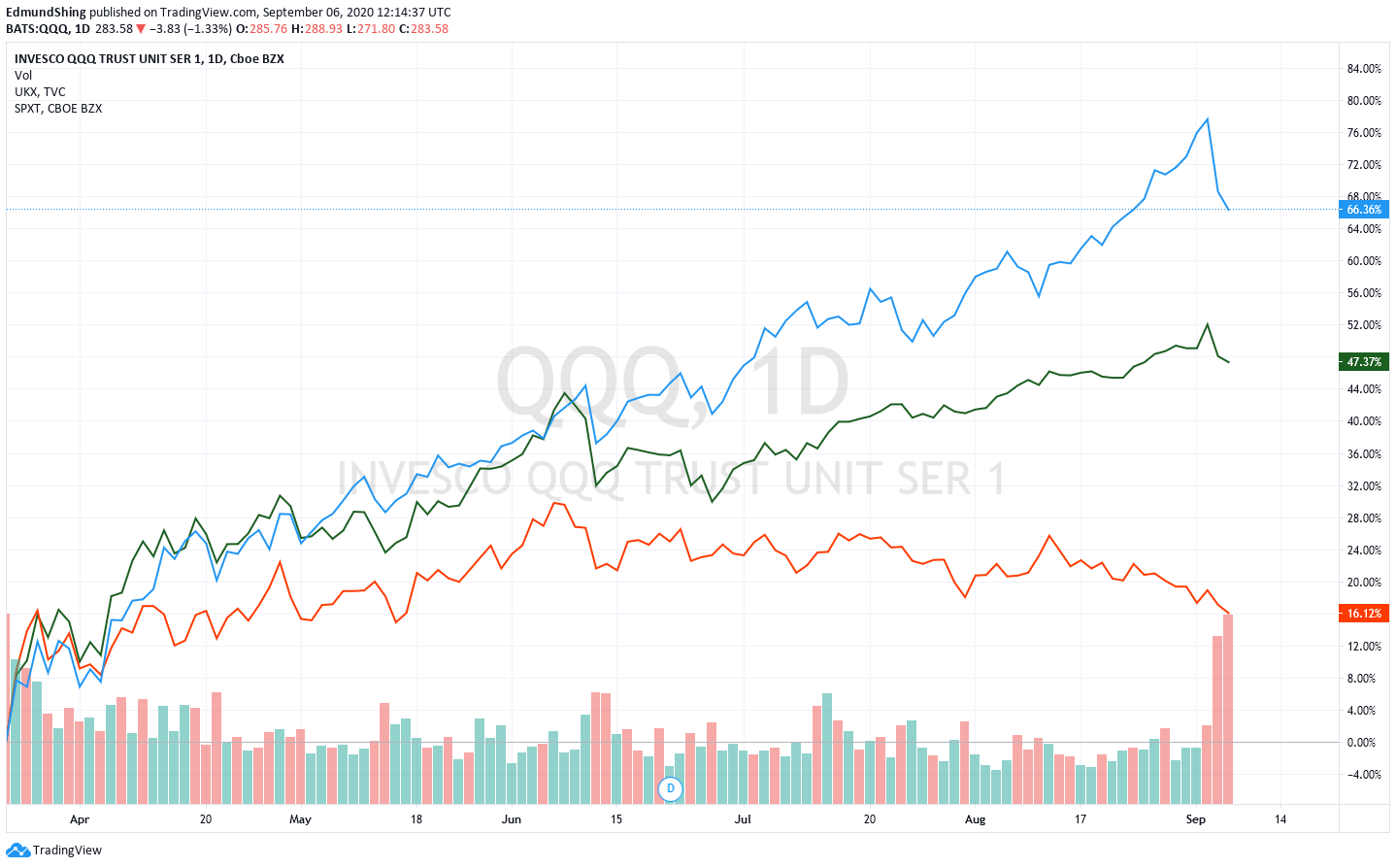
Bear in mind this even after this pull back, the Nasdaq 100 (in blue) has gained 66% since the March market lows, compared with a measly 16% for the FTSE 100 (orange) and 47% for the S&P 500 ex Technology index (green). I think most investors would be ecstatic with a stellar return like that after just over 5 months!
Nasdaq-100 far ahead of S&P and FTSE 100
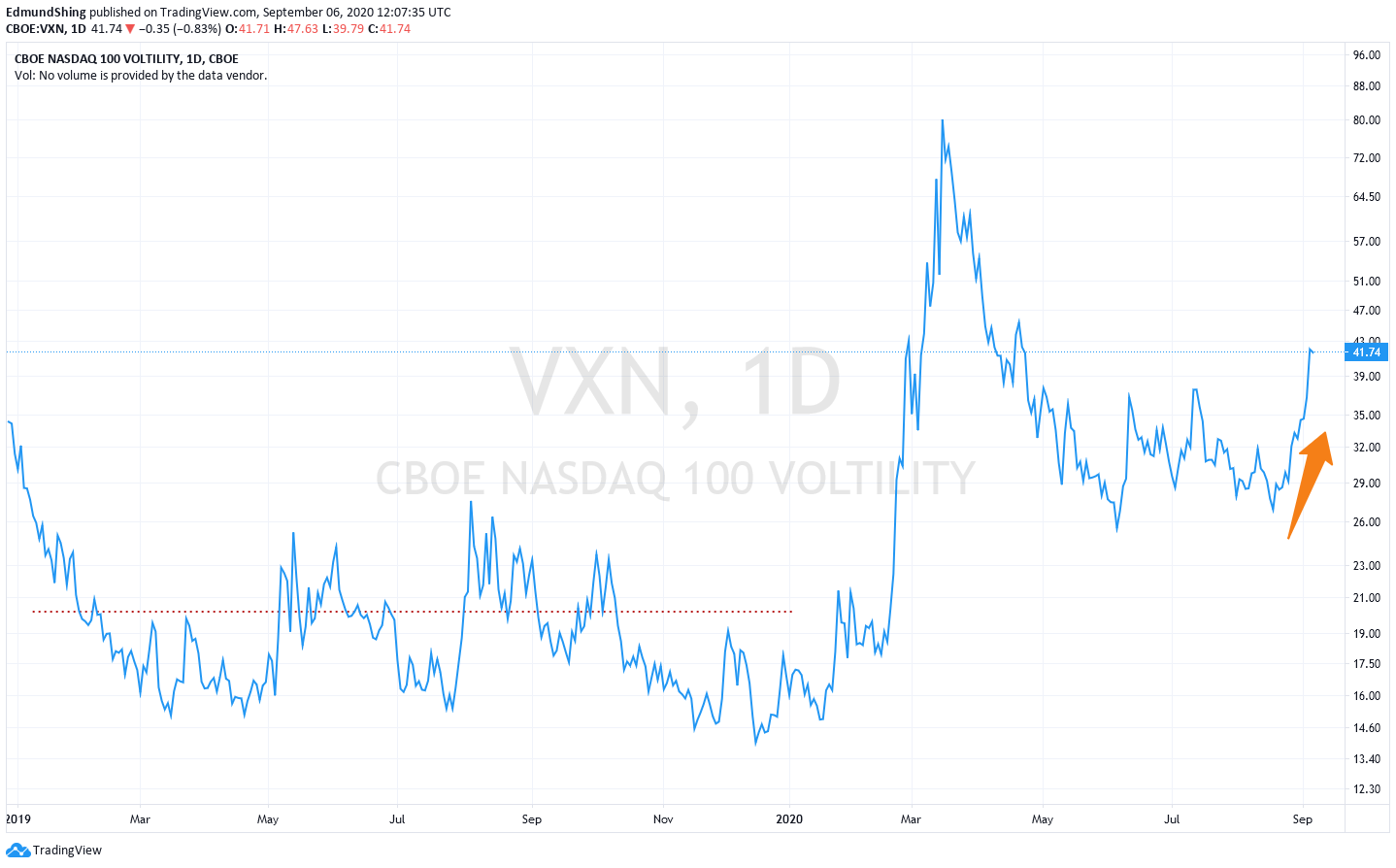
In addition, the Nasdaq implied volatility index, the VXN, had been signalling an expected rise in volatility, as the VXN itself had risen to a high level of 36 (compared with an annual average around 20 for calendar year 2019) even before this latest sell-off.
Nasdaq Volatility VXN has been rising
Lessons from recent(ish) history
For those of you with an investing memory that stretches back at least 20 years, you will no doubt recall another period when the Nasdaq was the standout equity investment globally, namely the late 1990s Tech-Media-Telecom market bubble and bust.
During this period, investors became hugely excited by the prospects for the nascent internet economy, as household internet access and usage of the world wide web really took off with the general public. Yes, it really was only just over 20 years ago!
Many commentators are comparing this current Nasdaq bull market to the late 1990s, which I feel is a little simplistic and actually unfair, even.
Why?
Point 1:
The scale and speed of the Nasdaq’s bull market in the 1990s is actually of a different order to today’s, as can be easily seen from the chart below, where I lined up the performance of the Nasdaq Composite index in the 1990s (ending in the March 2000 market top; in blue) to today’s bull market since 2009 (in green).
Nasdaq Composite: Comparing 1990s to 2009-
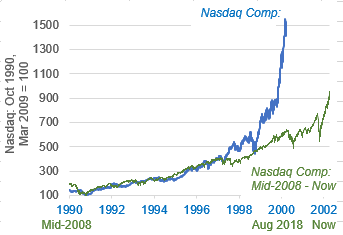
Starting in late 1990, the Nasdaq went up 15 times in 9½ years to its 2000 peak - a compound annual growth rate of 33% over this entire period. Thus far, the Nasdaq has gone up just under 9 times in 11½ years - a CAGR of 21%. Impressive for sure, but nothing like the 33% average posted in the 1990s.
Point 2:We should recall the environment prior to the start of this fantastic Nasdaq bull market. Over the 9 years between March 2000 and March 2009, the Nasdaq Composite lost fully 75% of its value from the peak.
Nasdaq from 2000 peak to 2009 nadir
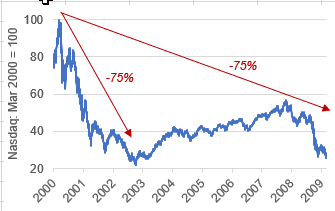
Indeed, it took over 15 years for the Nasdaq to regain its March 2000 level - this only finally occurred in April 2015.
Taken from the March 2000 peak level to today, the Nasdaq has compounded at a far less impressive annual rate of just 4%.
Point 3:Any long-running equity bull market sees periodic pull backs and corrections. In fact this is a healthy process, as it helps to prolong the life of a bull market as it resets expectations somewhat and tempers over-exuberance.
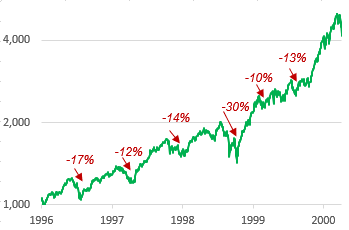
As an example, over the mid- to late-1990s, the Nasdaq actually experienced 6 occasions where it dropped 10% or more prior to its 2000 peak - on average, about once every 8 months over this time span.
Nasdaq suffered 6 corrections between 1996 and 2000
Nothing is certain, but...
Of course, it is perfectly possible that we have seen the peak in this Nasdaq bull market, and that a protracted bear market lies ahead of us. But I would argue that, on the balance of probabilities, that a resumption of the bull market is more likely, given the ongoing recovery in the global economy, the strong profit growth in the large-cap technology names leading this advance, and the lack of attractive investing options in other large asset classes such as government and corporate bonds and cash.
That doesn’t mean that I would rush out to buy into Microsoft, Apple, Amazon, Alphabet or Facebook right now. But equally, I have not given up on investing in technology companies, where I am comfortable with the long-term growth drivers, the valuations and I see robust cash generation.
Back in the late 1990s close to the crescendo in the TMT bubble, investors seemed to have given up on traditional valuation and profitability metrics, and new unprofitable companies were coming to the market in ever-greater numbers. For now, I don’t see a widespread repeat of this phenomenon, although it is true that, like so many other people, I simply do not understand investing phenomena such as Tesla.
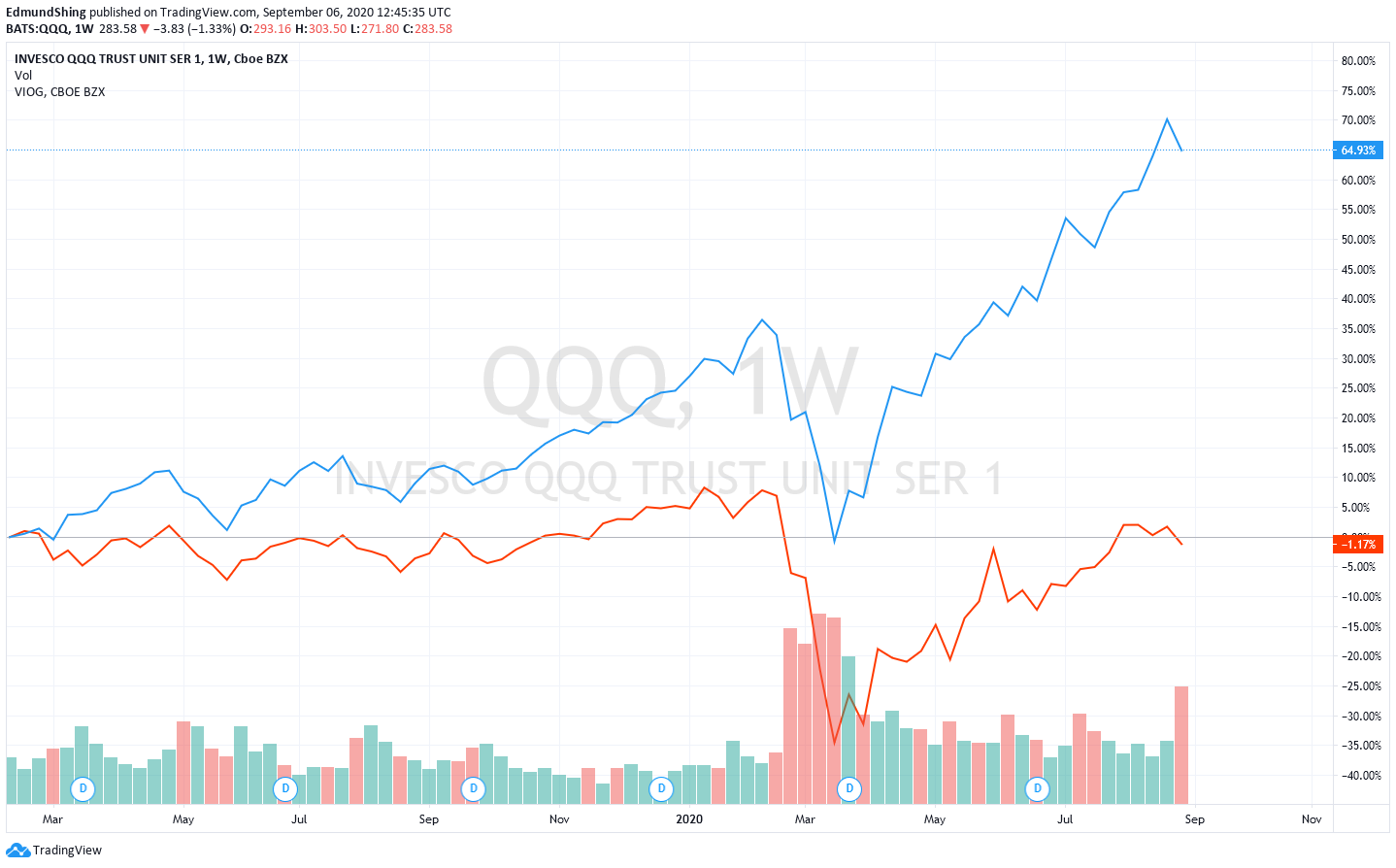
I would suggest that those looking to investing in US growth look more to small-caps as opposed to the mega-cap tech household names that dominate the Nasdaq (and S&P 500) today - just look at the dramatic under-performance of US small-cap growth names (represented here by the VIOG Vanguard Small-Cap Growth ETF) versus the QQQ since the beginning of 2019. There are certainly plenty of areas in the US stock market that have not performed at all like the Nasdaq 100 mega-caps, which might be more worthy of investors’ attention.
US Small-Cap Growth has badly trailed the Nasdaq 100 since 2019
If you are really determined to find a parallel between this Nasdaq bull run and that seen in the 1990s, I would hazard a guess that we are more like mid-1998 or early 1999 right now. So if we were to follow the 1990-2000 Nasdaq script, we could still see the Nasdaq double from here before finally peaking... Food for thought, at any rate.
Have a great week ahead,
Edmund
Disclaimer
This is not financial advice. Our content is intended to be used and must be used for information and education purposes only. Please read our disclaimer and terms and conditions to understand our obligations.
7 comments
Nobody knows of course but I think this move is more about dollar weakness than pound strength. The dollar index is down around 10% over the past few months and I believe that is a reaction to the excessive monetary expansion by the Fed which shows no signs of letting up. There have been murmurings that it’s days as the world’s reserve currency might be numbered. I don’t know whether it will get that extreme but I do believe the dollar index is a better gauge of the trend than the cable rate.
Cheers
Simon
Thanks Edmund. This is quite encouraging for those of us who focus on US stocks. None of us has a crystal ball, but, as you say, on the balance of probabilities is in favour of a continuation of. the bull market, though perhaps with rather lower returns for a month or two as the institutions bide their time to shake out the weaker hands.
Traditionally September is one of the worst months for market returns, and the recent sell-off supports that historical observation.
My thoughts are that the GBP/USD ratio has peaked and the USD will grow stronger, so the currency risk now favours the GBP investor who buys US stocks. If our No Deal Brexit turns out to be a shambles, the GBP could well fall to 1.15 USD.
A comparison of the NASDAQ 100 vs the FTSE 100 is interesting. The NASDAQ has achieved spectacular all time highs recently, whereas the FTSE 100 stands at 5983 compared with 6297 exactly 20 years ago ( a drop of 7.2%) - it is something of a mystery why anyone would want to invest in the FTSE 100 when there is instant access to the US market, or US tracker funds such as £EQQQ and £VUSA.
My strategy during September will be to buy into the US market via the above funds and Scottish Mortgage Investment Trust (LON:SMT), using a dollar average plan to take advantage of further dips in the markets.
I would also add interest rates are lower in this cycle than previous, adding fuel to the fire. Not to mention QE higher. Today's tech giants are also highly cash generative. But some tech stocks are at nose-bleed levels e.g. Zoom Video Communications Inc
Absolutely, there are a number of stocks we can put alongside TSLA in terms of being at difficult-to-understand valuation levels, like Zoom.
But I would certainly agree that today's deeply negative real interest rates (and near-zero nominal interest rates) on offer from long-term bonds are a concrete difference in today's markets versus the 1990s.
One thing also I didn't mention for UK- or Europe-based investors, is that the US dollar bull market may well have already ended, suggesting that currency may become a headwind in future for non-USD investors.
Edmund
Are you saying that you think the US$ will fall more against the £?
I think it already has been a headwind, as has fallen about 18% against the £.
Hi herbie47, with the Brexit negotiations ongoing, anything is still possible re GBP!
But my feeling, despite the usual Johnson bluster, is that a Brexit deal, even a relatively "skinny" one, is preferable to none at all for the UK government, which would I think reinforce the GBP against the USD.
Remember, in the longer term, GBP/USD has gone from peaks of:
2007: $2.12
2014: $1.72
2018: $1.44
recent March low of $1.15
to Now: under $1.32
so there is still big potential for further strengthening of GBP if a Brexit deal is agreed, and the UK economy manages to recover further.
Well it could go either way, plenty can go wrong on either side. Coronavirus cases in the UK are shooting up, yesterday nearly 3,000 new cases. I don't think the £ will go up much more, in fact I think it will drift down to around 1.30