Market Musings 081022: Energy is a strong point in a weak market tape

Market Musings 081022:
Energy remains a strong point in a weak market tape
OPEC+ put a floor under global crude oil prices.
This week’s podcast:
Is the incredible growth in ETF popularity justified?
- What is an ETF and why is it so attractive?
- What are passive and active funds?
- With so many ETFs on the market, how can investors know which ones to choose?
- How do ETFs ensure that temporary cash is put to good use?
- Are there any downsides to ETFs?
Summary:
- Crude oil prices rebound higher…
- As the OPEC+ oil-producing nations announce a 2 million barrel/day production cut
- The US will also have to stop releasing their Strategic Petroleum Reserve soon
- Chinese oil demand could rebound upon progressive economic reopening
- These supply and demand factors suggest higher oil prices
- A lot more investment will be needed for the energy transition
The path of least resistance for oil prices is... Higher
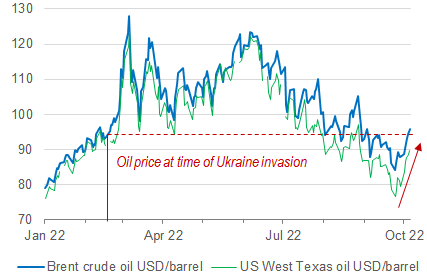
Crude oil prices have been drifting lower since peaking in early June at over USD120/barrel. They recently even fell to below where oil prices were prior to the Russian invasion of Ukraine in late February. Financial markets have been concerned about global recession risks and the consequent pressure on oil demand.
Crude oil prices rally on news of OPEC+ production cut
Source:Bloomberg
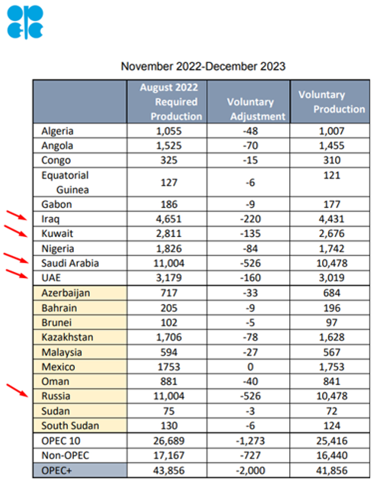
However, the OPEC+ oil cartel has changed this dynamic with their announcement this past Thursday at their Vienna meeting of a 2 million barrel/day oil production cut. This reduction in oil production is to take place gradually between November this year and the end of 2023. In the table shown here, note that the key oil-producing countries to cut production will be principally Saudi Arabia, Russia, the UAE and Iraq.
OPEC+ oil cartel announced a deep 2 million barrels/day production cut
Source: OPEC
Even though this announcement is somewhat of an exaggeration given that many OPEC+ members are already today NOT producing to their current oil quotas, the reduction in real oil production is still likely to be around 0.8m-1.0m barrels/day, still nearly 1% of global daily oil demand.
The US will stop their crude oil release of stocks from the SPR soon
Following the OPEC+ production cut announcement, President Biden on Wednesday said he would release 10 million more barrels of oil from the U.S. Strategic Petroleum Reserve (SPR) in November in a move to counter raising gas prices again.
The release of roughly 180 million barrels of oil from the U.S. petroleum reserves was expected to end Oct. 31. U.S. emergency oil stocks are already at the lowest level since 1984, with just 416.4 million barrels last week.
The US Strategic Petroleum Reserve has dropped to 416 million barrels from a peak of over 700m barrels

Source: US EIA
US gasoline prices have pulled back nearly 25% since peaking at just over $5/gallon in mid-June, now sitting at $3.90/gallon, in part due to the efforts of the Biden administration to release these crude oil stocks to lower the US crude oil price.
In 1 gallon of US unleaded petrol, about 57% of the cost is driven by the underlying price of US crude oil, while taxes total around 13% of the end price (a far lower tax burden than here in Europe).
US gasoline price has pulled back from over $5 to $3.90/gallon

Source: Ycharts
While the Biden administration could conceivably continue to release further stocks from the SPR, it will at some point soon have to stop - and perhaps even look to restock this reserve, potentially adding to global oil demand!
Chinese oil demand could rebound on softening of their zero COVID policy
The Chinese Communist Party is about to hold their Party Congress in the next few days. There is a high probability that their current zero COVID policy will be modified following the Congress, to allow for progressive reopening of China and for stronger domestic economic growth. This in turn should allow Chinese energy demand to recover, in particular their demand for oil products.
Thus over the next few months, we could well see a situation where global oil supply declines, and global oil demand increases.
Conclusion: absent a deep global recession, the omens favour higher oil prices
Adding together these various global supply and demand factors for oil, I would suggest that the path of least resistance for oil prices is higher rather than lower. In the past, it has required a deep global recession (as in 2020 during lockdowns or during 2008 in the Global Financial Crisis) to see even a temporary dip in global oil demand.
A lot more investment will be needed for the energy transition
Finally, from this last chart below, note that in 2021 the world used more coal, oil and gas than ever before. Coal consumption is likely to hit a new record this year and again next year, as global energy consumption continues to rise and natural gas supplies remain pressured.
A long way still to go in the global energy transition…

Source: Our World in Data
We can see therefore that we still have a long way to go in the energy transition journey, despite rapid expansion of renewable energy generation infrastructure.
Investment conclusion
Oil & gas producing companies remain in a relatively sweet spot despite the pressure on global stock markets. They are very cheap, offer solid dividend yields backed by high free cash flow generation, and are cutting debt quickly and are even able to conduct share buybacks to return more cash to shareholders.
I would lean more towards oil exploration and production companies as opposed to integrated oil majors like Exxon or Shell, as the benefit from higher oil prices on profits will likely be partly offset by lower refining margins and pressure on chemicals businesses from high oil prices and lower demand.
If we look at 3-2-1 crack spreads as a proxy for oil major refining margins, we can observe that they remain higher than average, but substantially lower than their mid-June peak.
3-2-1 crack spreads (proxy for refining margins) have fallen from peak

Source: Energy Stock Channel
In addition, I would lean more towards exposure to US and Canadian oil and gas companies, given their relatively lower tax burden and strong position in growing oil and gas production. Remember: the US is now a bigger natural gas supplier to Europe via Liquefied Natural Gas than Russia is, today.
ETFs one might consider include £SPOG , the iShares Oil & Gas Exploration & Production UCITS ETF.
Top US oil & gas company holdings in SPOG

Source: iShares
For more diversified global exposure to the Oil & Gas sector, there is also £WENS , the iShares MSCI World Energy UCITS sector ETF. This contains exposure to the “seven sisters” the 7 largest Western integrated oil & gas companies including Exxon, Chevron, TotalEnergies, BP and Shell.
Top global oil & gas company holdings in WENS

Source: iShares
Have a great week
Edmund
Disclaimer
This is not financial advice. Our content is intended to be used and must be used for information and education purposes only. Please read our disclaimer and terms and conditions to understand our obligations.
4 comments
There is deep value to be found in the unloved oil and gas equipment and services sector. The ETF XES covers this well and pays a small dividend. Tubular steel required for the petrochemicals industry is another unloved area, see French company Vallourec, massive upside potential and only a few companies in the entire sector. Same argument for the geological geophysical businesses.
If you believe prices are going up why not play it more directly via something like Wisdom Tree ETF £LOIL ? Leveraged play on oil price. Higher risk, highly correlated to price though with trader sentiment risk on top perhaps?
And if you think prices are too high you can play it the other way with the appropriately titled £SOIL !
Hi
Nice write up, many thanks.
I would add £IESU to your options as this ETF focuses specifically on the US energy sector with the Oil & gas suppliers featuring prominently.
EDIT: the £ thing not worked ... ISHARES V PLC S&P 500 ENERGY SECTOR UCITS GBP ACC (IESU)
I bought a small entry position recently.
Regards
Howard
Anyone holding or buying into £SPOG at the height of the Covid sell-off (or even in Oct) will have made a fantastic return - up to a 5-bagger.
I can see the attraction of £SPOG and others, but I'd be concerned with them at this price, that the slightest bit of bad news would lead to a significant price shock. For example, a definitive move towards a recession could create a major demand decline, or a signal of an end to the Ukraine war.
For me this is too much of a risk - I've been caught out too many times in the past by the "greed gene" and found that joining the party late often results in someone calling time just after arriving and being booted out into the cold, wet and dreary dark, with a long-walk home with tail tucked between legs.
I do hold plenty of exposure to O&G, but I've held these for a while and with most of them I hold them as much for the potential of major news around new resources as much for their short-term profits which at some time will normalise. I have also sold some off, protecting some of my gains.
If I was looking at this now, without any holdings, I'd be a little bit fearful of buying at the peak.