Market Musings 09/04/22: Security is the New Watchword

Market Musings 09/04/22:
Security is the New Watchword
Podcasts that might interest you:
ARE OIL PRICES SPIRALLING OUT OF CONTROL?
- Are we heading towards $200 for a barrel of oil?
- Will higher oil prices lead to a global recession?
- Are the IEA’s proposals to cut global oil demand feasible?
- What about alternative energy sources?
- How can investors play this space?
Also available in Apple Podcasts, Podcast Addict, Spotify podcast platforms
(search for “BNP Paribas Wealth”)
Weekly Summary:
- The New World: Forget the last 20 years!
- Lowflation is now a trend of the past
- All about energy, food, and raw materials security
- Technology security: Chip production, cybersecurity
- How to invest in this new strategic assets theme
- Idea; of the Week: APF Anglo-Pacific, commodity royalty company
1. The New World: Forget the last 20 years!
In a little over two years since the beginning of 2020, I would say that the world has changed structurally, firstly with the impact of the global COVID-19 pandemic, and now with the conflict in Ukraine.
These global shocks have triggered a shift in economic and political tectonic plates across the globe. The result is that new long-term structural trends have been set into motion, or at least given a huge boost.
What are these new long-term global trends that I speak of? I am thinking of the following trends (not an exhaustive list):
- A shift away from globalisation trends in manufacturing and production, back towards relocalisation and near-shoring of this economic activity, with a determination to reinforce the robustness of supply chains of goods and components in the face of current COVID-related supply chain disruptions.
- Renewed focus on energy security, in terms of electricity production from alternative energy sources, securing fossil fuel supplies and acceleration of investment in energy transition away from geopolitically-vulnerable and high carbon-emitting oil, gas and coal towards more geopolitically secure, low carbon sources of energy including renewables, biomass and nuclear. Linked to this is a renewed focus on energy efficiency, as it is far easier and more productive to reduce our energy usage than to find alternative ways to generate this energy.
- Focus on food and water security. The current lack of formerly bountiful grain- and seed-based food exports and also of potassium- and nitrogen-based fertilisers from Central and Eastern Europe has led to a surge in global food prices. This, together with elevated energy prices, increases political uncertainty given the essential nature of food and energy, particularly in developing economies. The world had become used to ever-cheaper food prices, but this trend has now dramatically reversed.
- Securing communication and the internet:aside from food and energy, the most essential service today in the developed world is communication and the flow of information via the internet. Thus security of this vital global information network has become paramount, pushing cybersecurity into the spotlight as a fast-growing priority for companies and governments alike.
- Securing strategic technologies: our daily lives are powered like never before by key technologies embedded in the semiconductor and software industries.
2. Lowflation is now a trend of the past
The very low inflation rates observed in the US and Europe since 2008 have been replaced by surging inflation of the type not seen since the 1970-80s, fuelled by a combination of surging commodity prices and higher good prices resulting from ongoing supply chain disruptions.
While the supply chain disruptions should eventually ease, allowing this source of goods inflation to decline, we will be still left with a combination of inflationary pressures from high commodity prices and rising wage pressures, particularly in the US and UK.
Deflationary commodity prices have been replaced by a new commodity supercycle: commodity markets historically have been marked by long periods of stagnation or even outright deflation, punctuated by brief periods of huge moves higher (as in 2009-11).
After a relatively long period of energy, food and metals price deflation from 2011 until 2020, we are now confronted with a new commodity bull market, extending from energy to industrial metals to foodstuffs.
CRB commodity index was deflationary 2011-2020, but is now surging

Source: CRB
The drivers of this bull market are twofold: on the demand side, there has been a sharp increase in demand as the global economy has recovered quickly from COVID-related lockdowns, which put a break on economic activity.
On the supply side, there is a combination of very low inventories of crude oil, industrial metals and a range of foodstuffs, combined with long-term underinvestment in new production and now the inevitable disruption to commodities supply from Russia and Ukraine.
London Metals Exchange Industrial Metals Inventories at very low levels
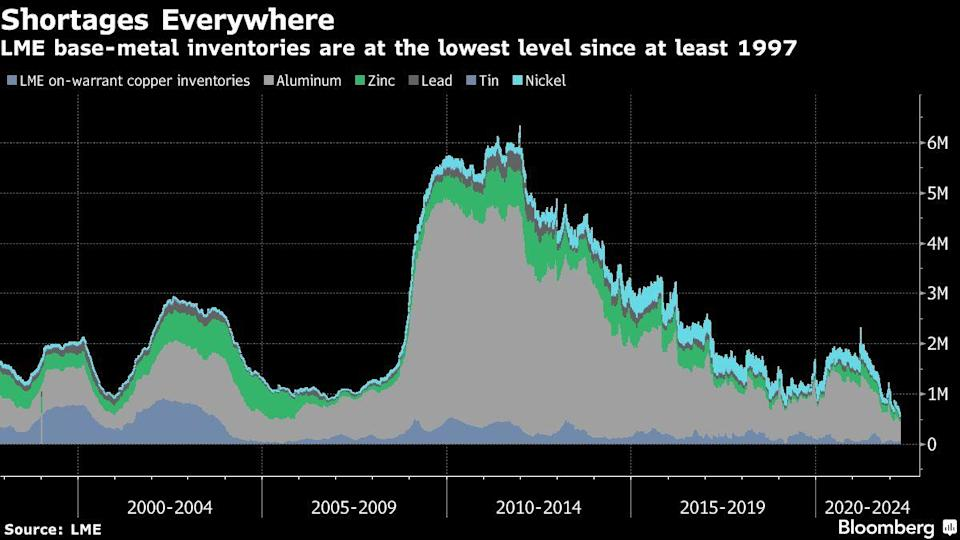
Source: LME, Bloomberg
Over the last 12 months, there have been some extreme movements in a range of commodities:
- Brent crude oil +69%
- Aluminium +62%
- Cotton +75%
- Sugar +31%
- Wheat +67%
Wages in a number of economies with tight labour markets (e.g. US, UK) are surging as a result of low unemployment rates and the desire of workers to maintain their purchasing power in the face of high headline inflation rates.
Wage growth of 6.5% y/y for hourly-paid US workers

Source: Atlanta Fed
3. All about energy, food, and raw materials security
Europe is a prime example of the shift in priorities, away from securing relatively cheap natural gas supplies from Russia towards the pressing need today to secure alternative sources of natural gas and other energy supplies as quickly as possible, so as to secure energy security and to reduce the need for Russian gas. Germany, Netherlands and Italy are three EU countries heavily reliant today on Russian gas supplies both for heating and also for electricity production.
2021 German power production: 44% from fossil fuels

Source: Clean Energy Wire
Whether this is achieved by switching where possible to liquefied natural gas cargoes from Qatar or the US, or by switching electricity generation away from natural gas more to renewables, nuclear power and of course renewable energy, this new energy security priority will be expensive to achieve.
As regards food security, the developed world had enjoyed a productivity boom in agriculture and farming, allowing food prices to decline steadily from 1980 to 2003, and again from 2011 to 2020.
Sharp rise in the UN FAO food index, driven by cereals and vegetable oil prices

Source: FAO
But today, we are faced with a sharp acceleration in food prices (+33% year-on-year in March 2022) of the sort seen from 1973 to 1981 and again from 2003 to 2011. We have already started to see the political ramifications of the surge in food and energy prices in the civil unrest in Peru, and are unfortunately likely to see more evidence of similar unrest elsewhere in the developing world, should prices remain so high and continue to put huge pressure on household budgets.
Clearly, huge investment is now required to increase the supply/production of energy, food and other raw materials, but this will take time. For the foreseeable future, these elevated commodity prices look to be here to stay, until and unless we see heavy demand destruction as people react to these high prices by changing their behaviour (people electing not to drive their cars or fly in aeroplanes due to the higher cost, for instance).
4. Technology security: Chip production, cybersecurity
We are similarly likely to see sharply increased investment in particular areas of technology, notably semiconductor production and also cybersecurity. Up to now, the key foundation of today’s technology, semiconductor chips for processing, memory, storage and sensors, have been largely produced in the Far East (e.g. South Korea, Taiwan). This new emphasis on national security is likely to trigger the construction of new semiconductor chip production in the US and Europe, so as to secure supply in this strategic industry.
Taiwan, South Korea, Japan and China dominate global semiconductor production

Source: ESIA
5. How to invest in this new strategic assets theme
There are a number of sub themes that one can invest in according to this new strategic assets mega-theme:
- Energy security: Energy efficiency, renewable and biomass energy generation, battery metals and energy storage, hydrogen power, oil & gas infrastructure, oil & gas exploration & production, uranium/nuclear power; SDCL Energy Effiency Trust (SEIT), Aquila Energy Efficiency Trust (AEET), L&G Hydrogen ETF (HTWO), L&g Battery Value-chain Go Ucits Etf (BATG) , iShares Oil Exploration & Production ETF (SPOG), Invesco Morningstar US Energy Infrastructure ETF (MLPP), Geiger Counter (LON:GCL)
- Food security: funds that invest in solutions to combat malnutrition, via more effective water irrigation, fertilisers and technologies to boost crop yields, better food transport to avoid waste on the road to market and to the consumer, companies that combat food waste. iShares Agribusiness ETF (SPAG), Rize Future of Sustainable Food ETF (FOGB)
- Metals and mining companies: companies in secure jurisdictions that produce the essential industrial and battery metals required to accelerate the low carbon/energy transition, including producers and recyclers of copper, tin, aluminium, nickel, silver and lithium. Blackrock World Mining Trust (BRWM), VanEck Global Miners ETF (GIGB)
- Technology security: Semiconductor and cybersecurity companies, satellite technology and networks. VanEck Semiconductor ETF (SMGB), L&G Cybersecurityt ETF (ISPY)
6. Idea of the week: Anglo Pacific
Anglo Pacific (LON:APF)
Commodity royalty company: commodities, income gth
Mkt cap £380m
Price 180p
- Theme: inflation hedge = renewable energy demand for battery metals, precious metals, uranium/nuclear, coal exposure (short-term)

- Royalty company attractions: exposed to revenues from commodities without the risk of cost increases. Just exposed to commodities revenue x commodities price

- Commodity exposure: 15 royalty and streaming-related assets providing diversified commodity exposure: cobalt, nickel, uranium, vanadium, copper, pms, iron ore, coking coal
- Geographic Exposure: 99% of APF’s portfolio is located in well-established mining jurisdictions - Australia, Brazil, Canada, Chile.


- Commodity prices rise: cobalt +58% y/y (50% of portfolio exposure now), coking coal +252% y/y, uranium +89%, vanadium +85%, nickel +96%, copper +16%. Commodity basket +43% year to date!
- Strong growth: EPS growth ahead from ramping up of recent acquisitions to full production, Dec-21 +60% v Dec-20. Net asset growth +20% y/y. Cheap at < 9x PE 22e
- 22e dividend yield 4.5%. Expect boost to equity value from deleveraging post recent acquisitions.


Conclusion: Low risk growth exposure to battery/energy transition metals + uranium, boosted by commodity price supercycle
Bonne semaine,
Edmund
Disclaimer
This is not financial advice. Our content is intended to be used and must be used for information and education purposes only. Please read our disclaimer and terms and conditions to understand our obligations.
8 comments
This hasn't aged well. Anglo Pacific/Ecora - a low risk growth play - how to lose 50% of your investment. Well done.
Arthur T:
Yes so true!!
Saying that, few people on the discussion board seem interested in coal. Even now you can get >>20% dividend returns on coal companies.
Link
excellent research
High inflation is here to stay for a while, whatever the immediate triggers/excuses, increasing the total M1 money supply by 33% since the start of Covid inevitably has to have an impact on the value of the pound in your pocket.
Brilliant post Edmund……..lots of very insightful thinking and investing ideas
Very interesting and thought provoking. Thank you for the effort and thought that went into delivering these insights.
I try to invest on a strategic basis. I feel my ability to pick individual winners, whether among the large or small companies market segments, is very limited. Accordingly, I try to take up diversified positions in sectors that I believe have good strategic potential based on longer-term trends and shifts in the global economy.
Edmund's approach is highly informative in supporting this style of investing. It is particularly helpful that, in addition to outlining his strategic thinking around general market prospects, Edmund suggests specific investment ideas that might be worthy of further consideration.
Exceptionally well thought out and researched information. Thank you.
Very helpful perspective - thank you.