Market Musings 130221: Is Black Gold Back in Vogue?

Is Black Gold Back in Vogue?
Summary:
- Retail Revenge of the FAANGs: Can it last?
- Why I am so keen on Semiconductors
- Identifying the characteristics of a commodity super-cycle
- Industrial Metals: Copper and Tin
- Unfashionable oil to make an unlikely comeback?
The FAANGs Bite Back
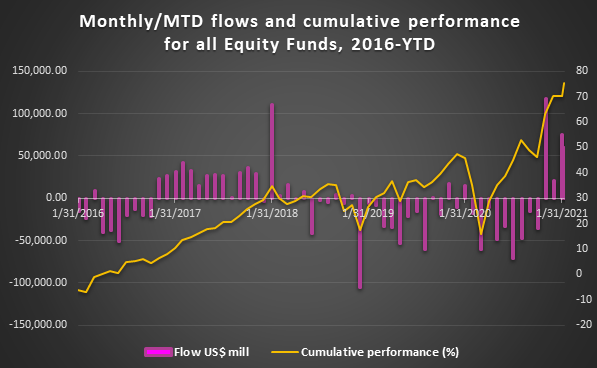
So I was wrong in saying that big tech in the US was at risk of a correction. At least so far. What is quite clear is that I have underestimated the power of the retail investor, at least in the short term. If we look at equity fund flows over the last month they've been incredibly strong.
EPFR reports strong flows into equity funds last week
Source: EPFR
According to EPFR, global equity funds have seen something like $58 billion of net inflows over the last week, which is one of the highest levels of inflows seen in many, many years. This may well highlight the euphoria that is starting to develop amongst retail investors. The same euphoria that I've previously pointed out exists also in other areas of financial markets, including cryptocurrency, SPACs, IPOs and hydrogen stocks.
However, there is a great phrase uttered in the last cycle (2007) by Chuck Prince, who was then CEO of the American bank Citigroup. He basically said that: “As long as the music is playing, you’ve got to get up and dance”. That's a little bit how I feel today. Yes, there are signs of over exuberance and euphoria creeping into different corners of the financial markets. But this trend is likely to continue, so long as central banks and governments continue to support the economy by flooding it with liquidity and spending.
This could be added to in the weeks and months to come, should the current lockdowns and restrictions related to COVID be progressively lifted, and allow households to finally spend some of that extra cash that they've been saving up. Recall that in the US, households have saved an excess of $1.5 trillion in their bank accounts over the last few months. Some of this money will be spent. Some of it will probably be invested. And when it is invested some of it is likely to make its way to the stock market, given how unattractive various areas of the bond market appear today at ultra low yields.
Note, for instance, that globally, something like 40% of all government bonds trade at negative yields, which is a pretty much a record high. 75% of all bonds offer a yield of under 1% globally, making government and corporate bonds unattractive by historical standards.
75% of all government, municipal + corporate bonds yield under 1%

Source: Deutsche Bank
As a result, it is unsurprising to see that investors looking to invest their cash opt for the stock market. Of course, the other area that they have been opting for that they will continue to opt for, in my view, is the property market. Unlike stocks, property is a real asset that you can touch and feel. And for a certain class of investor, potentially those who've been already burned by the stock market in the market crashes that followed 2000 and 2007, that makes more sense today, to invest in bricks and mortar than in these ethereal stocks and shares.
Steady rise in European house prices since 2014

Source: Eurostat
I think we see quite a large divide in the retail investor space, however, between:
- Older “boomers” on the one hand, who will prefer property because they've been burned over the last 20 years by stocks, and on the other hand,
- the millennials who are 30- and 40-something year olds who have only investing over the last few years and have enjoyed more than 10 years of a booming stock market, and thus continue to invest in stocks.
Talking of these millennial investors, Big Tech stocks remain the order of the day, looking at the performance of the FAANG index. While we could argue that US stocks, and Big Tech, in particular, are overvalued, this does not seem to bother millennial investors for the moment.
FAANG stocks outstrip global stocks, again...

Source: tradingview.com
And that's why we see tech and growth funds continuing to attract investor inflows. My personal feeling is that this will not last forever.
Note that the largest companies at the beginning of any decade in the US S&P 500 index tend not to be the largest companies in the same index 10 years later. Right now, technology companies dominate the top of the S&P 500 rankings. I am less confident that these names will be the same names in 10 years time in the past, judging from history. The only tech name to have appeared several times in this top 10 list over decades is Microsoft in fact.
Largest S&P 500 stocks in 1990, 2000, 2010, Today…


Source: etfdb.com, Vanguard
Of the 3 tech companies that featured in the Top 10 at the height of the last tech bubble in 2000, neither Cisco nor Intel make it anywhere near the top 10 this time around.
But momentum investors will continue to invest in tech, because that's where the money flows are for now. And to be fair, the recent quarterly results of these big tech names like Microsoft, Apple and Amazon have in general been outstanding. So there is some fundamental basis, at least in the short term for buying these stocks, even if valuations are somewhat stretched.
My focus within technology continues to be on the semiconductor sector. I consider the semiconductor sector to be the basis for the new Artificial Intelligence, 5G/Internet of Things, and electric vehicle ecosystems - in the same way that ball bearing makers were the foundation for the industrial growth post war as we used more and more electric motors, for instance. Today, those basic building components of the information economy are silicon chips.
Note, as well, that we see increasing reports of chip shortages appearing in many areas of the supply chains for industries such as auto makers. There simply aren't enough chips to go round. Just look at how China has been hoovering up semiconductor chip supply from its South-East Asian neighbours over the last 3 years. That suggests to me the existence of structural growth ahead in the semiconductor industry. I still believe that there are opportunities here, as we implement more artificial intelligence algorithms, applications and software.
China is importing more and more semiconductor chips

Source: Chinese government, Bloomberg
With 5G mobile internet now becoming a reality, we have exciting times ahead. I think the information revolution is far, far from over. I find it difficult to pick the winners of the various tech sub-sectors, but I would certainly concentrate on semiconductors.
If there is one other area within technology that I'm still convinced about in terms of structural growth over the long term, it is cybersecurity, because the threats to companies and to individuals in terms of the security of their sensitive data and of their digital identities are only growing. That requires more investment in cybersecurity to keep those companies and individuals secure from hackers and from data breaches. Given that the fines levied by national regulators for these data breaches gets bigger and bigger, it is clear that companies, as well as individuals, need to invest more and more in this area going forward.
For cyber security, there are a number of ETFs available, such as those available from LGIM, amongst others.
One last point, for which I should thank Wilkonz for pointing out is that there is now, finally, a UCITS ETF available for the semiconductor sector issued by Van Eck. In the past there was only a US-listed ETF available, SMH. But now you can buy the same ETF, but in UCITS form in Europe, and you can even buy it in pounds sterling.
A New Commodity Supercycle?
How do we know when we are seeing a new supercycle in commodities question. Well, there are a number of characteristics we can identify.
Firstly, economic growth and recovery, which drives greater demand for a number of commodities. The global economy is predicted by the IMF to grow 5.5% in 2021, a strong rebound from 2020.
Secondly, a long bear market in commodity prices, which precedes an upturn. Commodities as a whole have been falling since 2008, punctuated by several bear market rallies.
CRB Commodity index less than half its 2008 peak

Source: tradingeconomics.com
Because, thirdly, this drives a lack of investment as companies simply have not been incentivized to invest in new mining or extraction capabilities. This leads to pressure on supply as demand grows.
Mining capital spending in decline since 2012

Source: S&P Global Market Intelligence
In turn, this leads to very low inventories of commodities, such as we are seeing today in copper and tin.
LME copper inventories at 5 year lows

Source: Kitco
And finally, the clinching argument is structural demand for commodities coming from a new area, over and above cyclical economic recovery.
So if we look today how many of these boxes do we tick? Well, I think the answer is, all of them. Firstly, the commodity bear market has been in place for over 10 years depending on which commodity you look at prices across the board have fallen precipitously, as you can see from the CRB Commodity Index. Secondly, we've seen huge drops in investment in a number of extraction industries, whether it be industrial metals, coal, oil & gas or precious metals.
In each case, we've seen the amount of investment for new production falling precipitously. Companies have cut capex and have increasingly run themselves for cash in the shorter term in these sectors. And as a result, we've seen very little new capacity, being added, for instance in oil and gas industrial metals or precious metals.
In addition, particularly in the industrial metals segment, we have seen huge consolidation of the quoted sector, forming large diversified miners, such as Rio Tinto, Anglo American and BHP. In a sense, this allows the formation of oligopolies across a range of commodities. As a result, on the demand side, we clearly see strong economic recovery, hardly surprising, given a huge drop in economic activity, thanks to the coronavirus crisis and the lockdowns that followed.
I think the risk here is that we see a sharper recovery in demand than even the most optimistic, economists are forecasting right now. The release of pent-up consumption could be huge. Difficult to forecast, but it could be a very big increase in demand resulting for commodities, particularly from areas such as cars. Not to mention any resumption of travel, as people want to finally go on holiday. This is an area that could be enabled, of course by the increasing level of vaccinations.
Finally structural demand growth can come from renewable energy infrastructure demand. We know that the US and Europe are investing in more renewable energy infrastructure, going more green via solar energy, wind power and potentially also both biomass and hydrogen. This drives demand for industrial metals such as in particular, copper, aluminium and tin. To add to this, the growth in demand for electric vehicles will drive demand for these very same metals again. So the ESG or sustainability revolution that we're seeing is bizarrely very positive for these commodities.
Metals most affected by new technology

Source: Rio Tinto/MIT
We know, given the lack of investment over the past few years, that even worse pressures on supply are ahead. Even if mining companies were to invest today in greater amounts, it would still take 2, 3 or 4 years at least for that new investment to translate into increased supply from new mines.
So, ultimately, we have a perfect storm in a positive sense, in my view, for a whole range of commodities, precious metals, including silver and platinum in particular because they have industrial demand, industrial metals as I've already mentioned, and even potentially oil and gas, despite the fact that they're not ticking, the sustainability box.
On the industrial metals, check out again, the graphs for copper and tin, which are particularly bullish. Copper continues to move up, and is used very widely in electronics construction, and also renewable energy.
Tin is used in a number of alloys, but also particularly for soldering. So again, very widely used in electronics, which of course, then enters into not only chips, but also into anything to do with renewable energy and electronics.
Note that the tin price is up to the highest level since 2014, so a seven year high already. And it looks potentially set to go further. Note that inventory levels for copper nickel and tin are at very low historic levels, highlighting how demand has been outstripping supply for these commodities over the last few months.
Tin price reaches highest level since 2014

Source: tradingeconomics.com
The Contrarian Call: Oil & Gas stocks
As you can imagine, this is why I retain my bullish conviction on a range of commodities, not just for now, but for the next few years, potentially controversially, the commodity I'm starting to look at more and more now is crude oil. This, given the sharp moves that we've seen in Brent crude touching $62 per barrel of late, which is higher than I would have expected.
We seem to see relatively strong compliance with quotas from the OPEC+ countries, which control as you remember around 40% of the world's oil supply. And we don't see very much evidence at least yet of increased supply from shale oil producers in the US. And all the time, demand seems to be increasing indirectly, for instance, note that the price of second-hand cars has soared in the US, and I would believe in Europe as well as people choose to buy second-hand cars to get to work, as opposed to taking public transport, because of COVID.
If more people are going to be driving, particularly over the summer, particularly when they go on holiday, that then suggests that demand for petrol and diesel is going to continue to grow over the next six months. My intuition is that people are so fed up of lockdowns and being stuck at home, that they will relish any opportunity to take a holiday as soon as they are able. The likelihood is, it will still be difficult to travel abroad by plane this summer. So, an easier option may be to take the car and drive somewhere, ultimately driving extra demand for oil products.
So I am looking at oil companies - perhaps not so much big oil, but some of the smaller oil producers that are perhaps more geared to the oil price.
US Oil Explorer & Production ETF starts to follow Brent higher

Source: tradingview.com
Bonne semaine,
Edmund
Disclaimer
This is not financial advice. Our content is intended to be used and must be used for information and education purposes only. Please read our disclaimer and terms and conditions to understand our obligations.
24 comments
Excellent summary of the assets currently in demand. A big risk to investing in select companies is the capital raises at big discounts. As we have seen lately with banacora and horizonte. Maybe ETF's are a better way to play this theme?
Oil. A dirty word to some and certainly a dirty word to many investors in recent years (Including me). However, it’s not only the price of oil that impacts oil companies. Faced with a collapse in oil prices, the price of WTI even went negative for a short time last year, oil companies have heavily invested in new technology. They are generally leaner and more efficient than ever. Moreover, many are moving from “Big Oil” to “Big Energy”. And have the know-how to combine commercial savvy with engineering skills.
The broad impression I have is that most Governments are primarily concerned with the reliability of energy supplies rather than the price (At least within certain parameters). Large oil companies have a reputation for delivering major projects on time and to budget. For example, BP has partnered with DiDi in China to roll-out electric vehicle charging stations. The latter may be unheard of in the West but has some 135 million users in China. The complexities, scale and strategic importance of such projects lend itself to oil majors. While they look set to benefit from a chronic lack of oil exploration (Ironically due to low oil prices). The relatively cheap oil coming out of the ground is not being replaced at the same rate by more cheap oil. What remains is often difficult to extract. From an investor’s perspective, the oil sector may go in the same broad direction as tobacco - good for established players (And their investors) but not worth new entrants getting involved, at least not on a large scale. For BP that means a clear commitment to a quarterly dividend of 5.25¢ and share buybacks.
Oil appears to be on the way out. But, in my opinion, that time frame is long. It requires replacing some 1.4 billion cars, currently using internal combustion engines. As well as replacing and redesigning the global fleet of planes and ships. That doesn’t even go near the use of petroleum in the plastics industry. Or the entire defence sector - tanks, jets, etc.
For the moment, in terms of energy density, oil gives a lot of bang for the space it uses compared to batteries. Electric vehicles also appear to have range issues in extremely cold weather. As it happens, I think engineers will overcome both problems but, again, it’s a question of time. Large oil companies are adapting - they have no choice.
And, yes, I am an investor in BP (LON:BP.)
With regards to the wider commodity market, I generally don't try and buy individual miners or producers. I've opted for for long dated options via the iShares S&P GSCI Commodity Indexed Trust, this covers a the broader market and saves me valuable time trying to research various companies.
Whilst I'm happy with this choice it does irk me as I don't get the benefit of dividends if I was to opt for some of the individual commodity companies. Can anyone suggest a fund, etf... vehicle where it's possible to gain exposure to the commodity bull market and benefit with some income as well?
Many thanks
Phil
Blackrock World Mining Trust (LON:BRWM) pays a dividend of around 4% and gives diversified exposure to world mining.
Thanks Wilkonz, funny that came out to be my number one choice having read up on various options last night. My iShares S&P GSCI Commodity Indexed Trust is a bit heavily weighted to oil for my liking.
Good article and graphs Edmund, Thanks for sharing with us!
Outstanding as always Edmund. I'm with you I think commodities are a great play in terms of value and future demand, I seem to remember reading somewhere that if Tesla do hit their 20 million car target they would use up all the current world annual copper production.
Commodities should also be a good hedge against inflation I wonder if we may finally see it filter down to the Janet and John consumer this time round, the last fifteen years its been asset price inflation but relatively masked on the high street.
This time we have the QE trillions unleashed in nuclear fashion that makes 08/09 look like getting a round of beers in plus we have the pent up consumer billions saved and the worst supply chain situation for years due to covid so when we unlock I can see massive demand and lack of supply compared to pre March 2020.
This might be the trigger that finally brings markets down as inflation is probably the only economic situation that can't be cured by hosing even more QE trillions and would make the problem worse, petrol on a raging fire.
Would be interested in what other sectors you would view as defensive as it seems even down to BBB grade there is no yield and would be interesting to get your view on when you think interest rates may rise and how much say 0.50% would knock off a corp bond fund holding say BBB and above.
I currently hold Central Asia Metals (LON:CAML): and Blackrock World Mining Trust (LON:BRWM) as commodity plays.
Regards Andy
China is going all out to develop domestic semiconductor manufacturing capacity and history suggests that it will suceed in driving prices down. This doesn't bode well for the currently highly rated big chip players.
Wafer fabs are becoming extremely capital intense with TSMC talking about costs of $20bn per fab in the near future. The Chinese haven’t been able to match ASML in lithography so are limited to more mature technologies. US sanctions are likely to restrict their ability to buy in equipment.
So I know many people in recent years have badly underestimated the Chinese abilities to develop their technology and I have no doubt they are putting every effort into this by their own efforts and through espionage. But even so think it will be a few years before they are in a position to flood markets even assuming a thaw in China US relations allows this. I think it’s more likely the US would allege they stole the technology and apply sanctions.
The white swan event would be China invading Taiwan. Without TSMC the West has the problems. Hence the US getting them to invest$12bn in a plant in Arizona.
Thanks Edmund. As always I enjoy, and benefit from, your top down approach and sector analysis. Most of what I buy these days comes in the form of ETFs (often the US equivalent of the ones you've named), although I have recently bought $TSM, $RIO and Anglo American (LON:AAL) for the reasons you mention. As you say, with inflation looming and a scarcity of commodities, it's probable that the price of commodities will rise, to the benefit of commodity producers. And the consumer discretionary sector should boom when the lockdowns end and people get desperate to go out and spend some money.
As a side observation the US version of the cyber security fund ISPY is called HACK - both great names for cyber security.
Many thanks again and have a great week.
@Edmund - I liked the look of ISPY too but it's current top holding is Blackberry?!
Blackberry is only 2.7% so it's not going to upset the balance unduly. See below:
I think that depends which data provider you are using. Bloomberg today has Blackberry top at 4.1%. It has been one of the Reddit trades so that has been driving the share price all over the place.
Interesting. Thanks. I think I'd go with Bloomberg on this one.
@mblackstock6 - my (limited) understanding of Blackberry is that they've transformed themselves from a focus on handsets into a cyber security company. There are some interesting background articles on the web
https://www.eweek.com/security...
https://www.information-age.co...
Edmund,
Thanks. Really interesting to read as usual.
Michael.
Thank you interesting
Interesting read Edmund and echoes where I have been investing recently.
Re semiconductors I particularly like NVIDIA re the potential upside if the ARM holdings acquisition comes off. I see this as a good fit as well as a ?distressed discounted sale price by Softbank of ARM. I also like Micron as it seems to be at a discount to its peers. The Van Eck ETF seems to be bang on the money re NAV. I guess my concerns would be whether the news is already priced into the PE? if I look at the sector as a whole.
Re oil, Cairn Energy (LON:CNE) ticks that box for me re midcap producer, the uplift in crude doesn't seem to have been factored in yet, they have a large cash pile and they also have the prospect of payment from the Indian Government re the recent arbitration in their favour, the amount being approx the current market value if paid in full. Are you concerned about the 'distressed asset' piece and about rotation out of environment unfriendly stocks? The bigger companies are concerned enough about this to be greenwashing. Not sure the smaller producers can follow suit and whether that means that investment in this sector will end up being focused on companies with a green play as well
Re miners, I like a lot of them at the moment. I have added Sylvania Platinum (LON:SLP) Ferrexpo (LON:FXPO) and Evraz (LON:EVR) with a wild punt on Amur Minerals (LON:AMC) but I was also watching an interview with Charles Plowden today extolling the virtue of Rio Tinto (LON:RIO)
Thanks Edmund, another great article to read over the weekend. I agree the commodities area looks very interesting, and i think the requirements for industrial metals for use in technology and renewable energy applications is very much overlooked. My guess would be that because miners and other commodities players are greatly overlooked in passive investment products and ESG focusssd funds they still represent good value. So much of the passive inflows are focussed on relatively few stocks (FAANG for example) and therefore other areas of the market are incorrectly ignored. Just recently another example of this with Invesco removed as manager of Keystone Investment Trust (which held a number of commodities stocks) with, of course, Baillie Gifford stepping in to assign that cash to all their usual tech/growth ideas. All the capital seems to be being herded in one direction at the moment, it's not healthy, but commodities for me are still a fair value investment that i continue to allocate to.
Great summary, and I too have the same view, is also only a matter of time before the 'new' investors start to speculate in the commodities sector.
Thanks Edmund. I look forward to reading your piece every weekend.
Thanks Ed. Excellent and thought provoking commentary. Rapidly becoming essential weekend reading!
I concur with your view that we could be coming in to a renewed commodity bull cycle. The combination of pent up consumer demand with inelastic supply chains for commodity production compounded by lack of investment in recent years will be powerful factors. Question will be which horses to back.
Gus.
A large % of pf on commodities since I became aware of the potential inflationary pressures + EV revolution. I've gone into Horizonte Minerals (LON:HZM) - nickel - waiting for news anytime soon , Bacanora Lithium (LON:BCN) - Lithium - fully funded for construction of mine, Mkango Resources (LON:MKA) - rare earths - awaiting for BFS , KDNC - EV play (re-rating imminent) , £RMM - copper play (under the radar and undervalued) , Arc Minerals (LON:ARCM) - copper play (awaiting imminent news on possible agreement with £AAL , Sylvania Platinum (LON:SLP) and Tharisa (LON:THS) - pgm's - pgm / iridium / rhodium prices nearing / if not at all time highs
Article génial, j'adore et merci pour ce gros travail d'analyse