Market Musings 13/03/21: Can we believe the Great Rotation?

Can we believe the Great Rotation?
Summary:
- This week’s Podcast: The Check is in the Mail
- Bonds become less boring
- Bonds down, but stocks up
- Banks (and life insurers) the beneficiaries
- UK should benefit soon from re-opening
New Podcast: The Check’s in the Mail
This week’s podcast deals with the subject of President Biden’s latest USD1.9 trillion US fiscal stimulus package.
The Check is in the Mail

The Event: On Wednesday March 10, The US House of Representatives passed the Biden Administration’s $1.9 trillion additional fiscal stimulus bill into law.
This latest package includes a new round of means-tested direct payments of up to USD1,400 for most American adults, a weekly top-up of up to USD300 in federal unemployment benefits, another USD350bn in aid to state and local governments and an expansion of tax credits for children.
- How many stimulus packages have there been now?
- What will the effects on US and global growth be?
- Will this spur inflation?
- What are the best investments to benefit from this latest stimulus?
Bonds become less boring
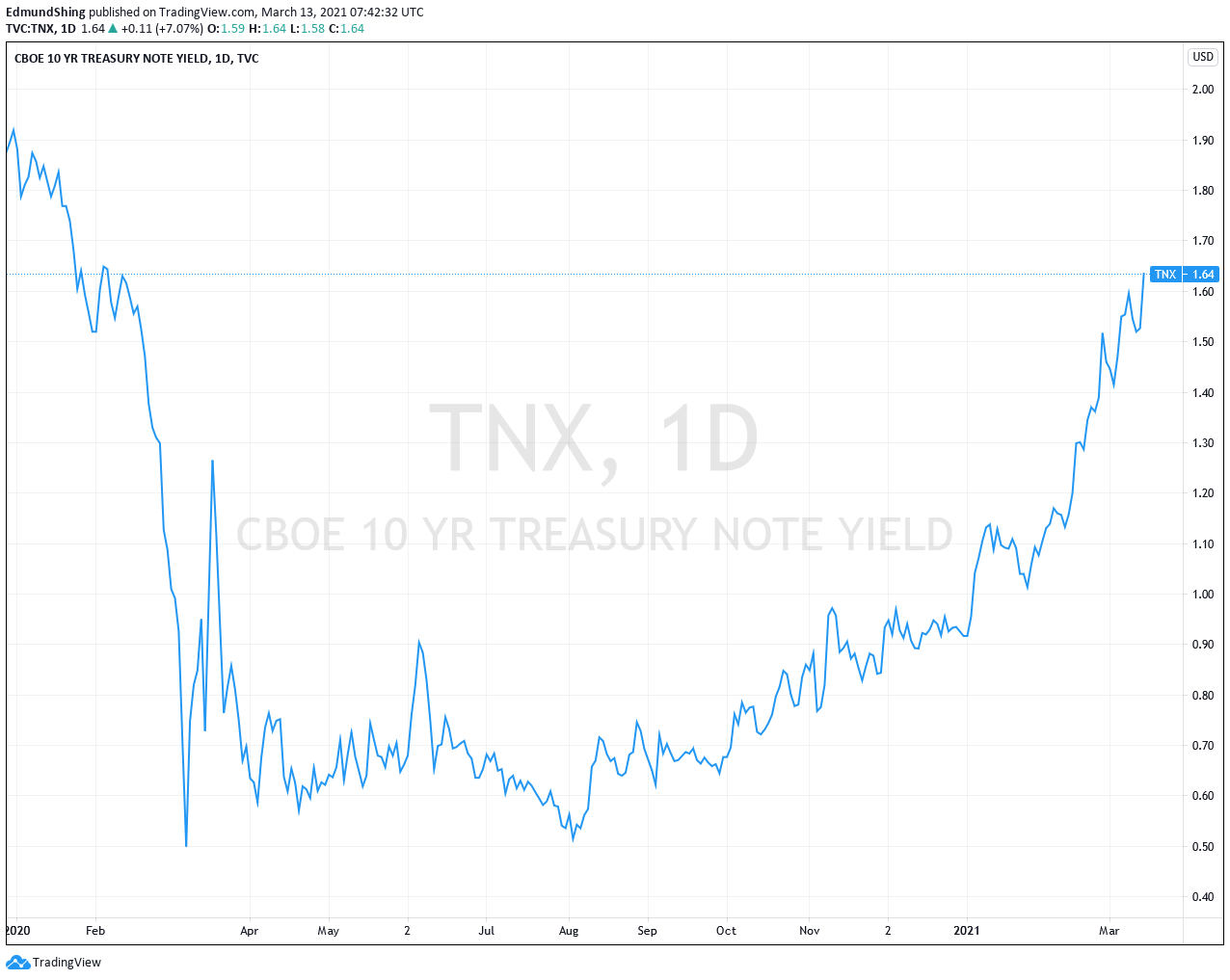
US bond yields continued their ascent, touching 1.64% on Friday.
US 10-Year Treasury Yield still rising
Source: tradingview.com
This follows the passing of the latest US stimulus bill in Congress, stoking further fears of inflation in the pipe.
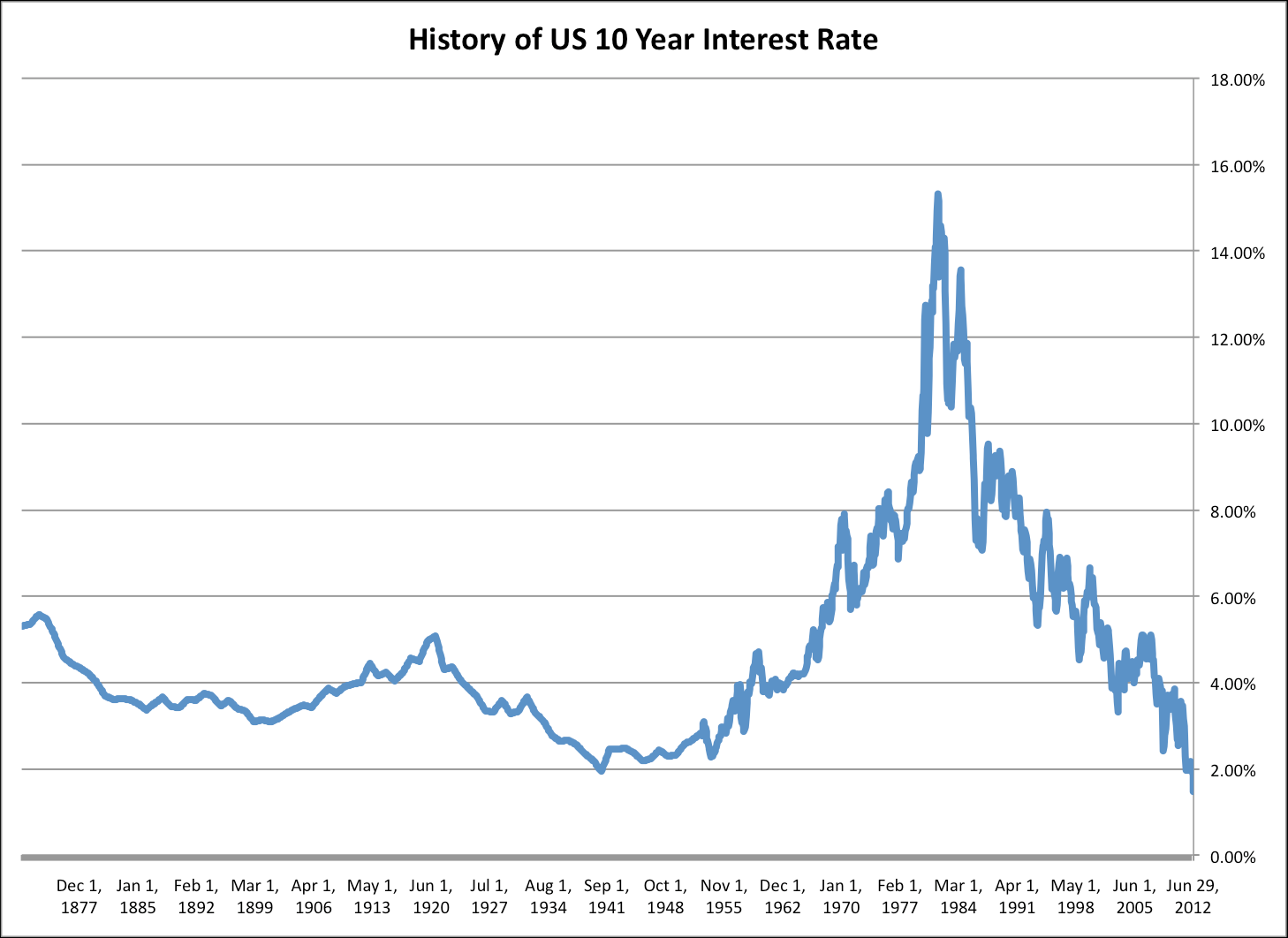
It is always instructive to put shorter-term moves in the context of history - in the chart below, you can see the course of the US 10-year bond yield (interest rate) since 1877.
The Long-Run History of US Bond Yields
Source:Avondale Asset Management
As you can clearly see, 1.6% is still a very low long-term interest rate in the grand order of things…
Stock Markets not Bombed by Bonds
In spite of the continued rise in yields, stock markets nevertheless rebounded over last week, led by more cyclical indices such as the German DAX, the UK FTSE 100 and the Russian RTS index.
The Russian index is interesting, given its very high weighting to commodities - Oil, Natural Gas and Nickel in particular. In addition, the Russian rouble itself tends to be a petro-currency given the effect of oil and gas prices on its domestic budget, strengthening and weakening in concert with crude oil prices. it is also a high dividend yielding index, offering an annual yield in excess of 5%.
The one index that looks noticeably weaker is the Nasdaq 100 (QQQ), which looks to have decoupled from these other indices. This is perhaps unsurprising, given its bias to long-duration tech stocks and the fantastic performance the Nasdaq posted in 2020.
But be on guard, as these popular tech stocks could enjoy another bump higher if US retail investors decide to re-invest their $1400 stimulus checks in the stock market, buying well-known retail favourites in the tech space.
US stocks do not fear rising bond yields

Source: tradingview.com
Banks Back in Favour
European and US banks going up

Source: tradingview.com
At a sector level, the steepening yield curve (the difference between short- and long-term interest rates) continues to boost banks on both sides of the Atlantic.
Over the last month, European banks have been led up by more retail-focused names such as ING, Lloyds and ABN Amro, all of which offer a prospective dividend yield of 4% or more.
But again, just to give some perspective, just look at the simply awful performance of European banks (EXV1) as compared to European small-caps (XXSC) since 2009...
European and US banks going up

Source: tradingview.com
We could put a positive spin on this chart, by saying that Banks can continue to rally a long way in the near-term… I would rather say that any view on the Banks sector should remain more tactical in nature, and is certainly not a buy-and-hold for the long term.
I say this as an employee of the Banking industry for the last 25+ years…
The other sector to clearly benefit from rising long-term bond yields is the Insurance sector, more specifically the Life Insurance sector, concerned with savings products. Here, the ability of life insurance companies to offer new bond-based life insurance savings products at higher initial yields outweighs any effect of higher yields/lower prices on their existing bond portfolio.
Over the last 3 months, leading life insurers have included Aegon in the Netherlands, CNP Assurances in France and Aviva in the UK.
The Continued Good News in the UK
With 23.3 million people in the UK receiving at least the first dose of one of the available COVID-19 vaccines, this has combined with current restrictions to drive down the current COVID infection rate dramatically, as can be seen by region in the table below.
Note that the most economically-dense regions of London and the South East are currently seeing among the lowest levels of infection, which should be encouraging news for the UK economy for the rest of this year.
COVID infection rates plummet in the UK

Source: @UKCOVID19STATS
With progressive re-opening on the cards soon in the UK, as in the US, we can expect domestic consumption-related stocks and sectors to benefit most in terms of improved sales and cash flows.
One of my preferred ways to take exposure to this trend is via the size factor in the UK, focusing on small-caps and then mid-caps, rather than the international FTSE 100 index.
Since 2016, UK small-caps have shone

Source: tradingview.com
Happy hunting,
Edmund
Disclaimer
This is not financial advice. Our content is intended to be used and must be used for information and education purposes only. Please read our disclaimer and terms and conditions to understand our obligations.
24 comments
With stimulus, housing boom and rising yields, US banks seem like a strong investment going forward.
The base rate doesn't need to change for a long time for them to now make a solid net interest margin.
I'm not as keen on UK banks just because the stimulus isn't the same and I wasn't positive on banking in general until recently as I expected long term deflationary pressures but the sheer scale of stimulus and yield moves has changed that.
It also seems like it will generate better returns than short term bonds, while providing safety as the banking industry have very strong balance sheets.
With that said, I think the discounting on the yield curve move has been overdone on some stocks. A 50 bps move gives a 26% discounting over 10 years with 5% in the final year. It could be expected it will move more but not every tech company is priced out on a 10 year return given their earnings growth.
A balance is probably more important than it has been for a while in the short term.
Thanks Edmund. Yes, the Nasdaq 100 is down about 7% from its all time high. Technology has been out of favour for a few weeks, but will certainly return. I think it's a safe bet that the Nasdaq 100 will hit 14,000 in the next six months. The recent pullback could be a good buying opportunity.
A safe bet - really?
If not safe, then a 'high probability win' bet, barring black swans. Let me explain. The Nasdaq 100 has consistently outperformed the S&P 500 and the DJIA, over the last 10 years. Last week, we saw all time highs for the S&P 500 and the DJIA, because money moved out of technology to the relative 'safety' of non-technology sectors. We actually need only a relatively small shift in sector popularity for the Nasdaq to hit an all time high, and move from there the short distance (1.32%) to 14,000. Over the last 5 years the technology sector has gained 168% vs. the next best sector (Consumer Discretionary) 87% (stats from October last year but still valid IMHO). There are no certainties in investing, but we all make our money from high probability bets. For me, the Nasdaq 100 is a high probability win. (This is a personal view and not intended to be financial advice.)
We have the Nasdaq at 14,000 today.
Some funds such as BG US Growth are already up around 15% from the lows, not sure which way this will go though.
Absolutely Herbie47. I've been topping up on my Scottish Mortgage Investment Trust (LON:SMT) which are very similar to Baillie Gifford Us Growth Trust (LON:USA) . They're up 22% from their recent pullback, and 22% short of their recent all time high. Both are looking like great pullback trades.
Yes I looked at Scottish Mortgage Investment Trust (LON:SMT) but did not like the amount of chinese companies in the top 10 holdings, I don’t want to try invest in China. I’m not keen on Tesla either but they have reduce the holding in them.
I think the reasons for avoiding China are more ethical than financial. The China A50 index seems to be close to bottoming out, after falling nearly 15% over 4 weeks, if it hasn't bottomed out already, and is more likely to head upwards than downwards. Alibaba (BABA) looks cheap and the current low price reflects a disagreement between Jack Ma and the Chinese government, rather than any business issues.
Not sure I 100% agree with banks not being potentially a decent long term play. Although admittedly I don't hold any bank stocks as I don't feel comfortable analysing their operations and accounts.
Banks are not inherently bad businesses (albeit they are heavily commoditised), they have been highly profitable in the past. The last ten years conditions have been very poor for banking, but there must be a set of conditions possible in which they would thrive. So the judgement would be if people think the economic environment will be supportive of banking in the longer term. In my opinion, rates probably don't need to be extremely high for banks to make good returns, after all they have been adjusting for lower rates for such a long time now. But overall this seems to be a judgement call on long term rates, which given the current extraordinary economic conditions is a really difficult call to make.
I've been looking for a while now to get a bit of weighting to banks via investment trusts, but most seem to have so little exposure (reflects the long term negativity I suspect). The only financials heavy one is Polar Capital Global Financials Trust (LON:PCFT) as far as I can tell, anyone got any other investment trust ideas for financials?
I hold and like the "pure play" nature of Polar Capital Global Financials Trust (LON:PCFT) as I think this sector probably needs some specialist analysis skills (as opposed to a more generalist IT). This is slightly older, but gives good insight into the manager's style and thinking:
https://www.piworld.co.uk/2019...
Not aware of any other Investment Trusts with a similar focus ... there may of course be OEICs, but I know nothing about these.
If you widen your remit to include ETF's there are many more options, e.g. £FINW tracks the MSCI World financials index.
Welwicha,
Another Fintech investment trust to look at might be Augmentum Fintech (LON:AUGM) (I hold) which focuses on smaller companies, especially challengers and those using new technologies.
Regards
Ricardo
Hi FederalReverse, I certainly didn't say that Banks were a decent long-term play! Rather the opposite, I said that they could be a decent tactical play...
Longer term, if you want financials, I would always prefer life insurers (if you think bond yields continue to go higher), and financial services with high profit margins (if you think we stay in a bull market) eg stock exchanges and asset managers.
Ed
Hi Ed, just to clarify, yes I was saying that I disagreed and that in my opinion banks could be a decent long term play, depending on the conditions. Just a thought, and for disclosure I don't currently have a banking heavy portfolio by any means.
Many thanks Edmund.
Do you have any favoured companies in the insurance sector? It's hard to look under the hood of these businesses. The telegraph tipped Legal & General (LON:LGEN) this week but I tend to view newspaper tips as a selling signal. I'm drawn to some of the higher yielding insurance names but are there any to avoid? Also which of the banks (any region) look interesting to you?
I'm inclined to take the opposite view on UK small caps vs FTSE100. The small caps have had a really strong run and the optimism may be overdone especially as the Brexit fallout is still playing out. On the other hand the FTSE 100 has lots of banks, miners, insurers and "value" companies which could be due a catch up. I'm thinking some big pharma looks cheap too e.g. Glaxosmithkline (LON:GSK) which is nearly a third off the pre-pandemic SP .
My impression from the UK budget is that the policy is now MMT with smoke and mirrors to give the impression of fiscal prudence. I'm guessing this means inflation and higher interest rates before too long. The FTSE 100 had a great run during the latter half of the 70s and early 80s when inflation and interest rates were high. Not sure whether this will hold true again but the industries represented in the index haven't changed much since then.
Neil Collins has been posting his articles online since the FT was unable to find room for his column. He covers the insurers this week here.
He likes L&G and is scathing about Aviva and Standard Aberdeen.
HI Momoko
I hold Aviva (LON:AV.) and Legal & General (LON:LGEN) as part of my 78 year old mum's ISA (aka Pension) fund, having bought in autumn 2020 as part of the income part of the fund. So looking at Dividend Yield primarily, with any capital appreciation as a bonus. I bought earlier and stop lossed out so could of would of and OUCH!
I would also add that I hold Phoenix Group (LON:PHNX) and Polar Capital Holdings (LON:POLR) too in this portfolio.
There are obviously several choices, such as Lloyds Banking (LON:LLOY) which was a previous hold but sold in going to total cash last February/March, but FOMO/nervous/too much else going on.
So whilst these are typically 2-5% stakes within the fund, and looking at a solid income and they are going to pay the dividend, I have done enough research to feel comfortable, but I would not stake my house on them, and as the investment is with Halifax Share Dealing I can exit Monday if I change my mind (ok it has changed again...)
Sorry short of technical analysis, as this depends are you wanting growth or income. I am income so I HOLD but that is only one of the three portfolios I manage.
Tommy
I agree on Aviva (which I hold). Save 5%+ divi from a business that is now more focused
To be fair Momoko, Miners have already done very well too! Although I still like them... On the insurers, I like Legal and General as I like not only their life insurance exposure, but also their indexed asset management arm, with growing exposure to thematic ETFs.
The contrarian in me also likes the look of FTSE 100 laggards such as British American Tobacco (LON:BATS) ...
Ed
Hi Momoko, thank you for highlighting Ip (LON:IPO) the other week when I was grumbling about the lack of platform access to Schiehallion Fund (LON:MNTN), looks very interesting, thank you, much appreciated.
Hi Momoko, My favoured company in the insurance sector is Beazley (LON:BEZ). Very good management and now might be a suitable time to buy, as they look good value on forecasts for the next 2 years and will benefit greatly from the all-round increase in premiums.
Yes could be a good time to buy insurers as premiums will increase this year, there are not many listed Lloyd’s syndicates left as most have been taken over. I will have a look at Beazley (LON:BEZ).
I do hold Aviva (LON:AV.) and Legal & General (LON:LGEN) mainly for income, not sure if they will be affected by Brexit.
Thanks Edmund. Always a good read.
I agree that post-Brexit, post-Covid the underperforming U.K. markets could fertile ground for investing and that the small and micro caps perhaps even more so than the international FTSE 100 or 250 companies. I see you identified a small cap ETF as a way to play this. I’ve recently taken a position in River And Mercantile Uk Micro Cap Investment (LON:RMMC) to achieve something similar albeit actively rather than passively managed. As the name suggests it is a micro cap focused Investment Trust and many of the holdings named in the recent report will be familiar to SCVR readers. It also has about 35% of its holdings in the US and other markets so there is a bit of geographic variety on offer.
https://documentscdn.financial...
Management fees are not too usurious, (about 1.3% plus a success fee for beating the relevant index) and it’s currently trading at a discount to NAV of about 8% so reasonable value IMO given its “Balanced Super Stock” status.