Market Musings 160923: The hidden cost of fashion

Market Musings 160923
The hidden cost of fashion
Following the latest fad can be bad for your financial health
Summary
Pandemic lessons: The rise and fall of ARK
Collapse on online retail stocks, food delivery, connected fitness, fake meat
Back to the old economy: Retail, Professional Media, Oil & Gas, Latin America
Podcast
Tackling the obesity epidemic
In today’s podcast, Edmund Shing, Chief Investment Officer of BNP Paribas Wealth Management, discusses the causes and consequences of obesity and its treatments.
Factors causing obesity
Related health conditions
So-called wonder drugs on the market
How to invest in this essential medical/health segment?
On Fads and Fashions: a Health Warning
The global COVID-19 pandemic has proved a very interesting case study in financial bubbles and busts. Of course, the widespread economic shutdown triggered by lockdowns, and the subsequent economic stimulus responses from governments and central banks were unprecedented in size.
We also saw the inflation of a number of investment bubbles, most notably centred around technology linked to the necessity of staying and working from home during the pandemic. Of course, there have been structural changes to our daily lives as a result of the pandemic, including a much higher percentage of white collar work which is now done on a mixed or work-from-home basis today.
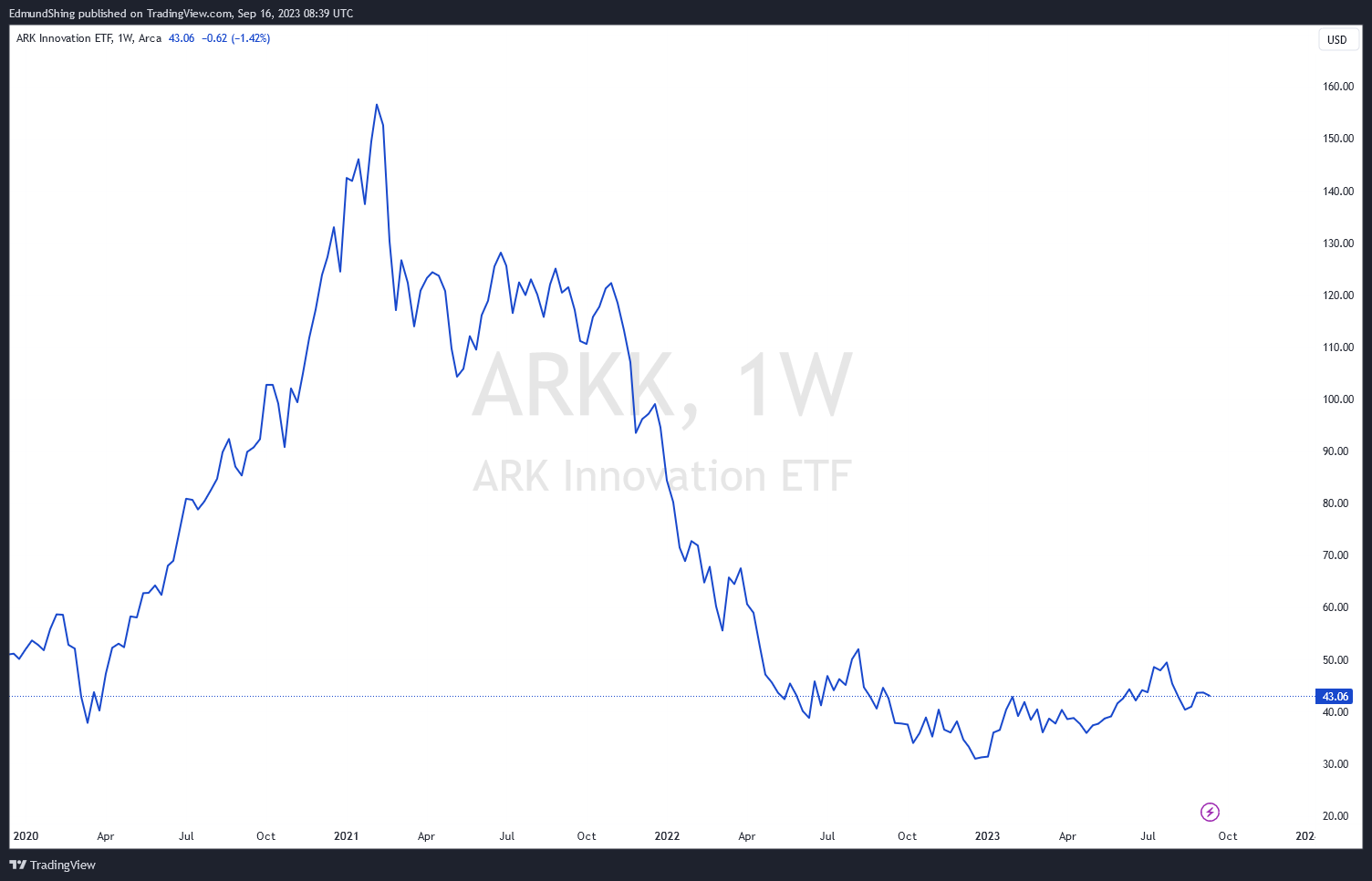
Perhaps the best illustration of the pandemic-linked technology bubble and subsequent bust (echoing to some extent the 2000 technology bubble) can be found in the incredible rise and fall of the house of ARK - the ETF issuer led by Cathie Woods that championed all manner of new, high-growth technology stocks and themes.
The rise and fall of the ARK
Source: tradingview.com
Today, the ARK Innovation ETF sits some way below its pre-pandemic levels, 73% below its early 2021 peak level.
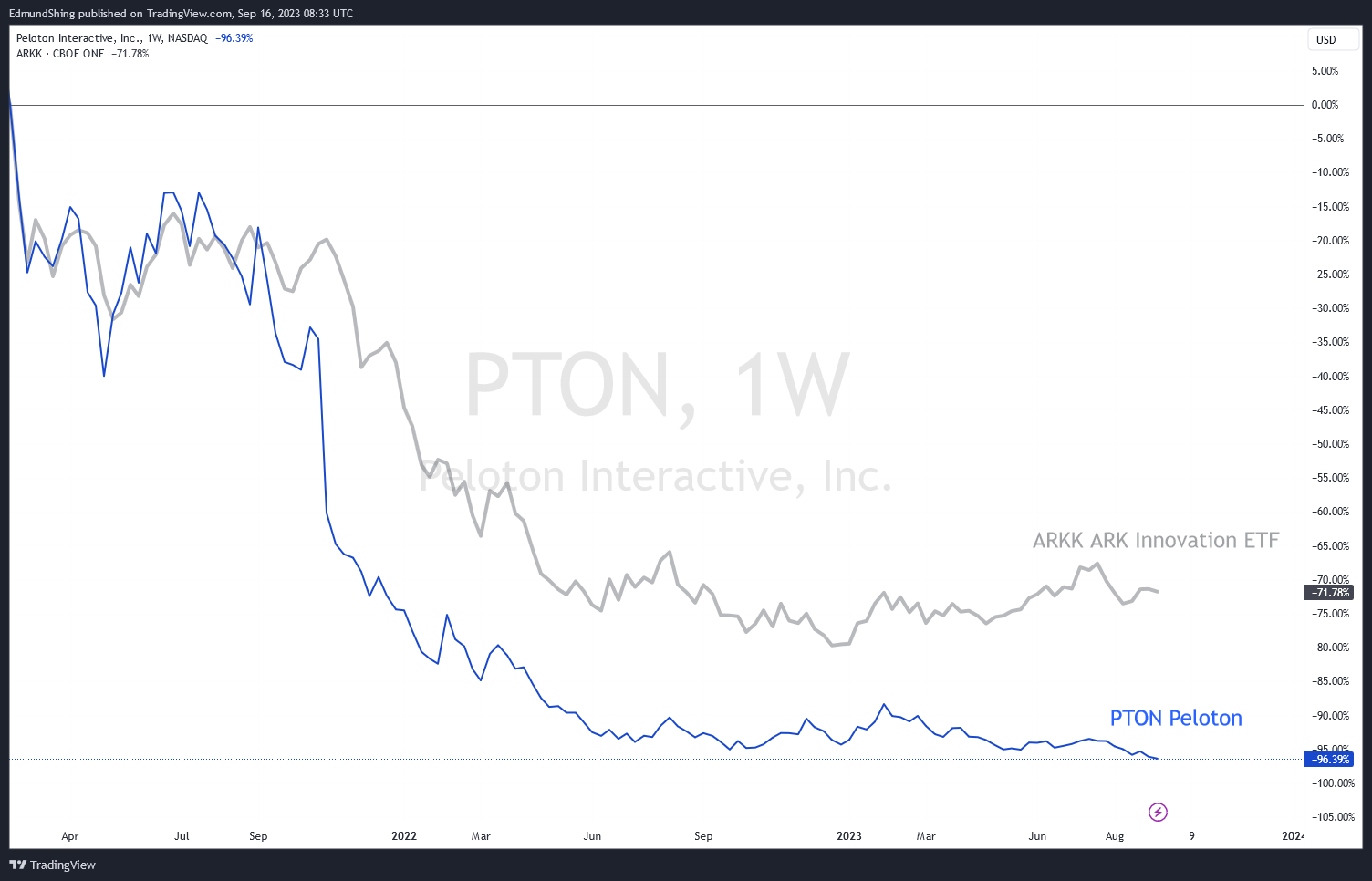
One of the stocks ARK favoured was Peloton, who offered us the Peloton bike with connected fitness classes. This online fitness fashion seems to have faded in popularity once reopening occurred - Peloton stock has lost 97% from peak and shows little sign of recovering.
Pandemic-era: The Peloton fitness fad
Source: tradingview.com
Similar can be said for food delivery stocks such as Just Eat and Deliveroo: while these food delivery services have indeed gained significant market share and continue to advertise heavily today, investors in these companies have suffered from a similar post-pandemic hangover.
Show me the money in food delivery: Just Eat, Deliveroo

Source: tradingview.com
In the case of Deliveroo, however, the radical steps company management is now taking to improve profitability is leading to a recovery in the share price.
Online retail, long a fast-growing segment taking market share from bricks-and-mortar retailers on a structural basis for many years, is following a similar path as they struggle to return to profitability. Boohoo has lost 92% since its mid-2020 peak of 412p, and now sits at only 33p.
The inexorable rise of online retail: Boohoo, Asos, AO World

Source: tradingview.com
A final fad that has since faded is of trends linked to veganism, in the form of fake meat (Beyond Meat) and oat milk (Oatly). In both cases, the initial excitement at Initial Public Offering time has been followed by a long decline, as these brands struggle to establish a solidly profitable business.
Vegan/Fake Meat: Beyond Meat, Oatly

Source: tradingview.com
What is the lesson to learn from these examples? One which I learned at great personal expense in the early 2000s - that is, to be extremely sceptical of investor excitement over new “exponential growth” stories.
All too often, we as investors are seduced by these narratives and invest at almost any price to capture a piece of the action and invest in the “next Amazon” or the “next Microsoft” - only to suffer as the excitement wears off, and the reality of businesses struggling to become solidly profitable becomes apparent.
As the academic literature tells us, over the long term “glamour” stocks such as these tend to underperform the broader stock market over time, even if one does occasionally manage to find the odd big winner.
In general terms, it has been a better long-term strategy to invest more in “boring” or “ignored” stocks…
Beyond the Hype: What “Old Economy” sectors work today?
Which more boring sectors and stocks are working today, then?
The first sector to look at is non-food retail, which seems to have recovered as online retail has faltered. In reality, of course, all retailers today have to adopt a hybrid physical + online strategy.
In the UK, you may be surprised to hear that a number of non-food retailers are prospering in spite of the current economic difficulties and high interest rates. Three to highlight here are Marks & Spencer (back from the dead), Next and B&M (more of a discount retailer).
Discount, Clothes retail: Next, Marks & Sparks, B&M

Source: tradingview.com
In professional media, Reed Elsevier continues to perform well off the back of its legal and academic offerings, hitting a new all-time high.
Professional (B2B) Media: Reed Elsevier - new all-time high

Source: tradingview.com
With the OPEC+ cartel cutting production quotas yet again in the face of surprisingly robust global oil demand, the Brent crude oil price has rallied to nearly $94/barrel, boosting both oil majors like Shell as well as oil exploration & production stocks (who are generally more sensitive in profit terms to the oil price).
Oil & Gas: Big Oil, Oil Exploration & Production

Source: tradingview.com
Finally, the relative robustness of the Brazilian and Mexican economies, combined with stronger currencies and cheap stocks/high dividend yields, continues to underpin strong performance of Latin American stocks.
Latin America: Brazil, Mexico offer tempting yields

Source: tradingview.com
On the commodity front, I will note that uranium and YCA Yellow Cake had another strong week last week… but I will not bore you any more on this front, as I have already written about this in previous weeks.
Bonne chance!
Edmund
Disclaimer
This is not financial advice. Our content is intended to be used and must be used for information and education purposes only. Please read our disclaimer and terms and conditions to understand our obligations.
7 comments
Thanks Edmund. Yes, Yellow Cake (LON:YCA) has done pretty well over the last couple of weeks (I hold). It's now at an all time high and looks like going higher. Worth a punt on the next pullback. Your earlier post about energy stocks was influential in my decision to invest so much appreciated.
Hi Edmund,
Where can I find your podcasts please?
I fully agree with the sentiments expressed above that echo the thoughts of two of the great investors.
Peter Lynch, who when asked what stocks to avoid said that he would avoid the hottest stocks in hot markets.
Howard Marks makes the point that very highly valued stocks, where investors chase prices to unsustainable heights are often accompanied by something new and exciting. The dot com bubble being an obvious example, where investors paid astronomical prices for companies that had no earnings, but were in some, often very tenuous way related to the internet.
Today, Nvidia and Arm are likely candidates for the above descriptors.
As I have commented in previous posts (apologies to fellow Stockopedia readers) valuation matters. If you are clever or lucky enough not to be holding the 'baby' when the music stops it is possible to make a handsome profit., but I know that I am not.
I wish investors in Nvidia and ARM well and they are no doubt very good companies, but would I pay a PE in excess of 100 for a stock, in short no. They are not for me.
Just click on the blue heading under the word 'Podcast' at the top of the article.
Cheers Tein.
Hi jonno
you can find our podcasts on the major podcast platforms - Apple podcasts, Spotify, Podcast Addict etc. searching for "BNP Paribas Wealth".
Alternatively, they are all here as well!
https://wealthmanagement.bnpparibas/vow/en.html
All the best
Edmund
Thank you Edmund.
I'm not disagreeing with you. When Arm was listed in the UK it was on a punchy rating, although not on its current US rating. I did hear of a UK guy who 10-bagged on Arm, mind. It was a long-term holding, and you would have had to have kept your nerve on its rating.
One potential problem I've seen with Arm is a relatively recent change in its licensing model. It's something like royalties being due not on the cost of the chip, but on the price of the finished device. This bumps up royalties, of course, but people have queried if this is a short-term move to aid in the flotation, rather than sustainable in the long term .
RISC-V is a license-free alternative to Arm that is gaining a lot of traction. (Technically license-free, although third-party designers are likely to charge royalties for custom "IP blocks").
A few years ago Arm introduced a good licensing scheme for its lower-end MCUs (microcontrollers). It enabled small fry like Raspberry Pi to gain a foothold in designing their own silicon.
Arm possibly did this to counter the threat of RISC-V.
I've probably got some of the details wrong. But not too wrong, I trust.
It will be interesting to see it all pans out.