Market Musings 16/10/21: Consider the ultimate stock rotation: Tech to Commodities

Market Musings 16/10/21:
Consider the ultimate stock rotation:
Tech to Commodities
Recent podcasts you may care to listen to:
Recent reports you may be interested to peruse:
Commodities have been a terrible investment since 2008
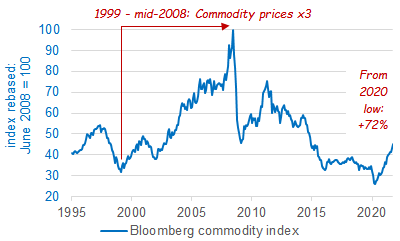
Quite clearly looking at the chart below, commodities have been a terrible investment since the middle of 2008, falling 75% over these 12 years. So why should we consider investing in commodities today?
Commodities have been an awful investment from 2008 to 2020
Source: BNP Paribas, Bloomberg
Well as I like to say, every dog has its day. Just as I believe that cyclical value stock indices such as the UK stock market will be a long-term winner from here, I also believe that this will continue to be the case for the commodities asset class.
Since early 2020 in the depths of the COVID-19 pandemic, the Bloomberg commodity index has already recovered some 72%. But we also know that from 1999, commodity prices tripled to their peak in mid-2008. If we were to see a similar recovery in commodity prices today, that would suggest that we still have a very long way to go.
Metals are on a roll
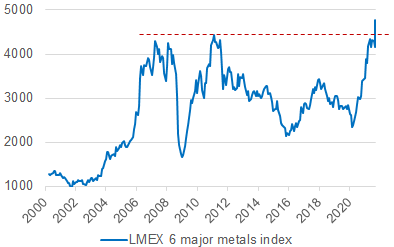
With all the worries about supply chains and provision of inputs from manufacturing and services, one of the bottlenecks is evidently commodity production. This is exactly why today we not only see an exponential rise in energy prices (crude oil and natural gas), but also a set of multi-year highs in a number of base metals including nickel, aluminium, copper, and tin. It is therefore unsurprising to see that the LMEX index of 6 major tradable metals has indeed surpassed its early 2000 peak to reach new highs as of today.
LMEX major metals index hits a new all-time high
Source: BNP Paribas, Bloomberg.
Note: LMEX index includes copper, nickel, zinc, aluminium, lead, tin
Ultimately, we are presented today with the combination of a) strong rebound in demand post pandemic and lockdowns, combined with b) the difficulties of companies to invest in new production to satisfy this growth in demand. Added to this of course, logistics problems both in shipping and trucking only make these issues more acute in the short-term.
But the longer-term picture is this: global mining companies as well as oil & gas companies have not been investing much in new productive capacity, given a combination of low commodity prices, and also the pressure from ESG strategies to invest in a low carbon future focusing on renewable energy, rather than fossil fuels.
Switching Technology into Commodity stocks: see 2000
The peak of the tech bubble in early 2000 saw a massive reversal in fortunes for the global Metals & Mining sector, as compared to the global Tech sector. In relative terms, from the tech peak in August 2000, the global mining sector then went on to outperform tech by an incredible 12 times by early 2008, following the strength in commodity prices, in particular industrial metals.
2000-2008: Metals & Mining Companies outperformed Tech by nearly 1200%

Source: BNP Paribas, Bloomberg.
As of yet, despite the surge in metals prices to new all-time highs on average, the relative ratio of mining to tech companies remains anchored close to the 2000 lows. The outperformance of mining companies still hasn’t even begun yet...
Just some food for thought.
Heavily consolidated sectors imply oligopolistic power
In addition, we can look at major oil and gas or major mining companies around the world, comparing the environment today with that of 20 years ago when industrial commodities last saw a prolonged surge in prices.
Since 2000, there has been a major consolidation via mergers and acquisitions of both of these sectors globally. This in turn has delivered much greater oligopolistic power, a form of transitory pricing power held by the largest oil & gas and mining companies today when final demand is strong.
Will these companies repeat the mistakes of the past, and invest heavily in new production at the top of the price cycle, as they did back in 2008/2009? I think the answer is quite clearly, no. After all, in commodities we should never forget the mantra “the cure for high prices is, high prices”. Greater production is exactly what tends to drive commodity prices back down, once supply starts to exceed demand.
Instead, I believe that this time around, they are much more likely to maintain production discipline, not invest helter-skelter in new mines or or oil wells, but rather maximize output from existing mines and oil wells and enjoy today's high prices, which in turn drive outsized profit margins.
European miners enjoy the highest profit margins since 2011

Source: BNP Paribas, Bloomberg.
These are of course cyclical Industries, and so need to benefit from high prices when demand is strong -- because as sure as eggs are eggs, when global growth really slows down commodity prices will decline anew. The only question we as investors have to determine, is when is that turn going to occur? I would suggest that this moment is still some way off.
The Impact of Sustainability and Zero-Carbon Objectives
In the rush to install new renewable energy sources in our quest for a low-carbon future, electrifying our economy will require a huge amount of raw materials, notably battery metals such as nickel, copper, cobalt, lithium and others. In addition, our continual consumption of new technology hardware suggests that base metals such as tin will enjoy high demand as well.
And as far as oil & gas demand goes, even though we are looking to phase out our use of fossil fuels in the long-term, this will certainly not be the case any time soon. The risk then is rather that energy prices stay high for a prolonged period, because of the lack of investment and because of the existence of global cartels such as OPEC+ and also a similar quasi-cartel (including Russia and Qatar) controlling natural gas production, until we have largely electrified the global economy -- in particular personal transportation.
Just remember that the average car on the road in Europe and the US is 12 years old. We are not all going to be replacing these cars with electric vehicles tomorrow, as that would be far too expensive for the average household. More realistic would be a target of driving a majority of electric vehicles in perhaps 15-20 years. This clearly implies that petrol and diesel consumption, while falling, could remain high for quite some years to come.
European cars are 11.5 years old on average

Source: Statista.
Three Investment Choices
There are clearly two choices for those who believe this long-term story in terms of investment.
Firstly you can of course invest directly in funds and ETFs that have direct commodity exposure, particularly to the energy and metals sub-sectors.
One fund strategy that I particularly like exploits the roll yield, that is the spread in prices between the spot price today for a commodity like oil and the price for delivery in the future -- let's say 12 months in the future. See the BNP Paribas Easy Energy & Metals Enhanced roll ETF (GSDE GY) as an ETF that implements this commodity-based strategy.
At the moment, that “roll yield” is 10% over 1 year for Brent crude oil -- that is to say that spot delivery today for one barrel of crude oil (c. USD85/barrel) will cost you 10% more than buying the same barrel of oil but for delivery in 12 months time (c. USD76.50/barrel). The idea is simple: you buy exposure to the delivery of oil in 12 months time, and then you wait 12 months. By that point the oil will have to be delivered, and you can then resell it at the prevailing spot price, which hopefully has not fallen in the meantime.
This strategy has generated 35% performance over the year to date, boosted clearly by the high demand for energy and metals.
The second option is clearly to buy companies that are related to oil and gas or mining -- the producers in other words. I talked about this a couple of weeks ago, when highlighting the attractions and the low valuation of the European oil & gas and mining sectors.
A third option that is also interesting to look at is investment in royalty companies. These are interesting hybrids in that they are lower risk than typical mining companies, because they did not actually build mines and extract commodities themselves. What they do is provide financing to these miners, and in return for that financing they receive a share of the profitability over the long-term. So you profit from effectively expensive financing of precious metals mining, exploration and development by way of these royalty companies.
Several of these exist in the US and Canada, such as Franco-Nevada in the gold sector. Wheaton Precious Metals Corp. is a Canadian-listed royalty company focusing more on silver mining producers in the same vein.
Royalty companies like Franco Nevada have been better bets than gold miners

Source: BNP Paribas, Bloomberg
Have a great week ahead,
Edmund
Disclaimer
This is not financial advice. Our content is intended to be used and must be used for information and education purposes only. Please read our disclaimer and terms and conditions to understand our obligations.
15 comments
Excellent article as ever, thanks Edmund.
Agree about the streamers…. I hold $FNV , Trident Royalties (LON:TRR) & $MTA - Metalla Royalty & Streaming - which is also worth checking out for those interested in the space.
Edmund thank you for your thought provoking article.
The economic circumstances do seem very similar to the year 2000. I wonder though whether there is one important distinction between now and the year 2000.
One limiting factor in this current scenario could be China. In the year 2000 China was basically a capitalist country with a communist label on it. During the last few months however China has been operated more like a command economy. An example of this is the Chinese Government restricting the usage of steel and taking action to control other commodity prices. Iron Ore prices have certainly reduced due to their action and the large miners operationally based in Australia don't seem to be doing terribly well.
China is the largest consumer of commodities in the world so its behaviour will presumably impact the commodities business model.
I accept that there are opportunities too including the US Infrastructure spending (once the bill is finally passed). Under the circumstances I'm left wandering whether the answer is to pick your commodities or your mining companies very carefully.
I would be interested to hear any further views on which areas could thrive taking into account Chinese intervention.
I also have concerns about China but more to do with their power cuts, reading that some factories will have to close for a few days a week which could effect commodity demand. This could have knock-on effects in the west as we have seen with the car industry.
Yes iron ore prices have certainly fallen.
Coal, gas and oil prices are strong due to supply and demand. Will probably drift down when winter is over.
Great article. I strongly feel commodities could be the big sector winner of this decade. You have a combination of tight supply because of years of under investment (due to the earlier collapse in commodity prices as well as the ESG factors); capital discipline with the big miners returning most of free cash to shareholders and not really investing in nee projects; ever increasing demand both from the urbanisation of Asia and investment in renewable energy infrastructure; very cheap valuations with FCF yields of 15-20% (higher for the smaller miners). On top of that they offer a good hedge if inflation does pick up.
My favorite is Anglo Pacific (LON:APF), rather damned for its coal royalties but steadily divesting them - only a relatively small position left in coking coal which is giving high returns just now. Just bought a large cobalt royalty stream, and is concentrating on battery metals
Duke Royalty (LON:DUKE) do NOT invest in mining or resources companies. They are not an appropriate vehicle for the strategies in this article. I suspect they just got added to the list because they have the word royalty in their name.
It certainly provides food for thought but I think it is hard to put all tech in a group now as it was grouped in 2000.
Barriers for entry for certain tech names are incredibly high (e.g. Apple, Amazon and Microsoft) and they will continue to growth top and bottom line y-on-y.
I think the barriers to entry in metals isn't necessarily so high because requires capital but not patented IPs.
Some tech names certainly are harder to judge and may underperform mining stocks but with the return to normality in commercial flights, supply chains, central banks inability to raise rates before unwinding their balance sheets and the US Shale oil return to pre-pandemic levels comes lower oil and lower commodity prices as production catches back up to demand.
Similar thing happened post 2009 and even through a time when interest rates kept increasing, because Mega tech earnings outstripped rates rises but I think tapering will be higher and rate rises will be lower this time (just my personal opinion).
It will be a rocky ride but when is it not?
Andrew.
Just a quick chart comparison of Nasdaq100 vs Rio vs WTI oil 2009-2015:
Thornabian, just to pose a question in reply - I haven’t had any investment exposure to US tech stocks for at least two years (more fool me in hindsight). Would I be wise to invest in it (eg Nasdaq tracker) now?
Mega tech earnings coming up soon and growth seems set to continue.
There was a small correction in some Nasdaq 100 names (Activision Blizzard/Qualcomm etc. - I bought both on the 20-25% sell-off) but the index powers on, held up by the main three.
Long term, I just don't see many companies with the competitive advantage that Apple, Amazon, Microsoft etc have.
They generally don't go above more than 5x earning yield and move in relative tandem to earnings growth but sell-off around 3x earnings yield and stay in that quite tight band.
Wider corrections can always happen and it doesn't mean other companies won't generate great returns but I don't buy the argument mega tech is over priced per say either; certainly doesn't seem like a bubble with $ATVI at 18x forward PE and Apple not far off. Tesla is the obvious one which seems very stretched in valuation but it is 4% of the Nasdaq100.
thanks Edmund I really enjoy these articles! I'm interested in peoples ideas on Trusts to play this sector aside from the usual commodity specialists such as Blackrock World Mining. Scottish Investment Trust Scottish Investment Trust (LON:SCIN) looks to have plenty of value/energy and miners so could be good...
I hold Blackrock Energy And Resources Income Trust (LON:BERI) The discount has been narrowing nicely but its's still at 3.5%
This is a great article and well done to the author for sharing it with all of us.
Perhaps an investment in CAPD fits well with the whole philosophy.
Any other suggestions are always welcomed.
Again , well done Edmund Shing.
Trident Royalties (LON:TRR) is a smaller, aim traded royalty fund that has a broader portfolio of metals than just gold. I'm still researching it at the moment but it seems a sensible alternative to FNV and WPM
I like Trident Royalties (LON:TRR) but they are at a relatively early stage. They haven't yet reached the inflection point where their flow of royalties is established enough to fund their future investments.
Trident Royalties (LON:TRR) is nice way to get exposure to lithium which today hit a record high. Lithium makes up more than half their portfolio, although this will probably reduce over time as they add new royalties. Listening to a recent Q&A with management they're are quite opportunistic - they purchased the lithium royalty cheaply when lithium prices were very low last year. They have since surged so this royalty must have significantly appreciated.