Market Musings 19/02/21: Inflation Worries Surface

Inflation Worries Surface (in the US)
Summary:
- US inflation concerns rise
- Inflation expectations rise, as do commodities (including food)
- Keep an eye out on Oil & Gas: crude oil stocks are shrinking fast
- Value v Growth: Higher inflation expectations drive a Value rebound
- Value sectors: Banks have reacted to higher bond yields
- New weekly podcasts (apologies if you have already seen this!)
Inflation concerns surface in the US
The latest (January 2021) survey of US consumer inflation expectations reveals that they expect higher inflation ahead - in fact, January’s reading was the highest for 5 years. This is hardly surprising, given the sharp recovery in US retail gasoline prices from $1.87/gallon in late April to $2.59 this last week. Food prices are also significantly higher, up 3.8% from a year ago in January. Both energy and food prices are very visible to consumers, and are key in driving their inflation expectations.
US consumer inflation expectations jump to 5-year high
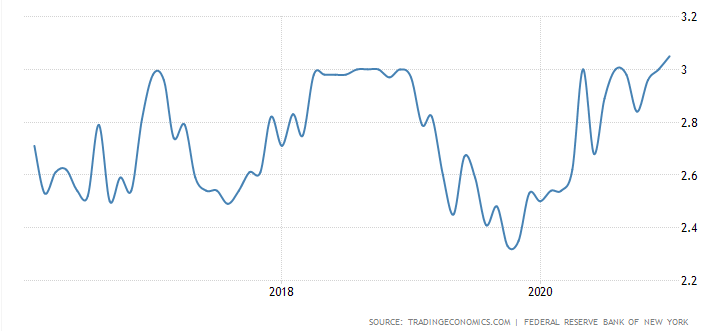
Source: tradingeconomics.com
Similarly, the US bond market has priced higher medium-term inflation expectations in the difference between US Treasury bonds and inflation-protected US bonds (called TIPs). This measure of medium-term inflation expectations has recovered to above 2%, the highest such level since September 2018.
US inflation expectations bounce back above 2%
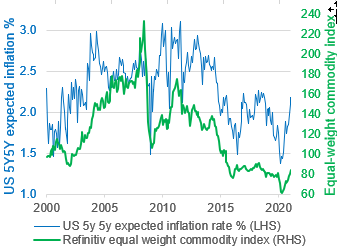
Source: Bloomberg
A number of leading indicators suggest that this surge in inflation is not yet over - core Personal Consumption Expenditure prices (the preferred inflation measure that the Federal Reserve looks at) remain steady at 1.5% year-on-year, for now, but the prices component of the New York Empire State survey suggests a surge in USD core inflation ahead.
Empire State price index points to higher future US core inflation
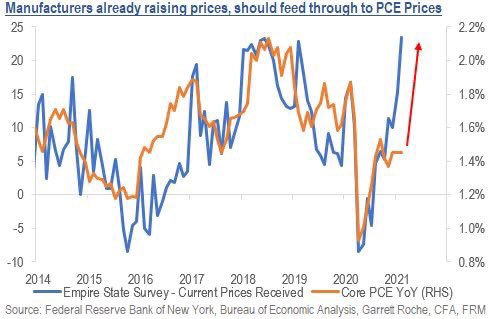
Source: Federal Reserve Bank of New York
Investors can gain exposure to rising inflation expectations via inflation expectations ETFs including one offered in the US by Proshares (RINF) and in Europe by Lyxor (INFU). These have already performed well since mid-2020, reflecting the rapid economic recovery and coincident recovery in inflation expectations.
US inflation expectations ETFs have already performed very well
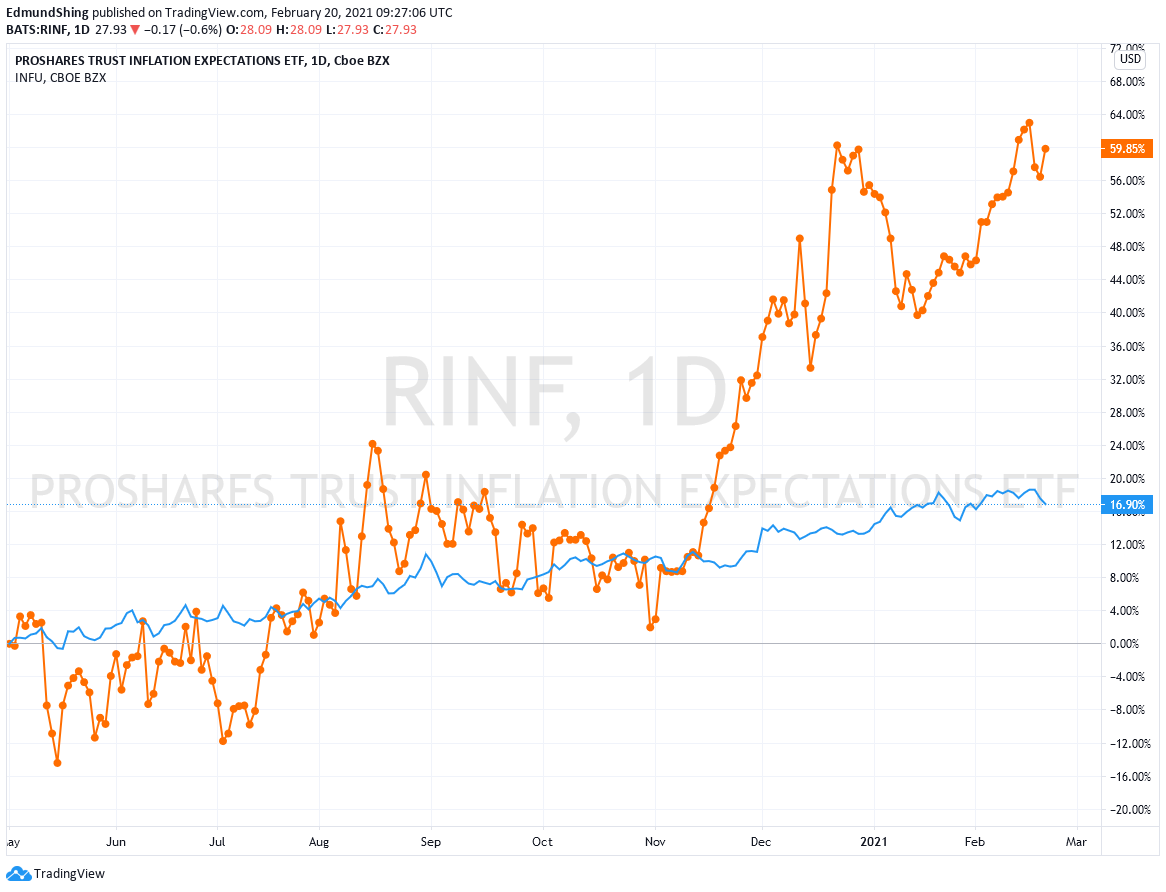
Source: tradingview.com
We know that rising inflation is generally bad for bonds, as they have a fixed coupon which is effectively eroded over time in real terms by higher inflation. It is hardly surprising that the TLT 20-year US Treasury bond ETF has fallen nearly 17% since August 2020.
But is this recovery in inflation expectations good or bad for stocks? Well, the evidence from history suggests that the US S&P 500 index can continue to generate solid returns as long as inflation is “moderate”, defined as above 1.5% but below 4%. With US all-items CPI at 1.4% year-on-year but rising, we would certainly seem to be in this moderate inflation range...
Moderate US inflation good for stocks: 4%+ would be a problem

Source: Jerome Blokland
One problem for poorer countries is that food prices are also rising quickly as part of the overall rally in commodity prices. 2021 has started the year with far higher world food prices, with vegetable oils and cereals rising fastest.
World food prices rise sharply


Source: FAO
As with other commodities, these higher prices can be traced at least in part to restrictions on world production of food, due to consistently low investment by food producers on the back of ever-lower food prices.
Food Producer Investment at multi-year lows

Source: Topdown Charts
But remember the mantra in commodity markets: “The cure for high prices is… high prices”.
As food producers generate higher profits on the back of these higher food prices, they should then invest more to grow food volumes, which will increase world supply and eventually impact food prices. But this may take time to happen, suggesting that food prices may remain high for some time to come.
One investment theme related to food that continues to interest me is the emerging trend towards plant-based foods, as more and more consumers discover the health benefits of a largely vegetarian or even vegan diet.
The FOOD Rize Sustainable Future of Food ETF is an interesting way to get exposure to this theme, including companies that produce plant-based meat substitutes (burgers, sausages etc.) and soya-based foods.
Oil prices could stay high: surplus stocks are disappearing
Crude oil prices have rallied impressively since the dog days of April 2020,with Brent crude oil briefly touching $65/barrel, and now just under $63. So far, oil quota discipline from OPEC+ countries has been surprisingly good, while global rig counts remain very low at 1183 (just over half of 2019’s average according to Baker Hughes). This suggests that new oil exploration remains very depressed, thus little extra supply can be expected from this source in the near term.
According to ING Research, the global oil market should see an increasing imbalance of demand over supply from now to end-2021. Oil stocks are already falling, and could drive oil market tightness, particularly over the summer driving season when people could drive more than ever on domestic holidays, after being cooped up at home under lockdowns for so long.
Quarterly global oil market balance (MMbbls/d): Demand > Supply

Source: IEA, EIA, Rystad Energy, ING Research
ING are moderately bullish on the prospects for crude oil prices, forecasting $70+/barrel for Brent by mid-2022.
The oil & gas sectors in the US and Europe have rallied considerably since November, but remain a long way below pre-pandemic levels. Should oil prices remain at these elevated levels, higher earnings should benefit these oil producers in spite of their evidently low ESG credentials, making them an out-of-fashion investment.
US XLE Oil sector ETF rallies on higher crude oil prices

Source: tradingview.com
Value v Growth: Higher inflation expectations drive a Value rebound
Is Value back as an investing style? While Value has been a terrible performer over the last 10+ years, the last few months have been kinder to value stocks, and they have outperformed growth and momentum stocks by a good margin since November 2020.
Since November, Value has far outstripped Growth, Momentum

Source: tradingview.com
With higher inflation expectations driving a steeper yield curve (the gap between short-term and long-term interest rates), the Banks sectors in the US and Europe have been strong recent performers, helped by their strong Q4 2020 earnings results.
In addition, Banks will begin to recover their income allure, as they will be able to pay dividends and even buy back shares in 2021, after banking regulators prevented them from paying dividends in 2020.
Consensus forecasts have BNP Paribas paying a dividend per share of EUR1.57 on the back of 2020 results, rising to EUR2.68 for 2021e. In the Netherlands, ING Bank is forecast to pay a 2020 dividend of EUR0.67, a 7.3% dividend yield potentially.
Finally, “value” Banks join the stock market party

Source: tradingview.com
Introducing new weekly thematic podcasts
(Apologies if you have already seen this…)
I wanted to highlight that I have started to record podcasts at BNP Paribas Wealth Management.
The first two podcasts focus on the following two subjects (click on title to go to podcast on the BNP Paribas Voice of Wealth website):
These podcasts aim to look at a theme in some detail, but in around 10 minutes! So not too long...
If you prefer to listen to your podcasts by subscribing on Apple Podcasts, Podcast Addict (on Android phones) or on Spotify, then please look for our podcast, titled:
Investment Strategy Podcast (from BNP Paribas Wealth Management)
There will be one new podcast on a fresh theme each week, released on Wednesday...
Many thanks for any of you who take the time to listen, all feedback appreciated!
Happy trails, Edmund
Disclaimer
This is not financial advice. Our content is intended to be used and must be used for information and education purposes only. Please read our disclaimer and terms and conditions to understand our obligations.
23 comments
whats your thoughts on the Reset? America formally being a Corporation owned by the Vatican and the Crown of London with it turning into a new republic. I would have thought pretty large news...
Good morning Timarr,
yes indeed. When is a tech stock a tech stock? Or maybe more importantly not a tech stock? Seems a very valid question to me. Though I am not sure what exactly is self-evident as an answer?
Tech stocks are not new. For some reason Microsoft is not a FAANG? I wonder why? The railway stocks and Ford etc were most likely the FAANGs of their day? Tesla seems to be a FAANG - but they haven't found a way to include it in the A to Z acronym yet? Although it seems to me that the tech involved in a Tesla and their gigafactories is perhaps less impressive than in a John Deere? But apparently that won't stop Elon from attempting to be the first to sell direct to everyone on more than one planet?
In my view a FAANG is more about the reach through, or apparent reach through, to every consumer on the planet than the tech? Which is why Microsoft, Intel and IBM aren't that kind of a tech stock and Apple apparently is? A marketing choice more akin to the old VHS Betamax contest than a judgement of their tech content or its success?
Just about every business is in the process of becoming a tech stock at some level? If they aren't then they risk becoming the next Arcadia?
That transition to new tech in a business may give them a competitive edge in their market. It may just allow them to survive for another generation in the endless game of innovate or die - or it may allow them to transform their business and even disrupt their market?
How Primark avoids becoming the next Arcadia will be a most interesting process? And perhaps Aldi and Lidl as well - in the sense that they have chosen to go the Primark route?
The John Deere's of this world are interesting. They need a lot of tech just to remain competitive in their markets? Yet not a lot of consumers want a 200kUSD tractor? I use a 1974 Massey Ferguson 135, it does all that I need from a tractor. and is very cheap and reliable to boot.
I'd expect that for most firms they will be forced to adopt tech just to surive, but for 10% they will manage to adopt tech and gain a competitive edge, and in turn for just 10% of them (1% of firms or less) they will succeed in transforming their business - but I am likely too optimistic in this? Those that succeed to the extent of disrupting is more likely to be 0.1%. If these firms were distributed evenly - and they aren't because the funding and opportunities are not even globally - there would be one or two on the UK markets?
So probably not even one FAANG likely on the UK markets? But there will likely be 10% of stocks that will adopt tech and gain a competitive advantage, which may result in profits for me, and 1% of them that transform their business which is what I am really looking for?
That's my competitive advantage? Looking for the firms that will gain significantly from their adoption of tech - though they can never become a FAANG?
So in that sense I see most firms on the market as potential tech firms - but very few of them as likely to be successful enough in their adoption to interest me?
All of which sounds very promising? But sadly my ability to foresee success and pick the winners remains stubbornly low, as for every Microsoft there are at least 1000 Digital Research (the company that backed out of the IBM operating system contract) - though my hindsight is exceptional!
apologies for the waffle and lack of clarity!
cheers
Mark
Thanks for this. I always get some useful nuggets and pointers from your articles
Thanks for the musing - always interesting. I'll try to get my head round RINF and INFU. I assume they're essentially a play on long a fixed treasury and short a linker of equivalent duration, but with some underlying complexity. Interestingly I see RINF is trading at the same level it was 5 years ago, but had been way higher around 2013-14 and clearly hit a low at the depths of the March 2020 crisis in confidence. So it's not really a 'long term asset' (in that if inflation expectations remain unchanged for a long period there'll be zero return on this asset) while a normal bond, or a linker, would generate some return. So essentially a directional bet best taken for a relatively short change in expectations? Also, RINF looks to have a pretty small market cap, so perhaps something of a niche play.
Also I'd veer towards a conventional soft commodities ETF, though I accept that sustainables may be on a roll currently.
Tbh, I was less convinced by the podcasts. The big tech one espoused views I've seen from many other sources recently. (Maybe they'll be proved right; maybe when the herd moves in one direction the opposite comes to pass.) I'm just not sure it's the best medium to use. Many investment topics benefit from visuals (''picture speaks a thousand words'') and personally I do prefer a short presentation which the reader can rapidly scroll down to gauge if of sufficient interest to read more closely. This just isn't possible with a podcast, though some longer ones have a table of timings so one can move forward to area of interest. Also the podcast player you've used is quite basic, eg has no 'fast' button - and most people can assimilate speech at up to 2x normal broadcast speed. I do actually listen to a lot of podcasts when out exercising ( eg the Economist ones are very good) but my non-multitasking brain isn't good at taking in a podcast while simultaneously reading an investment document! The better podcasts tend to have two speakers (like yours, with Q+A format!) but I assume that means quite an overhead in time spent preparation, scripting, occasional re-recording, then editing and releasing.
I suppose I've taken a lot of words to say that from my perspective the musings are a better use of time than the podcasts. Probably I'm just a troglodyte and others will vote differently :)
PS one thought on the big tech piece. I'm concerned for FB and GOOG in particular that one day the penny will drop and people will realise that so much spend on advertising is money down the drain! I know that corporate maintain huge marketing depts with equally huge budgets and infrastructure, so there's large vested interests in maintaining the status quo, but I heard a fascinating report recently (on a podcast actually!) of a serious academic study showing that the benefit from advertising was a small fraction of what was claimed by the marketeers.
PPS also saw the other day: Definition of a FANG = a FAANG excluding Apple Inc. You couldn't make it up!
Thanks Edmund - as always quite thought provoking.
I too have been wondering about oil companies - seem quite depressed if the current $60+ holds.
My one concern is US shale - at what point does the rising price see production there increase dramatically? It was said to have become the new swing producer.
Stocko is best when it focuses on the fundamentals of individual stocks or sectors. There is plenty on the sensational media covering Bitcoin and Gamestop. So lets keep it out to keep this excellent Stocko uncluttered and focused.
Thanks Edmund. And I enjoyed the podcasts too.
Enjoyed the Big Tech podcast. A few observations.
I'm not convinced the analogy between the Big Tech boom now and in 2000 is valid. Back then most tech stocks were pure stories, trading on imaginary future revenues. Facebook, Google, et al now have very real earnings. Lower down the tech tree the analogy is absolutely valid, some of the valuations are insane.
The issue of Big Tech regulation is definitely looming, but that doesn't necessarily mean that they'll underperform because of it. The analogy between Big Tech now and the oil companies in the 1890's seems more relevant: when Standard Oil was broken up by regulators the performance of its constituent parts improved.
On China and QR Codes - the history there is that the e-commerce companies needed a way of allowing people to pay without a deployed payment infrastructure. QR codes and smart phones were the answer. It's no more technically advanced than chip and PIN - less so, in many ways, but it's easy to deploy and we're now seeing it gain a lot of traction in other countries (although frequently backed up by a credit card).
What's interesting, in this regard, is that China's payments infrastructure - and I mean the stuff behind the scenes, not the way consumers pay - is far more advanced than the US in particular. In China the government was able to disburse relief funds directly to companies and individuals underpinned by a digital identity infrastructure that eliminates most fraud. In the US the government is still sending out paper checks in the post to dead people ...
timarr
I was thinking whether Tech is a useful categorisation because we apply it to some quite disparate businesses. How much do semiconductor equipment firms have in common with Netflix for example? I do tend to think that Facebook's day in the sun will pass.
The rotation for me should be towards the companies that are applying new technologies to transform and disrupt the more traditional stock market categories.
The rotation for me should be towards the companies that are applying new technologies to transform and disrupt the more traditional stock market categories.
I was looking at Deere & Co the other day - agricultural products. Satellite control, lots of robots. 40% of a vehicle's cost now is electronics. When is a tech stock not a tech stock?
A quick glance at the FAANGs tells the same story. You have the world's leading consumer goods manufacturer, the most connected social network, the biggest online retailer, the #1 video streaming company, the go-to seach engine and the most successful supplier of consumer software.
Are these the same sorts of companies? Can we just lump all of them together and argue that the S&P 500 is now 30% tech (or whatever it is)?
Obviously I don't actually know the answer to this. But everyone seems to be taking the answer as self-evident and I don't think it is.timarr
Plenty of food for thought here. Thank you Edmund.
Thank you, Edmund, for your market musings, which I always enjoy and should have thanked you for earlier.
Also, many thanks for your excellent StockSlam presentation on Atalaya Mining.
This is really useful macro commentary. Many thanks Edmund, will have a look for the podcasts
So Stockopedia discusses inflation, which presses the need for investors to protect their wealth. The current item which is doing that leaps and bounds is Bitcoin, up to $56k.
Yet on Fri, Feb 19, 2021 Paul Scott totally deramps it?
Yes it may be volatile, however, look at its past performance over 10 years compared to other commodities
For the purpose of balance I would like to see Stockopedia look at Bitcoin from a positive perspective - I mean I cannot even see any reference to any of the industry being developed from it, so ignoring the growth of many small cap companies.
There are already several other posts about Bitcoin, if you want to talk about it I suggest to do it there.
I’m totally fed up with it.
thoroughly agree.
https://www.stockopedia.com/co...
How about a virtual “swear box”? If you mention the “B” word you have to put a Bitcoin in the charity box - d**n that’s me $56,000 out of pocket.
FWIW I have sent a note to the Stocko editorial team to suggest that they might want to think about a formal Stocko site for BitCoin/crypto currencies to let the (IMHO obsessives/rampers but hey its a free world !!) enthusiasts talk about it themselves, away from Equities . Could have a similar channel for Bonds and Gold etc. Individual discussion posts wont get the following.
Thanks for the article.
Get out of bonds. Into value equities and bitcoin.
Enough please with the Bitcoin nonsense, it's ramped endlessly everywhere else as it is, we could do without this happening on Stockopedia too!
Well it’s certainly beating inflation today
I will get my coat