Market Musings 210924: Fed fires the starting gun

Market Musings 210924: Fed fires the starting gun
Fed Podcast: (click on link below)
Fed: The rate-cutting cycle has started with a bang (6 min podcast)
Weekly podcast: (click on link below)
Investing in insurance: what's the claim? (11 min podcast)
Summary:
The Federal Reserve starts its US rate-cutting cycle with a “jumbo” 50 basis point cut (0.5%), taking its benchmark interest rate below 5% for the first time since 2023.
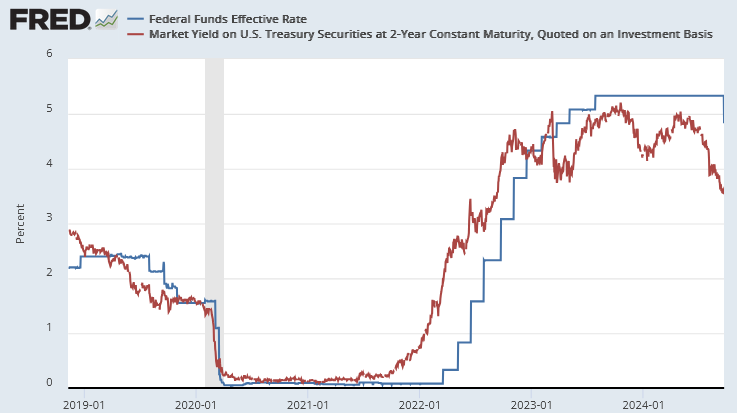
1. 2-year US Treasury bond yield at 3.6% points to further rate cuts to come
The gap between the Fed Funds rate (blue) and the 2-year Treasury bond yield (red) remains at historic highs despite this first rate cut. The bond market is expecting the Fed to cut substantially further over the next 12 months, with the Fed themselves pointing to a 3.25% Fed Funds rate by the end of 2025.
3.25% is likely the “neutral” interest rate for the US economy, the rate at which there is neither a boost nor a drag from interest rates on growth.
Fed cuts Fed Funds interest rate to below 5%
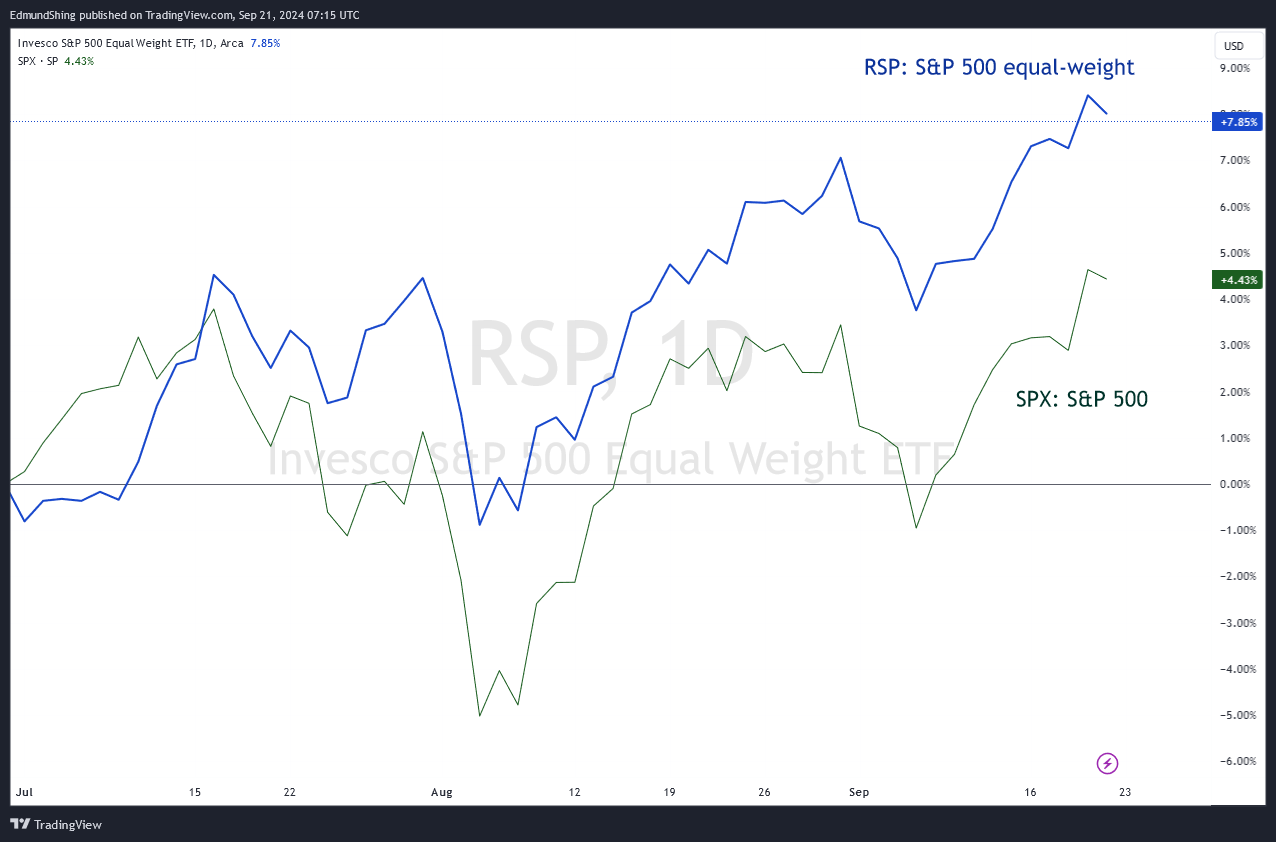
2. Positive reaction from US stocks, sending the S&P 500 to a new high
Since July, note the continued outperformance of the equal-weight version of the S&P 500, as the Magnificent 7 stocks struggle to regain the positive momentum they demonstrated for the first 6 months of the year.
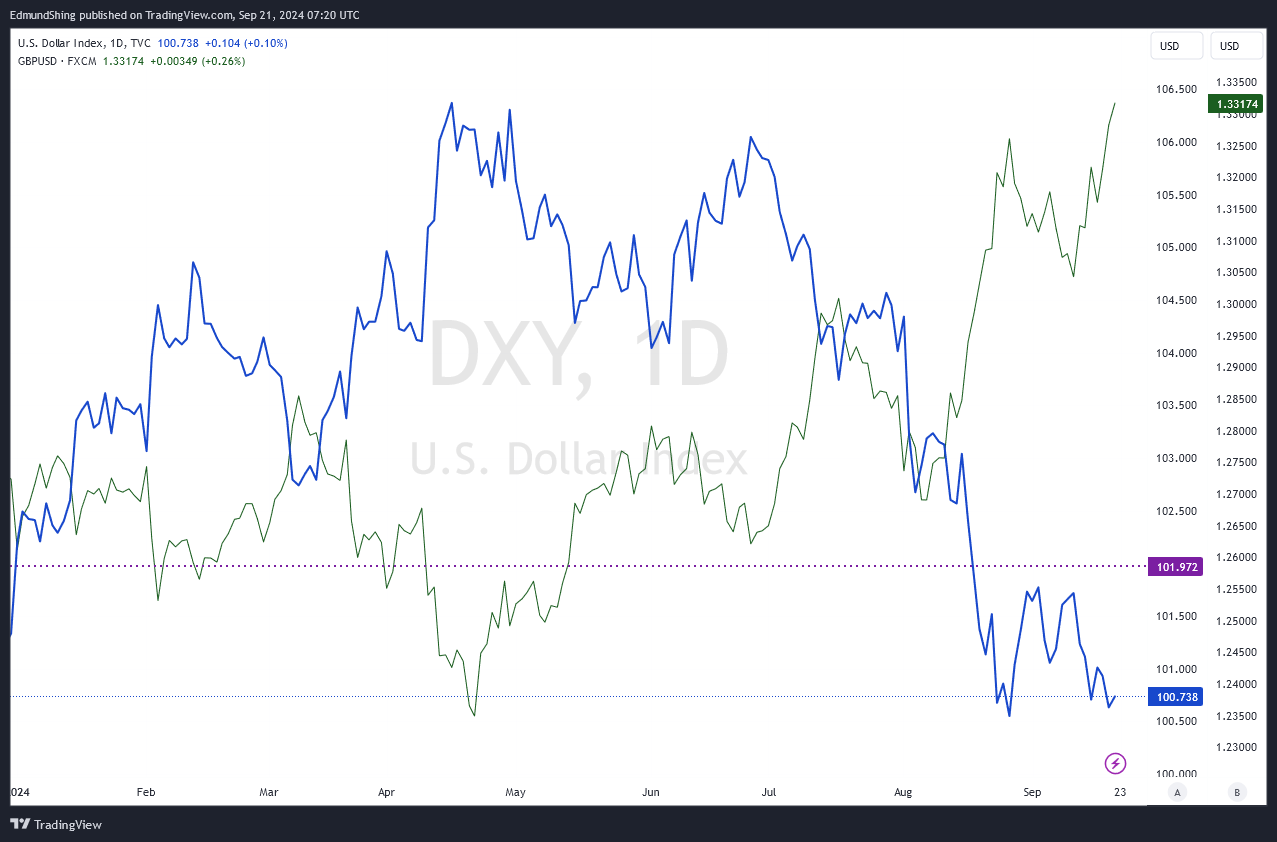
3. US dollar continues its weak trend, with sterling one of the gainers
Since the markets expect the Fed to cut interest rates faster than other central banks around the world (including in the UK and the Eurozone), the US dollar (represented by the DXY US dollar index in blue) is being undermined by the narrowing interest rate gap. The pound sterling remains one of the strongest currency pairs against the USD (in green), now above $1.33 for the first time since early 2022.
4. Gold (and silver) continue to benefit from a weaker US dollar, lower interest rates
This week, the gold price (in blue) hit another all-time high, breaching the $2600/ounce level for the first time. Silver (in green) is also benefiting from gold’s momentum, although it continues to lag for now (still far from its $50/ounce all-time high).

5. Gold miners continue to benefit from a rising gold price, rising profit margins
This week, the gold price (in blue) hit another all-time high, breaching the $2600/ounce level for the first time. Silver (in green) is also benefiting from gold’s momentum, although it continues to lag for now (still far from its $50/ounce all-time high).

Gold miners’ profit margins rise close to record highs…

6. Perhaps the best of the rate-cutting news has already been priced in by the US bond market
While the Fed cut rates, the long-term interest rate, as represented by the 10-year US bond yield, actually went up to over 3.7%. This suggests that a fast rawte-cutting cycle has already been anticipated by the US bond market, given the sharp 1% fall in bond yield (with a corresponding rise in bond prices) since May.

7. UK 2-year government bond yield has dropped by 0.8% from peak, now 3.9%
Expect a lagged reaction in the UK housing market from lower short-term bond yields…

8. Bank of England holds base rates steady - for now…
While the Bank of England did not follow the ECB and Fed in September in choosing to hold their base rate steady at 5%, it is just a matter of time before they cut rates further. Given the 1.1% gap between the current 2-year UK gilt yield and the base rate, the bond market is clearly pricing substantial UK rate cuts over the next 12 months, which should help property markets and domestic consumption.

9. UK Nationwide house price index on the rise, boosted by lower 2-year mortgage rates
Lower interest rates are already having a positive effect in interest-rate sensitive economies such as the UK and Sweden. In both countries, house prices are rebounding as mortgage rates decline… The rebound is modest for now, but should accelerate as the Bank of England (and other central banks) continue to reduce benchmark interest rates at a steady pace.

10. Listed Real Estate rebounds quickly in US, Eurozone, slower in the UK
US REITs have led the rebound with a 12% total return including dividends over 2024 to date, while Eurozone REITs have followed with an 8% return (led by German REITs). UK REITs have underperformed, up only 3% including dividends so far this year.

11. Non-food retail stocks shine in Europe, led by UK names like Marks & Spencer
Despite a supposedly downbeat domestic consumption environment, European non-food retailers have performed strongly, led by recovery names in the UK such as Marks & Spencer, and European heavyweights such as Inditex (owners of Zara).

12. In Emerging Markets, India continues to shine despite high valuation
While the Indian large-cap companies in the main SENSEX index are somewhat expensive today, this has not stopped Indian stocks reaching new highs - up 18% in pound sterling terms so far this year.

Have a great week ahead,
Edmund
Disclaimer
This is not financial advice. Our content is intended to be used and must be used for information and education purposes only. Please read our disclaimer and terms and conditions to understand our obligations.
3 comments
Interesting round up, pointing to a soft landing. Although this has rarely occurred in the last 50 years.
The widening gap between GBP and USD valuations of gold is well illustrated here, thanks Edmund. Obviously the US has the bigger problem with inflation.
Thanks Edmund
One of the biggest beneficiaries of interest rate cuts, are smallcap stocks - who typically can only borrow from banks at the front of the yield curve.
Therefore, assuming the central banks continue their easing bias and also engineer a soft landing - then ceteris paribus - this unloved sector could really start to motor over the next 12 months.