Mission Marketing (TMMG): Tickboxes and question marks

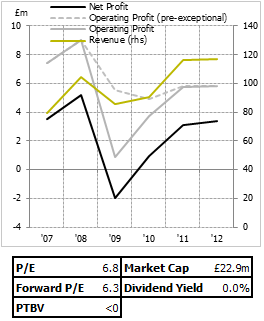 I'll confess up front: I have a bit of a bias against marketing agencies. While I've invested in one - Creston - I'm still on the fence about it, and its inclusion and survival in the portfolio is probably more attributable to it bumbling along around the same share price and not grabbing my attention more than anything else. That's a terrible reason, of course - endeavour to not be like me. In the interests of being open and honest, though, I'll try and quantify my bias. You can then decide if I'm being fair or not and - more importantly - I can appraise Mission Marketing, a reasonably cheap looking company, in as balanced a way as possible.
My qualms
Before I get on to the more quantifiable stuff, I'll indulge my tabloid side. Here're some snippets from the Chairman's Statement with Mission's recent interim results:
We've got a really nice business here... Our strategy is not driven by brobdingnagian principles; it is quite simply to excel in whatever we do... ... Perhaps this is due to peniaphobia but more likely it stems from a passion to establish the missiontm as the most respected and regarded Agency group in the UK.
I defy anyone who can read that and not raise at least an eyebrow. Perhaps I'm just lacking in grey matter, but I don't like having to look up words in interim results. Maybe he's just trying to liven things up - call me Scrooge, but I like the reporting of results to be as straightforward, user friendly and unbiasedly factual as possible.
On to the more relevant stuff, though. Why am I always a bit more cautious about investments in marketing companies?
1: Marketing companies are people businesses. I feel nervous when the driving factor behind a businesses's performance is something which is so flexible, and subject to its own whims. I had the same problem with broking firms; what does the business provide here? Well, a brand name and internal systems - but that's about it. Telephones and desks aren't hard to come by. This means, of course, that in good markets staff do very well - much of the surplus flows to them. It also, to my mind, makes their results far more unpredictable and subject to a set of criteria investors - with our outside-in accounting information - have trouble properly gauging.
2: They're also, in many cases, highly acquisitive. Acquisitive growth has been shown to be significantly less valuable than organic growth - acquiring companies are often shown to overpay a few years after when the smoke has cleared. This means potential shareholder returns are simply being plowed back in to the business in a value destructive way.
3: Management teams often have question marks. Particularly with small cap businesses like this and in conjunction with the above, I often feel that management (who are often founders of the business) aren't running the business in a way which maximises shareholder value - their sole remit. Aside from the value destruction in operations, I suspect there is a tendency toward high levels of director remuneration, excessive options grants and overall capital allocation decisions which are more aimed toward empire building than creating value.
Loosely, then, it comes down to three things - capital allocation, consistency of results and confidence in management.
On Mission
So how do Mission do on these criteria? Well, we can't really fix industry wide trends, and suddenly make this not a 'people' business. What we can do is look for consistency of returns, as a reasonably proxy for expectation of future returns. There is value in the brands these groups contain for instance, as well as internal structures and the simple fact that businesses just don't work the way they do in textbooks - labour doesn't flit from job to job based solely on wage competition, and businesses don't have perfect information on how much money a particular worker will make them. There should be some expectation of stickiness in returns. In Mission's case this is hard to figure out - they've only been listed since 2006. We have two years of relatively good performance, followed by 4 years in which they could probably reasonably claim the recession rather laid waste to them; operating profit is still at less than two thirds of what it peaked at in 2012, and it looks likely to fall further this year.
The problem is your definition of expectionality. In their interims this year, for instance, Mission report that figures will be significantly down after a 'major cost-saving program' by Aviva and the loss of Addiction's (one of their agencies) largest client. If we take these as one-offs, the business restrctures and moves on, trending back to the dizzying heights of its normal profitability. If we assume these are events that will happen fairly regularly - it's a competitive world, after all - we might suggest that they're not really exceptional at all, and that management are simply padding out their disappointing figures by separating them. Here's the RNS on those affairs, for you to make your own mind up.
Regarding the acquisitive growth, too, the short history makes judgement difficult. Addiction - one of the companies mentioned above - was acquired last year. You have to chuckle a little at the purchase of a company based on " Their work for the likes of B&Q and Remington [being] highly regarded" when they then lose their principal contract. The vendors certainly got a good deal there. Splitting up the performance of acquired companies is difficult because of the reporting structure, so it's difficult to judge the management team's capital allocation on a micro basis. We can try on a macro basis, though, perhaps by looking at the total amount of equity pumped into the business.
Shares in issue, for instance, have increased from 33.1m in 2007 to 77.0m in 2012, principally as the result of repeated placings to fund acquisitions, share creation in acquisitions and employee/director incentive schemes. This, of course, is not necessarily a bad thing; but it is value destructive if the capital being found by the business (which, I should note, is expensive; after all, equity investors have rated this business on a lowly P/E) isn't generating returns at above the cost. They've decided to start paying a dividend this year, which is (I suspect) a gesture aimed at earning them a more normal rating. The trouble is; if they're continuing to acquire and generate new shares to do so, paying a dividend makes little sense. It's giving with one hand and taking away with the other, and is more costly in the process. Retained earnings over the last 5 years are £14m, which is a pretty poor performance on a starting capital of £26m and with consistent and rapid capital growth through external sources.
Finally, on management; they've paid themselves an aggregate £5.4m over the last 5 years, which isn't ridiculous, but is a large percentage (roughly a third) of pre-remuneration net profit. Directors do hold quite a significant number of shares between them - which is a good thing, since it's a type of incentivisation I like. The fact that many of their shares seem to have come from nil-cost options, however, is a facet I do not like. I see they have 5 million outstanding LTIP (long term incentive plan) options to directors; about 7% of the company's issued share capital. I spent a few minutes searching around, trying to find on what basis they options are allowed to be exercised and what criteria the company have.
In an RNS, I found the following:
"the Remuneration Committee judged that the profit performance in relation to LTIP options granted in 2009 and 2010, which were dependent upon profits over the three year period ended on 31 December 2012, was sufficient to permit 90% of those awards to vest"
I'm far from an expert on corporate governance, but that sounds to me like it's the remuneration committee who simply decide how many they're allowed to exercise. No hard and firm criteria for shareholders, just the judgement of two non-executive directors. One of those non-executive directors, I note, was the founding partner of a company bought by Mission prior to its AIM listing. Presumably he profited handsomely from that agreement back then.
As ever, I make no judgement or comment - I simply think there is enormous potential for conflicts of interest in arrangements such as this.
Conclusion
Well, I did tell you I was biased against marketing companies!
Having read through a number of company communications I've almost come to like David Morgan's inimitable style. I say that through gritted teeth, but with stuff like this:
The first half of the year has been, as the curate might have said, good in parts... ...Where the curate may feel that the egg has travelled to the face is from our purchase of the Addiction Agency.
It's impossible not to give him some points for taking a rather unique approach to shareholder communications.
That's where my amusement ends, though, since there's enough red flags and question marks to give the impression that this really isn't a company which has benefited its shareholders over the last 5 years. Its enormous, 11 person board of directors, I might suggest, have done better in building an empire with capital raised through the equity markets. This is not me saying I don't think the company can do well - I suspect the business, at it stands today, can earn cash flows which makes the market cap look very cheap. It's what the company will continue to do with that money that bothers me.
Disclaimer
This is not financial advice. Our content is intended to be used and must be used for information and education purposes only. Please read our disclaimer and terms and conditions to understand our obligations.
1 comment
Some good observations, ExpectingValue. Thanks. I've held these in the past but sold out earlier this year to make a modest profit. At 70 pence they're probably reasonably priced. But the red flags you mention are holding me back. And they're looking like a falling knife at the moment.