Morgan Sindall (MGNS): Exceptional Returns?

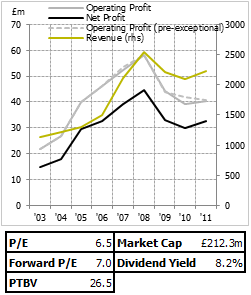 A relatively short one on the conundrum posed to me by firms like Morgan Sindall (LON:MGNS) . There's no shortage of them hanging around the cheap end of the market at the moment, either, with Kier being an obvious comparator that interested me a while back. They're basically construction groups with a service element, which makes them attractive for big projects, and means they have clear public sector links. About half of Morgan Sindall's work comes from the public sector. This is probably dragging on the sentiment for the shares, but that might be for good reason; though at least a little part of me thinks that Government infrastructure spending might become more in vogue in the near future.
So here's the - sort of - 'discrepancy'. When I first looked at these businesses I marvelled at the margins. Morgan Sindall makes less than 2% operating margin. Gross margin is more like 10%. If I put myself in the shoes of one of the managers who is trying to figure out the cost/benefit of a contract that I'm tempted to bid for, those seem like awfully fine lines to me! It's tempting for me to think something along the lines of 'how much thinner can margins reasonably get? Isn't there a baseline level?'. I'm not sure of the truth or otherwise in this way of thinking. Certainly there's no economic reason to think that margins should have a baseline, floor level, but psychologically speaking maybe the idea is a little more powerful.
With ultra thin margins, though, come huge economic returns. Returns on capital are enormous. If I define capital as property, plant and equipment + working capital + capitalised lease obligations, and consider all £109m of cash on the balance sheet as a part of working capital (i.e. not excess, though this is probably a reasonable assumption here), I get return figures of upwards of 40% for the last few years. The increase over the 20% seen pre-recession is mostly down to the huge improvements to working capital, which has turned negative as Morgan Sindall have presumably squeezed their suppliers less than they've been squeezed during the crunch.
The sector is hardly non-competitive, either. There's a lot of firms doing what Morgan Sindall too. Economic models would predict that as competition increases, return on capital will tend down towards the cost of capital. That doesn't seem to be the case here. Is this due to the sort of low-margin industry dynamics which prevent margins from reasonably getting much smaller? Will working capital situations revert?
Recently I've been thinking more about return on capital and what it means for a company and industry, and this seems a perfect case study. I'm drawn to think of high returns on capital in two ways - firstly, it means growth is cheap. This is a good thing. Secondly, though, I think returns should (at some point) be somewhat mean reverting - unless we have a good reason to think otherwise. Do I think Morgan Sindall have a rock solid moat or particularly strong features vs. their competitors, or that the industry as a whole has particularly large barriers to entry? No on the first, and perhaps on the second. There's probably a requirement of scale and reputation that really favours the incumbents.
The growth 'benefit' doesn't seem particularly relevant here, as I'm not sure the market as a whole has much room for growth and all their competitors have similar company structures. The mean reversion might be relevant, depending on how you view the strength of those factors. Given that you're hardly getting any assets for your money, though, you need a continuation of these great returns to see your investment turn a neat profit.
I find the industry perplexing. Am I missing something obvious?
Disclaimer
This is not financial advice. Our content is intended to be used and must be used for information and education purposes only. Please read our disclaimer and terms and conditions to understand our obligations.
2 comments
Is not this sector one of the most lethal of all for investors ? Off the top of my head Rok, Jarvis , Erinaceous , Stenoak and many many others have looked worth investing in over the years only to implode when the pressure to win contracts overwhelmed the desire to price them profitably within one or more of the small fiefdoms that comprised their subsidiaries. Furthermore most give in to temptation to book revenue too early , most grew by acquisitions founded on earn outs with all the risk that implies.
Not for me but interesting nonetheless.
Ps I've not looked at Morgan Sindall..at all!
Could it be that the ROC reflects high risk? The risk must be high if only because A] RoS is so low that one mistake and you are no longer making any returns at all and B] construction is clearly complex - how many construction projects (big or small) arrive within the original estimate.