My Market Themes, Sat 01/02/2020

1. Stock markets end in the red for January
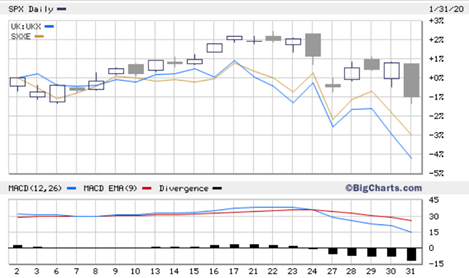
What happened to FOMO (Fear Of Missing Out)? The dominant theme of the last quarter of 2019 has evaporated over the second half of January, as multiplying fears over the spread of 2019-nCoV (coronavirus) drove global stock markets to a down month for January
Indeed, of the major Western stock markets, the UK FTSE 100 did the worst at -4% over the month, while the Eurozone lost 3% and the US S&P 500 only 1%.
From CNN’s Fear & Greed index, we can see that the tone of the market has shifted well away from the extreme greed level touched at the end of last year, to a moderate level of fear today.
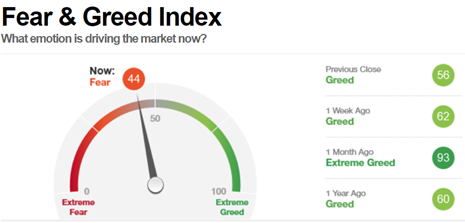
In terms of timing, this 44 Fear & Greed reading is not yet low enough to suggest a contrarian reversal to the upside is upon us. We may need to approach the extreme fear level for that to become a high-probability outcome.
2. Coronavirus facts and impact on China
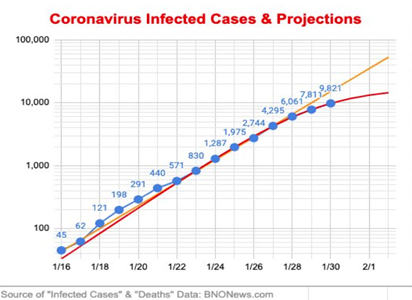
While it is difficult to pin down precise facts as far as 2019-nCoV is concerned, one fact that we can note is that the coronavirus is perhaps no longer following a precise geometric path in terms of number of infected cases. Of course, we will require several days more data to confirm this, but that already is one glimmer of hope.
Secondly, putting 2019-nCoV in perspective, we can look at this table from Bridgewater Associates that looks at the statistics of 20th and 201st century pandemics. I was personally surprised to discover how severe the H1N1 swine virus outbreak had been back in 2009-10.
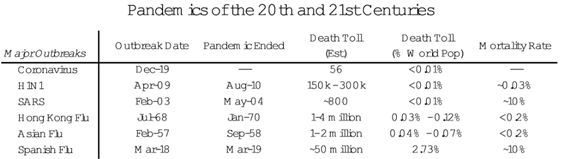
Source: Bridgewater via Linkedin
According to Dow Jones Market Data, there have been no cases in the last 40 years where the US S&P 500 index has fallen 6 months after an epidemic outbreak, with the US stock market flat or higher over 6 and 12 months following the outbreak of epidemics in each of 12 cases.
Looking below at the table of performance of the MSCI World index following epidemic outbreaks, related stock market falls have rarely lasted more than 3 months historically.
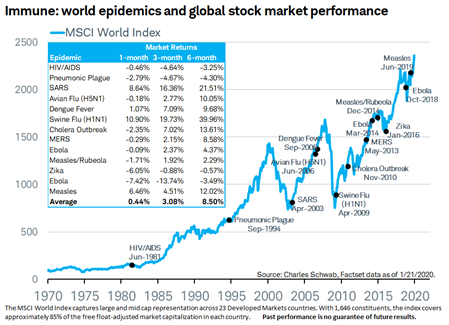
This would suggest that by April, stock markets could be well set for a strong rest of 2020. But we should however be prepared for further bouts of volatility in the near term, until we have firm evidence that this current 2019-nCoV outbreak has been contained and can be successfully treated.
The greatest economic impact will clearly be on the Chinese economy from the prolonged shutdown over Chinese New Year and the extreme travel restrictions put in place. This will likely have substantial impact also in the rest of Asia and Europe, in economies with close links to China.
At a sector level, we have to expect disruption not only for the Travel & Leisure sector (hotels and long-haul airlines), but also for Technology Hardware/Semiconductors and Industrial companies with substantial manufacturing footprints in China.
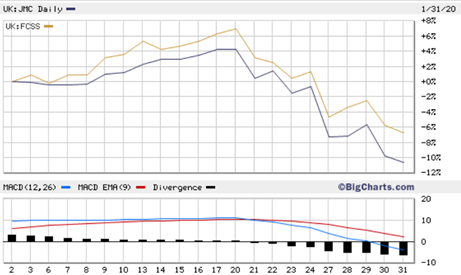
As far as Chinese stocks go, Monday should prove to be a heavy downwards reset for local stock markets there as they reopen for the first time; at some point in the next few months, it could be interesting to look once again at Chinese-focused funds such as the JPMorgan Chinese investment Trust (JMC) and the Fidelity China Special Situations trust (FCSS), which have fallen 10%-14% so far over the last 2 weeks.
3. Sector Focus: Trouble in Global Food & Beverages?
For many years now, the Food & Beverage sector has been a relatively happy hunting ground for investors, as one of the few sectors to demonstrate consistent outperformance against the UK and global stock market index benchmarks.
But for the first time, there are perhaps now structural headwinds starting to buffet the likes of Diageo, Heineken and Unilever, who have reported somewhat disappointing end-2019 results in terms of weak top-line sales growth and a worrying lack of pricing power.
In the chart below we can see that the European Food & Beverage sector (SX3P) has decoupled from the European minimum volatility index since September last year, hinting at some of the difficulties facing the sector today.
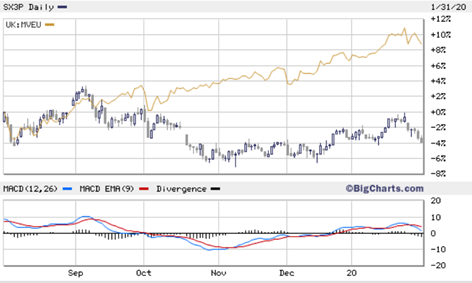
Yet despite this underperformance of late, valuations for the food & beverage mega-caps remain elevated, at between 19x and 23x 2020e P/E for Nestlé, Unilever, Diageo and Heineken.
The global beer market is a case in point, facing increasing saturation after a raft of mega-mergers globally creating giants such as SABMiller and Ab-Inbev.
While historically the brand premia that these global companies could command have grown, I wonder if consumers are now fighting back and becoming more discerning in their food and beverage tastes in developed and developing markets.
Bottom line, I shall be avoiding this sector until valuations become more reasonable, and I spot new drivers for long-term growth.
4. Commodities: Gold and Gold Miners
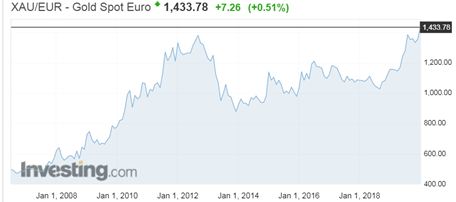
I make no apology for focusing once again on gold, which has been a key beneficiary of the current risk-off market mood alongside sovereign bonds, hitting $1588/oz on Friday. This represents an ongoing bull market in the yellow metal, reaching heights not seen in USD since 2013.
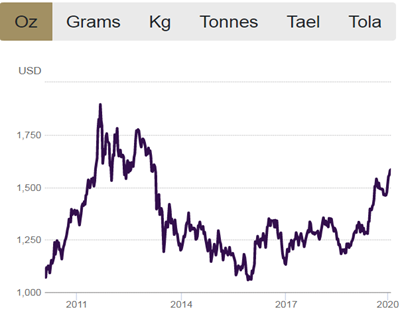
This looks even more impressive when cast in different currencies, such as the euro, against which gold has even exceeded its previous 2012 high, reaching EUR1434/oz:
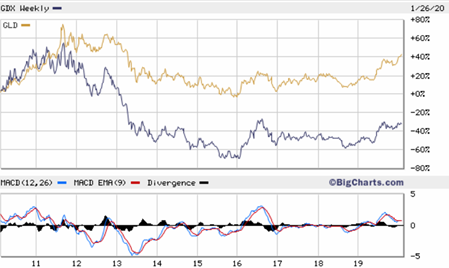
What I am really looking for, however, is a similar reaction from the Gold Miners sector. Since the 2011 gold price peak, gold miners (represented by the GDX ETF) have been a dreadful performer, not even recovering to the more recent high hit in mid-2016:
Even over the last 3 months, the GDX Gold Miners ETF have not even kept pace with the gold price, whereas normally we should be seeing a leveraged effect in gold miners, given their largely fixed cost base but variable revenues.
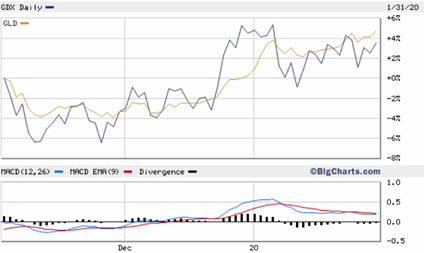
The longer that gold prices stay high or go even higher, the more likely it is that leveraged gold plays like gold miners will finally react.
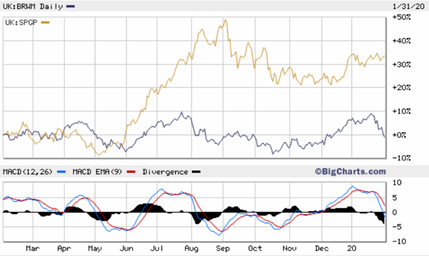
Aside from the SPGP iShares Gold Producers ETF (in GBP), there is also the L&G Gold Mining ETF (AUCP) and also the Blackrock World Mining Trust (BRWM), which has a considerable weighting to gold miners.
However the Blacrock trust also has heavy exposure to diversified mining conglomerates such as Rio Tinto and BHP, which as a group are suffering from the Chinese fallout in weaker copper and other industrial metals prices.
5. Featured ETFs of the week: MSCI Europe, World SRI ETFs
This week, I am putting the ETF focus on a key trending theme, that of sustainable investing. There are many flavours of sustainable investing in Socially Responsible Investing (SRI) and Environmental, Social and Governance (ESG) forms, a veritable minefield for those who want to have a deep understanding of the stock selection methodologies.
To keep it simple, I focus on the more common SRI methodology for both European and global stocks, based on indices constructed by the index provider MSCI.
Both the iShares MSCI Europe SRI ETF (IESG) and the UBS MSCI World Socially Responsible ETF (UC44) are shown in the chart below, and both have outperformed the MSCI Europe benchmark index (SMEA) by about 5% over the past year, as sustainable investing has really caught the imagination of investors.
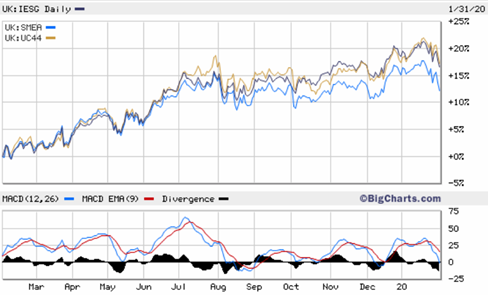
I believe that sustainable investing will remain a very popular theme for 2020, and so there is potential to both invest responsibly and also perhaps gain a little outperformance versus standard stock benchmarks via this theme.
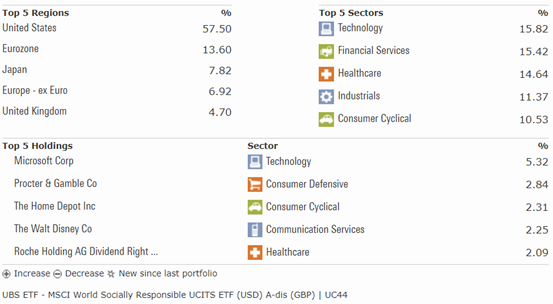
Looking under the hood of the MSCI World SRI index, we can see a sector skew towards Technology (nearly 16%) and Healthcare (nearly 15%), while Oil & Gas is a notable underweight in this index for obvious reasons.
6. Book of the week: The Acquirer’s Multiple
One book I can heartily recommend for beginner or even experienced investors with a penchant for the value investing style is The Acquirer’s Multiple by Tobias Carlisle. I found this book useful for its exploration of the value of the (low) EV/EBIT ratio (high earnings yield in Stockopedia) or acquirer’s multiple in filtering for value stocks. It was easy to read and easy to apply to one’s own stockpicking – check out his website for further details.
Have a great investing week ahead,
Edmund (@TheIdleInvestor)
Disclaimer
This is not financial advice. Our content is intended to be used and must be used for information and education purposes only. Please read our disclaimer and terms and conditions to understand our obligations.
7 comments
Really enjoy reading your articles Edmund.
Re beverages, though: "The global beer market is a case in point, facing increasing saturation after a raft of mega-mergers globally creating giants such as SABMiller and Ab-Inbev."
AB-Inbev acquired SAB Miller in 2016. How does M&A activity lead to market saturation?
Hi Howard, not M&A per se but the push by these mega-brewers to saturate the market with ever more "premium" brands, and also from betting on ever-growing volumes in emerging markets. It is evident from slowing worldwide growth in beer demand, fuelled to a large extent by a slowdown in volume growth in the beer-at-home segment.
Interestingly, the slump in beer volume growth is linked (according to buy-side analysts Exane) to a sharp decline in under-age drinking, who carry on their preference for non-alcoholic alternatives even after turning 18.
The risk is that the monster AB-Inbev shifts strategy to be more aggressive in taking market share, putting pressure on profitability across the brewing industry as a whole.
But the real problem for Food & beverage behemoths is the combination of slowing top-line growth, while valuations remain extremely rich.
Edmund
Thanks, Edmund, for the latest in this excellent weekend review series. At the moment I'm watching copper and nickel which look cheap currently but should recover when the China economy picks up. It may be too early to buy them right now.
"As far as Chinese stocks go, Monday should prove to be a heavy downwards reset for local stock markets there as they reopen for the first time; at some point in the next few months, it could be interesting to look once again at Chinese-focused funds such as the JPMorgan Chinese investment Trust (JMC) and the Fidelity China Special Situations trust (FCSS), which have fallen 10%-14% so far over the last 2 weeks."
Yes, tomorrow is a big day with Chinese traders back at their desks. Knowing this, the PRC has announced a stimulus package today. Not sure how it will play out, interesting times.
I have on watch list the following
China A50
Thailand SET - especially hit given their weight of income from Chinese tourists, whose trips have been cancelled
HK HS50
Copper - was already in a downtread with the global industrial slowdown, but hit recently with Coronavirus. I would have thought this needs to show signs of picking up before thinking China's out of the woods. There is a huge difference between the LME price and China mainland price, so which direction this settles tomorrow is a big signal.
Oil - approaching the sensitive level of $50 where it bounced off multiple times last year
FTSE100 - having touched nearly 7700 this month it's faded to 7260
It's tricky buying the dip but it's hard to bet against the weight of money the PRC can apply to the Chinese economy if they panic on a slowdown. Each time they do this the stimulus effect reduces but it's still positive.
US tech has only dipped slightly so no bargains there. Asia tech has sold off more, also on watchlist now are Alibaba, Tencent, Ping An and Taiwan Semiconductor. All good firms but have been trading on high PERs of date.
Otherwise a few FTSE firms have also been caught, I now watch Aviva and British Land as they are both fading and wouldn't mind buying a few on a dip.
Excellent article - thank you.
I've been waiting for gold mining shares to start moving northwards and have been increasing since the coronavirus news started. My own view is that the impetus will be when the companies start reporting their financial results in a month or so's time and the impact of the last 6 month's elevated gold price will be evident.
(This was hinted at in the Pan African Resources (LON:PAF) announcement on Friday - although there's a few other moving parts there - I don't hold)
Phil
Superb analysis. Thanks Edmund.
great article Edmund. comforting to know from the historical facts that the impact to stock market may not last more than 3 months.... of course 3 months itself is a long time for human psyche.